Tag Archives: Literature

The Right Place at the Wrong Time

I’ve mentioned a few times that I’ve taken quite a few memoir-writing courses. In five or six courses, the instructors assigned “The Fourth State of Matter,” an essay from JoAnn Beard’s memoir The Boys of My Youth. I had to read it over and over. But there’s a reason why so many instructors assign it. Wow, what a piece of creative nonfiction! I’ve written about it in a previous post. What occurs in the story is what happens when Beard was in the right place at the wrong time.

I’m not trying to be cryptic or coy. It’s best to let the essay speak for itself and take you by surprise.

This book is actually a collection of essays, but I call it a memoir because the essays are memoir pieces loosely placed together. Oddly, the effect is that of a more traditional memoir, although the book does not give the impression of one complete story.

THE BOYS OF MY YOUTH

THE BOYS OF MY YOUTH

From this book I learned that memoir can be shaped the way the story needs to be told, rather than following a predetermined format. A memoir can be a story collection. By constructing a book out of publishable essays, a writer can send her pieces out without waiting for the entire book to be complete.

From “The Fourth State of Matter,” the stunning essay at the heart of the book, I learned that several story threads can be woven together to create a rich tapestry. If you write creative nonfiction, be sure to read this essay!

25 Comments

Filed under Book Review, Books, Creative Nonfiction, Essay, Memoir, Nonfiction, Research and prep for writing, Writing

The Unique Big C Memoir

A few years ago I took a one day writing course with Tania Katan at Arizona State University’s Piper Writers House. We sat at the big rectangular seminar table. Tania gave us writing prompts and we had timed periods to write.

I’ve always responded well to tests (except when I flunked my first driving test, but that’s different  wink wink), and to me these were just timed tests. So I flung myself into each timed episode, writing furiously to beat the clock.

After Tania said to stop writing after the second or third assignment, she looked down the table at me and said, “Luanne writes like it’s a full contact sport.” I thought that was hilarious and, like a lot of humor, true.

That’s what My One-night Stand With Cancer, Tania’s memoir about having cancer at the age of 21, is like: humor that springs from a deep well of truth.

By the time she was 31, Tania had had cancer twice.

But it’s not just Tania’s young age as a cancer survivor that makes her book so unique. It’s also that she’s a lesbian and at 21, as she was faced with losing her breast, Tania was just figuring out her sexuality and her identity.

From Tania Katan’s memoir I learned that humor can bind wounds for both writer and reader. Also, it can bind people with few commonalities together in that moment of reading. In this memoir, humor is a way of looking slant at tragedy. By this off-center viewpoint, the poignancy is enhanced, and the triumphant penultimate scene of the book made me sob.

If you want to read more about Tania, you can visit her website!

14 Comments

Filed under Book Review, Books, Creative Nonfiction, Essay, Memoir, Nonfiction, Research and prep for writing, Writing

The Tender Neighbor

Eight years ago, I had major reconstructive foot surgery and was trapped in a hospital bed in my living room for months. I had a TV in front me, but never watched a show, as I found it difficult to concentrate on television for some reason. Instead, I listened to Billie Holiday and chatted by email and on online forums on my new laptop. And I read. But the reading is the miracle.

Seven years before my surgery, my husband and I had bought a house and began remodelling it. Before we moved in, a neighbor approached me as I exited my car. He began yelling at me about how our contractor was getting dirt on the street in front of our house. He didn’t even introduce himself before he lit into me, and he never once looked me in the face. I faced him and watched him shout while he directed his shouts 90 degrees to my right.

It took quite a lengthy period of good neighbor conduct before Henry and I started to speak to each other, beginning with “hello.” My husband and Henry began to converse on the sidewalk every couple of days.  Eventually Henry came into our home, and we became good neighbors, trading the contact information of service people, sharing the stories of our past lives (he had been a businessman and banker and came to California from New Mexico, where he had grown up), and, yes, gossiping about the other neighbors.

We were several decades apart in age, and Henry had a widower’s life while we were raising our two children. I learned that his wife had died not too long before he had gotten mad at me about my contractor’s work habits.

Then came the tumor in my foot, and the first person who showed up after the surgery was Henry. He had a book in his hand, The Tender Bar, by J.R. Moehringer. It was a memoir that he loved and wanted to share with me.

I had recently been going through a spell where I wasn’t reading for pleasure any longer. I’d taught literature for years and was burned out from a schedule that required me to read and re-read on demand. I no longer had the desire I’d always known for cracking open a new book and devouring it as if it were chocolate cake (or baklava, more specifically).

But here was a gift from a man whom I had gradually come to value, and he was the first person to give me a treasure after a pretty harrowing four months since the pain began and through belated diagnosis and finally surgery.  I had to read what he had given me.

That’s all it took.  I began to read Moehringer’s story and was transported to his childhood as he was “raised” by the men who hung out at the “tender bar.”

The Tender Bar has become a memoir classic, and rightfully so.  What did I learn from this book?  That tenderness can come from the most unexpected places. And getting over “burn out” from something one loves happens in an instant.

Henry was diagnosed with cancer more than once. In October 2012, he passed away before anyone expected. His decline was swift, and he didn’t have to suffer long. I’m sure he would be thrilled if you read the book he loved.

26 Comments

Filed under Book Review, Books, Creative Nonfiction, Essay, Memoir, Nonfiction, Research and prep for writing, Writing

A Responsive Reader

In my last post I shared what I learned from Lucy Grealy‘s Autobiography of a FaceReading that book was not one of my best “moments.”

Not long after I read that book and experienced the feeling that I didn’t completely connect, I read a companion work. Truth & Beauty, by Ann Patchett, is a memoir reflecting on the writer’s friendship with Lucy Grealy.

I fell into this book completely.  No reservations at all. And it did make me wonder if Grealy’s very difficult personality (personality disorder? and addictions) weren’t something that I picked up on and made me wary when I read Autobiography of a Face. It will be hard to go back and re-read that book as if I don’t know the extent of her “use and abuse” of Patchett.

Then, again, this book is Patchett’s version. Grealy is gone and can’t comment on it. She can’t write a “response memoir.” So why am I so willing to believe Patchett’s version, but hold myself at a distance from Grealy’s version of what is, in essence, her self?

Oh, this memoir business is a tough business.

What did I learn from this book? That the hard truth can be presented in beauty if it is accompanied by compassion.

###

Here’s a thought. I suspect I didn’t like Grealy from reading her book. The question would be: why not? Maybe it was her lack of compassion for others. I just didn’t see any at all. Would that be because she was born with a personality incapable of feeling compassion? Or would it be a learned response to life, based on her difficulties?

It’s easy to see why Patchett and Grealy were friends. Patchett had enough compassion for them both.

13 Comments

Filed under Book Review, Books, Creative Nonfiction, Essay, Memoir, Nonfiction, Research and prep for writing, Writing

An Unfeeling Reader

Lucy Grealy‘s Autobiography of a Face is on most short lists of best memoirs. Grealy became modestly famous from her story at the time it was published.

While I can’t say I didn’t enjoy reading it or sympathize with the girl who suffered so much, it didn’t affect me–reach me or touch me–the way it seems to affect most readers. I slightly pulled back from Grealy at times as I read the book. That’s kind of horrifying for me to think about because what happens to the young Grealy in the story is tragic: Grealy had cancer as a child and lost part of her jaw to the disease, growing up with a disfigured face.

Photo by Wikipedia

Photo by Wikipedia

As I try to look through the book to give you an idea of why I felt lukewarm, I can’t find any clues–although it seems to me that the world through her eyes didn’t seem like a world I know or a way that I connect with the world. Skimming the book, I realize I need to read it again. Maybe it was me. I want to be fair. I want to be accurate. I’ll toss it on the pile of unread books!

What I learned from this book: sometimes you need to read a book more than once to understand how and why you respond the way you do. I want to learn more about what makes a book engaging or important to me.

Has anyone else read this book? If so, were you completely drawn in?

Stay tuned for Wednesday’s post where I share what I learned from Ann Patchett’s book about her friendship with Lucy Grealy!

28 Comments

Filed under Book Review, Books, Creative Nonfiction, Essay, Memoir, Nonfiction, Research and prep for writing, Writing

Most Recently Read Memoir

I just finished Catana Tully’s memoir Split at the Root: A Memoir of Love and Lost Identity. This book makes for fascinating reading, in part because Tully’s story is so unique. She was a Guatemalan child of African origin adopted (sort of) by a German family living in Guatemala. Raised to be a socially polished European woman, Tully belatedly desires to learn more about her origins. The book not only chronicles her search, but how she comes to terms with the loss of her birthright.

What I learned from this book: While the various cultures that Tully inhabited piqued my interest, what I learned for my writing was most valuable. This memoir does something rare: although the first half of the book is engaging and an excellent read, the second half gets even stronger.

Why do I say that is rare? Most memoirs, even those by the greats (Tobias Wolff, for example), tend to weaken in structure in the latter portion of the books. It’s very hard to pull a memoir to a close, and so often they don’t seem tightly structured, except (oftentimes) by chronology. What Tully does is structure the book so well that the book increases in suspense in the latter half.  I could not put the book down once I got into that part of the book.

That doesn’t happen by accident, but by carefully planning the interactions of the various scenes. I suspect that in the first half, she “set up” all the “threads” so well that after a certain point, the reader is prepared to just follow the protagonist as she learns more and more.

Note: I love to read memoirs with good structure because (and I’ve said this before) structure is the most difficult part of memoir writing.

On Monday I posted a review of this book on the blog my daughter and I write about adoption.

For more from Catana Tully, you can read her book blog here.

17 Comments

Filed under Book Review, Books, Creative Nonfiction, Essay, Memoir, Nonfiction, Research and prep for writing, Writing

A Poet’s Memoir

Mark Doty, an American poet (b. 1953), wrote a wonderful coming-of-age memoir called Firebird

To the outside world, the four members of Doty’s middle-class family could be in a sitcom of the time period: the father is an engineer, the mother looks respectable, the older sister is popular, and the little boy is bespectacled and bookish. But all is not as it seems. Alcohol wreaks its slow destruction on the family.

But most crucial to Doty’s identity is a difference that occurs even before the disintegration does. The little boy, Doty himself, gradually comes to realize he is gay, and there is no place for being gay in the world in which  he grows up.

Because this book was written by a poet, the language is rich and evocative. I love the little boy at the heart of the book.

Here is one important thing I learned from reading Firebird:

Doty begins his memoir with a “Prelude” (so termed because of the use of music and art in the book) which is a beautiful essay in its own right and introduces the reader to a way of viewing a memoir. This essay is about a work of art from the 17th century by the Dutch painter Samuel Von Hoogstraten. It’s called Perspective Box with Views of a Dutch Interior.  

This perspective box contains the miniature furnishings of a miniature room which are distorted and misshapen; however, when you look through holes designed for viewing, suddenly the room comes into perfect perspective. Interesting way of viewing memoir itself . . . .

The metaphor of the work of art for memoir and the detailed description both serve as an inspiration to write with detailed accuracy and imagination.

Doty’s website can be found at markdoty.org.

18 Comments

Filed under Book Review, Books, Creative Nonfiction, Essay, Memoir, Nonfiction, Research and prep for writing, Writing

What Can You Learn From Reading a Memoir?

Six years ago, I had probably read fewer than 10 memoirs. To a non-reader, that might sound like a lot. But compared with the quantity of books I’ve read, it was an appalling number.

Then I got the idea I wanted to write a story about an aspect of my life and realized that I wanted to write a memoir. So I started reading memoirs to get the hang of how to write one.

After that, I started taking online courses in how to write a memoir.  And I continued to read them.

I’m trying to pull my book into a structure at this point, so I don’t have time to write reviews–and maybe you don’t have time to read reviews anyway ;).

But let me share the memoirs I’ve read with you one at a time.  No special order. Just as I pull them off the shelf.  Because they are all in my house. I bought each one of these so I could mark them up (if I desired) and keep them.

I’ll answer one question for each memoir: what did I learn by reading this book?

34 Comments

Filed under Book Review, Books, Creative Nonfiction, Essay, Memoir, Nonfiction, Research and prep for writing, Writing

A Poem Whose Bony Fingers Won’t Let Go

Even if you’re not a regular reader of poetry, make sure you know the name Lucille Clifton and read a few of her poems. You won’t be sorry. Her poems are short and they don’t mess around.  She passed away in 2010, so we have a limited supply.

Here is my favorite Clifton poem (just make sure you read the title first):Sorrows by Lucille Clifton

The more I read this poem, the more I love it. It’s kind of creepy, imagining sorrows as living scars or skeletons which refuse to leave us alone. But it’s so true.

This link will lead you to her bio, a list of her publications, and links to a few more poems.

The Hurston Wright Foundation has nominated The Collected Poems of Lucille Clifton 1965-2010 for its 2013 Legacy Award.

16 Comments

Filed under Nonfiction, Poetry, Writing

Hey, You, Where Did You Get That Poem?

You can find a lot of good books about writing poetry.  They usually are divided into chapters such as metaphor, rhyme, rhythm, and image.  

But Kenneth Koch approached the subject a little differently.  He theorized that to teach poetry writing to children, you had only to teach them to tap into their imaginations and to give them quality poems to read.

For his simpler book Wishes, Lies, and Dreams, he created practical writing prompts for kids.   Chapters include Class Collaborations, Wishes, Comparisons, Noises, Dreams, and Poems Written While Listening to Music.  It’s exciting just to read the titles.  I want to sit in his class and start writing.

So that’s what I do, sort of—I use his ideas for poems.  After all, aren’t these great prompts for adult poets, as well?

Still, Koch knew that kids—and adults—couldn’t just stop there.  To prime our mental pumps, we have to read quality poetry.  The more we read, while keeping the gates to our imagination wide open, the more we can grow as poets.  Of course, in the circle of reading and writing, by writing our own poetry, we enrich our reading experience of the poetic greats.

In Rose, Where Did You Get That Red?, Koch structures this interconnection of reading and writing around ten poems by masters such as Blake, Donne, Whitman, Steven, Ashbery, and Rimbaud.  I’m sorry to say that he did only use poems by male poets.  I’m not going to make any excuses about that tremendous oversight.  Ahem, let’s continue.

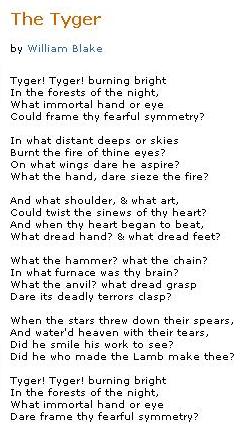
Koch introduced the children to Blake’s poem “The Tyger.”

He didn’t want them to stumble over Blake’s “language and syntax,” so he tried to connect the poem to the experiences of the kids, asking questions, such as had they seen a dog’s eyes glowing in the dark.

Here is the prompt he eventually gave them, and it’s one you can use too:

Write a poem in which you are talking to a beautiful and mysterious creature and you can ask it anything you want—anything.  You have the power to do this because you can speak its secret language.

14 Comments

Filed under Poetry, Writing prompt