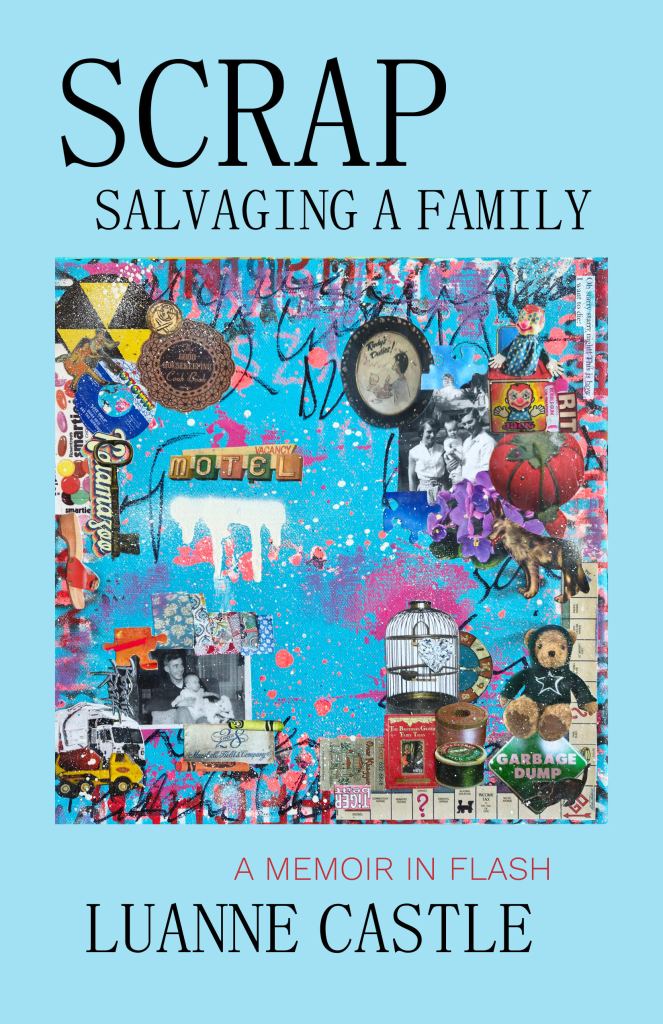
Colleen Chesebro asked me to post the process for my collages. I started “art journaling” during the pandemic, watching online videos to learn many different mixed media techniques. I was quite taken with junk journaling. Finally, I settled on mixed media collages as the medium I wanted to submit to literature and art journals.
My published art can be found through this link on my website: Luanne Castle Art. Pieces were published by Mad Swirl, Raw Lit, and Thimble Lit. I also have some art forthcoming in other journals.
I couldn’t make a video for you because I am not that coordinated. Also, I make a lot of small steps when I work because my time is broken into tiny fragments. So I am posting photos with commentary. I hope it’s easy enough to follow.
Art supplies are the first consideration. While I’ve managed to collect an embarrassing quantity in four years, I’ll post the main ones I use for almost all collages. Some collages also have an additional weird item, such as a feather, a jewel, etc. but here are the basics.
I’ll share the supplies in the order of the process. First you want to have paper that is thick enough and with the right finish/tooth to it. Try thicker weight watercolor paper or mixed media art paper. It usually comes in 8 or 9 inches by 11 or 12 inches. Let me jump ahead here by saying I do a weird thing that might be frowned upon in art classes. I let the collage form the way it wants to. Then I crop the background to fit the collage. I hate the idea of making the collage fit the size/shape of the paper.
Sometimes I prepare the paper by collaging scrap paper and then covering it with white gesso. Sometimes I only use white gesso. And sometimes I don’t prep it at all. Notice in the photo I have the matte version of Mod Podge to use as glue. I am starting to think I only want to use glue sticks instead of Mod Podge. The torn edges stay down better. Here’s a photo of the glue stick that I prefer. Then after that are the photos of the initial collage bits.


Here are photos from applying the bottom layer of collage. Remember that you don’t have to do this stage. It’s just to give more texture and depth to the piece.


When the gesso is wet, you can create a design or not. Here I used something designed for that purpose, but you can use your fingernails, a fork, anything your imagination can come up with.

Now we move to the creation of the backdrop that will be seen. Soft, dry pastels. Yum. Here I have some sticks and some “pan pastels.” What I love about this type of pastels is that I can apply them haphazardly and then wet them (with a spray bottle of water) and sponge or baby wipe them in whatever chaos I like. Beware that there are other types of pastels that are impervious to water and cannot be smeared around like this.


So why do I prefer pastels to paints? For the purpose of making backdrops to collages I like the way I can layer muted colors. I prefer to choose several colors that are close together for highlights and low lights. The idea is to create layers. I apply a color and then go back later and apply another color. Then another–or even the first one over again.
An aside: I do sometimes use paints, usually acrylics. Often times I have a paper that I’ve used to clean off a brush or to put excess paint. Then I paint or smear pastels over the top of the paint. The paint underneath adds another layer for color and texture. Here’s an example of a paint I use.

Once I get a background the way I like, I’m not done. Then I like to add something else. Often times it’s just a touch (in places) of this little shiny treasure, Lunar Paste.
 Occasionally, I like to build up texture using this Texture Paste. I used this on my piece “Found Sound,” which was nominated for a Best of the Net. You can find it on the link at the top of this post. In that collage I stuck to the off-white of the product, but Texture Paste can be painted over. Pastels will not work properly.

Here are some backgrounds in process.

After I have the background ready, I am ready to collage.
To create the collage, I like to cut out images from vintage issues of Life Magazine. I am starting to like vintage McCall’s, as well. I purchase these in lots from Ebay.

Once I amass enough photos that I like together to create a theme or story, even in a surreal way, I arrange them before I start to glue them down with the glue stick.
I may add stamping, pencil or pen marks, even a title.
When I get the collage finished, I trim the edges of the piece so that the balance is the way I want it.
This is a finished piece that was just in Thimble. Notice the sheen. That’s from Lunar Paste. Notice the stamping and pen marks.

Some people like to create collages that are “all collage,” meaning there isn’t a background that shows. I prefer this style for the focus. I love color, but want the collage to be the star, so I haven’t used bright colors for backgrounds. Besides color and making a mess :), my favorite part of art is composition. I love experimenting with how to arrange the collage to make the best composition I can think of.
STILL LEARNING. If you decide to try a collage, I would LOVE to see it!!!!