A Photo Update to An Old Story

In my old photo scanning I have found a photo I didn’t know existed. But I had heard about the subject of the picture. In fact, I wrote about it on this blog in 2012 and then re-blogged it in 2013. It’s in a story I wrote about spending time with my maternal grandmother. I’ll repost the story here. At the end I’ll post the photo I found because by the end of the story you will know why I thought it was such a great find.

###

When I was little I stayed with my grandmother during the day while my parents were at work.  It was just Grandma and me at the house.   Grandpa worked down the block, at his Sunoco filling station.  Every day at noon, Grandma and I brought his lunch to him.  He’d climb up out of the pit where he worked under cars and smile when he saw us with his gray lunch box.

Sometimes I played with the girl up the street and other days I’d pick through the toys and books left behind in their bedrooms upstairs by my mother, Aunt Alice, and Uncle Don.  I found a giant printing set, a potholder loom and loops, and a collection of miniature furniture and animals.  In my aunt’s room, I read my first chapter book, The Bobbsey Twins.   Grandma and I fried donuts and sugared strawberries.  We sang Ethel Merman songs like “Anything You Can Do.”  I could always manage to sing louder and higher than Grandma.

Any note you can reach
I can go higher.
I can sing anything
Higher than you.
No, you can’t. (High)
Yes, I can. (Higher) No, you can’t. (Higher)
Yes, I CAN! (Highest)

Occasionally, we walked “uptown” to the bank, passing the thrift store, which fascinated me. I thought it was a combination antique store and fine dress shop.  Also en route was the home of the Purple People Eaters.  My overweight, matronly grandmother sang the song and danced right there on the sidewalk for me.  It was years before I realized the building was actually a dry cleaning establishment, painted purple.

Grandma carried the filling station’s bank deposit bag in her big pocketbook, which also held mints and pennies for me.   We stopped at the florist to say hi to some relatives and at the bakery for sugar cookies.

With all the fun Grandma orchestrated, I still got bored one time.  I was in “that mood,” the one where it seems that all is wrong with the world.  Grandma knew how to handle the situation.  She put me in an old work shirt of Grandpa’s and handed me a paint brush.

“Come outside,” she said.  On the back stoop, she’d placed an old wooden child’s chair on a spread-out newspaper. “Go to town, Luanne,” she said.  I worked hard for a long time, painting that chair, which seemed so big

When my mother picked me up after work that day, she laughed.  “Mom, you had her do the same thing you made Don do to keep him busy!”  Even today when I feel “at odds,” this example keeps me working, moving forward through the doldrums.

Grandma did her chores while I was at her house.  She cooked and baked and ran errands, which were all on foot or by bus, as she didn’t drive.  I helped her and learned at her elbow.  She ironed my parents’ clothes, too, while I played at the kitchen table and sang with her.   She didn’t waste our time cleaning too much, but everything else got done—and done well.

She devoted a half hour to herself every day, watching As the World Turns while I “napped” beside her on the couch.

Mostly, though, Grandma doted on me and made sure I could learn and use my imagination.  She sat me on her lap and told me stories “from her head.” Her attention wasn’t fragmented by a cell phone or computer.  She limited her telephone and TV usage.  She was completely there in the moment with me each day.

Can we say the same today for our children and grandchildren and the children we babysit?

###

Here is the addendum to the story. A photo showing Uncle Don painting the same chair! This would have been about 1941.

13 Comments

Filed under Family, Family history, Grandparenting, Memoir, Nonfiction, Writing

The Women Before Us: My Review of Amy Bess Cohen’s Latest Family History Novel

The Women Before Us is the fourth family history novel by Amy Bess Cohen. Like the three previous books, this one is very loosely based upon Cohen’s ancestors. As a genealogist and family history blogger, Cohen has completed the mountains of research necessary to delve into the lives of these people. But Cohen doesn’t leave it at the usual pedigrees and timelines. Her research leads her to explorations of personality and motivation. She does this in her books and on her blog.

Brotmanblog: A Family Journey

This time, Cohen focuses on the lives of the women of three generations of Jewish women and how their lives are determined by who they marry. This can lead to happiness or it can lead to misery. The book is shaped by the experience of 18-year-old Edna Schwartz who travels from her home in Santa Fe to Philadelphia to visit her aunt in 1922. Against her mother’s hopes, Edna meets her future husband so far from home.

Within Edna’s story we learn the stories of her mother Harriet, Harriet’s German mother Hava, both who left their mothers behind to move with their husbands. We also learn the story of Edna’s (future) mother-in-law Mae who experienced the same displacement. As readers, we witness what these women learn from leaving behind their support systems.

Throughout the book, as suspense builds, there is subtle but consistent foreshadowing that perhaps Edna’s marriage will not be as successful as those of the women who came before her. There is a Jewish tradition to bestow the name of a deceased ancestor on a new baby. Edna and her husband break that tradition, and it seems another clue that things will go wrong. Is it the new age? The mores of a brash young country versus their religion training? That Edna and James are too reckless? That James is spoiled? Ultimately, the true damage to Edna’s marriage is something out of anyone’s control.

The brains of this book is the way it demonstrates how dependent women were on their marriages. These women were not Orthodox Jews, but like all women of their time, they had little chance of a life outside of marriage. And who they married dictated whether their lives would be hard or less so, happy, or even unsafe. The heart of this book is Edna’s mother-in-law Mae. I finished the book, hoping that in the fictional future of the story, one of Edna’s children will name their child after Mae, a strong, kind, maternal, industrious, intelligent woman who does what she must do for her family.

I finished the last page at night and fell asleep soon after. All night I dreamed about the book, the characters inhabiting every dream I had. Edna, Mae, James, Harriet, and the others. It’s hard to believe that these are not Cohen’s actual relatives, but these fictional people were touched with the magic of Cohen’s sympathetic understanding of her own grandmothers and great-grandmothers.

ORDER THE WOMEN BEFORE US

Amy Bess Cohen’s other books:

Amy Bess Cohen Books

22 Comments

Filed under #amreading, Book Review, Family, Family history, History, Novel

#TankaTuesday Challenge #71 Photo & Tanka

When I read Willow’s prompt for #TankaTuesday, I was intrigued. She asked us to find an old photo that holds a memory and write a tanka about it, focusing on words that evoke the season.

Since I am scanning old photos, this prompt seemed to fall right onto the paper for me ;. This photo was taken in July 1969 at our lake cottage. That’s my mom standing there in the middle of the photo.

green trees in full leaf

against sun’s hissing hot blue

lakewater splashing

around our knees, mom eyeing

the bold goose among the ducks

I really wanted that focus on the goose and mom looking at it because geese are more aggressive than ducks, and I’m sure she was worried about the goose around all the children.

About the goose: I’m willing to hear arguments that it’s a duck, but I don’t think so. It’s neck is longer, it’s much bolder, and the beak is a different shape. You can see the goose in the last photo here, too.

Here are more photos from that day.

my brother feeding the duck

###

23 Comments

Filed under #amwriting, #poetrycommunity, #ScrapSalvagingFamily, #TankaTuesday, Family history, Poetry, Syllabic Poetry

Scrap’s Ebook Now on Amazon!

Great news about Scrap! You can now order the ebook on Amazon!

Sorry for shouting! I’m just excited. Here’s the link:

ORDER SCRAP IN EBOOK

ORDER SCRAP IN PAPERBACK

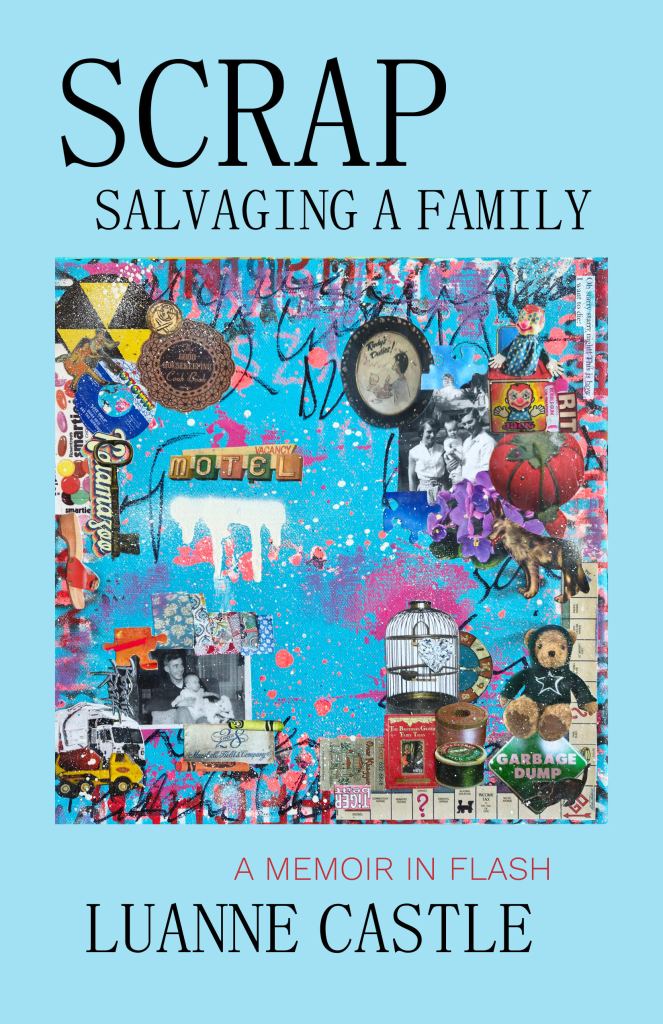
If you haven’t read Scrap: Salvaging a Family I hope you will. And if you have, I hope you like it and will share with others who might like it or find it helpful, especially with generational trauma, family dysfunction and abuse, or writing outside the boundaries of genre.

If you’ve written a review for Scrap and are on BookBub, the book will show up there soon–it’s pending approval. I’d appreciate it if you could copy your review over there!

Years ago I was writing posts inspired by the Dawn Raffel book The Secret Life of Objects.  My magical music box, one of the objects, has shown up in Scrap. I still own it, too! Actually I wrote about it twice on this blog. The first time was to introduce the music box. At that time I didn’t know what music it plays. The second time was after I discovered the song it plays: La Paloma.

Magical Music Box

The Origin of Poetry

You know what I just realized? I’ve never let Hudson hear or even see the music box. He spent the night last weekend and then was here all day yesterday because school was closed. He’s almost 2.5. Can you believe it?!

I’ll have to share the music box with him. He loves music, and I want him to experience it as I did.

Yesterday we went to storytime at the library (lots of exercise for Grandma as story is more like “story” called movement), got lunch with chocolate milk, swam (with Grandpa), played with Mickey Mouse playdough (his favorite character is not the usual for kids today–it’s Minnie Mouse!), played the piano, and painted. Of course painted. He insisted and kept bringing it up. He paints with acrylics on canvas so it’s quite a mess. But another beautiful painting was added to his portfolio.

25 Comments

Filed under #seekgathercreate, Art and Music, Book Review, Family, Family history, flash memoir, Flash Nonfiction, Grandparenting, hybrid memoir, Memoir, Nonfiction, SCRAP: SALVAGING A FAMILY

Memory’s Little Nudges

“There’s rosemary, that’s for remembrance,” said Shakespeare’s Ophelia.

I do love rosemary. The scent. And the taste in food.

Speaking of memory, I am fascinated by this quote:

“He who remembers his childhood better
Than others is the winner,
If there are any winners at all.”

from “1924” by Yehuda Amichai

What do you think he means by that?

I wonder if it has to do with learning from our pasts?

Do you think about memory very often?

I think that I do, but sometimes it is because I feel a sense of responsibility for what I haven’t even asked for. For instance, big batches of old family photos keep turning up in my care. I have been scanning the lot of photos from my mother’s house when she moved from the garden home to the “big house” which is the apartment building in her retirement community (now she lives in a different building, in assisted living). Nobody else was going to do this, so I felt responsible for the photos. My grandfather and my father had put a lot of time into taking pictures.

Then yesterday a big box shows up on my porch. My brother sent me all the photo albums that were left over.

Eventually I have to organize all my scans and post them where family members can get them. Or some such.

In the meantime, I do feel some stress over it.

But then I find photos that bring me back to a moment in time. I went on a trip to California with my parents and brother between 7th and 8th grade. My father had quit smoking, and the money he saved went toward the trip. Our goal was to head down to LA to visit my cousins, but we landed in San Francisco for a few days. We found the intersection of Haight and Ashbury where I searched for hippies who were left over from the previous summer’s Summer of Love.

We ran into a filming of the TV show Ironside. I loved that show. Raymond Burr who played Perry Mason for years on TV now played a police chief who was in a wheelchair. One of the stars was Don Galloway. The scene being filmed on the street had Galloway outside and Burr’s stunt double inside a white van. My dad, never shy to ask, got Galloway to pose for a picture with my brother and me. I also got his autograph, but I don’t have that any longer. Can you dig my groovy yellow wrap-style sunglasses?

Of course, when I went back to school after our trip, I was so much more sophisticated than the previous year.  Or so I thought!

Here’s another pic. In this one my brother and I (perhaps age 14) are playing Monopoly with my father at our house we lived at until I was done with junior high. I mentioned the game in Scrap, but game playing had an even bigger part in my childhood than I wrote about in the book. Monopoly was only one of several games, but it was the one most fitting for my father who began, when I was a teen, to collect buildings in real life in much the same way he did when playing the game. Because he didn’t have a lot of money to spend, they were usually older, run-down, in need of some TLC.

So I don’t need rosemary to remember. Just the drudgery of scanning old photos.

Or really anything. Everything reminds me of something before.

ORDER SCRAP: SALVAGING A FAMILY

ORDER SCRAP – AMAZON

33 Comments

Filed under #ScrapSalvagingFamily, coming of age, Family, Family history, Memoir, SCRAP: SALVAGING A FAMILY

Review of Louisa, a Powerful Historical Novel about Being Born a Woman

My book review of Gwen Wilson‘s new novel Louisa. You might know Gwen as The Reluctant Retiree blogger. Her new novel is a great read!

After reading Australian writer Gwen Wilson’s memoir I Belong to No One, I was eager to read her new historical novel, Louisa, based upon the life of her great-grandmother. I certainly can see how Gwen inherited traits of a desire for independence, strength, and a fierce spirit from her ancestor.

Louisa was born in England in 1855 to a successful Anatomical Bootmaker and his wife. When her father passed away, Louisa was 17 years old. She was inspired by her mother’s insistence on running the family business herself, even though it was frowned upon for a gentlewoman to do so. Louisa herself had dreams of independence and turned down two marriage proposals before shocking her family by emigrating. The new land of Australia beckoned her.

All Louisa’s idealistic plans for herself to become a teacher with no need to marry come crashing down around her as circumstances and cultural norms constantly dictate her woman’s place in society. Her life is very difficult, and at times it seems that Louisa will never be happy because as a woman she has no legal rights.

This theme is brought home at the first job she takes. She signs on as a so-called governess in a remote outpost where she witnesses how powerless a married woman could be, living under the thumb of her husband. The tragedy that occurs foreshadows later events in Louisa’s life.

The book addresses marriage, love, romance, domestic abuse, hypocrisy, single mothers, “illegitimate” children, and the role of women—all under the umbrella of Victorian Australia and England. I found the book to be well-written and very engaging. I didn’t want to put the book down and eagerly looked forward to “what comes next.” I find myself still going back to the book, thinking about feisty Louisa and the other women in her life. You will not want to miss this book.

I understand we are going to get a sequel to Louisa, Florence & Lucy, based upon the lives of Louisa’s daughters and focusing on what it was like to be of illegitimate birth. Gwen Wilson is also promising a companion nonfiction work where we will learn where Wilson’s research of her family history intersects with the novels. I can’t wait to read them!

###

After I read Gwen’s memoir years ago I knew we had stories that intersected. What I didn’t realize was that “illegitimate” births were a pattern in her family. My memoir Scrap: Salvaging a Family and Louisa might be different genres, different settings, and different stories, but they both center on the generational trauma of “illegitimate” birth.

CLICK THE BOOK COVER IMAGE ABOVE TO PURCHASE LOUISA!


17 Comments

Filed under Book Review, Family history, Fiction, History, Novel, Writing

The Economy of a Poet

Like so many, I feel a real affinity for the poetry of Sylvia Plath. She’s my favorite poet as Shirley Jackson is my favorite prose writer and Remedios Varo is my favorite artist.

For my MFA explication I wrote about the Plath poem “Fever 103.” I still love that poem which so well captures that feeling of having a high fever without really talking about fever or being ill.

For my PhD dissertation, each chapter was focused on one female poet and one type of identity. For my Plath chapter I wrote about performing gender.

Later, when I began to write more poetry, I could feel the influence of Plath’s poetry on me.

Most inspirational for me was how candid and direct her poetry sounds. And under the surface, I suppose, was her search for who her father was and how he connected to her. These features really guided me in writing Scrap: Salvaging a Family. But they also helped in creating this collage for Raw Lit, Issue 9. The Making of a Daddy which relies upon the imagery from two poems Plath wrote about her father: “Daddy” and “The Colossus.”

***

“Spare, precise, and quietly devastating, this is the kind of memoir that stays in the body long after the reading is done.”

That’s what the editorial review at The Book Review calls my memoir.

The Book Revue – 5 Star Review

Here’s another favorite paragraph:

“Her prose has the economy of a poet who knows exactly which word is doing the work and which ones can be cut. She has a remarkable ability to locate enormous emotion inside small, specific objects and moments, a trait that is genuinely rare and that gives the book its distinctive texture.”

ORDER SCRAP IN EBOOK OR PAPERBACK

17 Comments

Filed under #ScrapSalvagingFamily, Art and Music, Book Review, coming of age, ELJ Editions, Family, Family history, flash memoir, Flash Nonfiction, hybrid memoir, Memoir, Nonfiction, Scrap:Salvaging a Family, Writing

I’m Posting This Before I Get Too Nervous

Holy moly. I actually videotaped myself reading from the opening of Scrap: Salvaging a Family. 

Can’t stand seeing myself or hearing myself.

🙈🙉

I’m a little insecure about it, so feel free to “like” it on youtube ;).

It’s a little over 2 minutes long. Thanks for watching.

Scrap: Salvaging a Family

33 Comments

Filed under #ScrapSalvagingFamily, Book promotion, hybrid memoir, Memoir

This Song Socked It to the Hypocrites

When we  look back at our childhoods, there are so many important cultural touchstones of the era. For me, just entering 8th grade, nothing was more ubiquitous than Jeannie C. Riley’s hit “Harper Valley P.T.A.

Riley’s record, her debut, sold over six million copies as a single, and it made her the first woman to top both the Billboard Hot 100 and the U.S. Hot Country Singles charts with the same song.1

Top. That means #1. Nobody else did this until Dolly Parton in 1981 with 9 to 5.1

I’ve known for a long time that my favorite songwriter, Tom T. Hall, wrote the song. He was young, still thinking he was going to a writer, such as a journalist or a novelist.2

Gosh, I love his music–the storytelling, the heart and soul, his bluegrass roots (being from Kentucky y’all).

“Harper Valley P.T.A.” is not on this album. These are many of the songs Tom T Hall recorded.

Hall said that this song ended up being his novel.2

Think of that. He was an amazing observer, like many writers, and what he observed in America showed up in his songs. For instance, in his song “Who’s Gonna Feed Them Hogs,” he captures so well a man who is so tied to his profession (in this case, a hog farmer) and perhaps to denial as well that in the hospital he thinks more about “them hogs” than he does about the fact that doctors think he might not survive.*

Back to the Jeannie C.Riley hit song, written by Hall. Originally it was suggested he write a song reminiscent of the Bobbie Gentry 1967 hit “Ode to Billie Joe.” And that’s how the song sounded when Riley first heard it sung by a demo singer.3

The song became a big hit in part because of Tom T. Hall’s amazing song writing, but finally because Riley added the finishing touch that really moved the song up a level.

If you listen to the song you see that that final line that is repeated twice is what makes you want to jump off your feet, scream, and applaud. It wouldn’t mean anything without Hall’s songwriting, but without Riley’s ending it would have been a fun and thought-provoking song, but not a GINORMOUS international hit.

The song is told in 3rd person. The singer/narrator tells the story of a young single mother who is admonished by the PTA about how she is raising her daughter. “Mrs. Johnson” goes to the PTA meeting and calls the board out as hypocrites. She sums up with my second favorite line of the song: “Well, this is just a little Peyton Place and you’re all Harper Valley hypocrites!

Side note: Peyton Place was very popular, starting as a novel by Grace Metalious, based on true events, focusing on all the covered up sins, crimes, and vices of a small town–as well as the gossip. Sadly, Metalious died of cirrhosis of the liver at age 39. Look up the Peyton Place “franchise” if you don’t know much about it.

Back to the ending of “Harper Valley P.T.A.,” repeated twice, that is written by Riley.

Originally, the song lyrics stayed in the 3rd person POV, calling Mrs. Johnson “that mama.”3

But Riley moved to the 1st person in that ending, thus surprising the listener with the idea that the teen daughter was the one proudly sharing her mama’s story. She also added a very popular up-to-date touch by using the term “socked it to,” made popular by the TV program Laugh-in. 3 Thus:

The day my mama socked it to the Harper Valley P.T.A.

The day my mama socked it to the Harper Valley P.T.A.

By repeating that last line, the listener has the chance to really absorb that this kid is so proud of her mom for standing up to the hypocrites.

With that ending and the mini skirt Hall wrote into a song based on his own childhood observation (he was born in 1936), the song became emblematic of MY 1960s childhood. This song is an anthem for my generation.

In this way, this song presented an inspiring role model. Can you dig it?

***

1 https://en.wikipedia.org/wiki/Harper_Valley_PTA

https://theboot.com/jeannie-c-riley-harper-valley-pta-lyrics/

https://americansongwriter.com/why-jeannie-c-riley-hated-her-1968-one-hit-wonder-and-how-she-was-finally-convinced-to-record-it/

*Bonus video: “Who’s Gonna Feed Them Hogs”

15 Comments

Filed under Art and Music, coming of age, Music, Storytelling, Writing

Lily and the Good News

If you’ve followed what Lily has been going through following the death of Perry, here’s your eagerly awaited update!

She ate something on her own this morning!

I’m pretty darn sure that before the dental it was her tooth causing problems (and maybe some grief for Perry) and that after the dental the anorexia (and diarrhea) was caused by the meds, especially the antibiotic. She might have some IBD which made things worse, but in general, I think she’s on the upswing.

All that 24 hour a day nursing was worth it!

I’m so tired and she and the house need cleaning. But after she ate today I suddenly wanted to write a blog post about the music I’ve been listening to with Lily.  Lots of classic country, and I really started to focus on one song in particular. I’ll write it today and post it tomorrow morning :).

Thanks for all your good wishes and love and prayers for Lily’s health. Keep them coming, but I think we’re outta those dark fairy tale woods.

XOXO

Leave a comment

Filed under Cats and Other Animals