Category Archives: #amreading

Prefer to Listen to The Weight of Snow and Regret? You’re in Luck!

Elizabeth Gauffreau’s newest novel, The Weight of Snow and Regret is now available on audio book. I think this is a fabulous move. Some people have vision issues and want to listen to novels. Some people have long commutes and like to “read” along the way. In fact, years ago, that’s how I first read Joy Luck Club–on my commute. The audio version at that time was read by the author Amy Tan.

I posted a review of Liz’s novel in October. Here it is if you missed it: REVIEW

Here’s the link to the audio version:

https://books2read.com/WeightofSnow

Leave a comment

Filed under #amreading, #bloggingcommunity, Book Review, Fiction, History, Novel

Review of Candice M. Kelsey’s New Poetry Collection, Another Place Altogether

Candice M. Kelsey’s new poetry collection, Another Place Altogether (Kelsay Books 2025), is a brilliant exploration of a woman’s relationship with her mother, with her children, and with a world both beautiful and intensely dangerous. The book also explores her relationship with the two places she lives between: Los Angeles and Augusta, Georgia.

The book is divided between the first section, called “Endings,” and the second, called “Beginnings.” In the first poem of the second section, the poet arrives in Georgia from Los Angeles. In Georgia, the California poet experiences discomfort with remnants of the Old South she sees in Georgia. At the end of the poem, “Because Your Husband’s Shirt is Ironed,” Kelsey well demonstrates this culture clash. At the beginning of the poem, a coach assumes her husband’s wife ironed his shirt. Later, she mentions to the other “homecoming moms” that the dads don’t have a group chat, the women ignore her. She says, “O how the South hates a wrinkle.” I love how she moves from misogyny to that ending.

The poems in this book are threaded with or even end on darkness. Some of the most stunning of these dark poems are about her treatment by her mother. In “Flesh and Bone,” she writes that her mother is “declaring me her own / flesh and blood. Nailing me to her.” Contrasted with her mother in this poem is her dead mother-in-law who offers supportive advice (emails from the beyond) and inspires her.

I found the introduction of this “found mother” very powerful and relate it to another aspect of this collection. Kelsey’s poetry here is inspired by other poets, especially women poets. “Menopause: A Cento from Female Poets Laureate” is the most obvious example of this. The homage is very welcome as a hopeful note that balances darker scenes, such as the friend’s brother who molests her when she’s 12-year-old and the friend’s father who abused his wife over her weight. In fact, the gender norm dictating a woman’s slimness is a theme that pops up several times. The poet’s mother was complicit in this emotional torture.

Most hopeful are the poems about the poet’s children. Love and pride shine through even the challenging times. And although sometimes she might want to act like her mother, she does not. In “Mothers & Daughters,” she would have good reason to send a nasty text (because she feels bad herself and her daughter is being selfish, a typical teen), but she does not, whereas her own mother would not have held back.

Near the end, even with the sound of her mother’s critical voice in her mind, she overcomes so that she can love herself: “Whispering Candice, I touch my ear / and hear self-love with these lips.” Read Another Place Altogether and you too will love Candice Kelsey and her powerful words.

###

You can find Candice on Instagram at feed_me_poetry


20 Comments

Filed under #amreading, #poetrycommunity, #writingcommunity, Book Review, Poetry, Poetry book, Poetry Collection

It’s a New Year!

Welcome to 2026! I’m not asking for amazing things for the year; I’d just like it to be gentle with me.

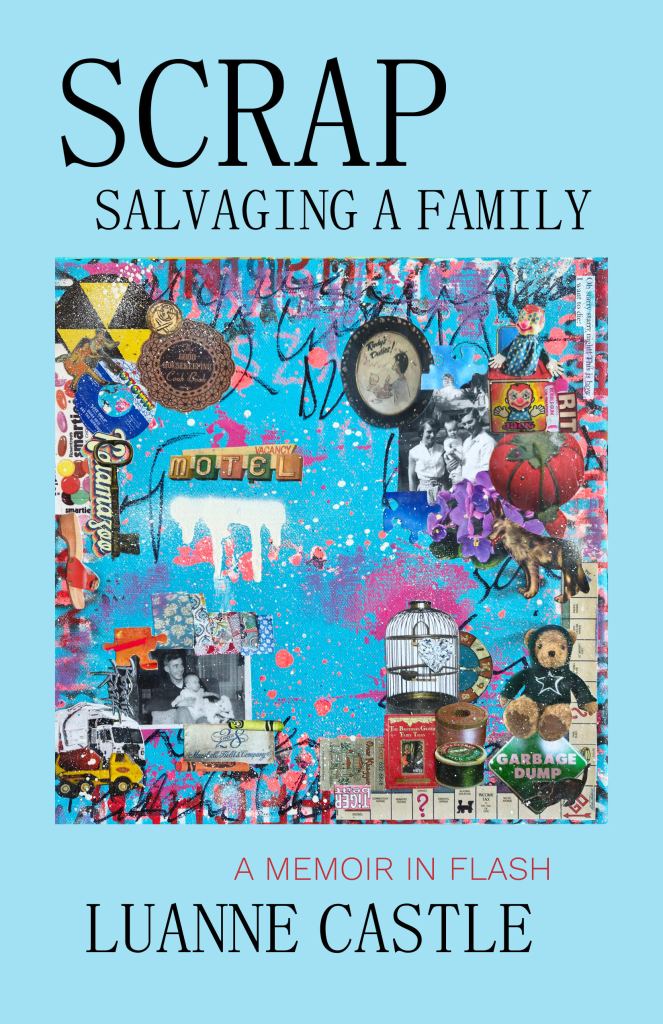
2025 was difficult, although I did have some writing successes in journals, have been working with the small press, ELJ Editions, that will be publishing my flash memoir, and had my manuscript inspired by painter Remedios Varo accepted by Shanti Arts.

*Scrap: Salvaging a Family, a hybrid flash memoir, will be out March 20, 2026

*Hunting the Cosmos, flash fiction and poetry for Remedios Varo, will be out fall 2026

I should have a cover reveal soon for Scrap. Can’t wait to share it with you!!!

The problem with the new year, though, is it springs from the old and all the unresolved issues of 2025 will go on in 2026. My mother’s dementia is one of those things. Taking over her affairs is very stressful and time-consuming, but worse is the dilemmas of communication with my mother. I can still have good conversations with her if I ignore the little idiosyncracies (the “critters” that have taken up residence in her apartment, but can only be seen by her), hearing about her going to a service two hours early and waiting for others to show up, etc.

Both Perry and Meesker have serious health issues. As you may remember, Perry was diagnosed with issues two years ago, but I don’t like to talk about it. All I can say is I am constantly feeding sick cats who need food all day long and cleaning up diarrhea, pee outside the box, and dramatically hurled vomit. And Lily still hates Sloopy Anne. Last night she threw herself violently against the gate we have up to keep them apart, trying to get to Sloops.

2025 was productive for me for writing, up to a point. I haven’t written anything for weeks now. Between grandbaby duty, my mom’s stuff, and these cats (on top of regular work and business), I’ve been too busy and very tired.

I read some good mystery series this year, though, as that’s a good way for me to unwind. Actually, I read far more than I usually do, but then I did have hip replacement surgery in May, so mysteries helped out a lot when I was suffering before the surgery and then during the recovery. Here are the series: Yorkshire Murder Mysteries by J.R. Ellis; Dark Yorkshire, Misty Isle, and Hidden Norfolk by J.M. Dalgliesh; Rev. Clare Fergusson and Russ Van Alstyne Mysteries by Julia Spencer-Fleming; Duncan Kincaid and Gemma James Mysteries by Deborah Crombie; China Thrillers, Lewis Trilogy, and Enzo Macleod by Peter May; DCI Craig Gillard Mysteries by Nick Louth. (To give you a clue, I am a fan of Louise Penny, Ann Cleeves, and Elly Griffiths, and the series I’ve listed here are more like the Griffiths and possibly the Cleeves than the Penny books. The Spencer-Fleming series is a lot like the Elly Griffiths’ Ruth Galloway books, notably because of the hot love affair in the middle of the mysteries.

In addition, I read some wonderful stand-alone novels and poetry collections. I reviewed just a few of them for this blog. If I reviewed your book in 2025 and didn’t list it, please let me know!

POETRY

Review of Robert Okaji’s Our Loveliest Bruises

A Gorgeous Collection Combining Genres of Poetry, Genealogy, and History

Review of Merril D. Smith’s HELD INSIDE THE FOLDS OF TIME

FICTION

Book Tour Stop: Book Review of Deborah Brasket’s When Things Go Missing

Elizabeth Gauffreau’s Masterful New Novel, A Review

Christmas Magic

Just got a call from my son. He miscalculated the days this week and asked if I could watch Hudson again tomorrow. Sure! (Good thing I fell asleep on New Year’s Eve at 8PM). The other night the Gardener put together a tricycle for Hudson. He’s almost two, and his feet barely reach the pedals, but we can work on learning to pedal a bike again tomorrow. 🙂

Let’s work on making 2026 a tender, playful, happy year! If we all puts our heads and hearts together .  . . .

48 Comments

Filed under #amreading, #AmWriting, Book Review, Fiction, Flash Fiction, Flash Nonfiction, Memoir, Poetry

Christmas Magic

Looking for a happy holiday romance? Check out Eden Dow Robins’s new Christmas release available in paperback and kindle versions. And inside find a little Easter egg in the form of my book Rooted and Winged!

https://www.amazon.com/Frost-Happily-Forever-After-Holiday/dp/B0G64ZSWC7

There’s more, too, but I don’t want to share it before you have read Frost!

Summary

“A small town, two frozen hearts, and a little Christmas magic…

Esme Gerard decided spending the holidays at her favorite place on earth was just what she needed. Once known as the most wicked wild west town in America, Jericho Ridge had been her asylum for more than a decade and was the perfect respite when her heart couldn’t risk taking one more hit.

Until Jack.

Their first encounter left her craving more. Something about him drew her closer. No matter how much she tried to tell herself she wasn’t ready, her heart told a different story.

Jack De Vine had priorities. As a single dad, his daughter was at the top of the list. Second was a secret legacy he had a sworn duty to protect. Third was the winery he and his family ran. Dating was at the very bottom. Ever since his ex-wife left him and their child years ago without a backward glance, he’d kept his heart stored in ice.

Until Esme.

From the first moment he saw her, he was drawn to her. That sent alarm bells off in his head. He knew he should steer clear of her, yet he kept looking for excuses to get closer.”

I hope your holidays are joyful!


Leave a comment

Filed under #amreading, #writingcommunity, Book Review, Books, Fiction, Rooted and Winged, Writing

Review of Merril D. Smith’s HELD INSIDE THE FOLDS OF TIME

Here is my book review of Merril D. Smith‘s beautiful new poetry collection. I hope it makes you want to order a copy!

Merril D. Smith’s new poetry collection, Held Inside the Folds of Time, is a testament to Smith’s background as a historian. But what is more important is Smith’s sensitivity to previous generations. She opens the collection with a poem about a cave painting. By doing so, he connects us with all who have come before.

She recognizes what she’s learned from her ancestors, who–in “How I Learned”–“showed me that I have my own wings– / unfold them, fly. This, too, is part of the pattern.” The poet can’t or won’t get away from them: “My dead follow me through every timeline” (“Suspended, Surrounded”).

Smith’s ancestors who immigrated to the United States, her own family of origin, even the soldiers who died in a Revolutionary War battle are all subjects of the book. “In Memorium: For the Unknown Soldiers at Red Bank Battlefield” asserts “their ghosts roam the battlefield / settling their bones, unsettled in time.”

Nature features prominently in Smith’s poetry, and this is where the lyrical beauty of her writing is best displayed. She uses many poetic techniques, particularly variations of rhyme, such as off rhyme, end rhyme, and internal rhyme. These lines are from “Cross-Quarter Days”:

The blooms have browned,

blossoms scattered to the wind

now snow veils the ground,

there above, one bony root unpinned.”

While the poems contain examples of the beauty of life, the overall tone of the book is a lovely mournfulness. As Smith writes in “Winter Birches,” “there is no happily ever, only after.”

Held Inside the Folds of Time demonstrates the potential gorgeousness of language as it mourns and celebrates the poet’s world.

34 Comments

Filed under #amreading, #poetrycommunity, Book Review, Poetry, Poetry book, Poetry Collection

Elizabeth Gauffreau’s Masterful New Novel, A Review

Liz Gauffreau is a master of historical fiction. And rather than creating a series (so far), she has written completely different books with different historical settings. I loved Telling Sonny, and now I love The Weight of Snow and Regret.

Here is my review of the latter. At the end I’ll share with you how you can purchase the book!

***

Elizabeth Gauffreau’s new novel, The Weight of Snow and Regret, is a tribute to the residents of the Sheldon Poor Farm in Sheldon Springs, Vermont, as well as testament to the harsh lives of society’s disadvantaged. The novel takes place in 1967-68, the last year of the tenure of the poorhouse. But the plight of the poor and culture-rocking events of that year resonate with familiarity with contemporary readers.

The first part of the story weaves in the life of Louisianian Claire and how she falls from her place in middle-class society to living in the poorhouse far from home. In this way, the reader is drawn into the novel through the perspective of this mysterious woman, then the reader is delivered into the capable hands of Hazel, a sympathetic foster child grown into a compassionate woman who now runs the home itself while her husband manages the associated farm. Through Hazel’s kindness and perspective, we meet the other residents of the poorhouse.

The place hasn’t always been run as Hazel manages it. Before her hard work, dedication, and home management skills, the neglect was extreme. Every surface was filthy, with trash strewn about. The residents’ clothing was in desperate need of laundering. In fact, Hazel believes that the men’s underwear had never been cleaned. Hazel cleans the home immaculately, creates wholesome meals with a tiny budget, and gives the residents the care and understanding that they need.

These residents range from the forgotten elderly to the mentally ill to those with intellectual disabilities. Although they respond differently to events, and their interactions with each other can be fraught, Gauffreau’s exploration of their behavior and treatment rings true. One twist is that Hazel herself lived in this poorhouse at one time. A couple of the residents from her childhood time at the shelter are still living there when Hazel takes over. This feels like a gut punch to her to think of them still living in the conditions she and her family had undergone.

Gauffreau meticulously researched the history of the home, poor farm life in the sixties and before, the blues music that spoke to Claire’s troubled and depressed soul, the national and world headlines of the time, and local history. Her painstaking implementation of her research with her compassionate feel for the characters, and her excellent storytelling senses makes this an engrossing read. I read far into the night, without being able to put down the book.

***

Help Meals on Wheels!

Purchase the paperback from the publisher, and $5.00 of the purchase price will be donated to AgeWell Meals on wheels of Franklin County, Vermont.


48 Comments

Filed under #amreading, #bloggingcommunity, Book Review, Fiction, History, Novel

Introducing Kathi Crawford and CONSIDER THE LIGHT

I’m introducing a new poetry-slash-flash nonfiction book by a debut writer, Kathi Crawford. I had the honor of writing a blurb for the back of the book.

Kathi Crawford’s debut chapbook Consider the Light, hybrid memoir in poetry and flash, shines a beam into the liminal spaces of a woman’s life. The collection examines transition periods and disruptions as Crawford recreates herself and her future at each of these junctions. As the child of working-class parents, she muses, “I need to save my family,” but as she grows older and must deal with her own problems, she takes what she can learn from others, such as self-discipline from her beloved Nanna, while forging a fierce independence. Crawford’s distinctive voice and story take the reader on a unique journey while offering whispers of familiarity to many who have faced similar hurtles. You won’t want to miss this engaging new voice.

Here’s the Amazon link. What a gorgeous cover, am I right? CONSIDER THE LIGHT – AMAZON

The cover artist is Brooke Summers-Perry. Here’s her Instagram:

https://www.instagram.com/brookesp_studio/

I think you will really enjoy this one, even if you tend not to read poetry. Here’s the book description:

consider the light is a hybrid memoir in poetry and flash nonfiction that traces one woman’s journey from her 1960s Rustbelt upbringing to a life of creative and professional fulfillment in Texas. Born into a working-class family shaped by grit and sacrifice, Kathi Crawford navigates decades of transformation-personal, cultural, and emotional-while forging her own path toward career success and lasting love.

Through moments of grief, reinvention, and unexpected grace, this collection illuminates the resilience required to see the best in each situation and in each other. With language that is spare, evocative, and deeply felt, Crawford invites readers to reflect on what it means to belong, to endure, and to choose light even when the shadows linger.

This debut book speaks to anyone who has wrestled with identity, loss, or longing-and found, in the struggle, a deeper kind of beauty. It’s a testament to the power of memory, the strength of women’s voices, and the healing potential of story. A compelling read for fans of women’s memoirs, personal transformation, and poetry about grief, hope, and resilience.

And you can read a little about Kathi here:

With a career spanning decades in organizational development, Kathi Crawford founded People Possibilities, LLC in 2008. She is an IAC-certified master coach who has worked with hundreds of clients one-on-one through leadership, career, and life transitions.

Alongside her business career, Kathi actively writes poetry and flash creative nonfiction. Her work has been featured online and in print in a variety of literary journals. Her chapbook, consider the light, is available from Finishing Line Press. This mini-memoir invites readers to embrace their flaws, honor resilience, and cultivate empathy for themselves and others, offering yet another avenue for Kathi to foster understanding and connection.

You can find Kathi on Instagram or LinkedIn @kathicrawford and subscribe to her blog @ kathicrawford dot com.

Leave a comment

Filed under #amreading, #poetrycommunity, #writingcommunity, Flash Nonfiction, Memoir, Poetry, Poetry Collection

Book Tour Stop: Book Review of Deborah Brasket’s When Things Go Missing

I’m thrilled to be part of the blog tour for the new novel written by Deborah Brasket whose blog Writing on the Edge of the Wild  I’ve been reading almost as long as I have been blogging.  I’ve reviewed this very special book, and I’d love for you to read the review, hoping that will motivate you to pick it up for yourself.

EBOOK GIVEAWAY The top 3 people who leave the most likes and comments on the participating blogs will be emailed a free eBook of When Things Go Missing (epub or mobi) PLUS two extra chapters (pdf or doc file)

***

REVIEW

As I began reading Deborah Brasket’s debut novel, When Things Go Missing, I was expecting a smart and well-written story since I had been reading Brasket’s thoughtful blog for at least ten years. What I didn’t expect was such gorgeous writing, significant and densely woven themes and images, or how strongly the book would make me feel.

This novel is the story of a traditionally structured family of four and how the pieces that are the individuals fit together—smoothly, imperfectly, and jaggedly. The mother leaves one day without saying goodbye or providing a destination. At that point, daughter, son, and husband all respond differently, depending on their relationship with Mom/Frannie. As might be expected, they feel as if the center of the family is gone, leaving them with only tenuous connections to each other.

When Franny leaves town, her son, Cal, is a heroin addict who relies on the help of a rotating roster of enablers—including his mother—to give him money or a place to stay. The younger child, Kay, is a graduate student in archaeology, focused on finding a place for herself in her field. They both rely on their mother emotionally, but with the maternal tenderness spigot suddenly all but closed tight, they struggle to discover who they are and how they can succeed in life whether their mother is a part of their day-to-day lives or not.

The character portraits are carefully drawn. Brasket captures not only Cal’s addictive personality, but his sister’s love wrapped in resentment for the way he siphons attention for negative reasons. Even if the characters and their fascinating evolution throughout the book were all When Things Go Missing has to offer, it would be enough. I couldn’t look away for an instant. Every moment was a surprise and yet each new action made absolute sense for these people and their troubles and their conflicted emotions for each other.

Anyone who has an addict in their lives will be able to relate to this book at a profound level. Anyone who is part of a dysfunctional family group will be compelled to learn from the psychology at work here. And, finally, any parent who ever wanted to just get away from everyone and everything to search for peace and to find themselves, will feel a connection with the character who is missing throughout the novel—Franny herself. Where Franny finds herself will surprise and please you. The character her husband and children find within themselves will gratify you. I promise.

When Things Go Missing made me cry. I could not stop thinking about it when I finished reading. Frankly, I was stunned by the beauty and the brilliance.

***

Following you will find the book information, description, and author bio–as well as the blog tour schedule.

PUBLISHER: Sea Stone Press
PUB DATE: September 22, 2025
PAGE COUNT: 352
FORMAT: E-book $8.99, paperback $14,95, hardback $21.95
AVAILABLE NOW at Amazon, Bookshop, Barnes & Noble, and all major retailers.

ABOUT WHEN THINGS GO MISSING
When Fran Albright turns fifty, she heads to the grocery store and keeps going until she reached the tip of South America, leaving behind an empty hole in the lives of her bewildered family. Her daughter Kay scrambles to finish her master’s degree while trying to glue the family back together. Her son Cal is torn between grief and rage as he fights his own addictions and demons without her there to help. And Walter tracks his wife’s journey southward with her credit card purchases, continuing to care for her as he always has, before heading north to Alaska. Adding to the mystery of the mother’s disappearance are the elated messages she leaves on Kay’s phone and the strange photos she sends Cal, who studies them like hieroglyphs he must decipher to save her and save himself.

When Things Go Missing is a masterful exploration of loss, loyalty, and self-renewal. Told through the viewpoints of Kay, Cal, and Walter, this emotionally rich, mystery-driven family drama is wrapped up in a propulsive page-turner you cannot help getting swept up in.

GENRES: Book Club Fiction, Literary Fiction, Family Saga, Women’s Fiction, Sibling
Fiction, Addiction Fiction, Introspective Family Drama, Healing and Self-Renewal


ABOUT THE AUTHOR

After sailing around the world with her husband and children, teaching literature to college students, and fighting for affordable housing as the leader of a nonprofit, Deborah J Brasket finally settled down among the golden hills and vineyards of California’s central coast to write the kinds of novels she loves to read.
http://www.deborahjbrasket.com
seastonepress@gmail.com

WEBSITES AND SOCIAL MEDIA
Author website and blog, Deborah J. Brasket, Author ~ Writing on the Edge of the Wild –

Novels

Substack Newsletter, https://deborahbrasket.substack.com/

Facebook, Deborah J. Brasket, Writer –  https://www.facebook.com/DeborahJBrasket/

Goodreads, https://www.goodreads.com/author/show/55448191.Deborah_J_Brasket

Instagram, https://www.instagram.com/dbrasket/

LinkedIn, https://www.linkedin.com/in/deborah-brasket-39384370/


BOOK BLOG PARTICIPANTS

18 Comments

Filed under #amreading, #bloggingcommunity, Book promotion, Book Review, Books, Flash Fiction, Nonfiction, Reading

Judy Kronenfeld on her Memoir _Apartness_ and Her Identity as a Scholar Poet, Part 1

Today I am introducing poet and writer Judy Kronenfeld. Although we didn’t know each other at the time, Judy and I were at the University of California, Riverside, at the same time–Judy taught there when I was a grad student.

Here is a beautiful poem Judy published in Sheila-Na-Gig, “Blue Corduroy Baseball Cap.”

Judy Kronenfeld

Judy has recently published a wonderful memoir comprised of prose and poetry called Apartness. Here is the book description:

Through a collection of honest yet often humorous essays and complementary poems, Apartness: A Memoir in Essays and Poems grapples with the feeling of unbelonging as a first-generation Jewish-American woman from an immigrant family in a primarily Protestant nation. Kronenfeld illuminates a sense of divide between herself and the world around her with graceful vulnerability and truthful ambivalence as she reckons with religion, social class, and aging.

Apartness is for anyone who has ever felt left out or struggled to find home.

My addition to the above description is that I think it’s a book for everyone.

My interview of Judy is in two parts. Today I am posting part 1 and next Monday I will post part 2 and will link back to this post. My questions are in italics; Judy’s responses are in Roman type. Here is part 1, which consists of two questions and answers:

1: Judy, you are a scholar and a poet/writer, two identities that have often warred with each other. When I was graduating with my PhD a fellow graduate student who knew I wanted to return to poetry told me that Sharon Olds said she was going to forget everything she learned (in grad school) so she could write poetry. The reference I found to a similar quote by Olds is from the Writers Almanac: “So what I said was something like: ‘Give me my own poems and I’ll give up everything that I’ve learned.’” https://writersalmanac.publicradio.org/index.php%3Fdate=2011%252F11%252F19.html  Her point was that she had learned the impersonal New Critical way of reading poetry (aka literature) and wanted to write intimate poetry fresh from personal experience, in other words autobiographical. As you know and write about in your book, New Criticism doesn’t allow the reader to take the writer’s own life into consideration. And this mentality permeated the landscape throughout the 40s, 50s, and 60s when poets like Sylvia Plath began to take it apart. You were steeped in New Criticism, yet you wanted to write poems based on your own emotions and experience. How did you weave those two aspects of yourself—creative and scholar–into one? Or did you have to keep them separate and if so do you feel as if you have two minds?


JK: For much, but far from all of my adult life, I have been involved with producing either scholarship or creative work—most often poetry, but also creative nonfiction and some short fiction. But I have also taught literature and criticism while trying to write creatively, or done scholarly research and writing, while teaching creative writing! Talk about liminality! And yes, it certainly can feel as if one is participating in divided and distinguished worlds. Yet that liminality may also foster “a disinclination to work within institutionalized frameworks of thought,” as I say in the preface to my critical and historical book on King Lear.

 I’ve tended to be something of a muckraker in response to the limitations of various academic approaches to literature. I was shocked at the almost religious “New Critical” shunning of historical and social context in my first English seminar (on the English novel) as an undergraduate, for example, and hoped to correct it in my own critical work. And I was skeptical (in a way that ultimately led to some of the understandings that underpin my book King Lear and the Naked Truth) of the simplistic “old historical” paradigm used as a heuristic for examining 17th century literature by one of my English professors in graduate school. He put “Anglicans” in one box labeled something like “appropriately or decently dressed” and “Puritans” in another labeled “the naked truth.” And this governing polarity was expected to illuminate content and form in a great deal of literature. My lucky New Critically close reading of Saussure in a seminar on Structuralism (taught by my anthropologist husband in 1972) gave me an understanding of contrast and reference in language that illuminated such matters as Reformation controversy on the appropriate “clothing” or “dress” in church services. “In short,” to quote my book, “the Reformation controversialists . . . all claim . . . to be as clothed and naked as they ought to be. . . . [S]hared contrasts and abstractions concerning appropriate and inappropriate uses of clothing permit controversialists to ‘talk the same language,’ even though they may not mean the same things at all” (p.67). Their specific referents for their abstract terms are what one needs to look at. What is an example of “comely” or “decent” clothing in the church? What is not?

To try to summarize a crucial point of my very long and rather complex book of criticism here is a bit insane. But it serves to illustrate, perhaps, that my desire to deeply understand the history, culture, and language in and surrounding literature I love has been important for me, even if I have not written on early modern literature since my book on Lear was published in 1998 (with the exception of a handful of book reviews from 1998 to 2001). So much of my self was deeply invested in criticism; I had to “say goodbye” to it in an emotionally and intellectually meaningful and public way by pushing myself to complete this very comprehensive critical book which makes use of everything I knew and learned about language and the religious culture of Shakespeare’s time. And I must say, to read any part of it again, after many years teaching creative writing until my retirement, and even more years writing poetry, is to acquaint myself with a mind reclaimable but somewhat foreign.

New Criticism, especially when I was an undergraduate, seemed to enshrine a view of creative writing as accomplished quite coolly and impersonally, perhaps best by a social elite, and not by ethnic minorities, or, indeed, very much by women. Yet the secular and religious poetry of John Donne and the religious poetry of George Herbert, for example, were passionate! And New Critical pedagogy also encouraged the student to give herself to such poetry, to live with its sounds and rhythms, to take such poems into herself. At the same time, this Jewish girl had to process such poems intellectually, which meant understanding enough of Christian theology to grasp the speaker’s emotions in a way fully related to his words. I was moved (even if not converted), perhaps because the course I took in the Metaphysicals as an undergraduate allowed me to concentrate fully and thoroughly on lyric poetry of a particular historical moment, for the first time. I was in love with lyric poetry and also with the leap across time involved in understanding it.

This experience of slow emotional processing of poems, combined with analytical and intellectual understanding, deposited the poems in my mind and heart in a lasting way, I found. Something I had deeply felt and analytically absorbed, for example, the sound of a line like “Oh! of thine only worthy blood”—in Donne’s sonnet “If poisonous minerals, and if that tree”—whose rhythm and wailing long o’s contrast with the sound of immediately preceding lines, could subliminally affect something unrelated I was writing years later. I think it’s important for those who want to write poetry to have this combined experience of emotional and intellectual understanding of poems when they begin to study. It was an experience that affected my own teaching of creative writing. I think analysis deposits the words read along with the emotional reaction one has to them in the writer’s mind in a more lasting way than emotional reaction alone.


2: Your essays—and I hate to call them essays because that word has always conjured up the boring genre of literature I didn’t want to read in grad school. Give me poetry, give me novels, or for teaching even give me drama so the class can read aloud. At the time, there was nothing called creative nonfiction, so everything else was called an essay. And I notice you call your pieces essays, but they are exciting and filled with fascinating cultural and historical details, emotional resonance, and an ability to straddle both a perceived mainstream American culture and your own ethnic upbringing that creates a tone of loving humor. Each essay on its own is a wonderful “article” that feels so satisfying to this reader. Taken together, they create an autobiographical feel as they are the archival creation of a life. Have you been writing essays as long as you have poetry? How do you know when a particular image or memory will work best in a poem or an essay? Did writing scholarly essays help you in writing creative essays such as those in the book?

JK: I haven’t been writing personal essays/creative nonfiction as long, or as frequently as I’ve written poetry. But I have kept private diaries or journals intermittently since adolescence and have quite a collection of these. In the last decade or so, I have slacked off. There were never obligatory daily entries (even weekly or monthly ones). I wrote when I needed to describe a new environment, or record a complex, disturbing or confusing experience, or indulge in a fantasy, or release anger or distress—really for any reason involving some sort of burden of emotion and/or thought relieved by the loops and glide of a pen in the hand. It wasn’t until the complex experience recounted in “Death and Belief” that I tried to deal in a public voice with a multi-layered experience that, as it turned out, shined a light on some central conundrums of my life. Once I had done this, it became possible to do it again. Writing scholarly essays was really different from writing these personal memoir essays. One has many sources to organize and credit, an argument to construct that relates to current critical paradigms, i.e. speaks in the current critical language of the academic institution of “English,” so it can be understood by academicians, yet provides something new as well. The task of organizing is definitely labor-intensive. In contrast, writing the essays that comprise Apartness (which I did not originally write with the idea of combining them into a book) was in many ways more spontaneous, indeed, easier (although that definitely does not mean that I did not revise!). I had written stories and published a number of them before I began writing these memoir essays which can share narrative arcs, characters, and dialogue, with fiction. However, the experience of learning to organize a lot of material is always a useful one, whether for the critical or the personal essay, though the materials are different.

Memory has long been an essential aspect of my poetry, perhaps because I returned to writing poetry, and first dedicated myself to the process in early middle age, when I was already able to look back on so much life. I don’t think there’s anything intrinsic to a particular image or memory that makes it work better in a poem or an essay. But essays are, of course, usually more discursive, so there has to be enough meat to the memory and the experience to sustain longer, perhaps more multi-faceted consideration. Both essays and poems have elements of showing, rather than telling, but a poem’s approach to a memory may be more glancing—even if only because it contains fewer words. A few of the shorter pieces included in Apartness, like “Blue Bowl of Sky,” are probably more like what has sometimes been called “lyric essay.” And the line between that and “prose poem” (“Resident Dead,” for example, was originally published in a collection of prose poems) might be pretty fuzzy.

Watch for part 2 on Monday!


Author bio:

Judy Kronenfeld’s six full-length books of poetry include If Only There Were Stations of the Air (Sheila-Na-Gig Editions, 2024), Groaning and Singing (FutureCycle, 2022), Bird Flying through the Banquet (FutureCycle, 2017), Shimmer (WordTech, 2012), and Light Lowering in Diminished Sevenths, 2nd edition (Antrim House, 2012)—winner of the 2007 Litchfield Review Poetry Book Prize. Her third chapbook, Oh Memory, You Unlocked Cabinet of Amazements! was released by Bamboo Dart Press in June, 2024. Her poems have been published by such journals as Cider Press Review, DMQ Review, Gyroscope Review, MacQueen’s Quinterly, New Ohio Review, Offcourse, One (Jacar Press), One Art, Rattle, Sheila-Na-Gig, Valparaiso Poetry Review, and Verdad, and four dozen of them have appeared in anthologies. She is a four-time Pushcart Prize nominee, and has also been nominated for Best of the Net. Judy has also published criticism, including King Lear and the Naked Truth (Duke, 1998), short stories, and creative nonfiction.  Apartness: A Memoir in Essays and Poems, was published by Inlandia Books in February, 2025.


24 Comments

Filed under #amreading, Essay, Family history, Interview, Memoir, Poetry, Reading

Sirens to Larks: Interview with Poet Rose Mary Boehm

Please meet the prolific and multidimensional poet, Rose Mary Boehm. She has graciously consented to an interview. I will give you her official bio first, but you’ll discover in her interview replies that there is so much more to Rose and her poetry than what can be discovered in a paragraph.

German-born UK national, Rose Mary Boehm lives and works in Lima, Peru. Author of two novels and ‘Tangents’, a full-length poetry collection published in the UK in 2010/2011, her work has been widely published in US poetry journals (online and print). She was three times winner of the now defunct Goodreads monthly competition and has been nominated for a Pushcart and Best of Net. Her other poetry collections are: ‘From the Ruhr to Somewhere Near Dresden 1939-1949: A Child’s Journey’; ‘Peru Blues or Lady Gaga Won’t Be Back’; ‘The Rain Girl’; ‘Do Oceans Have Underwater Borders?’; ‘Whistling in the Dark’; ‘Saudade’, and ‘Life Stuff’. A new chapbook is about to be published by Kelsay Books. Find out more about the author and her work on her website: https://www.rose-mary-boehm-poet.com/

INTERVIEW OF ROSE MARY BOEHM

I first met Rose in the Verse Virtual poetry community and journal. The journal itself is part of a community of poets that are very supportive of each other.

At the end of the interview I won’t respond because I want to leave you with how Rose ends the interview. Thank you, Rose.

  1. I have a theory that the creative chronology of a poet is more important than the physical chronology; however, the poet is first shaped in childhood experience. Your book From the Ruhr to Somewhere Near Dresden 1939 to 1949: A Child’s Journey, is a witness to those years, but years that were intensely defined by being a German child living in Germany during WWII. The book describes the deprivation of a war fought elsewhere and on the homeland. Please share a poem from the book and tell us what you hope the book accomplishes.


Having been a young child during WWII in Germany (I had just turned seven when the War ended) will forever colour everything I do and think and feel. I have a kind of PTSD which is well controlled (even though I just cannot, CANNOT read stories and see photos of the children of Gaza without despairing completely), but I can’t help referring back to my childhood again and again in many poems.

Now that I am in the last years of my life, I am desperate that my children and their children should not experience war, and this seems increasingly unlikely, the way the wind is blowing all over the world. It makes me scared and sad.

The book, From the Ruhr to Somewhere Near Dresden 1939 to 1949: A Child’s Journey, was a bit of an exorcism, a talk with a therapist perhaps, and hopefully a message to all children who lived either this war or any other. And, if they survive, how they often find (a somewhat troubled) childhood, remember the finer points of a caterpillar rather than the next plane strafing the house, the next bomb killing your neighbours, your parents, or you… if you’ve been small enough not to understand it all. My brother, eight years older, was not so lucky.

The collection is more of a story told in free verse than individual poems, numbered only in the order of telling the story. Seen totally from the child’s point of view, told in the child’s voice. Whatever I remember I remembered in this way – once I started looking.

I think I have to use two poems to give you an idea of the contrasts (‘normal’ childhood versus little-understood horror):


Poem 5

Mother calls them ‘Christmas trees’. My brother calls them flares.

I am wrapped in a blanket, sitting on Mother’s arm.

We are on the balcony. It is nighttime. Danger time.

These ‘Christmas trees’ stay for a while, suspended in the night sky.

Now she runs with me down to the shelter. Moments later

there is the whizz, the rumble. I press my hands to my ears.


In the shelter I always lie on the sofa and trace the pattern

of the velvet cover.  Maybe that man with the hoarse, loud voice

comes in these explosions and sweeps through the house,

killing everything with his breath. Black. He wears black

and he has a cape, like on the posters.


The siren won’t sound the ‘all clear’ tonight—that long, long howl

which tells us it’s alright to go back upstairs.

As during thunderstorms, the bangs come closer.

My brother looks as white as a ghost

and holds me tight. Mother comes to my other side

and holds us both. Suddenly the candles die.


Screams.

Silence.

Confusion.


Everyone speaks at once.

‘Where are the matches–must have been next door.

The Brandt’s… Must have been the Brandt’s.’


A light appears from the other side

and a figure in white. It’s Herr Brandt holding a candle.

I can’t help giggling. He’s wearing long, worn-out underpants.


Many houses are still burning.

Burning flesh stinks,

burning rubber stinks.

Death stinks.


Poem 6

I stand on the balcony. On tiptoes.

I’ll see him any minute now. The tram has

turned the corner, and it’s the tram

on which Father usually comes.

It’s a sunny afternoon

and I feel expectant and happy.


I can see his trench-coated figure,

recognize the way he walks, the way

he wears his hat. He carries his leather case

and something wrapped in paper. He probably

bought two of those flat fish with yellow spots

because it’s Friday. We always eat fish on Friday.

I am never quite sure whether it’s Friday

because he brings the fish, or whether

he brings the fish because it’s Friday.


  1. From your poems that I have read and those I have had the pleasure of hearing you read aloud, I have taken away that you have lived through a variety of changes: lovers and husbands, having children, living in various countries, learning many languages. How do you think your “multiple lives” and languages enrich your poetry? It might help if you have a couple of quotes from your poems to illustrate your points.


Yes, Luanne, it’s been a rich and varied life, full of pain, miracles, adventures, more pain, and much, much love. There is no way I can not weave this into my poetry. What am I saying, I am weaving nothing: it ‘weaves’ me. Those memories want out, and most of the time they become poems.

I chose the following poem as an illustration where my travels did not produce ‘place poems’ but a deeply-felt incorporation of history, place, and DNA.


A Pilgrimage


In Rosh HaNicra I look across

to Lebanon. Below me is the sea.

I pick up a stone and let it bounce

against the rocks.


The Sea of Galilee cuts me

with contrition. I want to atone

for sins to which I feel fettered

by blood. The Jordan washes the dusty crust

of the Negev from my skin.

The Dead Sea lifts my burden.


Haifa receives me in a language

I understand, Bethlehem’s brittle

alliances don’t inspire. My friend rejects

the kipah and holds my hand.

And Yom Rishon is the first day.


The languages are an enrichment and sometimes a small-ish problem: with each language you learn so much more than words. You internalise different cultures, customs, religions (or interpretations of it), images, music, rhythms. That’s definitely enriching. What can make you stumble at times are words you know in one language, you can feel what they mean in its totality in your belly, but there is no way they can be directly translated into their complete components in one English word. You have to ‘write around’ that word in order to make its full, round meaning understood in the way you do.

Of course, my travels, my pains, my children have all been sources for poems in many iterations. But instead of a few quotes, I think I’d better use the title poem of my collection ‘Saudade’, a poem that is the perfect example of  ‘writing around’ the meaning (as perceive by me) of the word ‘saudade’ which means so many things in Portuguese:


What is Saudade?

A moment that passes like

a paler shade of Spring,

like the knowledge of a certainty,

the vague promise of repeat.


The echo of something

which never was, a butterfly wing

that may have brushed your cheek.

Dreaming of indolence.


Expecting the first rains on dry fields,

not quite hearing the last lark before

the autumn winds, the first smell of snow,

the never-ending final summer dance.

Softest touch of his hand on yours,

the death of an infatuation.

Your evanescent youth.


A strange bliss in your longing,

fear of fulfilment. Praying

for the becalmed sea of inertia.

Celebration of absence.


You carry a sharp, merciless

switchblade made of stainless grief.


  1. If you had to leave quickly and could only take two of your books, which would they be and why? I’m not asking which you think are the technically best collections, but the ones closest to your heart now. Do you think your feelings about any of your poems has changed over the years?


Oh my, that’s the ‘impossible’ question. Each one of my books represents an important part of me, and I can’t leave even one important part of me behind. I’d rather think that I would be allowed to grab’em all. It’s a ‘Sophie’s Choice’, if I may use such a heartrenting example for mere books (but they are my children too, in a way).

If hard-pressed, tortured, threatened with a bucket of maggots, I’d probably choose ‘The Rain Girl’ and ‘Saudade’. Still, just writing this hurts. I also need ‘Life Stuff’. But please, let us keep that very much between us.


  1. Rose, what brought you to Peru and what is your creative life like there? What does Peru add to your poetry?


I was brought to Peru by my Peruvian husband, Luis (a Luis is affectionately known as ‘Lucho’ in Peru). I met Lucho in Madrid, where I had moved to from London, licking my wounds from a previous marriage that hadn’t made it. By the time Lucho and I got together, I was quite ‘together’ again too, or this new love adventure wouldn’t have worked. Take it from Granny: never marry on the rebound!

We stayed in Madrid for 18 years, and then took the plunge. We have now been in Lima for almost 14 years.

Peru was the first time where I lived (not just visited) a completely different planet, new language (even though I was fluent in Spanish – it’s a different Spanish here), poverty, llamas, braids, hats, Andean music, the gentlest of people as well as cheap lives easily taken over a cell phone. My book ‘Peru Blues’ was the result. I couldn’t write it now, I had to write it while I still saw everything with ‘foreign’ eyes. Over the years Peru became home, no longer an unknown country, and many things one no longer ‘sees’.

For example:


At the Seaside in Peru

Houses made from basket weave lean

into the dunes of the desert only a few meters

from the salty dance of the Pacific,

shivering in the stiff breeze.


Sand mixed with plastic and excrement,

small children crawl atop the landfill

with burlap sacks, the odd pig snuffles

between shards and pieces of iron.


A half-dead plant wrenched from the root,

reminder of what once was — unsalvageable.

Here I am, holding a small, brown hand,

sticky and bruised. Her large dark eyes

are those of a cornered deer.

Her mother turns to leave.


Contrasts

I remember lipstick smears on empty wine glasses, kisses

blown into the air, muak, muak, how good to see you,

Dahhling. There were important decisions

to be made. Go for Dior or Cacharel, and the wonder


how some women would never lose that dark-red

which ringed their mouths and made them appear

like fathomless caves, dangerous suction channels

inhaling man and mammal into Dante’s Inferno,


and the whispers behind long-nailed hands, ready

to claw and destroy, freckled breasts arching out

of low-cut silks and cashmeres, gold weighing

on bony hands. ‘Can’t be too rich or too thin,


Honey,’ that’s what the Duchess said. And now

I am watching from afar, on the screens of lies

which used to be the ‘small’ screens, how mudslides


reclaim the riverbed. The poorest build their precarious

homes there every year against all advice and the offer

of other land. My grandfather, some say, my mother, say others.

Tradition meets ignorance, and they tearfully watch again

their houses, children, wives and husbands

disappear under boulders and mud.


  1. Please describe your current project and why it is important to you. Why is it important to readers?


One of my current projects is a chapbook called, ‘The Matter of Words’, that’ll be coming out in the autumn of this year. I LOVE words, and – as I did with ‘Saudade’ – have written poems (short ones and longer ones) around ‘difficult’ words, words that are not used in daily speech as a matter of course.

But there is a full-length manuscript that is now looking for a home. That one – I won’t mention the title or give an example poem, not to discourage potential publishers, you know how iffy they often are about ‘previously’ published or curated – is a collection of all my favourite poems written since the publication of my other books, or those that didn’t quite fit. This may well become another one I’ll sneak into my backpack when I have to leave a lot behind.

And that’s where we are, that backpack. I am 87, and where I am going in the not too distant future I won’t need a backpack, and I can only hope that my writing will not completely disappear but give some meaning, joy (or tears) to those I leave behind.


23 Comments

Filed under #amreading, #poetrycommunity, #writingcommunity, Interview, Poetry, Poetry book, Poetry Collection