Tag Archives: Family memories

Third Place Contest Winner

So It Happened Like This

by Mike Durr

  1. Covington

In every generation there is a vitality that did not exist in previous generations. This vitality, this burning heart fire is what makes us great or greedy, good or bad. For me the fire in my heart was not realized until I was in the fourth grade. Growing up in Covington, Kentucky in those days was no different than growing up in any other small town along the muddy brown Ohio River.   Only a mile across the river, Cincinnati was the home of those fantastic Royals, led by Oscar Robertson. And the home of America’s first professional baseball team, the Redlegs. The tall buildings and bright lights were just over the suspension bridge, which most people pointed to with pride, declaring it was the original model for the Brooklyn Bridge. Covington had then and still does a melancholy feeling. As if leftover ghosts from the Underground Railroad still existed in the damp, dark, hand-burrowed passages of the hidden tunnel—a tunnel dug in a desperate effort to gain freedom from slavery by escaping to the North. It was a secret tunnel dug ages ago, but all of us kids knew where it was and we knew the ghosts were there. The ghosts also walked the alleys and quiet places of the town at night. Sometimes in the heat of summer you could hear calliopes from riverboats and see reflections of spectral images gliding north toward precious freedom.

The summer after my tenth birthday I broke into the tunnel and explored. The cool, dripping, moss-covered passage, blanketed in darkness for nearly a century, called to me with a promise of freedom and I answered the call. I walked where no one had since the Civil War. With the mighty river coursing above, I moved fearlessly through the dark. After awhile I could feel the great desperation and fear of those who had dug the tunnel, and they bore into my spirit and stayed with me long and hard as I grew up. To me they seemed to offer a warning: “Look what had to be done for our freedom. Nothing less. What will you do for your freedom? Stay here, like those who were afraid to cross under the water, and you will never have it.” I was just a kid and the message was not quite clear. I was too simple to understand, too unaffected to know. As the years passed I never went back to the tunnel. But I felt the ghosts and their influence was great within me.

By the time I was nineteen I was desperate to get away. The ghosts of freedom had stoked high the fire in my heart. So on Christmas Eve, just two weeks after my birthday, I joined the Navy.  Three days later and for the first time in my life, I was aboard a jet, strapped in, scared and sweating despite the cold December snow outside the window. The plane gathered speed and left the runway, carrying me North above the dirty ice-caked river. Carrying me to freedom? In reality carrying me to the Naval Training Center, Great Lakes, Illinois. I still remember the fear on that freezing, dreary gray afternoon. I was more afraid than at any time in my life. Only the ghosts sustained me. “What are you willing to do for your freedom?”

Late December in Illinois was much the same as in Kentucky. Everything was hard frozen, dirty gray and cold. The Naval Training Center was a collection of sooty, peeling, white wooden buildings, leftover from the Second World War. Old steam-heated buildings, well past their prime, with skins of frost on their warped wood-framed windows. Cracked and peeling paint covered the doors and walls like the dermis of an old leper long since resigned to death. No spit- and-polish Navy Pride, just a winter way station on the road to Vietnam. Oddly enough I felt ghosts here also. Not spirits in desperation but of it. They carried a fear and stink of wars long ago fought. Salt spray and fiery North Atlantic combat. These were spirits of unforgiving conflict and loss. I could sense them, hear them in their anguish, but I was unable to understand the message. I couldn’t yet realize what I would do for my freedom. So I trained with 71 others and grieved the absence of my family and friends. I ate, worked, slept and even breathed Navy. If the training center was not a proud place, I was becoming a proud seaman. Like the ghosts of this place, I was headed for war.

My war was not to be a conflict of cruisers and battleships. No destroyers hunting submarines on the high seas of the North Atlantic. No cobalt-blue shipping lanes of the tropical Pacific. No dolphins riding my bow wave through the vast clear sea. I was headed for the dirty brown water and deep green jungles of Indochina. Headed for the sweltering heat where every insect knew the taste of human blood. A place where the desperation of the oppressed was matched by the desperation of the oppressor. A place where every day spent outside a body bag was counted as a good one. A place where every good day meant 24 hours less to spend in hell. But I did not know these things until later. I could not even have guessed what I would do for my freedom.

###

Sam (the Marine in hat) and Mike in Phu Bai

A little levity before the serious work begins

Mike Durr is originally from Independence, Kentucky. He attended Holmes High School, University of La Verne, and University of Southern Mississippi.  A member of the Department of Defense for 21 years, Mike is also a former High School Science teacher and  Nuclear Security Training Supervisor. Currently, Mike lives as a pirate in either Florida or Bocas Del Toro, Panama.

Watch for the Honorable Mention stories next week!

3 Comments

Filed under Creative Nonfiction, Essay, Memoir, Nonfiction, WordPress, Writing, Writing contest

Second Place Contest Winner

Waste Not, Want Not

by Lisa Ellison

Four years before my brother ended his life, my grandfather and I held mass in a tiny kitchen in upstate New York. The sweet tang of simmering sauce offered the opening rites. The three-gallon kettle he had commandeered from work held the holy water that would bring forth our salvation in the form of tender white noodles, our Eucharist. When he twisted the knob on the chipped white stove we began.

“Things keep changing in this world. One day I hope they get it right,” he said, stirring the sauce.

“I hope so,” I answered, grating cheese and savoring his service in our hot little cathedral.

“You see, you’ve got to waste not to want not. Your generation . . . you’re always throwing things away so you can buy something new.”

I nodded in agreement. In two months I would start the tenth grade. I carried a scrap of paper in my back pocket with my shopping list—sweaters, jeans, new shoes. Typically I wore mine until they had holes in them. I felt around with my toes and panicked. Maybe later I would get a steak knife and discover a hole above the heel.

“Back when I was a kid, if you didn’t take care of things, you just didn’t have anything.” He sidestepped towards the cupboard. Heaps of mismatched glass bowls tottered precariously on the thin bowing shelves, chiming like church bells when jostled. “It’s that way with everything nowadays. You tell everybody your business. Words are precious, you know.”

I scooped the cheese into the serving jar. It fell like snow from the spoon.

“You say everything that’s on your mind. Everybody’s got to know how you feel.”

“Seriously?” I looked right at him.

He went to check the water. Small whiffs of steam floated up from the pot, apparitions.  “Some words are sacred, like I love you. Those words are for matrimony. You don’t just throw them around anytime you want.”

He stirred the sauce again. You could taste the air as he pulled meatballs from the electric skillet and tapped off excess sauce, bowls chiming in sweet melody.

“What do you mean by that?” I wrinkled my brow. Surely, he couldn’t be serious.

“I haven’t told anyone I loved them, except for your grandmother, in all my years. I love you is for marriage. It’s sacred.” He smiled and stared out the window, thinking of what? His worn, thin wedding suit draped across his neck?

My jaw dropped as the blood rose in my chest. What was going on with my priest? “You mean that’s it?” My voice raised half an octave as I spit out the sentence. “You don’t tell people you love them? It’s wasteful?”

“Actions speak louder than words,” he said, with grim finality. The water began to rumble. “Talk is cheap. If you say the same thing over and over it loses its meaning.” He ripped the top off two boxes of ziti and dumped them into the pot.

As he stirred the wild water, sweat poured off the brow of his ruddy Irish face. He was my father, son, and holy ghost. This was the man who took me dress shopping before recitals, who slept on the floor at age 63 so my brothers and I could share the only bed in the house. He was the man who walked three miles in the summer sun to borrow a car to take us swimming, who bought me a pair of Reebok sneakers when he worked as a dishwasher in a school because he couldn’t afford to retire. He was the man who looked down tearfully and said, “It’s just alcohol,” when we returned, pale and somber, after a meeting with my mother. I caught his gaze and said, “Grandpa, we know the truth. It wasn’t just alcohol.”

I reflected on all our times together—the walks to the store, the pancake breakfasts, the weekly kitchen sermons. He had never once told me he loved me.

He continued to alternate between stirring the pasta and spooning meatballs and sausage into iridescent serving bowls.

“But that’s wrong!” I blurted, fist clenched, pacing. I had never challenged the service before. “You have to tell people how you feel.”

“You’re just a kid,” he said, glaring.

“Well, you’re wrong,” I repeated. “I get all that other stuff about waste not, want not. But you have to tell people you love them. One day you may be sorry and wish you’d said it more.” A shiver ran down my spine as I uttered those prophetic words.

He spooned a noodle out of the water and popped it into his mouth. “One more minute,” he said, stirring the water again. “When you’re my age you can talk about what is and isn’t right. Until then, you just remember what I said—waste not, want not.”

“You remember what I said. One day you’ll be sorry.”

He looked up at the clock then walked over to the sink with the colander. ”Move on out before you get burned.” His tone was gruff and loud.

He always shooed us out of the room whenever he drained the spaghetti, worried he might burn us with the steaming pot. I obeyed and walked to the doorway. We didn’t know right then that we would all be sorry, that four years later we would see how profoundly you can be burned even when you’re not in the kitchen, that we would spend our Sunday mass in a dimly lit funeral home instead of the kitchen, language swallowed whole.

Later that night, as we got ready to leave, I kissed my grandfather on the cheek, peered into his eyes, and said, “I love you.” He patted me on the back and smiled. “Waste not, want not.”

Lisa Ellison lives in Charlottesville, Virginia with her husband, Mark, and two cats, Smokey and Beulah. She has a life long love of writing, and currently co-facilitates a mindfulness based writing group with her wonderfully supportive literary friends. Lisa volunteers as a pro-bono therapist through a local non-profit agency.  Her poem “Furious Houses” was published in the Winter 2012 edition of the journal Blooming in the Noise.

Watch for Third Place Contest Winner Mike Durr’s story, “So It Happened Like This,” on Friday!

10 Comments

Filed under Creative Nonfiction, Essay, Memoir, Nonfiction, WordPress, Writing, Writing contest

Do You Free Write?

Are you a journal keeper? A note taker? A free writer? I jot down a few writing ideas here and there, but I don’t keep a journal. The thought of journal keeping makes my pulse race from the stress.

But I think free writing is a neglected step in writing.

Today I stumbled on a timed “free write” from 1996. It amazed me how the seeds for my Freshly Pressed post “How and Why I Don’t Know Science”  were all there 17 years ago.

Here’s part of the free write, unrevised:

I begin with thinking of the Peter, Paul, and Mary song, “That Marvelous Toy,” and until I write about this I’ll remember nothing else.  That mechanical, marvelous toy.  My grandfather’s love of gadget toys.  When I was a child, we used to give him toys for Christmas.

Then I think of having to take earth science in 10th grade because I refused to dissect animals.  Earth science was so boring, taught by a beige boring person, and I was stuck at a table with kids who sat in the back of other classes.  Therefore, I learned nothing.  I yearned for chemistry and physics.

I loved 7th grade science where we saw anti-drug propaganda films and brought in chocolate colored ants.  We kept track of what we ate, to add up calories.  I ate 2nd most in the class by far.  Metabolism? In college I loved Aims and Achievements of Science which was taught like a biography class!

None of these memories 3:09/3:12 (phone/bathroom) though is the tangible revelation of science, is it?  Punished in 3rd grade, desk in hall to record roman numerals as high as I could, when the punishment was over, I kept going to see how far I could go.  But this was easy, a challenge, no revelation.

The dead squirrel in the front year–the squirrel whose mouth crawled with maggots?  Cutting the fish open?  They bleed?  Studying clouds in 5/6th grades?  Buying those science books at the grocery store and studying aspects of science, doing experiments, the Mich. State channel on Sat. afternoon–potato experiments, etc.  Seeing magic performed with science.  Seeing the birth of a baby on a movie at the world’s fair at Expo 67 (I was 12 and terrified, so very much bleeding, bleeding).

I blank.  Science?  What?  Making crystals on a string.  My shell collection.  Rock collection.  Dead leaves.  Pine cones.  Tadpoles in the stream behind Stonehenge.  Putting caterpillar in a jar and letting him cocoon all winter.  Forgetting to take him out when he turns into a butterfly–he dies in the jar.

My guinea pig babies dying–every single litter of them, until I couldn’t stand to go near the guinea pigs.  Leaving the birds too long without food or fresh water.

photo from Wikipedia

Reading over this collection of run-on memories, I can see a lot of different story seeds. A few I have already written about. The first litter of guinea pigs is a scene in my book. I’ve touched on the butterfly, but that is just another step until I write the actual piece about it.

I’m taking two projects away from finding this old free writing.

One is that I can write about my grandfather’s love of mechanical toys. On my genealogy blog I have been serializing an interview of my grandfather which was conducted in 1994—when he was elderly, but still healthy. I could post a story about Grandpa’s toys on that website. Or I could write it for this one.

The other project is that I ought to be doing a lot more of these timed free writes. They allow little memories to pop up, one after another, as I am pressured by the time deadline and freed from the pressure of having to write well ;).

Do you do free writing? If so, is it timed? What do you find helpful about it?

39 Comments

Filed under Blogging, Creative Nonfiction, Essay, Interview, Memoir, Nonfiction, Research and prep for writing, Writing

Guest post by the author of “Lake Erie”

GUEST BLOGGER POST

REAL FROZEN CUSTARD

by Wilma Kahn

Real frozen custard―any custard―is a food made with eggs and a milk product. Hence, eggnog is an uncooked custard, flan is a cooked custard, pumpkin pie is a pumpkin custard, rice pudding is a rice custard, cheesecake is a cream-cheese custard, and ice cream made with cream and raw eggs is a frozen custard.

A new ice-cream stand in Portage claims to serve “real frozen custard.” This boast is puzzling, since salmonella has made raw eggs unsafe to eat. On the other hand, people still drink eggnog, whose eggs have somehow been rendered harmless. Perhaps they have been powdered, pasteurized, or zapped with radiation. Is this how eggs in this new “real frozen custard” are made safe? Or is it egg free and, therefore, not custard at all?

Despite misgivings, I decided to taste this frozen custard. The minuscule serving was overpriced, and the consistency was that of compressed pudding. Nevertheless, this place gets plenty of business, making me doubt that its customers have ever eaten the real thing. If they had, they would never accept this oafish substitute.

My mother loved frozen custard. In 1957 she began saving S&H Green Stamps to purchase her own ice-cream freezer. Week after week, my sister and I dutifully licked and pasted the stamps into their books until Mother finally took them to the S&H Service Store to trade for the ice-cream freezer.

From the outside, this machine resembled a tall grey bucket, while inside stood a steel canister, and within that, a series of paddles called dashers. On top of the machine was a heavy steel cap attached to a crank. How, I asked myself, could ice cream come out of that?

Mother assembled the ingredients―light cream, sugar, eggs, and vanilla. She beat them together in a big bowl and poured the mixture into the metal canister. She placed the canister in the bucket, inserted the dashers, clamped down the metal cap, and poured cracked ice and coarse salt all around the canister.

Word spread on the wind that Mrs. Kahn was making frozen custard. Neighborhood kids abandoned their games of hide-and-seek, their swimming, and their castles in the sand. They stood sandy-footed in swimsuits, watching us crank the freezer.

The cranking was necessary, Mother told us, to turn the dashers to keep ice lumps from forming in the custard. So we cranked and cranked as the cracked ice melted and was replenished then melted again. As my arms and those of my siblings wore out, other children pitched in. When the crank was nearly impossible to turn, Mother told us to keep cranking. Finally, the crank refused to budge. She removed the metal cap, and we gazed at the frozen custard inside.

My mother carried the canister to the kitchen, where she pulled out the dashers and placed them in a bowl. When she had scraped off most of the frozen treat, she passed the dashers to a lucky child to lick clean. Mother dished up servings into grey and yellow Melmac bowls then handed them around to all the children. By this time, our imaginations and hunger had grown into a giant icy bubble of excitement. I spooned into my mouth something pale yellow, cold, sweet, soft, slightly granular, melty―delicious.

Real frozen custard, as I know it, does not hunker down in a Styrofoam bowl, heavy as cowflop. It comes from my mother’s own ice-cream freezer. Real frozen custard, like life, is an ambrosia that takes planning, saving, cranking―time―and it is eaten quickly, before it melts, for it is as ephemeral as a snowflake on the tongue.

Mother’s Frozen Custard Recipe 

  • 1 gallon Half & Half  (4 quarts)
  • 6 eggs *   **
  • 3 ¾ c. sugar
  • 3 T. vanilla
  • 1 ½ t. salt

Beat eggs until light. Add sugar ¼ c. at a time. Add salt, H & H, and vanilla. Crank freeze.

* Most frozen custard recipes call for egg yolks, not whole eggs. Whole eggs may have given my mom’s frozen custard its distinctive taste and texture.

**Remember, raw eggs may carry salmonella, a potentially deadly illness.

Wilma Kahn is a writer and writing teacher living in Southwest Michigan. She wrote “Lake Erie,” which was posted on Writer Site and subsequently Freshly Pressed.

13 Comments

Filed under Creative Nonfiction, Essay, Memoir, Nonfiction

Grandma and the Purple People Eaters: Re-Post

This week I need to take a little blog rest so I can focus on my other writing. In case you weren’t reading my blog back in December, here is a post from back then about my grandmother.

###

When I was little I stayed with my grandmother during the day while my parents were at work.  It was just Grandma and me at the house.   Grandpa worked down the block, at his Sunoco filling station.  Every day at noon, Grandma and I brought his lunch to him.  He’d climb up out of the pit where he worked under cars and smile when he saw us with his gray lunch box.

Sometimes I played with the girl up the street and other days I’d pick through the toys and books left behind in their bedrooms upstairs by my mother, Aunt Alice, and Uncle Don.  I found a giant printing set, a potholder loom and loops, and a collection of miniature furniture and animals.  In my aunt’s room, I read my first chapter book, The Bobbsey Twins.   Grandma and I fried donuts and sugared strawberries.  We sang Ethel Merman songs like “Anything You Can Do.”  I could always manage to sing louder and higher than Grandma.

Any note you can reach
I can go higher.
I can sing anything
Higher than you.
No, you can’t. (High)
Yes, I can. (Higher) No, you can’t. (Higher)
Yes, I CAN! (Highest)

Occasionally, we walked “uptown” to the bank, passing the thrift store, which fascinated me. I thought it was a combination antique store and fine dress shop.  Also en route was the home of the Purple People Eaters.  My overweight, matronly grandmother sang the song and danced right there on the sidewalk for me.  It was years before I realized the building was actually a dry cleaning establishment, painted purple.


Grandma carried the filling station’s bank deposit bag in her big pocketbook, which also held mints and pennies for me.   We stopped at the florist to say hi to some relatives and at the bakery for sugar cookies.

With all the fun Grandma orchestrated, I still got bored one time.  I was in “that mood,” the one where it seems that all is wrong with the world.  Grandma knew how to handle the situation.  She put me in an old work shirt of Grandpa’s and handed me a paint brush.

“Come outside,” she said.  On the back stoop, she’d placed an old wooden child’s chair on a spread-out newspaper. “Go to town, Luanne,” she said.  I worked hard for a long time, painting that chair, which seemed so big

When my mother picked me up after work that day, she laughed.  “Mom, you had her do the same thing you made Don do to keep him busy!”  Even today when I feel “at odds,” this example keeps me working, moving forward through the doldrums.

Grandma did her chores while I was at her house.  She cooked and baked and ran errands, which were all on foot or by bus, as she didn’t drive.  I helped her and learned at her elbow.  She ironed my parents’ clothes, too, while I played at the kitchen table and sang with her.   She didn’t waste our time cleaning too much, but everything else got done—and done well.

She devoted a half hour to herself every day, watching As the World Turns while I “napped” beside her on the couch.

Mostly, though, Grandma doted on me and made sure I could learn and use my imagination.  She sat me on her lap and told me stories “from her head.” Her attention wasn’t fragmented by a cell phone or computer.  She limited her telephone and TV usage.  She was completely there in the moment with me each day.

Can we say the same today for our children and grandchildren and the children we babysit?

4 Comments

Filed under Creative Nonfiction, Memoir

Memoir Gaps: Filling in the Blanks

I have always carried a lot of clear and strong memories with me, especially from my childhood.

But when you go to write a book-length memoir you need more than those memories–you have to remember what happens between those vivid images, to recreate the glue between them, in a way.  Sometimes searching backwards for the hazier recollections and the forgotten events seems as if I’m trying to get into a boarded-up old building.

E. St. JamesSan Jose, CA

E. St. James
San Jose, CA

William Zinsser, in Writing About Your Life, says that the way to write a memoir is to start with those vivid memories, writing up one each day.  Then he makes a giant leap to the assumption that by writing those recollections the writer will discover her own writing style, as well as what is important and what is less important–in fact, that the writer will discover what her story truly is!

Hmm, that’s great, but then he dumps us off at the curb, without any directions on where to go from there.

That’s the place where I began to flounder and, although I’ve worked very hard at finding my structure, my story-and my direction–still have difficulties.

After many efforts and revisions, I have the beginning chapters of my book and a rough idea of the rest of the structure.  But as the story moves on, I need to work on the glue between the vivid memories.  This is true more of characterization than anything else.  Particularly since in my childhood memories I was . . . a kid.  I didn’t see the adult characters in my life as the round and dynamic* characters people they are.  And I didn’t see myself as a round and dynamic character either–not clearly.

That’s why I am using other methods to try to fill in some of the blanks.  One of these methods has been studying psychological aspects of the characters, such as the HSP and Myers-Briggs analysis I wrote about.

Writing Prompt

Another method is to write an imaginary scene which shows a reason why someone did something.  For example, when I was in 7th grade I was sat on and beaten by a fellow classmate.  I was imprisoned underneath her because she outweighed me by more than 100 pounds.  I have no idea why she would do something like this, and I remember feeling the unfairness (actually, I felt squished, too).

To get insight into her personality and motivations, I wrote a scene which results in the beating.  The scene is fiction, and I can’t use it for the book (and don’t want to share it ;)), but in writing it I learned more about the girl and myself as characters.  It’s when I do research in this way that I frequently have little epiphanies, where I learn or remember things that I didn’t know I knew.

###

* round characters are seen as fully-dimensional human beings, whereas flat characters tend to be one-sided

* dynamic characters change as real humans change in life, whereas static characters remain the same

19 Comments

Filed under Creative Nonfiction, Memoir, Memoir writing theory, Writing prompt

A Minor Character in My Book, but a Major Character in My Life

For the past 2 1/2 weeks I’ve been out of town for business.  I missed my cats and my home computer.  Right now one of my cats is curled up next to the computer, so I am more content than I have been in a long time.  Still, I have suitcases to unpack, laundry to do, and lots and lots of work piled up.

I want to keep working on characterization in my memoir, but I don’t have time right now to write a new post.  However, I remembered that I have actually written pieces which were not for the memoir which still could inform my book.  It’s good to pull together as much material as I can.

Maybe you remember my maternal grandmother who I wrote about in Grandma and the Purple People Eaters.  Her girlhood dream was to be a writer.  She did get a couple of pieces in the newspaper and Reader’s Digest, but didn’t end up considering herself a writer.

Years after I had gotten my MFA in creative writing, and after I had been sidetracked by raising my kids and teaching, Grandma said to me that she didn’t want me to give up being a writer as she had.  I made a promise to Grandma that day that I would never give up writing.  That promise is always in the back of my mind and the bottom of my heart.

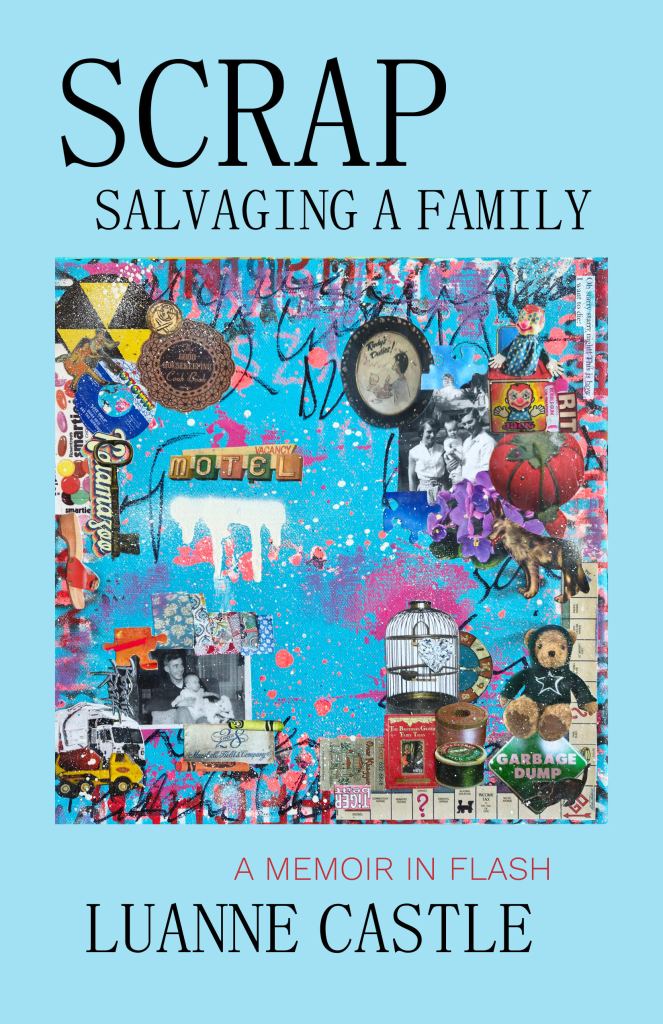
For my book Scrap, Grandma will be a minor character.  For my life, she’s been a major character.

So for today’s post, I am going to re-post a piece I posted about her on my family history blog The Family Kalamazoo.  It was called “Who Put the Ring Stain on the Scrapbook.”

00000001This is the scrapbook which my parents gave to me.  In it my grandmother (Lucille) Edna Mulder (later Edna Zuidweg) recorded the events of her high school graduation from Caledonia High School (Michigan), as well as a few clippings from her first year at Western Normal School in Kalamazoo.

In 1929, my grandmother graduated a year early, at age seventeen, along with her older sister Dorothy Mulder (later Dorothy Plott).  Grandma earned the 3rd highest GPA at 93.85% and thus was honored with the title “class historian.” Her sister was salutatorian. Grandma’s best friend Blanche Stauffer was valedictorian. Clearly, grades were not inflated in those days at Caledonia High School.

Grandma was the 2nd oldest girl in her family of three girls and two boys. When I was young and reading my mother’s copy of Little Women, Grandma told me she always thought that she was just like Jo, the 2nd oldest and the writer of the family.  Her sister Dorothy was Meg, and her younger sister Alvena (called Vena, later Vena Stimson) was Amy.  It makes sense to me that “Jo” would have been placed a year ahead so she could go to school with “Meg,” and that she would earn class historian to her sister’s salutatorian.

Salutatory

The scrapbook contains wonderful photos of Grandma, her friends, classmates, and teachers, but it doesn’t solve the mystery of who put that drinking glass ring on the cover.

9 Comments

Filed under Creative Nonfiction, Memoir, Research and prep for writing

My Practical Father (Not Always)

My father was born in 1928, and the memory of the Depression is imprinted on his decision-making.

When he has a color choice, he goes with “brindle brown” because it’s practical and doesn’t call attention to itself.  Until I actually looked up this color, I thought it was a term unique to Dad.  And I figured it meant something like “shit brown.”  Now I see that it really means spotted or streaked like an animal’s coat or like the word piebald.  I suspect that my father’s meaning is closer to what I had originally thought, rather than a dog’s sleek brown fur.

I’ll go a step further and assume Dad probably picked up that term in the Army.  Since he was raised by a single mother, Dad’s true “finishing” came from his fellow soldiers in the Korean War.

Dad’s always hated the color black.  It’s impractical–shows dust and lint.  He doesn’t like lavender either.  His mother wore the widow’s weeds of black and lavender, so maybe there is an emotional terrain underneath the practicality.

When I was younger, men owned small leather grooming kits for travel.  They were sometimes called Dopp kits, although Dopp was a name like Kleenex, an actual brand name.  My father’s was brown, and if somebody gave him a black one as a gift, he wouldn’t use it.

His brief case was brown, not black.  So was his squeeze-type coin purse, back in the days when men carried those.

For the past thirty years he’s carried a brown leather magnetic money clip.

images (2)His belts are brown and not black.  And certainly not khaki canvas or burgundy leather and they don’t have a big turquoise-studded buckle.

My father looks practical and shops with a practicality born out of that Depression upbringing.

But don’t be fooled by how he looks.  When a friend or an acquaintance would show up with something to sell, Dad would buy it, no matter how impractical.  He bought things like:

  • An old non-working violin he was told was a Stradivarius (it was not)
  • A silk Oriental rug (beautiful, but impractical)
  • An old motorboat much too heavy for the motor that fit the boat (it never worked right, but I was still light enough that I could water-ski slowly off the back of the boat)
  • An abacus when I started 4th grade (so I could do division on it)

You get the idea.

###

My dad is sick in the hospital right now, and the doctor isn’t quite sure what’s wrong.

###

Do any of your characters (or real life relatives) contain contradictions?

18 Comments

Filed under Creative Nonfiction, Memoir, Research and prep for writing

10 Areas for More Research

February is almost up, and I still have much left to research for my book.  I’m feeling a little overwhelmed by it all, so I thought I would sweep the rest into a list and gradually make my way through it this spring.

These are some remaining areas for research:

Contemporary photo of the junior high I attended

Contemporary photo of the junior high I attended

1.  Collect photographs of the buildings of my life: houses we lived in; schools I attended; places I went to for extracurriculars, such as the library, art center, and ballet studio; local parks; my great-grandfather’s farm; and stores, malls, and shopping centers.  I felt that this stuff would be readily available, but the truth is I’m  having a difficult time finding the majority of this material.

2.  Draw “blueprints” of our houses

3.  Glue several photographs of each main character on character boards so I can see the evolution in looks/aging and fashions and hair styles for each character.  For my grandmother’s life before I was born, search for fabrics such as she wore

4.  Draw maps of each neighborhood I lived in

5.  Study more about the trash industry in the sixties–teepee burners, city dumps and landfills, scrapyards and junkyards

6.  Study more about German immigration to the Chicago area in 1890s and the situation of German immigrants in Chicago and its suburbs through WWII

7.  Collect photos and research telephones, TVs, and radios we used over the years.

8.  Same as #7 for our cars and trucks and boats.

9. Research an area of interest for each main character.  For example, for my grandmother it could be sewing or clothing design.

10. Research all the little weird things that my kids wouldn’t know about.

 Examples include Fizzies soda tablets which we melted on our tongues

and rat fink rings

If you’re wondering how I plan to use the results of my research, I hope it will do double duty.  For example, research stimulates my memory.  When I see a photograph of a place I used to know so well, I think ahah, right, now I remember that window was there to the left of the door.  The other benefit of research is to check my memories to make sure I remember things accurately.

###

What research, if any, do you do for your writing?  Do you have ideas for new research?

5 Comments

Filed under Creative Nonfiction, Memoir, Research and prep for writing

Cold War Toys

In my last post, I talked about the bomb shelter my father built in our basement.  Every time I walked down the wood plank steps to our basement, I slammed right into the Cold War because the closed door to the shelter was located at the bottom of the stairs.

During this time, the majority of television shows I watched were some form of Western.  Cowboy shows.

You know what that means.  Guns on TV and toy guns in the neighborhood, the stores, and yes, my house.

I don’t think it’s any coincidence that the Cold War and guns went together.  It seemed acceptable that the cowboys had guns to protect themselves against the bad guys who also had guns.  And it seemed imperative that the homesteaders had guns to protect their families and property, just like we had the Bomb Shelter in our basement with the shotgun and . . . oops, I guess I forgot to mention that in the last post.

According to Shadows of the Past website, from the 1940s to the 1990s there were 145 different Western shows on TV.  An enormous number of these were in the 50s and 60s.

Clayton Moore

Clayton Moore (Photo credit: twm1340)

My early favorite was The Lone Ranger (I suggest you read the section in this Wikipedia article about the code of conduct by Clayton Moore and Jay Silverheels) which I eagerly awaited in reruns every Saturday.  However, there was another show which began the same year (1949) and didn’t last as long, but had an enormous influence on early fifties culture.  That was Hopalong Cassidy, a “good” cowboy who dressed all in black, giving the lie to the popular notion that only the bad guys wore black.

According to Wikipedia:

The enormous success of the television series made [William] Boyd a star. . . .  The series and character were so popular that Hopalong Cassidy was featured on the cover of national magazines, such as LookLife, and Time.[2] Boyd earned millions as Hopalong ($800,000 in 1950 alone),[2] mostly from merchandise licensing and endorsement deals. In 1950, Hopalong Cassidy was featured on the first lunchbox to bear an image, causing sales for Aladdin Industries to jump from 50,000 units to 600,000 units in just one year. In stores, more than 100 companies in 1950 manufactured $70 million of Hopalong Cassidy products,[2] including children’s dinnerware, pillows, roller skates, soap, wristwatches, and jackknives.[5]

Like other children of the fifties, I had a Hopalong Cassidy costume.  Mine was a cowgirl outfit, all in black with white plastic fringe.  It came with a cowboy hat and a hip holster and pistol.  I cannot remember if the holster was doubled sided for two guns or was only one-sided.  I don’t know where the costume came from as I remember it being an important part of my play attire from my earliest memories.  I regularly wore it for play until it eventually wore out.

I had a feeling that my parents were hoarding photos of me in this costume, and I was contenting myself with snooping online for other kids in their Hopalong Cassidy costumes (I found two young cowgirls), when I happened upon a photo of me in my costume.  And it’s exactly the way I remembered it.

The jack o'lantern in my hands confirms that I got this costume for Halloween

The jack o’lantern in my hands confirms that I got this costume for Halloween

I’m not cropping the above photo because I want to keep it for interior details about the period.

My friend Mark who lived next door used to play Cowboys and Indians with me.  We argued over who had to be the Indian because everybody knew the Indian couldn’t be allowed to win (me being sarcastic).  I had an edge because of my fringe, my brimmed hat with chin string that could be tightened, and my six-shooter.

A change that occurred . . .

Item by item, my Hopalong Cassidy outfit wore out and disappeared from my life.  As it did, I grew a little older and wasn’t as fascinated by the Cowboys and Indians game as I once was.  However, when I was with my cousins, who were younger, we did play.  I remember by then wanting to be the Indian because I could be “different” and use a bow and arrow.

My "bible"

My “bible”

By the time I was nine, playing at being an “Indian brave”* had become an obsession, resulting in me studying my “bible,” the Grey Owl catalog of “Indian supplies,” and spending my extremely limited spending money, earned by doing chores,  on  beads and a purse craft kit and “oxblood” skin paint.

By then the dark and dank feel of the Cold War had become for me the shining Space Race.

* Note: yep, I’m aware of the pitfalls here of using the terms “Indian brave” and “Indian” by today’s standards.  But I’m talking about 1957-1964.

19 Comments

Filed under Creative Nonfiction, Memoir, Research and prep for writing