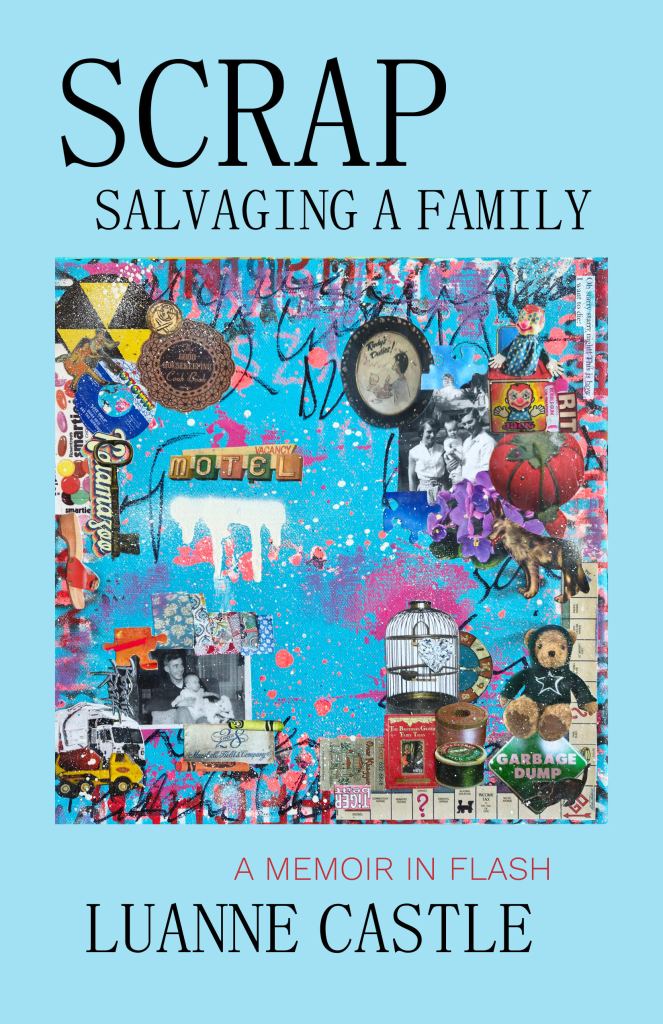
If you haven’t read Scrap: Salvaging a Family I hope you will. And if you have, I hope you like it and will share with others who might like it or find it helpful, especially with generational trauma, family dysfunction and abuse, or writing outside the boundaries of genre.
If you’ve written a review for Scrap and are on BookBub, the book will show up there soon–it’s pending approval. I’d appreciate it if you could copy your review over there!
Years ago I was writing posts inspired by the Dawn Raffel book The Secret Life of Objects. My magical music box, one of the objects, has shown up in Scrap. I still own it, too! Actually I wrote about it twice on this blog. The first time was to introduce the music box. At that time I didn’t know what music it plays. The second time was after I discovered the song it plays: La Paloma.
You know what I just realized? I’ve never let Hudson hear or even see the music box. He spent the night last weekend and then was here all day yesterday because school was closed. He’s almost 2.5. Can you believe it?!
I’ll have to share the music box with him. He loves music, and I want him to experience it as I did.
Yesterday we went to storytime at the library (lots of exercise for Grandma as story is more like “story” called movement), got lunch with chocolate milk, swam (with Grandpa), played with Mickey Mouse playdough (his favorite character is not the usual for kids today–it’s Minnie Mouse!), played the piano, and painted. Of course painted. He insisted and kept bringing it up. He paints with acrylics on canvas so it’s quite a mess. But another beautiful painting was added to his portfolio.
Like so many, I feel a real affinity for the poetry of Sylvia Plath. She’s my favorite poet as Shirley Jackson is my favorite prose writer and Remedios Varo is my favorite artist.
For my MFA explication I wrote about the Plath poem “Fever 103.” I still love that poem which so well captures that feeling of having a high fever without really talking about fever or being ill.
For my PhD dissertation, each chapter was focused on one female poet and one type of identity. For my Plath chapter I wrote about performing gender.
Later, when I began to write more poetry, I could feel the influence of Plath’s poetry on me.
Most inspirational for me was how candid and direct her poetry sounds. And under the surface, I suppose, was her search for who her father was and how he connected to her. These features really guided me in writing Scrap: Salvaging a Family. But they also helped in creating this collage for Raw Lit, Issue 9. The Making of a Daddy which relies upon the imagery from two poems Plath wrote about her father: “Daddy” and “The Colossus.”
***
“Spare, precise, and quietly devastating, this is the kind of memoir that stays in the body long after the reading is done.”
That’s what the editorial review at The Book Review calls my memoir.
“Her prose has the economy of a poet who knows exactly which word is doing the work and which ones can be cut. She has a remarkable ability to locate enormous emotion inside small, specific objects and moments, a trait that is genuinely rare and that gives the book its distinctive texture.”
Sorry if I split your eardrums ;). Scrap: Salvaging a Family is a Finalist in the Next Generation Indie Book Awards.
I think it’s very interesting that another of the memoir finalists is Deborah Sosin’s book Escape Velocity. She wrote it in 70 70-word memoir pieces. So that makes two finalist books that were heavily influenced by flash/micro writing. It would be interesting to look at memoirs from previous years and see if flash or micro popped up in that field. I kind of doubt there was much.
Just ordered Deborah’s book!
Remember that if you want to order an ebook of Scrap, it needs to be through the publisher, not Amazon. You can get a paperback either place.
Last night the gardener and I got back from visiting my mother in Michigan. As soon as I pull it together and maybe get a little sleep, I’ll letcha all know how it went.
Good news for some, especially if you live outside the United States! SCRAP is now available as an ebook on the publisher’s website.
The grass on the ground shows me that this was taken years after we first moved to the lake for the summers. I think this was when the cottage was finally demolished.
Lavender Orchids has published a review on Instagram. Here is the start of it:
###
A copy of the newspaper we received at our home about President Kennedy’s assassination
President Kennedy’s assassination was the biggest news of my childhood and happened when I was in third grade. It’s the one event that touched the lives of every child. In my case, we got let out of school early, but didn’t know why. I remember waiting outside for the school bus, wondering what in the world was going on.
On the bus, we got the scoop from the oldest boys on the bus, the older twin brothers of my friend Vivian. They had a transistor radio and were listening to the news. I could see from their excited faces that they loved being the ones to share the awful news with our tender little minds and hearts. After all, they were in SIXTH grade.
At one point in Scrap: Salvaging a Family, I tell the story of what happened when I got home that day, as well as what happened to me on the day of President Kennedy’s funeral.
Lion Scream by Robbie Cheadle is not a poetry collection or an expository nonfiction book about African animals. It’s not a memoir of personal encounters with wild animals or a picture book of animal photography and video links. The book is not a cautionary tale about the harm that humans are doing to our world’s animal populations. At least, it’s not just any one of the above—Lion Scream is all of these at once and is the most important book I’ve read this year.
By writing this book as an interactive casebook, alternating various approaches to the subject of wild animals and mass extinction, Cheadle grabs and holds the reader’s attention. She structures the book by the multitude of animals found in South Africa, from dung beetles to hippos. Within each short section are various brief approaches to the subject. Sometimes a poem that might be written “in character” as an individual animal introduces the topic and is followed by a knowledgeable description of the animal, its habitat, and some unique features.
In this way, I learned so much that I did not know. For instance, cheetahs are the fastest land animals in the world, but there are only 7,000 of them left in the wild! And a real dilemma is that they are in great danger in protected lands because they are prey to lions and other animals. Still, in unprotected land, they are under threat from the most dangerous, worst animals on the planet—humans. Likewise, I learned that wild dogs are very endangered animals. Cheadle says leopards are already “extinct in 67% of the country.” The information includes details such as that female hyenas have a penis-like appendage, and sometimes their babies suffocate in the birth canal. In addition, the female and infant hyenas eat before the males.
Underlying the book is a premise that makes this such an important book: we live in a time of the Sixth Mass Extinction. A mass extinction is when a large portion of biodiversity dies out. Natural events have caused previous extinctions, but the Sixth Mass Extinction is caused by human activity. If we think of what is happening with so many species endangered or becoming extinct in this long-view lens, we can see that this is a huge subject and one that we all have a hand in. If we are causing it, we ought to be able to fix it. The time to change this trend toward extinction is yesterday, but since we’ve already gone past that, it’s NOW.
Cheadle concludes the book with a short story, “The Nutcracker,” about a girl with extreme anxiety and depression over the Sixth Mass Extinction. The story is well-told and thoughtful. But Cheadle’s analysis of the story that comes afterward is particularly fascinating as both a push to the reader to read deeply into the story and as a summary of the importance of the book itself.
I am so glad I read this book, and now I want to make some changes in my life!
You can purchase Lion Scream at Amazon in either paperback or Kindle version. Note that there are photographs and links to videos in the book. I hope that will help you decide which version to go with. Here is the link: LION SCREAM AT AMAZON
I discovered Robbie because I started participating in Colleen Chesebro’s #TankaTuesday syllabic poetry fun, and I am amazed at all Robbie’s talents. In addition to being a prolific writer and baker/cook, she is a beautiful artist as well. Robbie is also a generous spirit to the blogging and writing community. That she also has published this important ecobook in an effort to help save the planet really warms my heart. Thank you, Robbie!
ROBBIE CHEADLE’S BIO
Award-winning, bestselling author, Robbie Cheadle, has published thirteen children’s book and two poetry books. Her work has also appeared in poetry and short story anthologies.
Robbie also has two novels published under the name of Roberta Eaton Cheadle and has horror, paranormal, and fantasy short stories featured in several anthologies under this name.
The ten Sir Chocolate children’s picture books, co-authored by Robbie and Michael Cheadle, are written in sweet, short rhymes which are easy for young children to follow and are illustrated with pictures of delicious cakes and cake decorations. Each book also includes simple recipes or biscuit art directions which children can make under adult supervision.
Robbie’s blog includes recipes, fondant and cake artwork, poetry, and book reviews.
My mother gave me my baby book which I have started to go through. I found a photo in it that I have never seen of the person who was my favorite when I was a kid: my maternal grandmother. In this image I am 20 months old. I also read in the book that for my first week of life Grandma and her other daughter, my sweet Aunt Alice, stayed with my parents and helped take care of me. She was the best grandmother anyone could ever have. The grandmother poems in Rooted and Winged are about her.
For months now I have been writing this post in my mind. The reason is that the post is meant to help clarify my thinking about a matter.
I grew up in an era where people still believed that it was important to “pull yourself up by your bootstraps” and to “put a good face on.” I also like to be seen as strong or even tough. Most importantly, there are always people worse off than ourselves. Some people have such horrible “roads to hoe” in life. It makes me cry to think of what some people go through.
Further down there is going to be a “but.”
Without boring you with too many details, underneath a lifetime of many and varied illnesses, I have a few chronic conditions that are a bit extraordinary. One of these is primary congenital lymphedema, particularly in the lower extremities. It’s what used to be known as elephantiasis.
Additionally, I have a migraine disorder that for the last 25 years has not (for the most part) been headaches, but a sudden and extreme set of symptoms. Because the symptoms didn’t fit neatly into a specific type of migraine, I was told they were “complicated migraines.” Most recently, the diagnosis is that I have genes for more than one rare type of migraine—and that they work together to give me symptoms of more than one disorder. Most likely these are vestibular and hemiplegic.
An extra issue in the mix, and I’ve written about this before, doctors at Mayo Clinic discovered that I had a very rare tumor in my right foot (rare meaning at that time medical staff couldn’t find any medical literature of a tumor in that particular bone). This was a nightmare that went on for 1 1/2 years and was complicated by my lymphedema. There were only two surgeons in the United States that Mayo considered competent to do surgery on this tumor, and it was performed by the AMAZING Dr. Eckhart at UCLA orthopedic hospital (RIP to a wonderful person and doctor). Five years after the surgery, he told me he never thought the surgery would work but he watched over me so carefully. Since the surgery I am not allowed to run, jump, hike, or do most aerobic activities.
I write about these details to give a little context. Back to putting a good face on and all that. Because I am a writer and keep up with current events in the writing world, I am more aware of new ways of thinking about things than I might be if I weren’t writing and especially reading new work. My view of myself that I have had my whole life has been as a blessed person–certainly privileged in many ways–and that I needed to stay tough and “power through” everything and then set it aside. Another way of putting it is to say burying it down deep. Perhaps what best fits is that I never made space for my health issues. I let everything else in my life intrude and take over the space they needed.
But (I told you there would be a but!) reading young writers, I am beginning to change my view of myself. I am disabled. Any time I go out I must have a hat and sunglasses with me for lighting situations (migraine trigger). I can’t go to concerts or sports games because of flashing lights. I can’t travel alone because it’s become too dangerous with the migraines which occur in a moment and are completely incapacitating. I must bring my lymphedema pump with me to travel–as well as lots of other things for the condition, and it takes a lot of time and energy every day. Most importantly, lymphedema affects much of the rest of my health, and as I age (arthritis and other deteriorations, for instance) it will become more and more of a problem.
So, while I have no ridiculous illusions that my situation is comparable to the tragic illnesses of so many others, I am finally realizing that disability has nothing to do with comparison between one person and another. And it isn’t negative or counter-productive for me to finally understand that it’s ok to admit that I am disabled, that it’s just a useful way to communicate with others. If people don’t realize that I am disabled, how can they be supportive?
I wish I had had this epiphany years ago when my son was still young. He has an exceedingly rare disorder that doctors misdiagnosed for decades. It’s so rare that in the NORD (National Organization for Rare Disorders) list it is lumped in with other disorders and diseases instead of being listed separately. At the most, only a couple thousand people in the U.S. have his disorder. The reason it’s important to note the rareness is because the less others know about your disability, the less helpful they are–even if they want to be!
You see where I am going with this? If I had been better about making space for my disabilities, it might have been easier for my son with his own situation. It’s hard enough when people see you from the outside and say, “Oh, it’s not such a big deal,” with absolutely NO understanding of what it’s like to live that life. So, while the gardener and I always respected the importance of his disorder (which I first noticed when he was nine months old, and the pediatrician practically laughed at me), we didn’t teach him to make space.
Now I see everything differently.
Have you ever had a big shift in how you viewed yourself?
OK, ending on something a little lighter. Perry is very unhappy about the cane I’ve been using since I injured my knee more fully when I got home from Michigan. Yesterday, I was walking in the living room, and Perry came up from behind and crashed into the cane, forcing me down on the bad knee. Yes, it hurt like heck, but it was funny, too, because what cat does something like that? A dog might do that if he’s frustrated enough. But Perry was just being Perry! And then we had the hugging session afterwards where he apologized to me! Sweetest, funniest little goober.
Artist Kelsey Montague has painted art wings all over the country (and elsewhere). One of her murals is at the Fashion Square Mall in Scottsdale, Arizona. When my daughter and I had lunch at the mall, she took my pic with the wings to celebrate the 2022 publication of my poetry collection Rooted and Winged.
The poems of Rooted and Winged explore the emotional and physical movement of flight and falling. They are of the earth, the place of fertile origins, and of the dream world we observe and imagine when we look upward. Golems and ghosts that emerge from the ground, as well as the birds and angels that live above us, inhabit the collection. We will always be striving for flight, even as we feel most comfortable closest to the earth.
There are poems about Arizona, California, and the lakes of Michigan. My maternal grandparents are the characters that most inhabit this book.
The poems of Luanne Castle’s Rooted and Winged are embedded in land and weather. “Bluegills snap up larvae in slivers of illusory light,” she writes early in the collection, hinting at the sensibilities of the companionable speaker who will usher us through the book.
Six years ago, I published a piece of flash fiction at The Story Shack called “Parking Lot Superhero.” I posted a link on this blog and yadda yaddaed about fiction giving me more freedom for structure. The story was one of the first flash pieces I wrote.
Here’s a confession. I don’t even know why I wrote that about freedom because the truth is that this story is completely true except for the names. So maybe the freedom actually came from changing the names. And by changing the names I was able to change the structure and how I ended up structuring it made all the difference. So, yes, I submitted nonfiction as fiction by changing the names.
This story is not one of my most well-written (and at some point I might revise it), but it’s still one of my favorites because the hero of the story (not me) was such a larger-than-life character in real life.
Going back to my title–Is it Real Life or is it Fiction?–maybe fiction is often real life, just many different aspects of real life glued together in a different combination and order.
One more thing. Why did I want to come clean about this story being true? Although I published it as fiction to protect “Jack” and his family story, I have felt guilt at not giving him credit for being a hero. I still won’t publish his name, but I feel better letting you know that he is a real living hero.