Tag Archives: Family memories

Exploring My Hometown

After my visits to Sedona and southern California, I traveled to my hometown in Michigan and just got back yesterday. I’m sorry I’ve been slow to respond to blog comments and am behind in my reading. I didn’t want to post online that I was going away, so I couldn’t warn you that I would be taking longer to reply. What an exhausting trip. My parents have moved into a retirement community and are putting their house up for sale. Lots of stuff going on, and it’s been difficult for them.

But what a beautiful time of the year to visit Michigan.

In the city

In the city

Hard to believe such a lovely spot on private land is visible to the public.

The blocks below are from the old synagogue that no longer exists. They have been erected at the site of the current synagogue.


The “cathedral” still towers over the highway, I was relieved to see. I never attended services there, but we did hang out on the grounds after football games.


It was fun and a little stressful visiting the old haunts and houses.  Meeting my new great-niece for the first time was best of all! She’s as cute as a bug’s ear. I don’t want to post her photo because she’s not my child, so I don’t think I should make that decision. But trust me: you can’t find a cuter 6-month-old anywhere!

As we drove to the airport out of town, we passed by Amish and Mennonite farms.


This week, I plan to catch up on my blog comments and, especially, reading your blogs!!!

50 Comments

Filed under Creative Nonfiction, Essay, Memoir, Nonfiction, Photographs

A Woman Who Can’t Be Categorized

Paula Fox can’t be categorized–at least, not by me. She’s won awards for her children’s books like One-Eyed Cat and The Slave Dancer. 

I’ve taught both these books. One-Eyed Cat is a particularly wonderful book which examines the complexity of emotions like remorse and guilt.

But she’s not “just” a YA or children’s author. She’s been called the greatest writer of novels for adults by Jonathan Franzen (read here), but I can’t vouch for those as I haven’t (yet) read them.Desperate Characters

She’s a memoirist, but I’m not sure Borrowed Finery (one of her two memoirs) is a memoir.

Borrowed Finery


I just finished reading the book last night. What a life! I was enthralled, following the details of Fox’s life, as she was moved about from person to person, city to city, even living in Cuba for a year and a half. Fox is 91 years old, and the book takes place up to the point that she is 21 years old, except for a short section at the end, so the book is not an exhaustive autobiography–probably why it’s called a memoir. Nevertheless, it didn’t feel like a memoir. There wasn’t a strong MDQ driving the book. Occasionally,  it is even anecdotal. That said, I was fascinated, both by the events and by her exquisite sentences.

Her mother abandoned her at birth; she was a cruel woman who seemed to blame infant (and child) daughter for the loss of her “spring.”  Her father and mother were married, and the father complied with the mother’s wishes. He also seemed to be quite cruel and a severe alcoholic, although as a child Fox was obsessed with him. One of the first times Fox was with her parents, they asked her to order from room service. When the meal came, she realized she had forgotten to order milk and mentioned it. Her father took the tray of food and threw it out the window.

Many people are familiar with some basics of Fox’s life. For instance, when she was 21 she gave birth to a baby girl. Linda was the result of a one-night stand, although Fox had already been married to someone else. Fox despaired of being able to take care of her daughter and gave her up for adoption–only to almost immediately change her mind. She was told it was too late to change her mind (it wasn’t). Eventually, Fox was reunited with adult Linda and they have a good relationship. Linda is the mother of three daughters. Two of the granddaughters Fox has a great relationship with. The other granddaughter through Linda is Courtney Love, who Paula does not think is a good person. It does make me wonder if Love inherited a gene passed on to Linda from Fox from her own horrible mother.

Although I know that an unknown writer can’t publish a memoir that relies on chronology and anecdote in the way that Fox’s can, I did learn many things from her book. Just soaking up her elegant phrasing makes me aspire to write better. Then I also saw that she easily moved forward in time when she wanted to “tie up” an anecdote. With her graceful style, I really had to pay attention to even notice such a move.

One of the hallmarks of memoir is the double eye–the protagonist at the moment the events occur and the older, wiser protagonist reflecting upon those events. In that respect, Fox’s book is a stunning memoir. In one scene, her father spanks her for coming into her parents’ bedroom. In reality, he’s upset that she saw him with another woman in the bed. The African-American maid speaks up to defend Fox.

Years later, when I thought about her–and I thought about her often–about how much she had had to overcome in the way of an enforced and habitual discretion, how a sense of justice in her had outweighed the risk–I realized how brave she had been.

If you prefer books with a strong and fast-paced through-line you might find this book too lyrical. But if you’re willing to sit down and let a writer with a perfect sense of timing guide you, you will appreciate the story of Fox’s early life.

26 Comments

Filed under Book Review, Books, Creative Nonfiction, Interview, Memoir, Memoir writing theory, Nonfiction, Vintage American culture, Writing

One Naughty Rabbit

It’s that bunny time of year! Every time I step outside I disturb a young rabbit feasting on my plants.

This slideshow requires JavaScript.

I’m going to take you back to 1959 today. (Yikes, how did today get so far away from then?) I have a certain quantity of very clear memories from the age of just before two to age four. This event happened in the spring, about three or four months before I turned four.

What I am searching for today is why this is one of those important early memories.  According to  Sven Birkerts, we have memories which are involuntary.  Memoirists, he argues, “need to investigate why a particular memory of a seemingly meaningless moment has such power that it still calls to us through decades.” I wrote about this theory when I first started this blog in a post called “Breaking the Codes of Childhood.”

My parents took me on a trip far from our Michigan home–to New Orleans. On the last day, we went on a boat ride along the Mississippi River. In the restaurant, the ship’s captain introduced himself to me, then hoisted me up and tousled my hair. He placed his captain’s cap on my head. The hat fit me perfectly.

Maybe it was not really his hat, but one he meant to give me all along, like a souvenir. He and his men fussed over me, and I thought I knew what it felt like to be a princess.

Mom and I went for a walk on the deck. Somehow my thin summer coat sailed over the side of the ship into the giant net that encircled the craft. Sailors tried to fish out the jacket, but they couldn’t reach it.

“Lulu, you need to learn to be more careful,” Mom said.

I hung my head. “Peter Rabbit.”

“What?”

“Peter Rabbit lost his jacket.”

Mom said, “Yes, you lost your jacket just like Peter Rabbit. He’s a naughty rabbit.”

I stood at the guard rail and stared at my little blue jacket, so recently wrapped around me, lying forlorn in the netting, so close and yet unreachable.

Peter’s jacket ended up as a scarecrow, whereas mine became fish bait

Why do I remember this memory so often? Any ideas?

* At home I had a 45 (record) with a narration of Beatrix Potter’s “The Tale of Peter Rabbit,” so I was very familiar with the story.

65 Comments

Filed under Creative Nonfiction, Essay, Memoir, Memoir writing theory, Nonfiction, Research and prep for writing, Writing

The End of a Special Time

My daughter leaves for her home today. She’s been with me for the past few months because she was performing in a show at a regional theatre here.

I don’t want her to leave. She’s a calm, generous spirit, and it’s been such a pleasure to spend time with her. We’ve done things I would never have done if she wasn’t with me.

We cleaned some dandelion greens . . .

and made a tart.

She scanned old family photos for me.

Ten years ago her paternal grandmother passed away on my daughter’s 16th birthday. As we went through a few of Grammy’s belongings, my daughter selected a vintage 1960s Le Monde bracelet watch to remember her by.

This slideshow requires JavaScript.

And I went to see my daughter’s show. A lot.

This was a little souvenir. Can you tell what show she was in?

58 Comments

Filed under Memoir, Nonfiction

Growing Up in Lake Country

Growing up in Michigan meant that I was always figuring out how to make decisions. And they all had to do with water. That’s because Michigan has over eleven thousand inland lakes, which means that each of the 83 counties has an average of a dozen lakes within its boundaries.

Kalamazoo County, where I grew up, has at least sixteen lakes. These aren’t cheesy reservoirs, like they have out west where I now live, but natural incubators of minnows, weeds, and snakes.

In the summer, I had the option of whether to be in or on the water. On the water meant sailing our little Sunfish, paddling the rowboat, driving the used and very rigged-up faded red motorboat with the too-heavy motor, or flying behind said motorboat on my water skis (the rare times I could pretend to some athletic skills).

Since I was a girly girl, for the most part, I usually had to have help sailing, paddling, or driving any of our boats. Therefore, on the water ended up meaning setting up my chaise lounge on the dock, covering it with a beach towel, and flipping open a book.

Young teen me on the lake

Young teen me on the lake

In the water meant floating around on some kind of well-worn flotation device, too lazy to get out, and becoming waterlogged in the process. This could be accomplished out past the weeds, but we were on the shallow, swampy side of the lake, and not too far out there was a large plateau of shallow water, lily pads, and bullfrogs. And other creatures as yet unknown to humankind. Therefore, I didn’t actually go in the water very often.

If I did decide to enter the water, I had to plan it out. Sometimes I’d walk slowly into the water. Depending on the weather, I’d do this either to get used to the cold or to luxuriate in the balmy water cooling my over-heated skin. This now brings back memories of stepping onto the lake bottom, its wet sand massaging my feet when I dug my toes in.

No, wait. I’d forgotten how we got such a smooth lake floor. It’s coming back to me now. Dad used to put me to work with a hoe summer mornings, and by lunchtime my back would be temporarily bent over and painful if I tried to stand up straight. He did plenty of hoeing himself, too, but much of the time we had to reach down closer to the roots and yank with our hands. I’d come up snorting water out of my nose and tossing back my wet hair so I didn’t have to smooth it with my hands which were slippery with weed-slime.

To enter the water for fun instead of work, instead of wading slowly, I’d cannon ball off the dock into the deep water with my head tucked so that the water didn’t blast into my skull. Then I’d swim to the old raft which floated atop four watertight barrels. From there, I could stay clear of the majority of greasy weeds.

The next decision I would over-think—and this only happened when I actually did get over my squeamishness with the weeds and the animals flitting past my toes underwater–was how best to haul my soaking wet self out of the lake, heavy water sloshing out of the seat of my bathing suit, threatening to take the bottom half of the two-piece off with it, and how fast I could scramble for a towel to get warm and not end up with skin like a plucked chicken.

It’s amazing that there was yet another decision after my ambivalence with our marsh-called-lake. I had to figure out how to make it through the winter when the lake had semi-frozen into a giant Icee. Come the first thaw, we would head out to the lake. No matter that we were still wearing jackets, no matter how many mosquitoes had sucked my blood the summer before, no matter how many water snakes I’d witnessed peeking their heads above the water line like miniature Nessies, I always wanted to go back.

Do you have any water memories from your childhood?

42 Comments

Filed under Creative Nonfiction, Essay, Memoir, Nonfiction, Research and prep for writing, Vintage American culture, Writing

Who Came Calling?

I’m not writing an autobiography or my “life story,” but the memoir story I am telling about our family does criss-cross my entire life.

It’s a different mindset to write about more recent times than it is to write about my childhood. For childhood scenes it helps to get myself back in that time by looking at artifacts from the period.

Occasionally, I brainstorm about objects and odd unimportant memories just for this purpose.

Recently I’ve been thinking about the men and women who came to our houses with the purpose of delivering or selling.

When I was in junior high my grandmother was still getting deliveries from Lockshore Dairy. The milk man would drive up very early in the morning and put the milk and cottage cheese and butter in a silver box on Grandma’s porch. Eventually, the company stopped making deliveries as home delivery and home sales were beginning to become old-fashioned.

In the way that sometimes old becomes new again, when my kids were little and we were living in California, I was able to order dairy delivery from Alta Dena!

When I was younger than nine, we were visited regularly by the Fuller Brush Man. If you click on the photo, you will find an article that describes how the company, after being in business for over 100 years, went Chapter 11 last summer. We bought cleaning supplies, as well as brushes from him. He didn’t look handsome and spiffy like the man in the poster; he was more sad and harried looking. Maybe if he had been younger he would have been more eager, but I can’t say he didn’t try to be enthusiastic about the products in the gigantic suitcase he hauled around with him.

Fuller Brush Man

Our Rexair vacuum was purchased from a man who came selling them. He spread his products out in our small living room and showed my mother how to vacuum up dirt without a bag in the vacuum. The dirt went into a pot of water at the base of the vacuum. Although we barely had any furniture and we didn’t have wall-to-wall carpet, she bought it! 

The Avon Lady still visited when I was in high school, but soon after that, Avon began to be sold through other methods than door to door sales.

There were various other people who came to the door, such as men offering to sharpen our knives and scissors.

Now when somebody rings my doorbell unannounced, I try to peek and see who it is or I just ignore them. What if they are coming to tell me my house is on fire? Or that there has been a disaster and we must evacuate? It might be nice to be able to open the door to a stranger and invite him in so I can look at his wares. Or am I just being nostalgic?

###

On another note, I’ve written before about the angst I have over reading my poetry aloud. A new issue of TAB: A Journal of Poetry and Poetics is out. You can read my poem “Vagrant.” Or listen to me read it ;).  Click the link if you’re willing.

73 Comments

Filed under Creative Nonfiction, Memoir, Nonfiction, Research and prep for writing, Vintage American culture, Writing

For the Birds

A year ago, I posted this piece about the place of birds in my life. I wonder if you have threads like this that run through your life.

I stand on a chair to reach my grandmother’s birdcage.  My dress and petticoat flip out in back, as I balance on my palms, my sturdy toddler legs straining toward the parakeet.  The parakeet contemplates my nose poking between the bars.  I want it to sing.  It’s all I want of this place, this apartment which rattles like death when the El rushes by. I think how much I miss my own home.  Unless the bird will sing.

Maybe it’s something that happened to me even before I was born.  I started reaching out for the word music with my baby fists, if only to rush them like a bottle to my mouth:  “Little Miss Muffet”; “See You Later, Alligator”; “A Fairy Went a-Marketing.” I recited and sang them repetitively—until my mother screamed at me to stop.  Even then, I slipped under the bed covers and sang “My bonnie lies over the ocean, my bonnie lies over the sea.”  My breath billowed up the sheet.

Only a fifteen-year-old can make the leap from puppy love to bird lover.  That’s what happened when I became fascinated with a boy with a bird’s name.  My girlfriend and I followed him oh-so-subtly-and-cleverly in the halls, only running into him “by accident.”  On the weekend I couldn’t wait for school to begin anew on Monday, so we went to the mall.  Woolworth’s had a department with birds in birdcages.  An arched cage so much like my grandmother’s parakeet cage held two lovebirds.  I paid $9.99 for the lovers.

When my husband and I got married in an ice storm, we drove from the hotel reception in a burgundy Marquise Brougham with a prayer on the dashboard.  Songbirds flew after us into the dark.  That’s the way I remember it.

I sat in Grandma’s old oak rocker, holding my baby son in my arms, murmuring:

Out of the cradle endlessly rocking,

Out of the mocking-bird’s throat, the musical shuttle,

Out of the Ninth-month midnight,

Over the sterile sands, and the fields beyond, where the child, leaving his bed, wander’d alone, bare-headed, barefoot

Whitman‘s poem managed something the others hadn’t been able to—it crept into my body, spreading out and occupying my flesh like a snakeskin it merely tolerated.  I still can’t get rid of it.  The poem and I battle inside like the gingham dog and the calico cat, but if it decided to leave, I’d be as empty as that snakeskin, discarded and colorless.  It’s a poem about a he-bird who loves and loses the she-bird.  Or it’s a poem about the curious boy who observes the bird and his troubles.  But really it’s about a rocking like the surging of the sea and the hissing and whispering and all manner of delicious delicacies of words and rhythm.

When my parents put Grandma in the nursing home, she had to leave her parakeet behind.  Not that yellow parakeet she had when I was a preschooler, but the green one she’d had since then.  Dad brought the cage to our house and put it in the family room where the bird could watch TV.  I kept changing the food and water, but the bird refused a single seed and died within a week.

Richard Siken told us wannabe poets never to write poems with birds in them.  “It’s been done to death,” he said.  I think he said that the bird as trope for poet was old after Whitman.  Or maybe he said before Whitman.  I went home and wrote a poem about Andersen’s Nightingale and the Chinese countryside and didn’t use the word bird.  That’s what you call a writing constraint.

We had such a problem with roof rats and teenagers.  The latter we knew would eventually move out.  My husband called in the pest control people for the former.  The man the company sent shuffled and mumbled, so we let him go about his business.  That afternoon my son ran into the house yelling his head off, and since he’s a mild-mannered young man, I scrambled to get to him.  He led me out to the back steps where three baby birds hung on a glue trap like Jesus and the thieves.  We poured a sort of holy kitchen oil to release them.  One had already died and a second stilled the instant it rested in my palm.  The third one regarded me with one black eye, vibrant as a drop of ink.  We hustled it to the veterinarian where the techs hustled it out of our sight.

My daughter writes songs that come out of her fully formed.  I don’t know how anyone can do that, but then she sings them and her voice sounds like warm magma flowing.  She sends me links to private songs on Myspace so I can listen before anyone else.

Over ten years ago cats started showing up at our house, looking for food and, later, shelter.  We only had a couple of dogs left.  The birds had departed long before for their heaven.  Now the cats outnumber the humans, and they think they have an equal vote.  They vote that anything with a fast heart rate can be considered prey.  So no more birds for our family.

This house in Arizona has a tile roof, and the pigeons think it’s a rocky hillside, like their homes before humankind. While pigeons have those pleasing round breasts and iridescent feathers like abalone, they excrete their body weight every day—and always from the eaves above my exterior doors.  I asked my neighbor to stop feeding the birds, but she doesn’t speak to humans.  We put up screens to stop them from roosting in the obvious places.  But a stubborn contingent stay put, and from my fireplace I hear them cooing.  My brown striped cat purrs on the hearth, in rhythm with the pigeon coos.

A young pigeon dances on my patio, with his wings akimbo across his back, like a child stuck in a shirt he’s attempting to put on.  Two adult pigeons watch from the roof.  I put him in a brown bag and drive him to the pigeon lady.  She has big man hands and examines him brusquely, but listens with her eyes closed, like a good doctor.  She says, “I’ve never seen this before.  It’s not a broken wing.  He’s twisted his wings together across his back, like you twist a twisty on a bag.”  She carefully and surely untwists his wings and puts them flat against his sides.  “I’ll keep him for the winter and release him in the spring when he’s healthy.”  I write a poem about the pigeon lady and through it she becomes a religious icon in my religion of one.

In the summer, I bring her another pigeon.  This one acts odd, walking around the yard, but only flying a few feet at a time.  She tries, but can’t save this one.  “He had an illness, and I don’t know what it was.”  She wants my permission to do an autopsy.  That’s the way she learns how to take care of the living pigeons.  When I hang up the phone, I can see through the window that another pigeon resting at the edge of eaves is breathing rhythmically as its body empties and fills and empties and fills in an unbroken pattern.

My grandmother outlived her parakeet in the nursing home for a year.  I told my parents that if she had had the parakeet in her room, she and the parakeet would both have lived longer, but they explained that she died of uremia from renal failure.  “The bird died because it didn’t eat, Luanne,” my mother said.  “Stop trying to connect things that are not related.”

###

In June, I wrote about the pigeon lady in another post. Birds and trees are two of my writing obsessions. When a motif turns up repeatedly on this blog, I can tell it’s another obsession ;). What are your obsessions . . . um, motifs?

42 Comments

Filed under Creative Nonfiction, Essay, Memoir, Nonfiction, Poetry, Writing

New Year’s Eve with My Dad

I first published this post last New Year’s Eve.  I’ve added an update at the end.

Although I rarely go to New Year’s Eve parties any more (cue: one big whine and then a hefty sigh of relief), when I was growing up NYE always meant parties.  My parents went to one or hosted one every year.

In the sixties, my parents held their parties in the basement of our house.  Mom draped a paper tablecloth over the ping-pong table and Dad stocked the bar he’d built in the corner.  He set up table games and placed ashtrays on every available surface.  When he dragged out the box with the hats and noisemakers and boas I scrambled to help.  My favorite was the noisemaker blow out.  When I blew on the pipe end, the little roll of paper unfurled with a sputtery raspberry.  The tin drums which spun on wind-up stems sounded a raucous blare, so Dad would grab one of those and twirl it.

In the kitchen, my mother made canapés and Chex Mix.  She refrigerated 7-Up and washed the “frosted” highball glasses. Gold leaves, which I was sure were 24k gold leaf, decorated the crystal.

These plastic clips identified which drink to refill: rum and Coke, Seven and Seven, etc.

These plastic clips identified which drink to refill: Rum-and-Coke, Seven-and-seven, Gin-and-tonic, Scotch-and-soda.

I’m not saying I was a snoop, but I could hear everything.  I could even see a flash of the neighbor’s shiny bald head or Dad’s hand dealing cards through the register in the floor right near my bed.  I sat on the floor for hours with my legs cramped up underneath me.

While I didn’t hear anything of particular interest, the social interactions between the adults—their jokes, the vibrations in their voices, the sudden bursts of laughter– kept me straining my hearing.  Dad’s loud, excited voice rose above the others.  Everyone else faded into a background buzz in comparison with him.  Dad was the life of the party.

For his 80th birthday I made him a video of his life, and when Dad saw himself on video, he said, “I didn’t know I was so obnoxious!”  I had to laugh to myself at that because it isn’t as if nobody has told him that over the years.  Mostly, though, his enthusiasm for having a good time has been infectious.  At eighty-four he still likes to stir things up.  I suspect he’ll be wearing a hat and sounding his noisemaker at midnight tonight in Michigan.

Dad is ready for the party!

Dad is ready for the party!

###

This year Dad is, of course, 85. I will be seeing my parents the day after tomorrow, so I can ring in the New Year with them just a tad late.

30 Comments

Filed under Creative Nonfiction, Essay, Memoir, Nonfiction, Writing

What Do Your Memories Look Like?

Maybe they look like scraps.  Mine do.

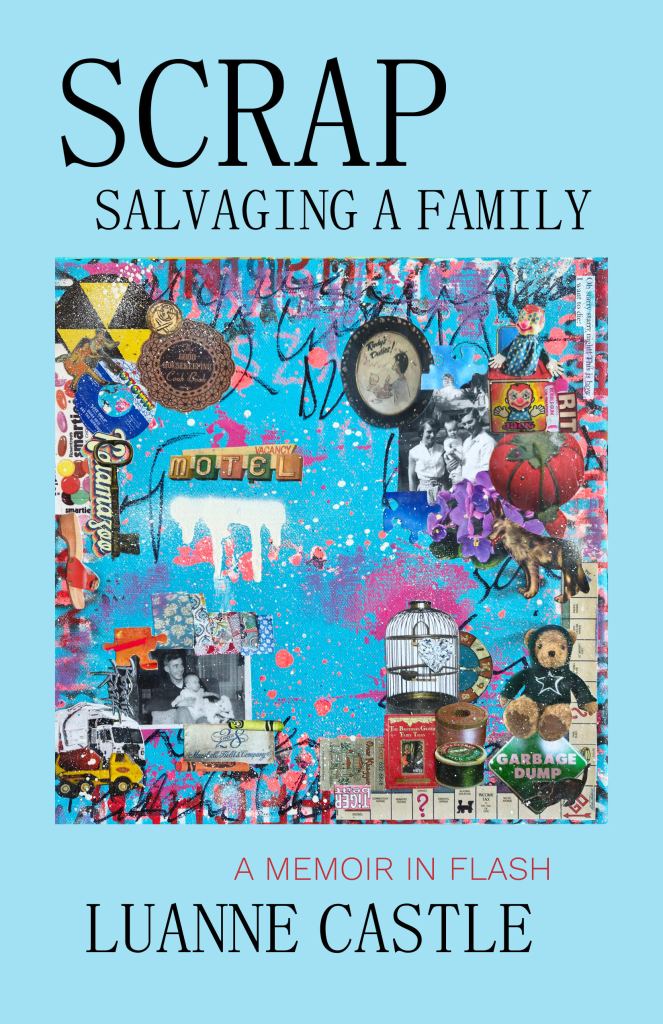
Have you found Anneli’s Place yet on WordPress? She showcases the work of writers on this site. She was so kind to showcase a little piece which introduces Scrap, the memoir I’m working on.  Please check out “Memory Patchwork” for an image of what structures my book.

And then drop over and read Anneli’s other blog, too: Words from Anneli.

13 Comments

Filed under Blogging, Books, Creative Nonfiction, Essay, Memoir, Nonfiction, Photographs, Vintage American culture, Writing

Honorable Mention: “For Ian”

For Ian

by Regenia Spoerndle         

The sun was shining, the birds were singing, the breeze warm, gentle and perfect. It was a take-your-kids-to-the-park-for-a-picnic kind of day, not a go-to-the-doctor-with-four-children-who-can’t-stand-waiting-rooms-any-more-than-you kind of day.  It was a summer day that begged changing goals, ambitions, and schedules into a book at the park and a nap. It was a perfect day. I didn’t know this was the day my son had died.

We drove to the doctor’s office. I read Doctor Seuss to children and People to me. They called my name. I shared a threatening look of discipline with the children, leaving them behind. I hoped the doctor would move quickly.

###

There’s a problem with the stethoscope. We’ll get the doctor. A distant fear creeping toward me ready to grab my throat and shake every fiber of my being until I no longer recognized life. I didn’t want to know this was the day my son had died.

Sometimes it’s just a game of hide-and-seek. Let’s look again. A grimaced face, furrowed brows, and deep sadness in his eyes–unprofessional, but compassionate. A knock at the door. Your children miss you; here they are. Six people in a room made for one, crowded with dread so thick I wonder if we should slice it and hand out the pieces. It’s unspoken, yet the doctor and I know.

An announcement of an opportunity to check with an image, the innocence of childhood excited to see, a shout of celebration, a hidden painful glance from the doctor pretending to look at his shoes. We begin to walk to the room where it will be confirmed.

A quiet pronouncement, youthful giggling, questioning, not understanding. I’m sorry. My daughter stops, her sensitive spirit catching a shift, she looks at my face, reads it and cautions, What’s wrong Mom? I can’t. I don’t. How do you speak the words?

I say them somehow. I hear those awful, wretched words, and watch the world shift. The faces crumble, the tears form, the arms wrap around. It is the circle of life and death, and the sorrow that chases it. This is the day my son has died.

Regenia credits her love of writing to wonderful children’s literature that filled her childhood, a black metal Underwood typewriter with an unlimited supply of paper, and an inspiring high school English teacher who’s only comment on her essay was, “You really have talent as a writer”. Besides her love affair with the written word, Regenia enjoys adventures with her six children, husband of 25 years, foreign exchange students, and the family dog, Daisy. Regenia is an adjunct faculty member at the University of Akron and Notre Dame College of Ohio, where she teaches undergraduate English, Public Speaking and Newswriting classes. In addition, Regenia serves as a Local Coordinator for Academic Year in America (AYA), matching up high school aged foreign exchange students and host families.  Regenia attempts to chronicle her diverse, and sometimes crazy life, on her two blogs found at regeniaspoerndle.com and ayaexchangestudents.wordpress.com/.

Watch for another Honorable Mention story on Wednesday!

8 Comments

Filed under Creative Nonfiction, Essay, Memoir, Nonfiction, WordPress, Writing, Writing contest