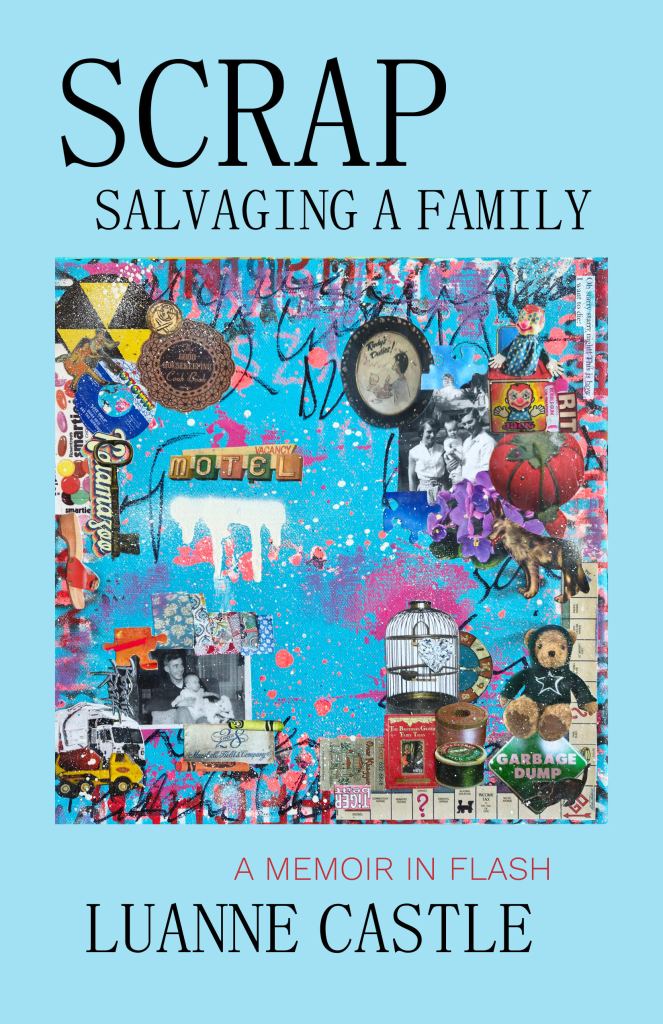
Today’s reblog is about an influence on my life–and a prevailing metaphor.
Tag Archives: Story
Filed under Creative Nonfiction, Memoir, Poetry
I’m sort of on a kind of partial hiatus this week, so I am re-blogging my very first Writer Site blog post. Have a mindful day and be sure to notice people’s faces :).
Filed under Creative Nonfiction, Memoir, Memoir writing theory
Through the Woods in My Cape
Since I’m the new kid in town, I was thrilled to get an invitation from LouAnn at her blog, On the Homefront , to attend her Virtual Christmas Party on December 15. Ok, I admit it: it’s true that she’s invited virtually everyone (or everyone virtual). But I choose to think of it as a personal invitation since I enjoy her blog so much. We’re simpatico (says me) since we share the name Luanne (which technically is the correct spelling, but please don’t mention that to LouAnn).
Party-goers are to come as their favorite author or character from a book. We’re to bring a 1970s appetizer and a song request selected from specific artists. As if I were planning a costume for a costume party, I’ve been obsessing over my masquerade identity for days.
It didn’t take me long to realize I want to attend as Little Red Riding Hood. She’s my writing alter ego. I figured this out after reading Tristine Rainer’s Your Life as Story. In this fabulous book on writing memoir, Rainer describes how each writer (read: person) inherits a myth which forms a pattern for her own life. It’s our duty as writers to understand this and not to get trapped in old patterns to the extent that we follow them to an unhappy conclusion.

I could see right away, that though I was the princess who felt the pea under 4,000 mattresses and feather beds when I was a kid and Cinderella when I married a rescuing prince, my main storyline has been that of Little Red. In my journeys as Red, I have travelled from the family home back to my grandmother’s home to save grandmother from her own sad story. I’ve dodged the wolf many times. There are hundreds of Little Red versions around the world, and they all have different endings. I like that Little Red–whether she gets eaten, kills the wolf, or saves her siblings—remains tough and spunky.
Little Red is the pattern for my memoir Scrap. In this first draft of my book the narrator describes this connection: “This past year, a girl in my kindergarten class had brought her doll for Show and Tell. The little cloth Red Riding Hood was three dolls in one. When you turned Little Red upside down, you pulled her skirt over her head, and on the other end you got Granny. When you took off Granny’s cap and turned her around, it was the Wolf’s face on the reverse of Granny’s. The difference between Granny and the Wolf was like the difference between Dad’s two sides. I, of course, was Little Red Riding Hood.”

Facsimile 3-character doll: Little Red and Grandmother

Facsimile 3-character doll: the wolf
For years I collected Little Red dolls, without understanding why. When I taught college-level children’s literature, we read and compared many versions of the fairy tale. I’m not sure if Red’s story became mine because reading the Little Golden Book version was one of my earliest memories, although it’s certainly possible.
What I do know is that I won’t be attending LouAnn’s party as Nancy Drew or Judy Bolton, as Catherine Earnshaw or Lucy Snowe, as Emily Dickinson or Muriel Rukeyser. I’m going as Little Red Riding Hood and if my cape and hood look particularly Christmassy, that will just be the frosting on the Christmas cookie.
Filed under Creative Nonfiction, Memoir, Memoir writing theory
For the Birds

I stand on a chair to reach my grandmother’s birdcage. My dress and petticoat flip out in back, as I balance on my palms, my sturdy toddler legs straining toward the parakeet. The parakeet contemplates my nose poking between the bars. I want it to sing. It’s all I want of this place, this apartment which rattles like death when the El rushes by. I think how much I miss my own home. Unless the bird will sing.
 Maybe it’s something that happened to me even before I was born. I started reaching out for the word music with my baby fists, if only to rush them like a bottle to my mouth: “Little Miss Muffet”; “See You Later, Alligator”; “A Fairy Went a-Marketing.” I recited and sang them repetitively—until my mother screamed at me to stop. Even then, I slipped under the bed covers and sang “My bonnie lies over the ocean, my bonnie lies over the sea.” My breath billowed up the sheet.
Only a fifteen-year-old can make the leap from puppy love to bird lover. That’s what happened when I became fascinated with a boy with a bird’s name. My girlfriend and I followed him oh-so-subtly-and-cleverly in the halls, only running into him “by accident.” On the weekend I couldn’t wait for school to begin anew on Monday, so we went to the mall. Woolworth’s had a department with birds in birdcages. An arched cage so much like my grandmother’s parakeet cage held two lovebirds. I paid $9.99 for the lovers.
When my husband and I got married in an ice storm, we drove from the hotel reception in a burgundy Marquise Brougham with a prayer on the dashboard. Songbirds flew after us into the dark. That’s the way I remember it.
I sat in Grandma’s old oak rocker, holding my baby son in my arms, murmuring:
Out of the cradle endlessly rocking,
Out of the mocking-bird’s throat, the musical shuttle,
Out of the Ninth-month midnight,
Over the sterile sands, and the fields beyond, where the child, leaving his bed, wander’d alone, bare-headed, barefoot
Whitman‘s poem managed something the others hadn’t been able to—it crept into my body, spreading out and occupying my flesh like a snakeskin it merely tolerated. I still can’t get rid of it. The poem and I battle inside like the gingham dog and the calico cat, but if it decided to leave, I’d be as empty as that snakeskin, discarded and colorless. It’s a poem about a he-bird who loves and loses the she-bird. Or it’s a poem about the curious boy who observes the bird and his troubles. But really it’s about a rocking like the surging of the sea and the hissing and whispering and all manner of delicious delicacies of words and rhythm.
When my parents put Grandma in the nursing home, she had to leave her parakeet behind. Not that yellow parakeet she had when I was a preschooler, but the green one she’d had since then. Dad brought the cage to our house and put it in the family room where the bird could watch TV. I kept changing the food and water, but the bird refused a single seed and died within a week.
Richard Siken told us wannabe poets never to write poems with birds in them. “It’s been done to death,” he said. I think he said that the bird as trope for poet was old after Whitman. Or maybe he said before Whitman. I went home and wrote a poem about Andersen’s Nightingale and the Chinese countryside and didn’t use the word bird. That’s what you call a writing constraint.
We had such a problem with roof rats and teenagers. The latter we knew would eventually move out. My husband called in the pest control people for the former. The man the company sent shuffled and mumbled, so we let him go about his business. That afternoon my son ran into the house yelling his head off, and since he’s a mild-mannered young man, I scrambled to get to him. He led me out to the back steps where three baby birds hung on a glue trap like Jesus and the thieves. We poured a sort of holy kitchen oil to release them. One had already died and a second stilled the instant it rested in my palm. The third one regarded me with one black eye, vibrant as a drop of ink. We hustled it to the veterinarian where the techs hustled it out of our sight.
My daughter writes songs that come out of her fully formed. I don’t know how anyone can do that, but then she sings them and her voice sounds like warm magma flowing. She sends me links to private songs on Myspace so I can listen before anyone else.
Over ten years ago cats started showing up at our house, looking for food and, later, shelter. We only had a couple of dogs left. The birds had departed long before for their heaven. Now the cats outnumber the humans, and they think they have an equal vote. They vote that anything with a fast heart rate can be considered prey. So no more birds for our family.
This house in Arizona has a tile roof, and the pigeons think it’s a rocky hillside, like their homes before humankind. While pigeons have those pleasing round breasts and iridescent feathers like abalone, they excrete their body weight every day—and always from the eaves above my exterior doors. I asked my neighbor to stop feeding the birds, but she doesn’t speak to humans. We put up screens to stop them from roosting in the obvious places. But a stubborn contingent stay put, and from my fireplace I hear them cooing. My brown striped cat purrs on the hearth, in rhythm with the pigeon coos.
A young pigeon dances on my patio, with his wings akimbo across his back, like a child stuck in a shirt he’s attempting to put on. Two adult pigeons watch from the roof. I put him in a brown bag and drive him to the pigeon lady. She has big man hands and examines him brusquely, but listens with her eyes closed, like a good doctor. She says, “I’ve never seen this before. It’s not a broken wing. He’s twisted his wings together across his back, like you twist a twisty on a bag.” She carefully and surely untwists his wings and puts them flat against his sides. “I’ll keep him for the winter and release him in the spring when he’s healthy.” I write a poem about the pigeon lady and through it she becomes a religious icon in my religion of one.
In the summer, I bring her another pigeon. This one acts odd, walking around the yard, but only flying a few feet at a time. She tries, but can’t save this one. “He had an illness, and I don’t know what it was.” She wants my permission to do an autopsy. That’s the way she learns how to take care of the living pigeons. When I hang up the phone, I can see through the window that another pigeon resting at the edge of eaves is breathing rhythmically as its body empties and fills and empties and fills in an unbroken pattern.
My grandmother outlived her parakeet in the nursing home for a year. I told my parents that if she had had the parakeet in her room, she and the parakeet would both have lived longer, but they explained that she died of uremia from renal failure. “The bird died because it didn’t eat, Luanne,” my mother said. “Stop trying to connect things that are not related.”
Filed under Creative Nonfiction, Memoir, Poetry
Story Problems
When I was four, I spent the seven-month Michigan winter playing in our basement. Dad had built walls in opposite corners, one to create a laundry for Mom and the other for his workshop. The open area just outside the workshop had become my playroom. Nothing special designated it as mine. The floor was concrete, which Dad had painted with gray industrial paint. Scotch tape didn’t hold up my drawings on the cinder block wall, and when I tried to nail a finger-painting to the gritty cement, I wasn’t strong enough and Dad’s hammer was too heavy. The nail slipped to the floor, my painting torn.

Halloween party in the basement–I am not in the photo as I was too young to be up this late
What my playroom contained were wooden crates of costumes and dolls and books. These served as portals to my imagination. With the single light bulbs shining from overhead, and these possessions spread out before me, the room felt cozy and cheerful, no matter that the window up near the board-studded ceiling was blocked by a snow drift.
One day, as I sat cross-legged, engrossed in Little Red Riding Hood, my mother came out of the laundry room and sang me part of an old song:
School days, school days,
Dear old golden rule days.
‘Readin’ and ‘ritin’ and ‘rithmetic,
Taught to the tune of a hick’ry stick.
She laughed and said, “I’m glad to see you’re so good at your 3Rs.”
I didn’t understand what she meant, so she explained to me that the basics of a good education were reading, writing, and arithmetic. I could read and write and liked to add small sums on the notepads Dad brought me home from work.
 She was right. I loved all three subjects. I couldn’t get enough of my Little Golden Books and each time we went to National grocery store, I begged for one of the 25-cent books with the foil spines.
The power of writing a sentence was already apparent to me. There was a symmetry to subject-verb-direct object which thrilled me.
And who wouldn’t love to create beautiful numbers out of lines and curves and then find out that 2 + 2 always equals 4? How serene I felt once I understood that certainty.
Upon starting school, I continued to relish all the subjects we studied. Science, the partner of math, captivated me in all its forms—meteorology (keeping a temperature log), astrology (creating a scrapbook of the nine planets), biology (growing mold on potatoes). I was complete, a whole person, half reading/writing and half math/science.
During arithmetic, we were presented with both numerical problems and story problems. The latter were akin to reading mysteries. It stands to reason that I would have loved story problems, but herein lies a problem. A problem related to writing memoir. No matter how much I think about it, I can’t remember whether I preferred numerical or story problems. It seems that I ought to know the answer to that, but the experience is long forgotten or disremembered.
Along with the absence of that memory is another mystery. I don’t know where I lost the math side of me and became identified with only one side, the reading/writing side. How did something that seemed so fresh and interesting to me as a child become a burden by junior high? If I could remember how I felt about story problems could I find the answer?
Tristine Rainer, in her book Your Life as Story, gives a variety of tricks to retrieve memories. Her tricks include:
- study photos as “memory sparkers”
- listen to music from the time period
- re-visit the floor plan of your old home
- let your body remember through an action or movement
As I work on my memoir, sometimes I can’t remember important parts of my story, and I use Rainer’s ideas. For me, internet research into a time period sometimes helps. So do old television shows, since I am of the first serious TV generation.
If I want to solve the mystery of my dislike of math, maybe I should follow Rainer’s 4th trick and get my hands on an old arithmetic textbook and start solving problems.
Filed under Creative Nonfiction, Memoir, Memoir writing theory