Category Archives: Memoir writing theory

The Motif of Origins

I’ve always been fascinated by origins. In college, I double majored in marketing (to make a living) and history (motivated by that fascination).

When I was a kid, my own origins seemed clear enough on my mother’s side since I grew up in the same town her people had lived for a few generations. On my father’s side, “far away” in Chicago,  there were so many gaps and distortions and puzzle pieces that didn’t fit together.

As I finished my undergraduate degree and entered grad school, I realized that I didn’t really know nearly as much about even my mother’s family as I had thought. I focused my study on local Kalamazoo history and, ultimately, on my family’s history.

More recently, I’ve been writing my family history blog and trying to find answers to the many questions that arise.

  • What branch of the family was made homeless by the fire mentioned in a newspaper clipping I found in my grandmother’s papers? (Answer: the George Paake family–and I’ve made an acquaintance of a shirttail relation and been given copies of many family photographs and documents)
  • What happened to my great-great-grandfather’s sister Jennie when she left Kalamazoo? (Answer: she moved to Seattle with her two adult daughters. A kind stranger’s father found their scrapbook at the nursing home he worked at 20 years ago. After reading my blog, she has now passed that scrapbook on to me so I have beautiful photographs of these women in Seattle)
  • How many Van Liere siblings were there?  (Answer: 8–see photo below)
  • How many DeSmit siblings? (Answer: I don’t know yet!)
A photograph of Jennie with her daughters from the discovered scrapbook

A photograph of Jennie with her daughters from the discovered scrapbook

The VanLiere boys

Surprisingly, people who have found my genealogy blog have shared many photos and enthralling stories of my family.

My very first blog post on Writer Site, “The Study of Faces,” was about my feelings of connection to my ancestors.

While the search for origins in my book has nothing to do with the genealogy I focus on in The Family Kalamazoo, it is also motivated by a curious nature and a search for identity. Issues of inheritance, genetics, and rights to our own stories are part of the subject of origins.

How is it with you? Are you ambivalent or uninterested? Do you care about your origins? Are you obsessed with them?


52 Comments

Filed under Books, Creative Nonfiction, Essay, Memoir, Memoir writing theory, Nonfiction, Research and prep for writing, Writing, Writing goals

The Motif of Curiosity

An important series in my book is curiosity. In fact, the 230,000+ words I’ve written (yes, I know it needs a lot  of cutting) and the dream of the book itself would not exist without curiosity–namely, my curiosity.

From the time I started reading Bobbsey Twin  books (like Nancy Drew but for younger kids) at age 5, I realized that curiosity was a constant flame inside me. If you aren’t familiar with these old books, the detectives are two sets of twins in one family–Bert and Nan, Freddie and Flossie. This series is so old that I grew up reading the books that belonged to my mother when she was a child.

My Bobbsey Twins collection

As a kid, I practically inhaled all the mystery series books I could get my hands on–mainly from the school and public libraries. Nancy Drew, the Hardy Boys, the Dana Girls, Judy Bolton, the Khaki Girls.  On and on.

In my early twenties I read every single Agatha Christie mystery.

Today I still enjoy mysteries, but I also am working on genealogy and my family history blog. The great thing about genealogy is that when the past gives up some of its secrets, it presents the genealogist with many more! The genealogy bloggers I’ve met are incredibly curious people.

All of this has been preparing me for writing my memoir, of course. Only I didn’t know it until recently.

When faced with secrets and unknowns, my recourse is to–well, what else?–PRY.

Are you a curious person? How has your curious or incurious nature affected your life?

53 Comments

Filed under Books, Creative Nonfiction, Essay, Memoir, Memoir writing theory, Nonfiction, Research and prep for writing, Writing, Writing goals

I Contradict Myself

If you read my review of the Augusten Burroughs’ book Running With Scissors, you know I’m conflicted about it. I feel differently about the prequel A Wolf at the Table–the story of his frightening father.

a wwolf at the table

In this book Burroughs captures my attention up front by saying that for years he couldn’t remember much from his childhood about his father. When it all starts coming back, it’s almost too much to bear.

He also presents himself as a sympathetic character, one that I feel a deep empathy for. One of the ways he does this is by showing how his father treated one of their dogs–and how it bothered Augusten.

They had three dogs, and Burroughs loved them all. The two larger dogs were allowed inside the house by the father. The smallest, “a little black elkhound with a curlicue tail” named Grover, was not allowed in the house. The reason was that the father, for no apparent reason, considered him an “outdoor dog.” Grover “practically never left the deck where he slept, pressed against the sliding glass doors.” Burroughs writes: “Like there was a special breed of dog that might die if exposed to a sofa.” This upsets Burroughs (and me). The last two paragraphs in this passage are especially poignant:

Even on the coldest winter night when Grover was no more than a black, furry mound curled into himself and pressed up against the house, my father wouldn’t let him in.

Sometimes, I let bad thoughts linger. Like, if my father made Grover sleep outside in the cold, what stopped him from locking me out there, too? He had two sons; what if he decided to make the younger one the “outside” son?

And, in a way, that is exactly what does happen to Burroughs.

One of the strongest threads in this book is the secret that Burroughs’ father shared with him. The question is: did it happen or not? But it’s Burroughs asking the question this time, not the reader.

If you look up reviews you will see that some critics don’t like this book. They might miss the humor they found in Running with Scissors. But this book has real heart. Some readers say that Burroughs couldn’t possibly remember the mobile above his crib. I don’t know what they are talking about because I remember a vivid event from when I was still in a crib–less than two years old. I remember my room in detail, especially the shadows and lights and special objects like my music box.

In reading reviews of this book, I noticed that Burroughs’ brother, who has Asperger’s, says he has trouble reading behavior in other people and that he believes their father had some of his own “autistic traits.” This is a controversial subject because many of us love people who have Asperger’s or are autistic. Their condition doesn’t make them cruel to children or animals.

If you had a very difficult parent, this book might break your heart.


36 Comments

Filed under Book Review, Creative Nonfiction, Memoir, Memoir writing theory, Nonfiction, Research and prep for writing, Writing

Running from Lawyers

I haven’t seen the film Running With Scissors. But this trailer looks similar to the book.


I’ve read the book.

Augusten Burroughs’ memoir Running with Scissors is the weirdest one I’ve read. According to this story, Burroughs had a horrific childhood. His father was a terrible alcoholic, and his troubled mother abandoned him to her psychiatrist. But it gets worse. The psychiatrist was wildly inappropriate and his household was in chaos. Burroughs was molested by the psychiatrist’s son.

What I found most disturbing, though, was Burroughs’ light rendering of this tale of his childhood.

The reviews mainly focus on this humor and how it makes such a dark tale palatable. Sometimes I found myself being taken in by this humor, but most of the time I felt odd being complicit (by reading) in making light of what Burroughs went through. It’s his choice to coat the events in that tone, but it demeans the events for other people who have gone through similar situations.

Running with Scissors

So what did I learn from reading this memoir? That you need protect yourself from being sued as much as you possibly can.  Because he was. Sued. By the family that raised him (Turcotte in real life; Finch in the book).

This article tells how the lawsuit was eventually settled.

Author Augusten Burroughs and publisher St. Martin’s Press agreed to call the work a “book” instead of “memoirs,” in the author’s note — though it still will be described as a memoir on the cover and elsewhere — and to change the acknowledgments page in future editions to say that the Turcotte family’s memories of events he describes “are different than my own.” It will also express regret for “any unintentional harm” to them.

Here’s an article in Vanity Fair telling the point of view of the psychiatrist’s family.

In this article, you can meet Burroughs’ mother.

The more I read about this case, the more I am uncertain who to believe. The story seems fantastical to me, but what if it all really happened?

The Turcottes say Burroughs made up many events (including the name Augusten Burroughs as his real name was Chris Robison)–and that he embellished most of the rest.

I am not going to presume to be a judge and jury. All I can do is take the book on the book’s own merits. For me the tone wasn’t right for a memoir with the events and characterizations that are included in this book. But if you can get past it being a memoir and think of it as fiction, it seems more like a John Irving novel, like The World According to Garp (RIP Robin Williams).  And I love John Irving novels.

Maybe I’ll watch the movie. Should I?


59 Comments

Filed under Book Review, Creative Nonfiction, Memoir, Memoir writing theory, Nonfiction, Research and prep for writing, Writing

The Motif of Shame

Last week I wrote about secrets, the central series or motif of the memoir I’m writing.  Sherri, from A View From My Summerhouse, mentioned the destructiveness of secrets and linked it to shame. This resonates with me because I’ve found that shame wells up in my story at every “low elevation,” like water pooling at a sandy beach. In fact, shame seems to drive reactions in my central characters far too often. That’s why it’s one of the 12 series of my book.

I never thought too much about shame until I studied Pia Mellody‘s 8 major emotions:

  • ANGER
  • FEAR
  • PAIN
  • JOY
  • PASSION
  • LOVE
  • SHAME
  • GUILT

Then I realized that not only is shame important and that I had been ignoring it, but that it was the creepy emotion. It’s the one that makes me feel . . . creeped out. Humiliation, regret, self-hatred, mortification, embarrassment, I could go on. There are so many words for these feelings. But no matter what, shame makes me feel YUCKY.

You’ve heard of the “it factor” that celebrities with charisma have? Shame has the ICK factor.

As a kid, my shame came mainly from two sources. One was my dad yelling at me where other kids could hear. Sometimes it was just that he was yelling in the house, and they could hear him. Other times it was that he would yell and punish me in front of friends.

The other source was when I felt embarrassed by being singled out or feeling that I was drawing potentially negative attention to myself, such as by wearing the wrong clothes. I hated negative attention and mistrusted positive attention.

Do you have memories about shame? Do they still control your life or not? Do you write about them?


63 Comments

Filed under Books, Creative Nonfiction, Essay, Memoir, Memoir writing theory, Nonfiction, Research and prep for writing, Writing, Writing goals

Now, What Happened Again?

I feel a little bothered–maybe even disturbed–about something I noticed in reading memoirs.

When I go to write memoir reviews, I tend to remember them by their schtick. You know: the memoir about the father with Alzheimer’s, the one about the college-age woman who was diagnosed with breast cancer, the girl from Texas with crazy gun-toting alcoholic parents,  the woman who secretly taught women Western literature during the Iranian Revolution, the man who learned gambling as part of Chinese culture while still a child, the young woman who had sex with her father, the girl who slept with hundreds of men. You see what I mean?

This is all well and good. After all, I am writing about the girl who lived over a bomb shelter and in front of the city dump with the garbage man father.

But does it mean that all memoirs have to have schtick to make them memorable?

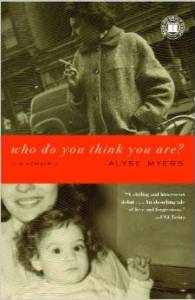
I eagerly raced through New York Times contributor Alyse Myers’ memoir who do you think you are?, thinking, “Wow, this is a well-written exploration of a sad and horrifying mother-daughter relationship.” It seemed as though Myers’ mother resented her daughter (more than Myers’ two sisters). The narrator is almost a Cinderella character, her mother a wicked and cruel mother.

Myers becomes independent at a young age in response to her relationship with her mother. She is driven and successful. Finally, she finds the perfect man to marry. She is nervous for him to meet her mother. When they do meet, her mother asks him what he sees in her daughter. Yet the man is charmed by Myers’ mother, and the mother even tries to impress a little by baking a cake–something she didn’t do for her daughter.

How does Myers go from being the abused outsider of her family to “being there” for her dying mother? To even wanting her future husband to meet her mother? The book shows the path.  Excellent story.

But when I go to remember the story, it’s difficult. I have to reread the book. I don’t have that hook to grab onto and reel in the plot elements from my memory.  And why? Because the book has no schtick. Sure, it’s about a horrible mother-daughter relationship and there is much to be learned from reading the book. But many memoirs showcase bad parent-child relationships. Many take place in the 1960s as this one does. In New York City, as this one does.

Does that mean the book’s weakness is that it doesn’t offer a memorable image?

As readers, sometimes we make fun of the schtick that memoirs are made of, but when it comes down to it, is that what makes them books that live on in our imaginations?

55 Comments

Filed under Book Review, Creative Nonfiction, Memoir, Memoir writing theory, Nonfiction, Research and prep for writing, Writing

The Central Series: The Motif of Secrets

According to the book architecture method, after determining all the series (repetitions) in her book, the writer must decide which is her central series–the main storyline will rest on this series.

My central series is secrets. A secret can be a painful wound at the heart of a family. What happens to a secret that doesn’t get any air? It festers and infects the entire body of the family.

The other side of the coin from secrecy is privacy. Aren’t people entitled to their privacy?

In my story, the protagonist (me, of course) tries to exhume the family secrets, but is also desperate to hang onto her own privacy with the family. Sounds sort of hypocritical ;).

Photo by Marisha

To give myself inspiration on the topic of secrets, I searched for quotes. These spoke to me as meaningful for my story:

“If you want to keep a secret, you must also hide it from yourself.”
― George Orwell, 1984

Of course, it is impossible to hide a secret, once known, from oneself. The more I realize it’s a secret, the more it weighs on my mind. Therefore, one way or another, the secret will out itself.

“Secrets, silent, stony sit in the dark palaces of both our hearts: secrets weary of their tyranny: tyrants willing to be dethroned.”
― James Joyce, Ulysses

I envision secrets just this way–heavy and controlling with their silent power. They want to be kicked out of their thrones, uncrowned, but we let them tyrannize us and those close to us.

“You cannot let your parents anywhere near your real humiliations.”
― Alice Munro, Open Secrets

I learned early to protect myself from my family by developing a thick wall. That was my way of secret-keeping.

“Secrets have a way of making themselves felt, even before you know there’s a secret.”
― Jean Ferris, Once Upon a Marigold

Although this quote doesn’t come from a weighty tome as do the other quotes, it is so fitting for my story. From before my birth the secrets existed, so I grew up under the weight, the tyranny, of the secrets long before I finally realized they existed.

Have you written about secrets in your family?

P.S. Those of you who were commiserating with me about my old cat Mac who has a bad heart and was diagnosed with diabetes: I got his glucose down with a diet change. So he doesn’t need insulin for now!

If you have cats, think about switching to high quality canned food. I did hours and hours of research and now wish I had done so years ago. If you want to know more about the results of my research, email me at writersite.wordpress[@]gmail[dot]com.

42 Comments

Filed under Books, Creative Nonfiction, Essay, Memoir, Memoir writing theory, Nonfiction, Research and prep for writing, Writing, Writing goals

Disney and Me:A Memoir

A memoir is usually focused on a specific thread or time period of a writer’s life, whereas autobiography is “my chronological life story.”

One of my favorite books is an autobiography that I would argue is a memoir because of its focus on the writer’s artistic life as an artist and writer. It’s a children’s book that is also a book for adults.

I’ve mentioned the book here in a previous post: Disney animator, illustrator, and writer Bill Peet’s Caldecott Honor BookBill Peet: An Autobiography.

Autobiography for children and adults of one of Disney's great illustrators, Bill Peet

Autobiography for children and adults of one of Disney’s great illustrators, Bill Peet

The book is 190 pages–longer than a traditional picture book; however, it won an award as a Caldecott Honor Book in 1990 because the book is fully illustrated–there is at least one illustration on each page, along with engaging text.

Bill Peet worked for Walt Disney on many movies, shorts, TV shows, books–even Peter Pan peanut butter. He wrote the original (1961) 101 Dalmatians, working from Dodie Smith’s book. Disney asked Peet to “plan the whole thing: write a detailed screenplay, do all the story boards, and record voices for all the characters. That had been a job for at least forty people on Pinocchio in 1938, but if Walt thought I could do it, then of course there was no question about it.”

Throughout the book, Peet’s desire to pursue his own artistic endeavors is constantly at odds with first school and then his job at Disney. If you are an artist or a writer, you will feel that, in some ways, his story is your story.

In many great memoirs, readers learn about other characters in addition to the narrators. Peet’s book presents a complicated and somewhat frightening Walt Disney. The simplest disagreement could cause Disney to put an employee “in the doghouse,” and then other employees would give that person “the silent treatment.” He even shows a scene where Disney comes in to Peet’s office and unburdens himself about his own difficult childhood. While there isn’t anything in the book that isn’t appropriate for children, there is enough texture–enough “teeth”–to the book that makes for a fascinating read for adults, too.

Pear Blossom checking out Bill Peet's book

Pear Blossom checking out Bill Peet’s book

The illustrations are all by Peet himself, and you will recognize the classic Disney look. By the story, you will learn how much of Peet’s creations are part of that Disney look and of the Disney stories you or your parents have grown up with.

Something about this book stimulates my mind and my heart. I think I have a crush on the book. I love chatting about it.

29 Comments

Filed under Book Review, Children's Literature, Creative Nonfiction, Memoir, Memoir writing theory, Nonfiction, Research and prep for writing, Writing

The Motif of Fear

I wasn’t surprised to discover fear is a pattern that repeats itself throughout my book. A twin of anger, the series I wrote about last week, fear controlled much of my childhood and teen years.

Although, for the most part, I learned to fear because of the anger of others, fear invaded all aspects of my life. In this rough passage that takes place when I am in first grade, I am almost “paralyzed” with fear of the dog that lived across the street from my house:

The chow wasn’t giving up, and my stomach began to clench as if it were pressed in my father’s metal vise. I sank onto my knees on the dirt drive, small stones digging into my skin, wedging between the lips of the cuts and scrapes I’d gotten riding my bike too fast. Dear God, make the lady call him inside. I bit the inside of my cheek and was soon sucking on iron, as the taste of blood flooded my mouth. Eventually time collapsed on itself, and I ceased recording it in my head. I sat and sat, alert to the barking.

Fear is something I know. As an adult, fear became anxiety, which comes with specific symptoms like tingling limbs. I know what makes me afraid. What makes me anxious is more mysterious.

Fear terror eyeHave fear or anxiety ever controlled your life? Do you find fear tied to anger or is it unrelated? Or are you a particularly fearless person? What made you so?


41 Comments

Filed under Books, Creative Nonfiction, Essay, Memoir, Memoir writing theory, Nonfiction, Research and prep for writing, Writing, Writing goals

A Woman Who Can’t Be Categorized

Paula Fox can’t be categorized–at least, not by me. She’s won awards for her children’s books like One-Eyed Cat and The Slave Dancer. 

I’ve taught both these books. One-Eyed Cat is a particularly wonderful book which examines the complexity of emotions like remorse and guilt.

But she’s not “just” a YA or children’s author. She’s been called the greatest writer of novels for adults by Jonathan Franzen (read here), but I can’t vouch for those as I haven’t (yet) read them.Desperate Characters

She’s a memoirist, but I’m not sure Borrowed Finery (one of her two memoirs) is a memoir.

Borrowed Finery


I just finished reading the book last night. What a life! I was enthralled, following the details of Fox’s life, as she was moved about from person to person, city to city, even living in Cuba for a year and a half. Fox is 91 years old, and the book takes place up to the point that she is 21 years old, except for a short section at the end, so the book is not an exhaustive autobiography–probably why it’s called a memoir. Nevertheless, it didn’t feel like a memoir. There wasn’t a strong MDQ driving the book. Occasionally,  it is even anecdotal. That said, I was fascinated, both by the events and by her exquisite sentences.

Her mother abandoned her at birth; she was a cruel woman who seemed to blame infant (and child) daughter for the loss of her “spring.”  Her father and mother were married, and the father complied with the mother’s wishes. He also seemed to be quite cruel and a severe alcoholic, although as a child Fox was obsessed with him. One of the first times Fox was with her parents, they asked her to order from room service. When the meal came, she realized she had forgotten to order milk and mentioned it. Her father took the tray of food and threw it out the window.

Many people are familiar with some basics of Fox’s life. For instance, when she was 21 she gave birth to a baby girl. Linda was the result of a one-night stand, although Fox had already been married to someone else. Fox despaired of being able to take care of her daughter and gave her up for adoption–only to almost immediately change her mind. She was told it was too late to change her mind (it wasn’t). Eventually, Fox was reunited with adult Linda and they have a good relationship. Linda is the mother of three daughters. Two of the granddaughters Fox has a great relationship with. The other granddaughter through Linda is Courtney Love, who Paula does not think is a good person. It does make me wonder if Love inherited a gene passed on to Linda from Fox from her own horrible mother.

Although I know that an unknown writer can’t publish a memoir that relies on chronology and anecdote in the way that Fox’s can, I did learn many things from her book. Just soaking up her elegant phrasing makes me aspire to write better. Then I also saw that she easily moved forward in time when she wanted to “tie up” an anecdote. With her graceful style, I really had to pay attention to even notice such a move.

One of the hallmarks of memoir is the double eye–the protagonist at the moment the events occur and the older, wiser protagonist reflecting upon those events. In that respect, Fox’s book is a stunning memoir. In one scene, her father spanks her for coming into her parents’ bedroom. In reality, he’s upset that she saw him with another woman in the bed. The African-American maid speaks up to defend Fox.

Years later, when I thought about her–and I thought about her often–about how much she had had to overcome in the way of an enforced and habitual discretion, how a sense of justice in her had outweighed the risk–I realized how brave she had been.

If you prefer books with a strong and fast-paced through-line you might find this book too lyrical. But if you’re willing to sit down and let a writer with a perfect sense of timing guide you, you will appreciate the story of Fox’s early life.

26 Comments

Filed under Book Review, Books, Creative Nonfiction, Interview, Memoir, Memoir writing theory, Nonfiction, Vintage American culture, Writing