Category Archives: Essay

Paper Hanging My Book

When we moved into our last house, I had a vision for my kitchen and family room. Those “two” rooms were a large open space, divided by a bar-height counter and a set of upholstered bar stools. Now keep in mind that this was the nineties.To coordinate with my rose and green plaid drapes and couches, I wanted an old-fashioned small print floral wallpaper inside two glass doored cabinets and on the bulkhead above. While I like to design, I am not very good at implementing projects like painting and wallpapering. So I asked around and called the paper hanger that was most highly recommended.

I can no longer remember his name, though “Jim” pops into my head. He was of retirement age with white hair and a nasty case of diabetes, but he was still working full-time. When he arrived in his rusted and dented panel truck, he spent some time examining the wallpaper rolls I had purchased. Then he began hauling out all manner of sawhorses and drop cloths and tools.  By noon he had converted my garage into an elaborate workroom.

By 5PM he had finished measuring and preparing the walls. I figured he would start pasting up the wallpaper the next morning. I was wrong. He did arrive by 8AM, but he still had more prepping to do. I asked him why it was taking him so long to prep. He said, “I’ve been doing this a long time. More’n forty years. If I spend my time prepping, the job will go quickly and there won’t be any mistakes.”

I probably rolled my eyes when I left the room. But once he started putting up the pretty wallpaper, I was able to watch him complete the room, even with a trim border, in an hour. One hour to wallpaper my kitchen. And it looked perfect, with invisible seams and absolutely no bubbles. Clean edges.

Later, I had him wallpaper my kids’ bedrooms, too, and he did the same excellent job by putting the focus on the prep, not on the final step.

Whenever I have a job to do, I tend to think back to Jim and what he taught me with his work technique. His method can be applied to many projects.

In fact, I was thinking today about how writing a book is turning out to be like paper hanging Jim’s way. By writing 200,000 words in scenes ahead of time, and by taking the time to really plan out how to structure it all, I suspect that when I put it all together, that will be the fastest part of the writing.

P.S. I’ve been super busy at work lately, so I am really frustrated that I don’t have time to work on the book, but when you let me chat about it on here, it helps keep me motivated, so thank you!

Have you ever worked using a method like Jim’s–heavy on the prepping, light on the final step?

36 Comments

Filed under Blogging, Creative Nonfiction, Essay, Memoir, Memoir writing theory, Nonfiction, Research and prep for writing, Writing

Target My Structure

I’ve mentioned before that I have had many problems structuring my book. With 200,000 words of memoir already written, I was overwhelmed and confused about how best to structure the story. What to leave in and what to take out. Whether to organize chronologically or thematically.

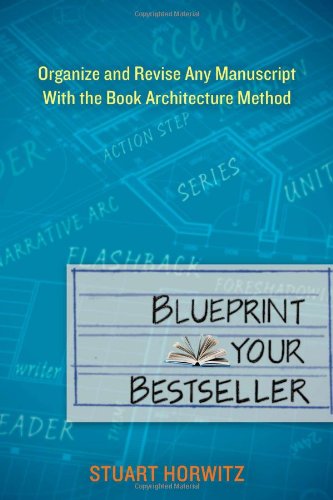
So I was very happy to find the book, Blueprint Your Bestseller, by Stuart Horwitz. His “architectural” method is really working for me.


In following Horwitz’ plan, some of the first steps include identifying all the series in your book. You can’t know this until you have enough scenes written.  So if you don’t have 50,000 or more words, I would just write out your scenes first. Then find all your series.  A series is anything that has “iterations.” Repetitions, a pattern. But not just any pattern–a pattern where the series “undergoes a clear evolution.” It happens or shows up more than once and changes a bit? It’s probably a series.

Series can be symbols or metaphors like the hat that Holden wears in Catcher in the Rye. They can be characters, objects, phrases, settings, absolutely anything. When I worked on this aspect, I was shocked to discover that many of my series are emotions, such as anger, fear, and shame. Of course, these emotions don’t exist by themselves. They are represented by tangible events or objects, such as locked rooms and guns.

In another early step in this method, I discovered the “One Thing” my book is about. Horwitz took me on a sure path to find this out through a step by step process.

Every time I work on a new step I experience an epiphany about my book.

This past week I accomplished the next step. I created a target for my book, putting my “One Thing” in the center bullseye location. Then I placed post-it notes representing scenes (pink), series (yellow), characters (blue), and settings (green) on the board.  Horwitz says, “The trick of the exercise is to put the narrative element closer to or farther from the bull’s-eye, or theme, depending on the strength of the relationship.” Doing this project, allowed me to see that certain scenes and settings were too far removed, whereas there is a close-knit relationship between everything else.

Caveat: I have so many scenes that I did not place all my scenes on the board. It would have been impossible. I expect to weed out scenes in the next step of the process.


The architecture method is supposed to work with any book, no matter the genre.

As a blogger or a writer, do you ever have problems with structure?

46 Comments

Filed under Books, Creative Nonfiction, Essay, Memoir, Memoir writing theory, Nonfiction, Research and prep for writing, Writing, Writing goals

A Lesbian in Mayberry

Remember idyllic small town Mayberry? Imagine a town even smaller and put it in Texas. Deep in the heart of Texas.

Imagine the small local school, a nice small town man its principal. The Baptist church where he sings in the choir. Now imagine his little blonde daughter who also sings in the church choir.

Slam on the brakes. Wait. Now imagine that his little blonde daughter is a lesbian, ogling the other little girls.

This is WordPress blogger Sheila Morris’ coming-of-age memoir, Deep in the Heart: A Memoir of Love and Longing.

Sheila writes the blog, I’ll Call It Like I See It. Her rescued Welsh Terrier, Red, writes another blog, called Red’s Rants and Raves. I read both blogs, but I admit I have a real affinity for hilarious Red and his worldview–admittedly one low to the ground.

By reading Sheila’s book I’ve gotten to know her better. I was surprised to learn that she came from such a small town–one so small I can’t even imagine living there.  Even the food seems different from what I am used to.  Take Ma’s (her paternal grandmother) fried pineapple pies. They sound a bit like turnovers, and they clearly are delicious.

This book was a comfortable and enjoyable read. The main tension was young Sheila’s attraction to other girls in the midst of that tiny town and the Baptist relatives. Three of her grandparents had a big hand in raising her, and she was obviously doted upon.

I’m not saying that there aren’t other negative elements that occasionally pop into view. The racist viewpoints of one of her grandmothers, for instance. Her disconnect from her mother, for another. The beloved grandmother she shared a bedroom with losing the last part of her life to serious depression.  But she paints the story with a loving wash that makes her childhood seem as if it’s ideal (if only there wasn’t this huge secret that she carries and doesn’t understand).

The structure of the book is different. In fact, I’d call it a book of short stories–each one in the genre of memoir, but each one holding its own as a story. Frequently the end of a chapter (or story), brings that particular story to a conclusion, then the next chapter will zip back in time and pick up just a little later than the previous story began. I thought this was interesting because I have a chapter that necessitates a flash forward, and I couldn’t figure out how to work it in with the rest of my book. But maybe it takes another “rethink” about structure.

This book is as charming as life in Mayberry.

28 Comments

Filed under Book Review, Books, Creative Nonfiction, Essay, Memoir, Nonfiction, Research and prep for writing, Writing

What If Your Father is Homeless?

If you’ve heard of this book, it’s hard to forget the title: Another Bullshit Night in Suck City. Nick Flynn’s memoir is about his father who eventually became a “homeless person.”

If you’ve read this book, you can’t forget the story. Or Nick’s father. Or Nick. Reading it is a life-changing experience. Amazing book.

Although the style is lyrical, experimental, poetic, the narrative is strong because the storyline packs a punch: Nick works in a homeless shelter and meets his father there. Here’s a sample of the writing style:

Even before he became homeless I’d heard whispers, sensed he was circling close, that we were circling each other, like planets unmoored.

Nick had been living a life very separate from his father. The man was an alcoholic con man, given to grandiose fantasies. He was a convict and maybe brilliant, but he wasn’t tied enough to reality–or to his son. Nick himself went through a period of alcoholic numbness, directionless. But he turned his life around.

The story isn’t told in strict chronological fashion. But through the weaving of memory and “current” events, the reader shares Nick’s intense emotional journey.

The writing is gorgeous, the story is fascinating, and Flynn’s ability to create the “feeling of being rained upon” (E.L. Doctorow quote, see below) is superb.

Nothing like learning from a master.

Throughout the book, we hear that Nick’s father always said he was writing the Great American Novel.  There’s no doubt that Flynn has written one of the Great American Books.  He’s accomplished a lot that his father was unable to do.

Good writing is supposed to evoke sensation in the reader – not the fact that it is raining, but the feeling of being rained upon.

E. L. Doctorow


24 Comments

Filed under Book Review, Books, Creative Nonfiction, Essay, Memoir, Nonfiction, Research and prep for writing, Writing

Why Wait to Publish?

We have a lot of book writers on WordPress–all in various stages of book writin’: thinking about writing a book, actually writing one, talking about writing one, with several finished manuscripts, publishing a first book, many published books on the shelf.

What I hear very little about on WordPress is publishing smaller pieces before the book is finished. Maybe because I started as a poet, this has always been my route.

Poems are arguably the smallest genre of writing, so it made sense to send a few out into the world and see how they fare. Eventually, I had enough poems written and published to pull them together into a manuscript, but it didn’t occur to me that it was time for a book. I had to be reminded about it by a mentor.

When I branched out into writing creative nonfiction, my goal from the beginning was to produce a book. The writers on WordPress and the writers in the memoir-writing classes I’ve taken have been as focused on The Book as I have been.

But my opinion is that it’s just as important to write smaller pieces or to take chapters or smaller portions of the book-in-progress and revise into stand-alones. These pieces can be submitted to magazines and journals. Maybe you are thinking, “Well, I am writing a novel, so there is no way to send out part of this baby!”  I searched Duotrope (search site for writing submissions) for “novel excerpts” and over 100 places are accepting submissions of novel excerpts currently. Once you weed through them, you might find only a dozen are a good fit, but hey, maybe that’s 12 more than you realized were out there!

What I am trying to do is figure out what kind of market is best for each short piece and then revise each one until it sparkles before sending it out to editors of the “right fits.”

I try to think of my short works as canaries in the coal mine of the literary world. Either they make it or they don’t.

Here is some great advice given by the character Christmas Eve in the Tony award-winning musical Avenue Q:

from a wonderful Tumblr site called “Things Musicals Taught Me”


Do you submit your writing in less-than-book-length form?


39 Comments

Filed under Blogging, Creative Nonfiction, Essay, Memoir, Nonfiction, WordPress, Writing

What Happened When I Got Really Mad at A Big Bully

Yesterday I read a post by my buddy Jaye at Jaye’s Brain that made a connection between adoption and bullying.

In a book review of an anthology by adoptees, Perpetual Child, that I’ve been reading, she wrote:

An essay by Matthew Salesses stood out for me not only by what it said regarding adoption but what it said about bullying/adoption. I started out blogging, unintentionally, by writing about the bullies on the bus. Again, I thought it was my over-sensitivity and my desire to prevent anyone from having negative feelings (or perhaps, any feelings at all) that made me a (bullied) target.

Salesses, in his essay, wrote about being bullied because he was a transracial adoptee. Jaye was adopted, and she writes about the power of the essays and other pieces in Perpetual Child. She shares her very first blog post–which, guess what, just happens to be about being bullied. Go read it (link is in her quote above)!!! And the topic is bus bullying, a subject that I wrote about here.

In 2012, I started my first blog, Don’t We Look Alike?, writing it with my daughter. The subject of DWLA is adoption, and over the past almost two years, I’ve learned a lot about the subject–and revised some of my viewpoints. I want to share with you the first post I wrote. I’m not sure that today I could write my story with the same tone I do here, but this is how the experience seemed to me for most of my life.

The post didn’t have too many readers, but a couple of the “likes” were by bloggers who I still read and who occasionally read this blog.

It’s interesting to me how different my response was to this bullying than to the subsequent bullying I myself was subjected to at my new school in 3rd grade. At the time of the following story, I was in 2nd grade, and at my familiar “old” school.

Here’s my story:

I’m the mother of two young adults, both adopted from Korea when they were babies. But my relationship with adoption began much earlier. I’m the sister of an adoptee, too. Back in the early sixties, it was still a new idea that adoption wasn’t a secret to be kept and that an adopted child could grow up knowing he was adopted and still feel loved and accepted by others. My parents embraced this idea. When they started the adoption process for a boy, they explained all this to me and I thought I understood. Yet it wasn’t quite that simple.


It was a March day, when my parents and I drove downtown to pick up my brother Teddy from Catholic Family Services. We weren’t Catholic, but Mom explained that their agency was the one with the babies and we were in need of a baby. We pulled up in front of an old house on South Street and went in. Teddy lay in a white bassinette in a small room. My parents and I encircled him, looking down at our new baby. Our case worker said, “He’s just six weeks old. Isn’t he a darling?”

Though shocked to see his face covered with a red rash, I quickly decided not to be picky since I had been waiting all seven years of my life for a brother.

A few months before, when the case worker was going to visit us for the first time, Mom and Dad had warned me that she would ask questions, and I sensed that our family getting the stamp of approval rested on me and my answers.

I kept things businesslike, asking for a brother since our family needed a boy more than another girl. Since it was 1963 and I’d never met anyone who was adopted, I assumed that kids, adopted or not, would automatically look like their parents. I had my mother’s brown hair and blue eyes, so I put in an order for brown eyes to match Dad’s.

Now I peered closer at the baby with his frill of reddish-brown hair. “He’s got blue eyes like mine!” I’m sure I sounded accusatory. The case worker explained they were fresh out of baby boys with brown eyes, so they had chosen Teddy because he looked like Mom and me. I considered the logic and figured he would do.

When we got him home, all the relatives started coming over to meet him. For two weeks, we had somebody at our house almost every day. They liked to have me sit on the couch and hold Teddy while they took our picture. Teddy felt like one of my dolls, but warm and heavier, and yet I was conscious of how fragile he was and how careful I had to be with him. Every day I rushed home from school so I could see him. Day by day, I learned to be more comfortable with him, and how to hold the Playtex bottle with its plastic bag insert so he could get formula without swallowing too much air. I learned how to burp him, patting his back which seemed barely bigger than my hand. He relaxed and smiled at me when I picked him up, and he wrinkled his forehead when I lay him back in the crib.

I’d been in the choir at the Methodist church all school year. A group of us would walk from school to the church [once a week]. We were six kids, all ages, from an afternoon kindergartener to a tall fifth grader, a girl I’ll call Jane. Her size and confident demeanor gave her a lot of authority.

That day we decided to cut through the backfields to the church, although we usually just marched down the side of Gull Road. Jane said it would save us a lot of time to cut through, and nobody wanted to argue with her, although the snow was melting in the field, leaving ruts filled with mud.

Since having a baby brother was a new phenomenon in my life, I liked to bring up the subject–a lot. After having been an only child, I loved the sound of the words my brother. As we walked, I chimed in with something about my brother Teddy.

Suddenly Jane, who was leading, turned around and said, “He’s not your REAL brother. Don’t lie about it.”

My skin seemed to peel back from my limbs, and my stomach got a sick flipfloppy feeling. “What do you mean he’s not my real brother?”

“He’s ADOPTED. That’s not REAL.” A sea of bloody red anger splashed across my eyes. Jane had no siblings and, since she was eleven, probably thought she’d never get any. But I wasn’t thinking from her perspective. To me, her words were an act of violence against Teddy.

That’s the first memory I have of being angry. I lowered my head, aiming straight for her stomach. Eventually Jane and I got back on friendly terms, but I never forgot that some people don’t really understand what adoption means for those of us whose lives are changed by it. My parents’ philosophy had become my philosophy, but I now knew it wasn’t shared by everyone.

###

When I was in 7th grade, a very large girl sat on me and started to beat me up, but I was rescued by my friend’s father who jumped out of his car when he saw what was happening. Other than those scary few moments, the only time I was ever in a physical fight was when I head-butted Jane. In case you’re wondering, not much happened after that point because Jane apparently was shocked somebody stood up to her and not inclined to fight.

Have you been in a physical fight with a bully?

28 Comments

Filed under Creative Nonfiction, Essay, Memoir, Nonfiction

Phone Rage

Here’s a story of something that happened to me a couple of years ago. I posted it on the site “Cowbird” at the time, but I’ve taken my stories off that site now. The style of this post might seem out of the norm for me, but the subject matter is a typical part of my daily life ;).

Here ’tis:

When I answer the phone, she says, “Is this Luanne? Your credit card was declined. I couldn’t get your order of 24 jockstraps out today. Do you want to give me another card?”

“There’s nothing wrong with my card! I’m not even near my credit limit. Let me call the bank and get back to you.”

I scrounge around inside my big shoulder bag, looking for my wallet and the offending plastic, and then I call the number on the back of the card. I get looped around and around, passing go—the original menu—several times. I hang up. Neither the front nor the back of the card reveals another likely telephone number, so I go upstairs to the files and bring down a statement with a phone number.

After passing through several more departments, I finally reach a person. At first I can’t understand her quick robotic cadence. Within a few seconds, I decide she has said, “What may I help you with?”

I tell her my problem, and she researches while I sit on hold. Meanwhile, I file my nails, take off my too-tight bra, and check my Facebook. I can’t wait to call my husband and yell at him for expecting me to order all those jockstraps. 

She finally comes back on the phone, and I have to shake my head to wake myself up. “I am very sorry, but there isn’t any problem with your account.”

I explain the phone call I got from the sporting goods company and how I need to use this credit card.

“Yes, there is not any problem with your account.” Again, I have to pause to figure out what she’s just said.

“Well, obviously there IS a problem or I wouldn’t be calling you. What is the available credit on this card?”

“Okay, let me check that information for you. Would you mind waiting just a moment?”

“I’ve already waited! I’ve been trying to get to the bottom of this problem for,” and here I glance at the clock on my computer, “forty-five minutes!!” My foot taps wildly.

“Yes, I see. I am very sorry that you are having this problem. If you will let me check that information for you . . . .”

“Go ahead!”

After finding out my balance, I ask her how we can solve the problem when there isn’t a problem and how I can get my jockstraps.

“Yes, you want to know what the problem is. There is not any problem. Is there anything else I can help you with? I am glad to have been of service to you.”

I call my husband on his cell. “You won’t be getting your freaking jockstraps, and if you still want them, you can just order them yourself.” I hang up before he can respond. That’s the benefit of being married a really long time.


42 Comments

Filed under Creative Nonfiction, Essay, Memoir, Nonfiction

Dead People and Mysteries

I just finished reading Monica Holloway’s first memoir, Driving with Dead Peopleand I’ve been sitting here for fifteen minutes trying to figure out how to write about the book without including any spoilers.

Not an easy task with this book since the last chapters hit me hard.

Near the end of the book, I wondered how I missed it all. On reflection, I guess it’s because the book is that well-written.

You’re going to love this one as the narrator’s voice is engaging, but if you don’t like to read dark memoirs, then it might take a frightening turn for you. If you venture on, you find that your journey has value, and that Holloway is courageous.

Holloway tells the story of her childhood, growing up in the midwest. Her father is cruel, and at first her mother seems as much a victim as the four children. Then Holloway’s mother goes to college and gets the courage to leave her husband. Emotionally, she turns her back on her children as surely as if she had completely abandoned them.

Her obsession with death and dead people keeps Holloway going throughout these years. Her best friend’s father owns a funeral parlor, and she gets a job driving dead bodies for him. She haunts the graveyard.

Additionally, the passion (different from obsession) that gets Holloway through it all is her love of and talent for acting. She eventually earns an MFA in theatre from the University of California, San Diego. She builds a life far from her Ohio roots.

But the path is not without great difficulty. The family has been destroyed by the behavior of the parents. Her closest sibling, the oldest sister, has been particularly damaged. But so has Holloway herself, and it’s only at the very end of the book that she discovers just how much.

From this memoir I learned that writing a memoir can be like writing a mystery. In this type of memoir, the writer can’t give away all the critical information up front as the story needs to develop in its own time. But clues need to be embedded throughout the narrative so that when all is revealed, even if the reader is shocked, she will see how inevitable the events were. She won’t feel that the writer was playing games, withholding just for the sake of sensation. Holloway creates a suspenseful, seamless story using this technique.

Holloway has published a second memoir, about the relationship between her son, who is autistic, and a dog.  Here is a book trailer for this book:

Cowboy and Wills looks charming, and I am putting on my to-be-read list.

If you want to find out more about Holloway or about the third memoir she is currently writing, check out her website.

Enhanced by Zemanta

41 Comments

Filed under Book Review, Books, Creative Nonfiction, Essay, Memoir, Nonfiction, Research and prep for writing, Writing

Writing Sometimes Means Getting Up Off the Chair

Spring in Arizona is glorious. We never did have winter this year, but I can tell it’s spring because there is a nest of baby quail behind the house. All but two of them hatched yesterday. A large and messy nest weighs down a flimsy Palo Verde branch overhanging the wash. I watched the bird fly back and forth to the nest, but the bird was so small and my vision so limited that I couldn’t make out the type of bird.

We also have lots of blossoming shrubs and trees and vines. Bougainvilleas are one of the more distinctive blossoms.

Living in the southwestern United States, I expect to see Bougainvilleas as backdrop to certain settings, especially around the walls of Spanish and Italian style stucco houses.

Bougainvilleas are apparently native to South America, but they have made their way to Arizona and California–and to the Philippines and southern European countries.

They are well-known for their distinctive reddish (but not red) color. The shade differs a bit, according to the sunlight and the soil. They come in both vine and bush varieties.

My husband and I decided we wanted to buy a few new bougainvillea vines, and the company delivered them to us. The place we wanted to put them is not only across the driveway from our other bougainvilleas, but on the same wall as our neighbor’s plants.

So it was important to match the color. Not a problem, I figured. To my knowledge, all Bougainvillea plants were the same color. (I always envision how gorgeous they are against white stucco near the beach in San Diego).

The plants that were dropped off at my house, though, were an orangey shade. They completely clashed.

The company exchanged them. For a hot pink color. I couldn’t figure out how it could be so hard to select the right color when all the Bougainvillea between the Pacific Ocean and New Mexico were the same color.

I checked the internet. Apparently there are over 80 different Bougainvillea plants

So I got off my writer roots (that’s the body part you use to plant yourself on the chair at the computer) and hauled myself to the nursery–armed with a twig from ours, a twig from my neighbor’s, and a twig from the hot pink so-not-right plants.

The man who helped me at first showed me to a section of Bougainvillea. I matched my “swatches” the best I could, but nothing seemed quite right. I said, “I want the color of San Diego Bougainvillea.” He just gaped at me.

I felt as if I were in that scene from Mr. Blandings Builds His Dream HouseI was Myrna Loy describing paint color to her gape-mouthed painters:

I want it to be a soft green, not as blue-green as a robin’s egg, but not as yellow-green as daffodil buds. Now, the only sample I could get is a little too yellow, but don’t let whoever does it go to the other extreme and get it too blue. It should just be a sort of grayish-yellow-green. Now, the dining room. I’d like yellow. Not just yellow; a very gay yellow. Something bright and sunshine-y. I tell you, Mr. PeDelford, if you’ll send one of your men to the grocer for a pound of their best butter, and match that exactly, you can’t go wrong!

When Myrna Loy is done with the full description, the painters say:

Mr. PeDelford: You got that, Charlie?

Charlie: Red, green, blue, yellow, white.

Mr. PeDelford: Check.

That was how much my flower man cared about the color I needed. I hemmed and hawed and sent him on another errand.

In a few minutes, Ryan (an everyday hero) stopped by to help me. He brought me to another section of the nursery. All the Bougainvillea, vines and bushes, were the right color. And they were 1/3 the price of the other colors. Go figure.

What I learned is that when you want the correct San Diego color Bougainvillea you want to buy “Barbara Karst Bougainvillea.” That’s all you need to know. Those will be the perfect ones.

My new vine matches my neighbor's boughs.

My new vine matches my neighbor’s boughs.

Now I want to know how one goes about getting one’s name on such a well-known flower. And who is/was Barbara Karst?

Do you have a gardening tip to share?

Enhanced by Zemanta

31 Comments

Filed under Arizona, Creative Nonfiction, Essay, Flora, Garden, and Landscape, Memoir, Nonfiction, Research and prep for writing

Reading Politics in Literature

I actually took notes when I read Azar Nafisi’s memoir Reading Lolita in Tehran. The book contains so much information and so many thought-provoking quotes, I had to make it easy for me to find them later on. For what, I had no idea. but it seemed important. In reading this book, I felt as though I had entered a world foreign to me, but met a character in the form of the narrator who is someone familiar–a voracious reader and a teacher.

Nafisi’s memoir takes place when she, an Iranian moves back to Iran from the United States, where she attends grad school . She decides to go home at what turns out to be a time of change and danger–during the Revolution.

What starts out as a hopeful movement, becomes an authoritarian anti-Western repressive government. Nafisi witnesses the controls tightening as the abuse of power becomes more chaotic. She writes of men and women being tortured and killed, of women sexually abused and raped and blamed. The powerless are doomed.

Although she starts out teaching in the university, soon Nafisi is expelled for refusing to wear a veil. She comes back for a time, but ultimately, she resigns and takes her teaching underground. She teaches literature in her living room to female students. It’s very hush-hush as they are all in danger if discovered.

What did I learn from this book?

  1. The structure of Nafisi’s memoir is very unique. Because the book is about teaching literature, she gives the book shape by forming sections around the books they read:  “Lolita”; “Gatsby”; “James”; and “Austen.” She makes connections between the literature studied during the section and what is happening to the characters in the book and to Iran. Her clever structure is a good example of  a memoir structured thematically.
  2. Until I read this book, I didn’t realize how little I knew about Iranian culture and about the Revolution. I’d seen Ayatollah Khomeini on TV often in the early 80s, and it was if a dark spirit entered the room each time he filled the screen. But this made me turn from Iran and not seek to learn more.
  3. Most importantly, Nafisi shows how naive and idealistic she and her fellow Iranian students were when the Shah was in power. They believed that revolution was necessary and would help Iran and its people. But their dream turned into a nightmare. The book shows how we have to be careful what we wish for. A promising course might not lead to freedom and happiness, but to a dangerous theocracy.

Although I ended up with  5 typed pages of valuable notes from this book, I remember one passage by rote. In the Gatsby section, a character says:

[The Great Gatsby] is an amazing book . . . . It teaches you to value your dreams but to be wary of them also, to look for integrity in unusual places. “

I’ve taken on this quote as a personal mantra.

###

I’m looking forward to reading Nafisi’s recent book Things I’ve Been Silent About. She lives and teaches in the United States, and this book sounds like a memoir about her childhood, growing up with parents who told her romantic stories.  This is her website.

26 Comments

Filed under Book Review, Books, Creative Nonfiction, Essay, Memoir, Nonfiction, Research and prep for writing, Writing