Category Archives: Family history

One More Week Before Scrap’s Release!!!

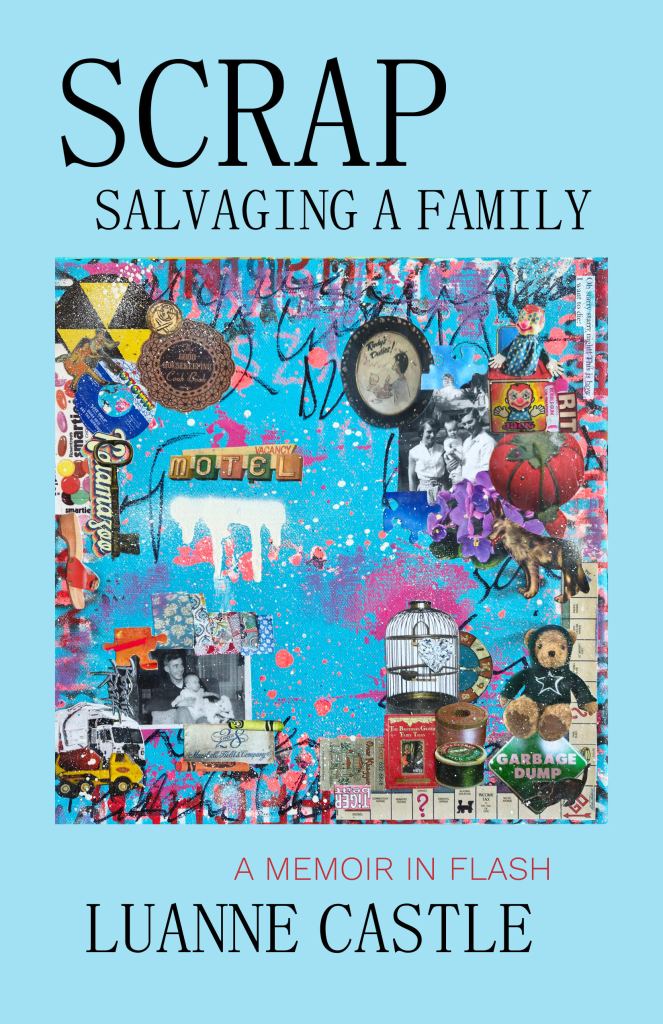
I’m looking forward to the blog tours for my new book Scrap: Salvaging a Family, published by ELJ Editions.

First up are friend blogs!

Joy Neal Kidney, March 21, book review

Liz Gauffreau, March 23, book review

Marie Ann Bailey, March 24, book review

John W. Howell, March 25, book excerpt

Miriam Hurdle, March 30, companion story to Scrap

(If you want to participate just let me know at luanne[dot]castle[at]gmail.com :)!)

Then there is an April and May tour through Poetic Book Tours, schedule in link.

POETIC BOOK TOUR FOR SCRAP

11 Comments

Filed under #bloggingcommunity, #ScrapSalvagingFamily, Blog Tour, ELJ Editions, Family history, flash nonfiction, Memoir, Nonfiction, SCRAP: SALVAGING A FAMILY, Scrap:Salvaging a Family

Judy Kronenfeld on her Memoir _Apartness_ and Her Identity as a Scholar Poet, Part 1

Today I am introducing poet and writer Judy Kronenfeld. Although we didn’t know each other at the time, Judy and I were at the University of California, Riverside, at the same time–Judy taught there when I was a grad student.

Here is a beautiful poem Judy published in Sheila-Na-Gig, “Blue Corduroy Baseball Cap.”

Judy Kronenfeld

Judy has recently published a wonderful memoir comprised of prose and poetry called Apartness. Here is the book description:

Through a collection of honest yet often humorous essays and complementary poems, Apartness: A Memoir in Essays and Poems grapples with the feeling of unbelonging as a first-generation Jewish-American woman from an immigrant family in a primarily Protestant nation. Kronenfeld illuminates a sense of divide between herself and the world around her with graceful vulnerability and truthful ambivalence as she reckons with religion, social class, and aging.

Apartness is for anyone who has ever felt left out or struggled to find home.

My addition to the above description is that I think it’s a book for everyone.

My interview of Judy is in two parts. Today I am posting part 1 and next Monday I will post part 2 and will link back to this post. My questions are in italics; Judy’s responses are in Roman type. Here is part 1, which consists of two questions and answers:

1: Judy, you are a scholar and a poet/writer, two identities that have often warred with each other. When I was graduating with my PhD a fellow graduate student who knew I wanted to return to poetry told me that Sharon Olds said she was going to forget everything she learned (in grad school) so she could write poetry. The reference I found to a similar quote by Olds is from the Writers Almanac: “So what I said was something like: ‘Give me my own poems and I’ll give up everything that I’ve learned.’” https://writersalmanac.publicradio.org/index.php%3Fdate=2011%252F11%252F19.html  Her point was that she had learned the impersonal New Critical way of reading poetry (aka literature) and wanted to write intimate poetry fresh from personal experience, in other words autobiographical. As you know and write about in your book, New Criticism doesn’t allow the reader to take the writer’s own life into consideration. And this mentality permeated the landscape throughout the 40s, 50s, and 60s when poets like Sylvia Plath began to take it apart. You were steeped in New Criticism, yet you wanted to write poems based on your own emotions and experience. How did you weave those two aspects of yourself—creative and scholar–into one? Or did you have to keep them separate and if so do you feel as if you have two minds?


JK: For much, but far from all of my adult life, I have been involved with producing either scholarship or creative work—most often poetry, but also creative nonfiction and some short fiction. But I have also taught literature and criticism while trying to write creatively, or done scholarly research and writing, while teaching creative writing! Talk about liminality! And yes, it certainly can feel as if one is participating in divided and distinguished worlds. Yet that liminality may also foster “a disinclination to work within institutionalized frameworks of thought,” as I say in the preface to my critical and historical book on King Lear.

 I’ve tended to be something of a muckraker in response to the limitations of various academic approaches to literature. I was shocked at the almost religious “New Critical” shunning of historical and social context in my first English seminar (on the English novel) as an undergraduate, for example, and hoped to correct it in my own critical work. And I was skeptical (in a way that ultimately led to some of the understandings that underpin my book King Lear and the Naked Truth) of the simplistic “old historical” paradigm used as a heuristic for examining 17th century literature by one of my English professors in graduate school. He put “Anglicans” in one box labeled something like “appropriately or decently dressed” and “Puritans” in another labeled “the naked truth.” And this governing polarity was expected to illuminate content and form in a great deal of literature. My lucky New Critically close reading of Saussure in a seminar on Structuralism (taught by my anthropologist husband in 1972) gave me an understanding of contrast and reference in language that illuminated such matters as Reformation controversy on the appropriate “clothing” or “dress” in church services. “In short,” to quote my book, “the Reformation controversialists . . . all claim . . . to be as clothed and naked as they ought to be. . . . [S]hared contrasts and abstractions concerning appropriate and inappropriate uses of clothing permit controversialists to ‘talk the same language,’ even though they may not mean the same things at all” (p.67). Their specific referents for their abstract terms are what one needs to look at. What is an example of “comely” or “decent” clothing in the church? What is not?

To try to summarize a crucial point of my very long and rather complex book of criticism here is a bit insane. But it serves to illustrate, perhaps, that my desire to deeply understand the history, culture, and language in and surrounding literature I love has been important for me, even if I have not written on early modern literature since my book on Lear was published in 1998 (with the exception of a handful of book reviews from 1998 to 2001). So much of my self was deeply invested in criticism; I had to “say goodbye” to it in an emotionally and intellectually meaningful and public way by pushing myself to complete this very comprehensive critical book which makes use of everything I knew and learned about language and the religious culture of Shakespeare’s time. And I must say, to read any part of it again, after many years teaching creative writing until my retirement, and even more years writing poetry, is to acquaint myself with a mind reclaimable but somewhat foreign.

New Criticism, especially when I was an undergraduate, seemed to enshrine a view of creative writing as accomplished quite coolly and impersonally, perhaps best by a social elite, and not by ethnic minorities, or, indeed, very much by women. Yet the secular and religious poetry of John Donne and the religious poetry of George Herbert, for example, were passionate! And New Critical pedagogy also encouraged the student to give herself to such poetry, to live with its sounds and rhythms, to take such poems into herself. At the same time, this Jewish girl had to process such poems intellectually, which meant understanding enough of Christian theology to grasp the speaker’s emotions in a way fully related to his words. I was moved (even if not converted), perhaps because the course I took in the Metaphysicals as an undergraduate allowed me to concentrate fully and thoroughly on lyric poetry of a particular historical moment, for the first time. I was in love with lyric poetry and also with the leap across time involved in understanding it.

This experience of slow emotional processing of poems, combined with analytical and intellectual understanding, deposited the poems in my mind and heart in a lasting way, I found. Something I had deeply felt and analytically absorbed, for example, the sound of a line like “Oh! of thine only worthy blood”—in Donne’s sonnet “If poisonous minerals, and if that tree”—whose rhythm and wailing long o’s contrast with the sound of immediately preceding lines, could subliminally affect something unrelated I was writing years later. I think it’s important for those who want to write poetry to have this combined experience of emotional and intellectual understanding of poems when they begin to study. It was an experience that affected my own teaching of creative writing. I think analysis deposits the words read along with the emotional reaction one has to them in the writer’s mind in a more lasting way than emotional reaction alone.


2: Your essays—and I hate to call them essays because that word has always conjured up the boring genre of literature I didn’t want to read in grad school. Give me poetry, give me novels, or for teaching even give me drama so the class can read aloud. At the time, there was nothing called creative nonfiction, so everything else was called an essay. And I notice you call your pieces essays, but they are exciting and filled with fascinating cultural and historical details, emotional resonance, and an ability to straddle both a perceived mainstream American culture and your own ethnic upbringing that creates a tone of loving humor. Each essay on its own is a wonderful “article” that feels so satisfying to this reader. Taken together, they create an autobiographical feel as they are the archival creation of a life. Have you been writing essays as long as you have poetry? How do you know when a particular image or memory will work best in a poem or an essay? Did writing scholarly essays help you in writing creative essays such as those in the book?

JK: I haven’t been writing personal essays/creative nonfiction as long, or as frequently as I’ve written poetry. But I have kept private diaries or journals intermittently since adolescence and have quite a collection of these. In the last decade or so, I have slacked off. There were never obligatory daily entries (even weekly or monthly ones). I wrote when I needed to describe a new environment, or record a complex, disturbing or confusing experience, or indulge in a fantasy, or release anger or distress—really for any reason involving some sort of burden of emotion and/or thought relieved by the loops and glide of a pen in the hand. It wasn’t until the complex experience recounted in “Death and Belief” that I tried to deal in a public voice with a multi-layered experience that, as it turned out, shined a light on some central conundrums of my life. Once I had done this, it became possible to do it again. Writing scholarly essays was really different from writing these personal memoir essays. One has many sources to organize and credit, an argument to construct that relates to current critical paradigms, i.e. speaks in the current critical language of the academic institution of “English,” so it can be understood by academicians, yet provides something new as well. The task of organizing is definitely labor-intensive. In contrast, writing the essays that comprise Apartness (which I did not originally write with the idea of combining them into a book) was in many ways more spontaneous, indeed, easier (although that definitely does not mean that I did not revise!). I had written stories and published a number of them before I began writing these memoir essays which can share narrative arcs, characters, and dialogue, with fiction. However, the experience of learning to organize a lot of material is always a useful one, whether for the critical or the personal essay, though the materials are different.

Memory has long been an essential aspect of my poetry, perhaps because I returned to writing poetry, and first dedicated myself to the process in early middle age, when I was already able to look back on so much life. I don’t think there’s anything intrinsic to a particular image or memory that makes it work better in a poem or an essay. But essays are, of course, usually more discursive, so there has to be enough meat to the memory and the experience to sustain longer, perhaps more multi-faceted consideration. Both essays and poems have elements of showing, rather than telling, but a poem’s approach to a memory may be more glancing—even if only because it contains fewer words. A few of the shorter pieces included in Apartness, like “Blue Bowl of Sky,” are probably more like what has sometimes been called “lyric essay.” And the line between that and “prose poem” (“Resident Dead,” for example, was originally published in a collection of prose poems) might be pretty fuzzy.

Watch for part 2 on Monday!


Author bio:

Judy Kronenfeld’s six full-length books of poetry include If Only There Were Stations of the Air (Sheila-Na-Gig Editions, 2024), Groaning and Singing (FutureCycle, 2022), Bird Flying through the Banquet (FutureCycle, 2017), Shimmer (WordTech, 2012), and Light Lowering in Diminished Sevenths, 2nd edition (Antrim House, 2012)—winner of the 2007 Litchfield Review Poetry Book Prize. Her third chapbook, Oh Memory, You Unlocked Cabinet of Amazements! was released by Bamboo Dart Press in June, 2024. Her poems have been published by such journals as Cider Press Review, DMQ Review, Gyroscope Review, MacQueen’s Quinterly, New Ohio Review, Offcourse, One (Jacar Press), One Art, Rattle, Sheila-Na-Gig, Valparaiso Poetry Review, and Verdad, and four dozen of them have appeared in anthologies. She is a four-time Pushcart Prize nominee, and has also been nominated for Best of the Net. Judy has also published criticism, including King Lear and the Naked Truth (Duke, 1998), short stories, and creative nonfiction.  Apartness: A Memoir in Essays and Poems, was published by Inlandia Books in February, 2025.


24 Comments

Filed under #amreading, Essay, Family history, Interview, Memoir, Poetry, Reading

A Gorgeous Collection Combining Genres of Poetry, Genealogy, and History

I am guessing that Meadowlark Songs: A Motherline Legacy feels like one of the children of the author Joy Neal Kidney. Writers often feel that way about their creations. If so, I am hoping I can call myself one of the book’s many grandparents. My chapbook Kin Types, a collection of poems and flash prose, reinvented the lives of my female ancestors. Kidney mentions my book as one of her favorite resources, which tickles me more than I can tell you—because the genre seems fresh and new and so dear to my heart. And now I see it reimagined by Kidney who has created a gorgeous, well-researched, and organized delve into the lives of the women of her family who came before her.

Meadowlark Songs is primarily a poetry collection illustrated with family photographs and supplemented with informative prose. Each “mother” before Kidney has her own section, as part of the “motherline.” The cover design by Nelly Murariu beautifully captures the feel of the book.

The ancestors in the book began their lives on the east coast of the United States, but gradually moved farther inland, as far as Nebraska but the family put down deep roots in Iowa. The women’s lives come to life in Kidney’s poetry. These women are strong, resolute, and inspired by their Christian faith.

Family stories and legends are also captured in the poetry. For instance, in “Startled by Santee Sioux,” we read how Laura Goff, Kidney’s great grandmother, was a Nebraska pioneer when a couple of Santee Sioux men walked into her home. She negotiated a trade for dress goods by bartering her chickens to the men. The book is full of fascinating anecdotes such as this.

Probably my favorite part of the book is the last section, about the author herself, “The Memory Keeper,”—and her passion for creating a lasting storyline of her family through this book, as well as her previous books. We read about what formative experiences she had, and how her faith has been her guidance through it all.

I’ve cried and laughed reading Kidney’s other books, but I felt even closer to this book as she connected with the women who made her who she is today. Such a powerful experience for any woman.

You can connect with the author here: https://joynealkidney.com/

Click on the book image above to purchase through Amazon.

Joy Neal Kidney is the oldest granddaughter of Leora Wilson and author of four “Leora books.” She lives in central Iowa with her husband, Guy (an Air Force Veteran of the Vietnam War and retired Air Traffic Controller). Their son and his wife live out-of-state with a daughter named Kate.

A graduate of the University of Northern Iowa, Joy has lived with fibromyalgia for two dozen years, giving her plenty of home-bound days to write blog posts and books.


35 Comments

Filed under #amreading, #writingcommunity, Book Review, Family history, History, Memoir, Nonfiction, Poetry, Poetry book, Poetry Collection

Three Stories in MacQueen’s Quinterly

What a lovely surprise this morning. The fabulous EIC of MacQueen’s Quinterly, Clare MacQueen, has published three of my stories in the new journal issue. This is one of my favorite lit mags because Clare has a very eclectic taste, so the magazine offers so much variety, including funny stories and syllabic poetry.

Here are links to my stories:

Very micro humor story: http://www.macqueensquinterly.com/MacQ23/Castle-New-One.aspx

Surreal flash story: http://www.macqueensquinterly.com/MacQ23/Castle-Mountain-Painting.aspx

Creative nonfiction/memoir childhood story: http://www.macqueensquinterly.com/MacQ23/Castle-Haunted-Childhood.aspx

34 Comments

Filed under #AmWriting, #amwriting, #writingcommunity, Essay, Family history, Fiction, Flash Fiction, Flash Nonfiction, Memoir, Microfiction

Joy Neal Kidney’s Latest Leora Book in the Wilson Family Saga

Joy Neale Kidney has documented an American saga of hard work, dedication, patriotism, and above all, sacrifice with her four Leora Books. I have reviewed Leora’s Dexter Stories, Leora’s Letters, and Leora’s Early Years previously.These first three volumes tell the Wilson family history and the tragedy of losing three sons to WWII through the mother, Leora’s, perspective. The fourth book in the series, What Leora Never Knew: A Granddaughter’s Quest for Answers, describes Kidney’s own search for more answers about her uncles’ military careers.

The book contains heartbreaking information, such as Leora receiving news of Dale being MIA on her birthday. Dale’s sister Doris was pregnant and had only told Dale in a letter. But the letter was returned to her, “marked ‘Missing in Action.’” Kidney puts together information and shares it in an easy-to-read style. For instance, the Wilsons received three notes from radio operators that Dale had been taken POW by the Japanese, but this was never confirmed. The information included personal identity info that was not on their ID tags. Where would the Japanese have gotten this information if they didn’t have Dale?

I love that Kidney included images of documentation and letters. The visuals help to connect the reader to these difficult days that her family went through. A poignant section is when Kidney realizes that Dale had a diary and how it was separated from his other belongings. I could tell you more, but why don’t you just read the book? You might want to read the other three before you get to this one or if you want to get right to this one, consider at least reading Leora’s Letters, the first book, the one where I learned that all three men had died during the war, a book that reduced me to tears in a doctor’s waiting room.

Instead of commenting here, feel free to head on over to Joy’s blog and comment over there if you want to say hi! https://joynealkidney.com/

Leave a comment

Filed under #writerlife, Book Review, Cats and Other Animals, Family history, History, Memoir, Reading

Interview with Eilene Lyon, Author of a Groundbreaking and Exciting Account of the California Gold Rush

I’ve pursued family history research for probably fifteen years and have been reading Eilene Lyon’s fascinating blog Myricopia about her own research for a long time as well. Therefore, I had an inkling of what her new book was going to be about. But I had no idea how thoroughly researched and well-structured Fortune’s Frenzy would be. Nor did I realize how engaging a story she would create about the California gold rush.

Eilene’s perspective, like mine, is that the history of ordinary Americans is important and fascinating. When she discovered that some of her ancestors had been involved in the gold rush—and that their story was something brand new to our traditional historical vision of that event—it was a fabulous starting point for her project.

PLOT SUMMARY PROVIDED BY EILENE LYON

In this true story, Henry Z. Jenkins and a group of Indiana farmers use shady financing to make their way to California during the gold rush, causing devastating impacts to their families and their futures. Fortune’s Frenzy relates previously untold aspects of the gold rush: how the wealthy took advantage of gold fever by offering usurious loans, and how the cold calculus of transporting people to California became a deadly game for profit.

Eilene Lyon immersed herself in American history from an early age,
when her parents took her to iconic sites such as Williamsburg, Philadelphia,
and Gettysburg. She has been putting history into context through
studying the lives of her ancestors for over twenty years. Her work has
appeared in various history journals and can be found on her blog at
Myricopia.com. She speaks on genealogy and family history writing at
regional and national conferences. Eilene lives in Durango, Colorado,
with her husband and husky-lab Sterling (named for a great-grandfather,
naturally).

INTERVIEW OF EILENE LYON

Eilene has agreed to respond to interview questions about her beautiful book.

  • Your book tells the story of previously unknown ramifications of the gold rush as it affected countless Americans, but your story begins and ends with the story of Henry and Abby Jenkins. How are you related to them? Can you please describe these two characters to give prospective readers an idea of who these people were?

They are my 3rd great-grandparents (maternal). At this time there are no known images of Henry and Abby, so I can’t provide a physical description. Both of them have a family background in the Quaker tradition, having been born and reared in Philadelphia. Henry, though, was never a member of the Society of Friends, but his mother was for most her life. Both were well educated—Abby sometimes stepped up to teach her children and others. Henry and Abby had a strong religious faith, but they spent much of their marriage struggling to make ends meet, which added strain to their marriage. I get a sense they were very loving to each other and to their children.

  • Your book cover provides a startling look at one of the new ways of looking at the gold rush that you provide: a 19th century ship on a choppy sea! All this time I thought that men traveled from the eastern U.S. to California by land—on their horses or with buggies or covered wagons. But your book presents a completely new vision. Can you explain a little about why some people would have traveled on water—and do you have any statistics on how many traveled by water versus overland?

The sea route to California was a principal one from the very beginning, even though it had its own dangers. It actually cost less and involved fewer logistics than overland travel. People living on the east coast rounded up any vessel that would float (and some that didn’t) and went around the horn of South America.

Even in 1849, some went across Mexico from Vera Cruz, or across the isthmus at Panama or Nicaragua. Unfortunately, in the early years of the rush, there were few ships available on the Pacific coast of these countries. The isthmus route became favored by 1851, both going to and coming back from California. If you factor in the people who went there from other countries, the majority of people heading to the gold rush arrived by sea, landing in San Francisco. There aren’t any accurate statistics, though.

A detail about the cover image I’d like to note is the early steamship in the background. This painting was done in 1838, but these old ships were very much still in use during the gold rush years.

  • I was very taken by your writing style. You give beautiful descriptive details of time and place that can only have come from very intensive research. You also tie in what happens in the book with larger financial and political events that really made me feel that I was “there.” What types of sources did you use and how did you find them? And how did you find primary sources, such as letters?

Thank you! I spent eight years researching and writing this book. It began with a collection of Jenkins family letters that I’ve had in transcript form for decades, passed on to me by my grandmother. The problem with letters is that the people writing and reading them know the context, but from a 170-year remove, all of that is missing and has to be reconstructed. I was fortunate that I also found a Liestenfeltz family descendant who had a memoir written by another character in the book, and a Lowry descendant with another letter. I combed archives, partly using ArchiveGrid and the Online Archive of California. Some records I could obtain via email, but much of it was collected by visiting places such as the Huntington Library and Bancroft Library in California. I also visited the places in Indiana and Ohio where my characters lived.

  • There is a character in the book called Allen Makepeace. How would you describe him and how he made a living? Did he perform any vital role in life in those days or was he merely a parasite?

That’s an interesting characterization for Makepeace—parasite! He got into the merchandise business as a teen, bringing wagon-loads of goods from Ohio to Native Americans and early settlers in the undeveloped areas of eastern Indiana. He and his extended family were responsible for creating the town of Chesterfield and developing the Madison County seat of Anderson. Once he became wealthy, he served as community banker, because there were no banks at the time. He was not a benevolent lender, though.

  • I don’t think this is really a question, but I must comment that Fortune’s Frenzy made me imagine that the United States of this time period was really the beginning of the way things are run today by financial movers and shakers and by the legal system. People certainly seemed to take advantage of litigation. If you would like to comment on that, it would be wonderful, but not necessary.

It’s actually fair to say that the gold rush helped usher in modern financial practices. Companies like Adams Express and Wells Fargo got their start there and the need to be able to send money to families in eastern states drove the development of money transfer certificates and such. I actually find all the financial aspects of this story quite fascinating. It may seem tedious to others. For a time there were fears that all this gold coming from California would disrupt global finances and markets, causing runaway inflation. Those fears generally weren’t realized.  

  • Eilene, nothing about your book was tedious! What motivated Indiana farmers to leave home and go to California? I imagine the draw of becoming rich overnight was huge, but why leave where they were?

You know the acronym FOMO (fear of missing out). Very real back then, too! Indiana in the mid-19th century was nothing like it is today. It was covered in dense, swampy forests. Clearing and draining it to create farms was incredibly difficult, back-breaking work. The pioneer farmers were actually better equipped physically to endure the rigors of mining than the doctors, lawyers, and shopkeepers—once they figured out what to look for and how to extract the gold.

  • What is the most important idea(s) or feeling(s) you would like your readers to come away with after finishing Fortune’s Frenzy?

In one sense, I wanted this work to stand as a valuable piece of historical research. But I did not want it to read like an academic book. I wanted to create a story that anyone could enjoy reading. Hopefully I have managed to meet both of those goals.

I’ve read a lot of gold rush literature—fiction and nonfiction—in the course of researching the book. I think it’s fair to say that even scholars of the era will find new information that will be surprising.

It isn’t important that this is a story about my ancestors and their network, per se. I hope everyone will get a sense that their family history is important. Their ancestors lived through historic events and even created them. History is not just about famous people, politicians, wars, etc. I think the everyday life events in Indiana, as depicted in this book, are fascinating, too.

WHERE TO GET A COPY OF EILENE’S NEW BOOK

40 Comments

Filed under #writingcommunity, Book Review, Family history, History, Interview, Writing

Kitty Comics

Thought I’d share a cute comic strip created by a fellow blogger. If you like humor, you’ll love it. If you like cats, you’ll doubly love it.

Check it out, read a few for the flavor, and follow Polly’s blog for regular kitty comic humor! Let’s show this dedicated cartoonist some BLOGGER LOVE!!!

Do you know how long it’s been super hot here in Phoenix? It’s been 25 days in a row of temperatures over 110 degrees! This is so bad for humans, especially those at risk, for animals, especially those at risk, and for every other thing–houses, cars, and all the plants and trees. Our tree leaves are dying! I am so lucky to have air conditioning and not have to work outside because I have to wear compression stockings on my legs. My cats are also lucky to live in the air conditioning. I worry so much about animals outside because heat + human stupidity is a deadly combination. People on the Next Door app are complaining about all the idiots forcing their dogs to run on the pavement. Then they probably don’t even look at the paws later and see the damage they have done.

Speaking of air conditioning, don’t think that it alone can cool off an interior enough to be comfortable without taking a toll on the AC unit and possibly causing it to break down. You cool the house to take the edge off and add a nice electric fan :). Took me years of living here to figure that one out, speaking of stupid.

And on that note, what about that Delta flight where they kept the passengers sitting in a plane in Vegas without AC for four hours when it was 115 degrees outside? What made anybody at Delta think that was a good idea? Why didn’t the pilot do something? The pilot is responsible for all those people and should have risked their job and RESISTED. Delta is so lucky that people didn’t die.

OK, hard to think about anything but the heat right now. Hope you have it cooler wherever you may be!

The photo is of the view from my parents’ house back in the early 2000s. When I was growing up we had a little cottage where the house is now (you can see the deck of the house). This lake is three small lakes together, quite shallow, and the portion on our side was very swampy when I was a kid. Over time, my dad did a lot of work on the lots and the water in front of the lots (our lot and then he added two to our right in this photo), so it turned into more of a traditional lake. As a teen I used to be so frustrated to be stuck way out at the lake and not in town with my friends, but we had a lot of fun out there, both in and out of the water. Right now I am feeling nostalgic for it because it never felt hot at the lake!!!!

OK, if you didn’t head over to Polly’s yet, here’s another link: https://pollymorse.blog/2022/11/03/cooper-and-fitz/

36 Comments

Filed under Cats and Other Animals, Family history, Writing

Making Space

My mother gave me my baby book which I have started to go through. I found a photo in it that I have never seen of the person who was my favorite when I was a kid: my maternal grandmother. In this image I am 20 months old. I also read in the book that for my first week of life Grandma and her other daughter, my sweet Aunt Alice, stayed with my parents and helped take care of me. She was the best grandmother anyone could ever have. The grandmother poems in Rooted and Winged are about her.

For months now I have been writing this post in my mind. The reason is that the post is meant to help clarify my thinking about a matter.

I grew up in an era where people still believed that it was important to “pull yourself up by your bootstraps” and to “put a good face on.” I also like to be seen as strong or even tough. Most importantly, there are always people worse off than ourselves. Some people have such horrible “roads to hoe” in life. It makes me cry to think of what some people go through.

Further down there is going to be a “but.”

Without boring you with too many details, underneath a lifetime of many and varied illnesses, I have a few chronic conditions that are a bit extraordinary. One of these is primary congenital lymphedema, particularly in the lower extremities. It’s what used to be known as elephantiasis.

Additionally, I have a migraine disorder that for the last 25 years has not (for the most part) been headaches, but a sudden and extreme set of symptoms. Because the symptoms didn’t fit neatly into a specific type of migraine, I was told they were “complicated migraines.” Most recently, the diagnosis is that I have genes for more than one rare type of migraine—and that they work together to give me symptoms of more than one disorder. Most likely these are vestibular and hemiplegic.

An extra issue in the mix, and I’ve written about this before, doctors at Mayo Clinic discovered that I had a very rare tumor in my right foot (rare meaning at that time medical staff couldn’t find any medical literature of a tumor in that particular bone). This was a nightmare that went on for 1 1/2 years and was complicated by my lymphedema. There were only two surgeons in the United States that Mayo considered competent to do surgery on this tumor, and it was performed by the AMAZING Dr. Eckhart at UCLA orthopedic hospital (RIP to a wonderful person and doctor). Five years after the surgery, he told me he never thought the surgery would work but he watched over me so carefully. Since the surgery I am not allowed to run, jump, hike, or do most aerobic activities.

I write about these details to give a little context. Back to putting a good face on and all that. Because I am a writer and keep up with current events in the writing world, I am more aware of new ways of thinking about things than I might be if I weren’t writing and especially reading new work. My view of myself that I have had my whole life has been as a blessed person–certainly privileged in many ways–and that I needed to stay tough and “power through” everything and then set it aside. Another way of putting it is to say burying it down deep. Perhaps what best fits is that I never made space for my health issues. I let everything else in my life intrude and take over the space they needed.

But (I told you there would be a but!) reading young writers, I am beginning to change my view of myself. I am disabled. Any time I go out I must have a hat and sunglasses with me for lighting situations (migraine trigger). I can’t go to concerts or sports games because of flashing lights. I can’t travel alone because it’s become too dangerous with the migraines which occur in a moment and are completely incapacitating. I must bring my lymphedema pump with me to travel–as well as lots of other things for the condition, and it takes a lot of time and energy every day. Most importantly, lymphedema affects much of the rest of my health, and as I age (arthritis and other deteriorations, for instance) it will become more and more of a problem.

So, while I have no ridiculous illusions that my situation is comparable to the tragic illnesses of so many others, I am finally realizing that disability has nothing to do with comparison between one person and another. And it isn’t negative or counter-productive for me to finally understand that it’s ok to admit that I am disabled, that it’s just a useful way to communicate with others. If people don’t realize that I am disabled, how can they be supportive?

I wish I had had this epiphany years ago when my son was still young. He has an exceedingly rare disorder that doctors misdiagnosed for decades. It’s so rare that in the NORD (National Organization for Rare Disorders) list it is lumped in with other disorders and diseases instead of being listed separately. At the most, only a couple thousand people in the U.S. have his disorder. The reason it’s important to note the rareness is because the less others know about your disability, the less helpful they are–even if they want to be!

You see where I am going with this? If I had been better about making space for my disabilities, it might have been easier for my son with his own situation. It’s hard enough when people see you from the outside and say, “Oh, it’s not such a big deal,” with absolutely NO understanding of what it’s like to live that life. So, while the gardener and I always respected the importance of his disorder (which I first noticed when he was nine months old, and the pediatrician practically laughed at me), we didn’t teach him to make space.

Now I see everything differently.

Have you ever had a big shift in how you viewed yourself?

OK, ending on something a little lighter. Perry is very unhappy about the cane I’ve been using since I injured my knee more fully when I got home from Michigan. Yesterday, I was walking in the living room, and Perry came up from behind and crashed into the cane, forcing me down on the bad knee. Yes, it hurt like heck, but it was funny, too, because what cat does something like that? A dog might do that if he’s frustrated enough. But Perry was just being Perry! And then we had the hugging session afterwards where he apologized to me! Sweetest, funniest little goober.

44 Comments

Filed under #amwriting, #poetswithcats, #writerlife, #writingcommunity, Cats and Other Animals, Disabled identity, Family history, Memoir, Nonfiction, Writing

Nostalgia: #TankaTuesday

Colleen at Wordcraft poetry suggested this prompt today: to write a tanka using our own inspiration.

Since I just traveled to Michigan to visit my mother and other family, I used something from that trip as inspiration. When I was a baby, a friend or coworker created a caricature of my father and me. It always hung in my father’s basement workshop. I spent a lot of time with him in that workshop; therefore, I saw it often. The last few times I have gone to Michigan, I have looked at that caricature and tried to figure out how to get it home to Arizona. Now my mother is moving from her duplex into an apartment in her retirement community, so I shipped it home to myself. I kept the chipped old frame because it is part of the experience.


In this old cartoon
Daddy diapers baby me,
the tweety bird babe,
as if time is paralyzed
by memory’s insistence.

45 Comments

Filed under #amwriting, #TankaTuesday, Family history, Memoir, Poetry, Writing, Writing prompt

Violent Crime & the Family: New Essay at South 85 Journal

writersite.org

The beautiful South 85 Journal has published my essay, “Family History,” in the new issue. This creative nonfiction piece is about a violent crime that occurred within my extended family. Writing this has been so difficult, but also necessary. I just couldn’t wrap my head around what happened, so I explored it in this way. I hope you read this piece because the sharing of it also helps me process it all. But a warning: it is about violence and family.

https://www.south85journal.com/issues/spring-summer-2022/family-history/

My great-grandfather’s gavel

###

Working on 100 Small Steps at Everything Art UK–this is day 15

23 Comments

Filed under #amwriting, art journaling, Creative Nonfiction, Family history, History, Literary Journals, Memoir, Publishing