Tag Archives: Writing tips

Another List for Me

I’m a list maker from way back.  The only way I can get through life is to keep a daily to-do list. Actually, I keep two.

List A is a grid I make using Word’s “table” function. The items on the list rarely change. They include grooming my four cats, riding the stationery bike, and writing blog posts. These items get checked off when accomplished.

List B is written on a legal pad, and the contents change as work comes up. Sometimes the list has 50 or 60 items I need to handle. My goal is to keep it down to ten, but that rarely happens. Once in a blue moon I can scratch off the last item–and scratch I do because this is a scratch off list, not a check off list.  Because I am constantly adding new chores and completing others, every few days I have to copy the “open items” to a new sheet of paper and throw away the old, messy one.

What do I like about living by these lists?  The main benefit is that once I add something to my list, I relax just a little bit inside.  Carrying around daily chores in my head is very difficult for me.  I find it stressful.  I certainly can’t think about writing if I keep my head filled with the mundane. So, instead, I put it all on my lists and then just pragmatically work my way through the lists.

The other benefit is that I love scratching off and checking off chores.  As I check or scratch, I say to myself in a very satisfied tone, “Yes!”

For the past few weeks, I’ve had a lot of extra business work and personal work, so I haven’t been able to get in much writing.  When I went to write yesterday, I found I couldn’t get one word on the screen–and that is really unusual for me.  I need to prime the pump again . . . somehow.

I’m going to try using my list making to help me get started writing again.

Here’s a preliminary list:

  1. Go through all my stories and scenes to sort for the book.  I hope to find a few scenes I’ve forgotten that I wrote.
  2. Find two  poem exercises that inspire me and write two poems. One has to be a doll poem.
  3. Finish the long play scene and do a first revision.
  4. Write a CNF short story that doesn’t take place in my childhood or youth.

Like all my lists, there is no deadline on accomplishing most of these items.

Lists are to reduce stress, not to cause stress!

List my cats: 1, 2, 3, um, where's #4?

List my cats: 1, 2, 3, um, where’s #4?

30 Comments

Filed under Creative Nonfiction, Essay, Nonfiction, Research and prep for writing, Writing

What I Learned about Revision

I’ve been reading a lot about the revision process this past week. I was particularly taken with a list created by Madeline Sharples.  In her list one particular point stood out.  In fact, I can’t get it out of my mind.

She says “Don’t edit as you write.  Write, wait a while, then edit.”  I thought that for a full-length book she couldn’t possibly mean write one scene or one chapter and set it aside, then revise, then write the next scene or chapter.  That must mean write the whole durn book, then wait a while and then edit.  Wow, why didn’t anybody tell me this before?

For the first couple of years, it’s true that I needed to keep revising because I had to find my story and how to start it.  I thought I had my story—it was about how I grew up with a father who was in some ways wonderful and in other ways a terror.  But it wasn’t until I wrestled with getting my memories down on paper that I learned I had to have a very specific string to hang these beads on.

Well, that’s been accomplished for a year now, and I am still revising by scene and by chapter and listening to a lot of advice from my wonderful and smart readers. But it’s time I take Sharples’ advice and just write the book already.

Then I can set it aside to breathe and start my next book about my goofy husband or maybe my cats.  Maybe finish my play, my young adult novel, or my poetry manuscript.

When I’m ready I can revise the entire book.  Good thing I planned for a ten year process.

Now there’s one caveat to this advice. If you’re a writer like Dylan Thomas , you can skip the advice altogether. He wrote two lines of poetry, revised, and then kept going.  He didn’t go back and revise the whole poem. That’s a writer with the final product in his head from the beginning. I can’t even imagine having that ability.

12 Comments

Filed under Creative Nonfiction, Memoir, Memoir writing theory, Poetry, Research and prep for writing

The List You Need to Write a Memoir

I started working on my memoir an embarrassingly long time ago. When I started I thought I knew what a memoir was–after all, I’d read I Know Why the Caged Bird Sings. It’s the story of Maya Angelou’s childhood.  OK, I could do that.  I didn’t have a similar experience–not even close–but I had my own events to write about.

What I didn’t realize when I started was that a memoir isn’t just telling what happened to me in chronological order.  The story is all in how you slice it, according to Tristine Rainer (I’ve written about her great advice several times).

In order to write a memoir I had to figure these things out:

  1. Exactly what story I wanted to tell.  After all, I have had a full life and could probably mine several books out of it.  To focus on one particular story, I took the advice of an instructor and wrote a one sentence description of my story.  It wasn’t a Faulknerian sentence either.  Just one concise sentence that sums up what my book is about.
  2. What scenes belong in the book and which ones don’t.  I wrote quite a few scenes that don’t belong in the book.  But what the heck, they make good fodder to write blog posts from ;).  Or I can save them for a second book.  Writing the scenes was valuable, though, because they primed the pump of memory.  The more I wrote, the more I remembered.
  3. How to structure the story.  The problem with real life is it isn’t well-paced.  It comes in long stretches–childhood, adolescence, young adult life, etc.  There are threads which reach back and forth across your life, further complicating the process of ordering the book.  I found structure to be the most difficult part of writing my memoir so far.
  4. What to do with advice that doesn’t fit.  I’ve gotten a lot of it.  My first memoir instructor said something like NO FLASHBACKS EVER.  That drove me nuts. It took me four years to read Bernard Cooper’s The Bill From My Father and get his tacit endorsement of flashbacks to move forward with my structure.  That instructor also told me to write my book in the present tense.  While I have a couple of sections which are in present tense for effect, I discovered that it’s too difficult to tell a book-length story of any complexity in the present tense.  So I eventually chucked both pieces of advice.
  5. What to do about backstory.  I’m still figuring this out.  I’ve been weaving past and present together, and this is helping, but there is a lot of information that is getting shoved aside that has to be conveyed to the reader.  And yet by moving between scene and summary in rhythm, there still isn’t much room to cover summary, especially when even very tangible concrete descriptive (whatever you want to call it) summary takes up a lot of room, albeit not nearly as much room as scene.
  • What do or did you need to figure out for your own writing?

39 Comments

Filed under Creative Nonfiction, Memoir, Memoir writing theory

Look Outward, Writer

Here’s a lovely reminder that writers need to turn outward, not just inward.  In writing about “the other,” one writes the self.

“We think that to find ourselves we need turn inward, examining the intricacies of origin, the shaping forces of personality.  But ‘I’ is just as much to be found in the world; looking outward, we experience the one who does the seeing.  Say what you see and you experience yourself through your style of seeing and saying.”

That quote is by Mark Doty in Still Life with Oysters and Lemon

Still Life with a Glass and Oysters
Jan Davidsz de Heem (Dutch, Utrecht 1606–1683/84 Antwerp)

14 Comments

Filed under Creative Nonfiction, Memoir, Memoir writing theory

What’s Happening in February: Prep and Research for My Book Project

Thanks to Faith Adiele, I’ve been reading Robin Hemley‘s A Field Guide for Immersion Writing: Memoir, Journalism, and Travel.  In this book, Hemley suggests writing a blog as a way to research a writing project.

It sounds like great advice, but as you know I already have a blog (well, more than one).  He also warns in a June 2012 interview:

It’s quite easy for writers to spread themselves too thin: writing a blog, tweeting, Facebook updates, all that. Most writers need good long stretches to simply be alone with their work and their thoughts.

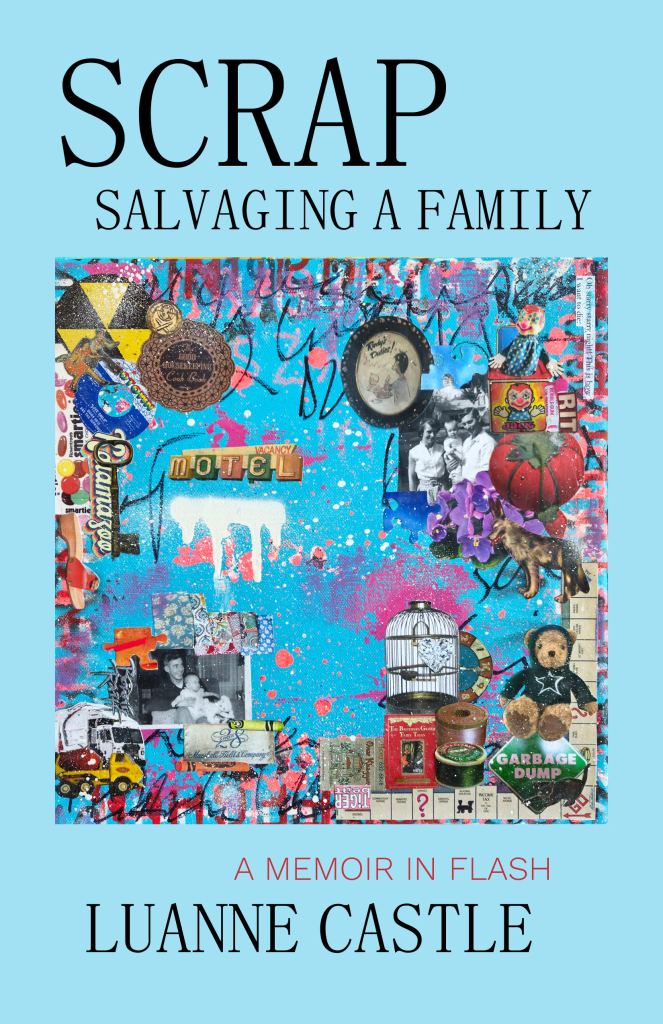
So I decided that rather than spread myself more thinly, I would use this blog for the month of February as my laboratory.  I’ll work on some of my prep and research for my book Scrap.  For this project, I am studying my history and experiences, particularly as they involve my father and our relationship (which looks like both drama masks) and arranging these memories into a new and enriching vision.

I hope you won’t mind coming along and visiting during this nostalgic trips to the fifties, sixties, and seventies.

from Wikipedia

from Wikipedia

23 Comments

Filed under Blogging, Creative Nonfiction, Memoir, Memoir writing theory, Research and prep for writing