Tag Archives: reading

Finding a New Cozy Series

The gardener and I visited our local used bookstore and loaded up a box. I know, I know. I’ve said I have a shelf and a half of unread books. I have a lot of want-to-read books on my Goodreads list. I’ve promised people their books will be read in the next phase. But the gardener was out of his books to read. He reads hardcover-only historical fiction, preferably in Asian settings.  Nothing too specific hahaha. I didn’t happen to have any of those on my shelf, so off we went.

Can you imagine me waiting around in a bookstore with discounted and sale prices and twiddling my thumbs?

All of this is to say It’s Not My Fault.

I thought I’d check out mysteries and poetry. I don’t even bother to look for memoirs because our store rarely has any in stock. Maybe people don’t give up their memoir copies as quickly?

In the somewhat lame poetry section, I found a Billy Collins book, so I grabbed that. But most of the rest were obviously cast-off textbooks/the classics–and I already have those.

In mysteries I had better luck. I prefer cozies. And of cozies I most prefer theatre (those are hard to find) and cats (those are easy to find) and retail shops (antique, book, etc.). What I never thought I’d find would be dolls!

And here they were: 4 wonderful mysteries of the Dolls To Die For series by Deb Baker. The entire short series right in front of me. And guess where they take place? Phoenix! (aka home)

So I brought them home where they are right at home.

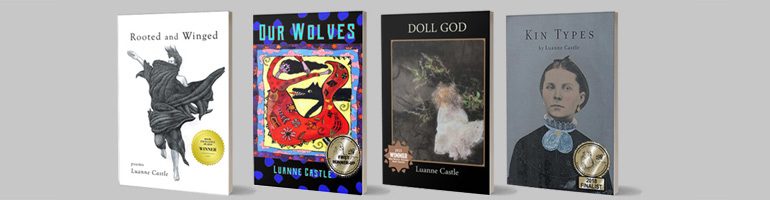
When I lined them up with the doll buggy, I was reminded of a poem in Doll God. “Vintage Doll Buggy” was originally published in The Antigonish Review, a Canadian literary journal. I wrote this poem about war and innocence, focusing on a green doll buggy I’d seen in an antique store. But I happen to have two versions of that buggy–one pink and blue; the other red and white. In the poem you will see why I used the green buggy instead of mine.


Vintage Doll Buggy


“Every Boy Wants a Pop Gun”

— the company’s slogan. And

not just guns, but air rifles,

clicker pistols, caps.

They specialized in the arms

industry for boys in striped Ts.


How this paean to fertility

flowered in that factory, it’s hard

to figure.  Pre-war, maybe 1930s.

Pressed from Ford plant

scrap metal, like the guns.


The inside cups like a clam shell.

Like an embrace.  A sheath.

With a satin pillow, it’s a rolling

coffin, a time capsule.


When the fighting began,

the government banned metal

for toys.  The war effort claimed

even the green paint.  At the factory

they pressed en bloc clips

for the M1 Garand rifle.


Now its wheels bow out,

the green paint

chipped and dulled.

The yellow canopy still reverses.

A calm lingers inside as when

one fingers past a peony’s petals.


castle promotional cover

Click through to Amazon

Nancy Ann Storybook doll with pre-war doll buggy

46 Comments

Filed under Arizona, Books, Doll God, Dolls, Fiction, Literary Journals, poems about dolls, Poetry, Poetry Collection, Writing

Where to Find a Parking Lot Superhero

Just realized that my flash fiction piece “Parking Lot Superhero” was published by Story Shack two weeks ago! Yikes, how did I lose track of time? Speaking of time, the magazine gives an estimate of five minutes to read it ;).

PARKING LOT SUPERHERO

The story was illustrated by artist Hannah Nolan.

Thanks so much to the editor Martin Hooijmans and to Hannah.

This is my first attempt at flash fiction.  I like how fiction gives me more freedom with structure than nonfiction does, and the flash length is fun to work with. It’s challenging to be concise but also rewarding to complete a story that is this short.

Do you read and/or write flash fiction that isn’t serialized? Where the whole story has to be read in five minutes? Do you prefer flash fiction or the traditional short story length and why?

####

Pic of a vintage police car found just outside the Grand Canyon. With a character like Jack (in my story), the protagonist and her friend didn’t need the police.


18 Comments

Filed under Fiction, Flash Fiction, Literary Journals, Publishing, Reading, Writing

Elephants in My Room

The other day I finished reading my first Jodi Picoult book. I chose Leaving Time without knowing anything about it because it was available at the used book store (if I write used bookstore, doesn’t that mean that the store is secondhand?). It was cheap, and I wanted to see what her writing was like.

It was serendipity that the book turned out to be about elephants because I had just finished reading Sara Gruen’s Water for Elephants. Maybe some readers would say, “Oh no, not more elephants.” But not this animal lover. I can’t get enough elephants.

By the way, remember my mother-in-law, the artist who painted the murals at The Birdland nightclub? She had a collection of little elephant statues that I inherited. I have them stuck to a shelf with museum putty so I couldn’t arrange them for a photo. This is how I have them jammed in, along with her Birdland and Stork Club memorabilia (sigh).

What a mess

Anyway, I loved both books . . . a lot. Gruen’s novel is highly acclaimed. A movie was made of the book. As is typical, I haven’t seen the movie. It’s a story about a young man who travels and works with a circus. He takes care of the animals, including a beautiful and highly intelligent elephant that only understands Polish.  My Goodreads review is short because I’ve been too short on time lately for writing reviews.

Loved this book. I was so worried about the ending, but the ending turned out to be perfect.

Picoult’s book is a little more complicated. The average Goodreads star rating is 3.91. That’s pretty decent, but it’s comprised of some 1s and 2s. This is what I wrote in my review:

I’ve read some of the Goodreads reviews of this book, and I think I understand why I give this book a 5 and some others give it a 1 or 2. This is a book that appeals to a soft heart for animals. Picoult skillfully teaches me so much about elephants and their brilliant, creative minds and big hearts–and I don’t even feel as if I’m being taught. I feel as if I am living with the elephants. If you are mainly interested in humans and don’t feel a kinship with animals you might think that the book feels as if there are odd gaps at times–explainable by the story being told from multiple points of view. It might even seem a little jerky occasionally because of this. That is all understood by the end of the book (the twist), so it makes sense. Not my absolute favorite story without the elephants, but the elephants are the stars of the show–AND VERY WELL WORTH THE READ. in fact, I wish everyone would read it to learn more about them and to help them survive before it is too late and they are all gone.

One of the really cool aspects of the novel is that it comes with a prequel at the end that gives additional information about the elephants. Another is that one of the elephant sanctuaries in the book is the real one that exists in Tennessee. That is on my bucket list along with Cleveland Amory’s Black Beauty Ranch. Check it out!

When my son was in high school, he and I picketed the circus together–all over their treatment of the animals, especially the elephants. So imagine my excitement a few months ago at hearing that Ringling Brothers was giving in to the will of the people fighting for the health of the elephants by retiring all their elephants!

One of the most meaningful books I’ve ever read was Jeffrey Moussaieff Masson’s nonfiction When Elephants WeepIn it he makes an airtight case for the emotional life of elephants (and other animals). In his book I first learned that elephants have been known to create art!!!

When Elephants Weep

Now I’m looking for more elephant books to read. Has anybody read The Elephant Whisperer?

#amwriting: Yup, I’ve been getting my chapbook in shape, so that gives me a feeling of accomplishment. And now my daughter is visiting with her kitty. YIPPEE!!!

56 Comments

Filed under #AmWriting, Book Review, Cats and Other Animals, Fiction, Nonfiction, Reading, Writing

Pinched Ideas on Recommending Books

In March I have a flash nonfiction piece coming out in a journal called Toasted Cheese. I will post a link when it’s published. The piece is called “And So It Goes,” and it’s the story of my great-great-grandparents who immigrated from Goes and Kloetinge (Netherlands) to Michigan. It’s meant to be part of the family history chapbook I plan to put together.

If you’re a writer or want to write, I think you might want to check out and follow the Toasted Cheese website. They are very interactive and provide DAILY writing prompts and creative articles about writing and reading. Here’s a sample article from this past December. The subject is book recommendations.

***

What Do You Recommend?

A Pen In Each Hand

By Baker

  1. Recommend on social media at least one thing you’ve read this year. If you don’t use social media, recommend in person. Independent authors are particularly grateful for recommendations.
  2. Create some recommendation business cards and leave them with your favorite works in the bookstore. You can print them at home. They could be as simple as the word “recommended” with a thumbs-up or a shelf card that lists why you recommend the book. Don’t put stickers on or in the books.
  3. Ask for recommendations at a used book store and/or independent bookstore. If you’re lucky, your local chain bookstore will have fellow book lovers who are well-versed enough to recommend as well.
  4. Recommend a book to a friend on Goodreads.
  5. While you’re there, write a recommendation of a book. If you’re stuck for one, think of a book you discovered on your own and write the review as though you’re speaking to your younger self.

***

What do you think of those recommendations? Do you do any of them? Or do you finish a book and move onto the next and squirrel away your reaction in your own mind?

***

Kana playing with her activity board

This toy is pricy, but it’s rewarding to see cats hunting for their food (without any resulting tragedies to small animals). This is an activity that is natural for them.

33 Comments

Filed under Book Review, Books, Creative Nonfiction, Essay, Family history, Flash Nonfiction, Literary Journals, Nonfiction, Publishing, Reading, Writing, Writing Talk

Lyrical Experimental Flash Nonfiction Bug Struck Me

Cover art by Alex Walsh
Issue 45.1
Winter 2015

Table of Contents

Special Feature: Honoring Alan Cheuse

  • Nicole Idar & Elizabeth Gutting, “Alan Stories”
  • Michael Cowgill, “Major Key”
  • Priyanka A. Champaneri, “Lessons from AC to PC”
  • Nicholas Delbanco, “A Chapter in a Long Tale”
  • And back from our winter ’88 issue, Alan Cheuse’s “Bio”

Fiction

Nonfiction

  • Jason Arment, “Fear City”
  • Luanne Castle, “Ordering in Four Movements”
  • Gail Griffin, “Gloria”

Poetry

  • Drew Attana, “Parallel Parking”
  • Brian Ma, “Mirage Roche”
  • Ellen Noonan, “Ditto”, “Certainty”
  • Heather Bartlett, “A Mockingbird Sings”
  • Katie Willingham, “Let’s Hope Kepler-186f Is Baren”, “Honey Locust”
  • Monika Cassel, “Feeding Cake to the Storks”
  • Felicia Zamora, “No Fisher”
  • Shareen K. Murayama, “Exploded as in Fairy Tale”
  • Amy Jo Trier-Walker, “Prowl the Marriage Away”
  • Phoebe Reeves, “ˈƐƏˌtaɪt (airtight)”
  • Vanesha Pravin, “Dialectic Through a Stained Glass Window”
  • Champa Vaid, “Neither Sleep nor Death”, “Tree of Memories”

Editorial Staff

  • Fiction Editor: Lina Patton
  • Poetry Editor: Qinglan “Q” Wang
  • Nonfiction Editor: Eric Botts
  • Assistant Fiction Editor: Sarah Bates
  • Assistant Poetry Editor: Douglas Luman
  • Assitant Nonfiction Editor: Kerry Folan
  • Faculty Advisor: Eric Pankey

Readers

Betsy Allen, Sarah Batcheller, Kristen Brida, Edward Capobianco, Andrew Cartwright, Christina Crockett, Sarah Davis, Kyle Freelander, Kelly Hanson, Michael Hantman, Frank Harder, Darcy Gagnon, Ariel Goldenthal, Kelsey Goudie, John Guthrie, Stephanie Klien, Joey Kuhn, Madison Lennon, Isaac Lewandowski, Lisa Macedo, Janice Majewski, Yousra Medhkour, Katie Ray, Katie Richards, Rebekah Satterwhite, Cloud Spurlock, Melanie Tague, Alex Walsh, Madeleine Wattenberg, Sarah Wheeler, Lily Wright

Special Thanks To

Leslie Steiger, David S. Carroll, Kathryn Mangus and the George Mason University Office of Student Media, Eric Pankey and the George Mason University Creative Writing Program.

Leave a comment

Filed under Creative Nonfiction, Essay, Flash Nonfiction, Literary Journals, Memoir, Nonfiction, Publishing, Reading, Writing

Go, Read, Enjoy!!!

Let’s talk about Sheila Morris‘ new book The Short Side of Time. It’s a collection of some of her best blog posts. Click through the cover image to order her book.

I’ll let the blurb I wrote for her book (yes, she asked me to write a blurb–woohoo!!!) describe The Short Side of Time:

These hand-picked treasures from the blogs of Sheila Morris showcase her humor and heart while immersing the reader in the day-to-day life and decades of experience offered by a lesbian now on the “short side of time.” Morris loves her sports teams, the written word, and her friends. What means the most to her, though, is family, including her partner Teresa, her dogs, and her late grandmother. Morris’ lively and thoughtful voice draws readers into the drama of her Texas upbringing, as well as how recent milestones for the LGBT community have contributed to her life.

Sheila and I first met through her blog about her dog The Red Man, Red’s Rants and Raves, and my family history blog The Family Kalamazoo.  Red writes the blog posts in his own voice, which is very appealing to this animal lover. Sheila has two other blogs, as well. Imagine my surprise when I first read I Will Call It Like I See It, written in Sheila’s voice, rather than Red’s! Sheila showcases her photographs on The Old Woman Slow’s Photos. Slow is what Red calls Sheila. Sheila’s partner Teresa is called Pretty. After reading Red for a long time, I had to get used to thinking of them as Sheila and Teresa, rather than Slow and Pretty!

One of the most distinctive qualities of Sheila’s writing (and there are several) is the way she uses humor. She uses it liberally, yes, but also with a carefree flourish that I admire.  She is someone you would want to have around you a lot, maybe a coworker who works in the same space, or a friend you spend a lot of time with.  Since that isn’t possible for most of us, reading her new book is the next best option. Then, if you haven’t yet, read her memoir, Deep in the Heart. You can read my review of that book on the post “A Lesbian in Mayberry.” You’re going to want to get your hands on a copy of that one, too!

Go, read, enjoy!!!

I’m closing comments today because I have to travel so please take the time to go check out one of Sheila’s three blogs!

***

1 Comment

Filed under #AmWriting, Book Review, Books, Essay, Memoir, Nonfiction, Reading, Writing

Reading from The Book

On Sunday, I gave a poetry reading in Redlands, California, at the State Street Deli and Cafe. It was organized by Carla McGill, who did a fabulous job of it. Before I read, Carla read some of her own poetry, as did two other poets. After the event, I was able to sell and sign some copies of Doll God. Although I get nervous speaking in public, I really do love reading my poetry aloud. Actually, I love reading poetry aloud, period.

You know what I notice in this photo? How messed up my scarf got. What a shallow mind.

Here are a couple of clips of the reading. In the first I read “American Girl,” “Effigy,” and “Calculating Loss”–all poems from the book.

and in this clip I read a new poem about my great-grandmother.

60 Comments

Filed under #AmWriting, Book promotion, Books, California, Doll God, Dolls, poems about dolls, Poetry, Poetry book, Poetry Collection, Poetry reading, Writing

Crack the Spine Interviews Luanne

Mid-September my story, “Small Solace,” was published in  Crack the Spine Issue 163. Some of you read it at that time and those of you who commented helped get me an interview with the journal, so thank you!

The interview was published today. You can find it here.

A big heartfelt thanks go to the editor, Kerri Farrell Foley!


Leave a comment

Filed under #AmWriting, Fiction, Interview, Literary Journals, Publishing, Reading, Writing

Adding Fiction to My Poetry and Memoir Resume

You know how I’m always yammering about poetry and memoir? Well, darned if I didn’t get a short story (fiction!) published today in Crack the Spine. Called “Small Solace,” it’s a little bit weird. I hope you enjoy it. If you do, please go to one of the magazine’s sites and post a comment of some sort about it. That’s because they use feedback to determine what pieces go into a print issue and which writers they do a Wordsmith interview on (they only choose one author each issue).

Here is the issue–look for page 27:  Crack the Spine Issue 163

I did warn you that it’s a little weird. Yes, the wallet image here is a clue as to the subject.

Here are some places to leave feedback:

Comment form below issue link

Facebook

Twitter

Crack the Spine website

Or email them at contact@crackthespine.com

Thanks so much, peeps!

25 Comments

Filed under #AmWriting, Fiction, Literary Journals, Publishing, Reading, Writing

A Group Journey Out of Homelessness: A Book Review

I was born with the desire to know what it’s like to live more than one life. If you’re a reader, you understand what I mean. That’s why we read. For the time it takes to read a novel or memoir, we can get inside someone else and look through his or her eyes at the world around us. Better yet, we can hear that writer or character’s heartbeat.

When I choose a book I tend to choose a memoir or fiction that is closely tied to one protagonist. But I just finished a book that is a compilation of memoirs by a group of writers.

These writers are bound together by a writing class and a commonality: they have all experienced being homeless. Writing Our Way Home is subtitled “A group journey out of homelessness.” Edited by southern writer and blogger Ellen Morris Prewitt, whose touch is so light her name is not on the cover or title page, this book weaves together the stories of fifteen writers and organizes them thematically.

I began reading slowly because I wanted to isolate and listen to individual voices in the group and not confuse them with each other. I needn’t have worried. Very early on, I began to “hear” who was “speaking” within the first sentence or two of each brief entry. I listened to Leroy Scott’s straightforward prose, Cynthia Crawford’s engrossing storytelling, Tommy Payne’s brilliant and varied writing style, Latasha Jackson’s pattern of detailed imagery (sipping peach wine in the bath, the lost doll collection), and other unique voices. As Tommy himself says, “It is easy to tell a book written by James Michener from a book written by Ian Fleming. An Ernest Hemingway novel from a play written by Shakespeare.” And so it is with these writers.

Most importantly, I learned what these fifteen people had to say about their own lives and about the condition of being without a home.

The book developed from a writing class that Ellen teaches in Memphis. The class and the Door of Hope organization that runs the class seem to be based in Christian teachings, although I don’t find much about religion on their website other than that they offer contemplative prayer classes, as well as creative writing.

If you have ever—even once–looked at a homeless person and forgot that he or she has a whole history of living, relations, emotions, and past belongings, as well as current needs, hop over to Amazon and pick up a copy of this book! If you want to find out if you should give a handout to someone who asks, you will find eleven answers.

Now that I’ve read Writing our Way Home and had time to let it settle into my bones, I feel it’s permanently changed me. A big thanks to Roderick Baldwin, Donna Connie, Cynthia Crawford, Jacqueline Crowder, Veyshon Hall, Tamara Hendrix, William L. Hogan, Jr., Latasha Jackson, Anthony Johnston, Robbin K., Rhonda Lay, Jockluss Thomas Payne, Leroy Scott, WJS, and Master Major Joshua Williams for inviting me into your lives.

21 Comments

Filed under #AmWriting, #writerlife, Book Review, Books, Essay, Inspiration, Memoir, Nonfiction, Writing