Tag Archives: reading

You Wanted to Hear What That Flash Nonfiction Course Was Like?

Marie from 1WriteWay and I completed our Flash Essay on the Edge course. It was offered by Apiary Lit, which offers editorial services, as well as courses they call workshops.

The course instructor was talented writer and teacher Chelsea Biondolillo. Her prose has appeared or is forthcoming in Brevity, Passages North, Rappahannock Review, Hayden’s Ferry Review, Shenandoah, and others. She has an MFA from the University of Wyoming and is a 2014-15 O’Connor Fellow at Colgate University. You can check out Chelsea here or do a search for her pieces in online magazines. Her knowledge of the genre and generosity to share that knowledge with her students was outstanding.

I took the course because I hadn’t written for months, mainly because of my father’s illness and death. Knowing the way I operate, I figured that a course would force me to focus and get a little writing done.

As planned, Marie and I evaluated the course when we were finished. We are both posting a list of the pros and cons of the course, as we saw it. At the end of the list, I’ll give you my additional impressions. Check out Marie’s post because she will give her own impressions.

Course Textbook

PROs

  • The teacher prep was outstanding. She provided a wealth of readings, which were useful in showing me what flash nonfiction can look and sound like.
  • The course was only four weeks, so I found that to be very manageable. If it had been longer, I would have been too stressed during the summer and at this time in my life.
  • The instructor generally gave useful feedback, seemed qualified in the subject, and was very nice. She seemed to love her subject.
  • The instructor was accessible, responding within the same day if there was a question or concern.
  • Other than a problem I will list under CONs, the website was pretty easy to negotiate.
  • The online classroom had various forums that enabled you to share your work with the other students and have discussions.
  • The writing prompts were generally interesting, but I didn’t feel tied to them, which was good.
  • The course was not graded.  I could focus on what I wanted to turn in, not what I thought I had to turn in in order to get an A.
  • The course got me writing without adding stress to my life.
  • I got more writing done in this past month than I would have otherwise.
  • I feel that I know where to go with flash nonfiction now. It would be ideal to get more feedback down the road on attempts at Flash Nonfiction, but at least I feel much more comfortable with the genre from taking this course.
  • Above all, I had fun with the readings and the writing.

CONS

  • Although there were forums available, we had no real discussion of any of the readings. We were not strongly encouraged to interact with each other. We had maybe one discussion prompt during the whole course.
  • The readings and essay examples were available through either some kind of Adobe program that took a bit of time to figure out, or through hyperlinks that weren’t always easy to download.
  • We posted our written assignments privately to the instructor so I had no way of learning from what others had turned in or from reading instructor comments on the work of others. I didn’t care for this method as it diminished what I could learn from the course by a hefty percentage. I suppose this is the difference between the workshop method and a traditional style class.
  • We felt isolated in this class and had little interaction with anyone but each other and the instructor.  In the discussion forum, one other student interacted with us, and another made a couple of independent comments.  Other than that, it was a strangely quiet class.
  • Two platforms were used for the course:  an online classroom and a blog, so sometimes I had a little trouble negotiating the course. Sometimes I had to login in two places. This inconvenience turned out to be less of a problem than I first anticipated, but it could be streamlined.  The blog material could have been included on the classroom platform.
  • Since I don’t know how many people were in the course, I don’t know the instructor’s workload. My belief is that in a course that is short in length, the instructor should return assignments in short order. The lag time between turning in an assignment/beginning reading for a new lesson and getting the instructor’s feedback on my previous assignment was a little too long for my comfort.
  • The price at $199 was a little steep for four weeks and no discussion/no workshopping.

***

 I want to make clear that I am really glad I took the course. Apiary hired a qualified instructor and offered a solid, contemporary course. There was so much that was right about the course. But I think it needs a little tinkering to make it better in terms of both learning environment and the economy of the course.

The above list really hits the main points of what I liked and didn’t care for about the course. The oddest thing for me was working in such an isolated environment. I’ve been in many workshops, and this isn’t a workshop. In workshops, your work is presented to the teacher and classmates. Typically, you receive feedback from both the instructor and at least a fair number of peers. I learn this way from what several people have to say about a piece. And I learn a lot from reading the work of others and seeing what all, especially the instructor, have to say about a variety of writing.

That said, there are people who hate workshops, generally because they have had a bad experience with one. I also find it fun to diss them sometimes. But, overall, they are an effective way to improve one’s writing.

The class seemed eerily quiet, perhaps because it wasn’t a workshop. But if we had had discussions about our readings, that would have provided some connection between students.

One other student (besides Marie and me) did participate in the class as much as possible. The course had a feature that she and I both used. It was called the Work-Sharing Blog. We were allowed to post anything we wanted to and see if anybody would give us feedback. It was not encouraged by the instructor or the course setup, but this other student and I both took advantage of it. I was thrilled to get feedback from her and from Marie on a piece I’ve struggled with.

I’ve taken online writing courses from a variety of schools/companies. They all have their pros and cons. For what I wanted this summer, Apiary’s course satisfied me fairly well.

If you are looking for an online writing course, my suggestion would be to decide how you want to learn and then ask questions. If you want a workshop, ask if all students will be sharing their work with the class and if the class will be providing peer feedback. Will there be guidelines for providing that feedback? The guidelines protect the writer from snarky or downright mean classmates. If you don’t want a workshop, ask those questions, too. Be aware that the majority of online writing courses are workshop-based.

Have fun! It’s so rewarding to get motivation, specialized readings, and writing feedback all in one place.

Once I get my thoughts together on the subject, I’ll post something about the genre of flash nonfiction, to give you an idea of what we were working on.

53 Comments

Filed under #AmWriting, Creative Nonfiction, Editing, Essay, Flash Nonfiction, Inspiration, Literary Journals, Memoir, Memoir writing theory, Nonfiction, Research and prep for writing, Writing, Writing goals, Writing prompt, Writing Tips and Habits

Summer Reading

Marie from 1WriteWay and I are finishing up our Flash Essay course. We’ll be posting about it before too long. I’ve had a very full work and personal (not fun stuff) schedule this summer, so adding that course was a bit much, but it did get me writing again. That’s always a good thing, even if just for my mental outlook.

I’m enjoying having Nakana part of the household but because of travel and a non-recorded leukemia test on Nakana I’ve had to wait to introduce her to the other cats.  I’m sure they wonder who that is behind the closed door! Tiger is especially curious and waits in the hall for me when I’m with Nakana.

I’m reading two books right now. One is Writing Our Way Home, a collection of writings by people who have been homeless, edited by WordPress blogger and Southern writer Ellen Morris Prewitt. I’m going slow and savoring.

41EaKva8i8L._SX331_BO1,204,203,200_The other book I’m reading is one suggested for class: The Rose Metal Press Field Guide to Writing Flash Nonfiction:

FlashNonFiction_200Because I am way too overtired this summer, I am falling asleep the minute I sit or lie down, so reading books where I can read in digestible chunks is wonderful. These are both well worth putting on your list.

As I move into the August hubbub and end of summer doldrums (brief pause to hurriedly look up “doldrums”–yup, that fits–“a state or period of inactivity, stagnation, or depression,” but I think I also meant dog days, which are the hottest days and a period of sluggishness), I might post less regularly. I try to usually post Mondays and Thursdays, although sometimes I add in an extra or switch a Thursday for Wednesday or Friday. But I don’t plan on sticking to any particular schedule in August. Then I’ll re-start my regular schedule in September. I’ll be checking on your blogs as I get online!

If you are still thinking of picking up a copy of Doll God, it’s also a book that can be read in small chunks–a poem a day, for instance.

castle-promotional-cover

About summer in Arizona, Doll God has this to say:

the heat hints at its future
when all will be blue blue blue.

Blue sky over everything. Only here in Phoenix is blue not a cool color, but a FLAME HOT color!

30 Comments

Filed under #AmWriting, Blogging, Book Review, Cats and Other Animals, Doll God, poems about dolls, Poetry, Poetry book, Poetry Collection, Reading, Writing

Memoir Review: My Grandfather Would Have Shot Me

It’s not been such a great week. I closed comments on Monday’s post. Then I realized I couldn’t respond to comments when they were closed. I don’t know why that is, but apparently that is how WordPress operates. But know that I read your birthday wishes and thank you for them!!!

I’m going to try to pretend that the week has suddenly and miraculously taken a turn for the better and just move on. (Nothing big wrong–just very disappointed in humans. Well, maybe that is big).

I haven’t reviewed a memoir in months, but I’m back doing it today. The story in a nutshell will show you why this book tells a sensational(istic) tale, but also why it’s an important book to read.

Here’s the nutshell. The daughter of a white German woman and a Nigerian man, Jennifer Teege was born and raised in post-war Germany. She was adopted at age 7 by a German family. She ended up in Israel where she attended college, learned Hebrew, and made lifelong Israeli friends. At age 38, she learns that her grandfather was a famous Nazi, Amon Goeth. If the name doesn’t ring a bell, think harder. Think of Ralph Fiennes in the movie Schindler’s List. THAT Amon Goeth. (Shudder).

Amon Goeth

Yes, Amon Goeth had a black granddaughter who was born in 1970, long after he died.

Teege’s memoir is a very important book because of its great historical, psychological, and philosophical consequence. I’ve read a lot of Holocaust memoirs, but most of them have been from the perspective of the Jewish survivors and sometimes, like Anne Frank’s diary, the dead victims. This book examines the consequences for the descendents of the Nazi perpetrators—both 2nd (like Jennifer’s birth mother) and 3rd (like Jennifer) generations

Additionally, Teege’s perspective is unique because she herself is biracial and grew up in a transracial household—the only non-white family member. Teege also carries the baggage of an adoptee who suffers from abandonment issues.

In this story, we see her life as a child with her mother, Monika, and her grandmother, Ruth Irene Kalder, the mistress of Amon Goeth. That would be the mistress who lived on the premises of Płaszów, the concentration camp where Goeth routinely tortured and killed people.

We see her life with her white German family. Although her parents suffered from parenting and post-war issues themselves, they were kind, but clueless about parenting an adopted biracial child. That makes for an ambiguous relationship. But one of the most heart-warming aspects of the book is the relationship Teege had with her two brothers, the biological children of her parents. She was close to them from the beginning—and the closeness has lasted, particularly with her brother Matthias.

We see her eventually search for her biological father. And we see her reconnect with her Israeli friends (who have lost family in the Holocaust) after learning about her grandfather.

We also see Teege visiting Płaszów twice. One occurs right after she learns about her grandfather and after she has miscarried. The second occurs after she has had time to process this terrible news about her origins and hours after her father dies.

How history has affected Teege’s life, both before she knew the truth and afterward, makes for a fascinating read.

On Goodreads, I gave the book 4 stars because it didn’t have the greatest structure. If you notice the intensity flag in the middle it’s because of how she goes back to talk about her childhood. It’s all important to the overall story, but after such heavy-hitting information about the Nazi camp in the first chapters, it feels like a book about adoption for a little while. That’s ok, though, because it helps to learn so much more about Teege.

This is a book that should affect every reader in profound ways. What a story Teege has!

###

I should mention that the book was co-authored by Nikola Sellmair, a German journalist. The book shouldn’t be read as a work of creative nonfiction in the way of Mary Karr books, but is interesting in how it gives two viewpoints throughout–that of Jennifer Teege in traditional first person memoir and a more objective viewpoint from Sellmair (differentiated by different font).

31 Comments

Filed under Book Review, Books, Memoir, Nonfiction, Reading, Writing

More Tsuris: A Cat’s Tale of Mourning

We had a close call this past week. As you probably know, I lost my father in May. Then a week and a half ago, I lost my oldest cat Mac. It’s been a rough year.

For at least a week, I actually forgot my first book,  Doll God, was published this same year! I am not kidding either. What kind of ridiculous year is this?!

Anyway, 3 days or so after Mac died, cat #2, my sweet dear Pear Blossom, stopped eating! If you have or have ever had a cat, you might know that cats cannot go without food. Their livers go haywire. It’s very dangerous. I tried everything: a dozen kinds of canned food, fresh chicken, tuna, treats, kibble, egg, tiny hotdogs for babies, you name it. I had to resort to feeding her baby food (Gerber 2nd foods are the ones you want–safe and healthy for cats) with a syringe. I could get about 5-7 ccs in her before she would let it ooze out all over the couch. Yes, the couch because she wouldn’t move from the couch. For days she lay there.

I hadn’t had much time to grieve my father before Mac became sick and died. Now I had had no time at all to grieve Mac and my darling booboo girl looked as if she were going to die.

After $1,000 in vet bills (see how blithely I just wrote that hahaha), she seems to be coming back a little. The only medical problem they found is a UTI (she and my human daughter are both prone to those). But hubby and I are sure that she is grieving Mac.

It’s understandable. She is 15 1/2 and we’ve had her for 15 years. She was inseparable from Mac in those 15 years. In fact, and go ahead and think I’m weird (er), but I have a very long kitchen counter and have 3 cat beds lined up on it. She slept there every day with Mac and Felix. Tiger prefers to sleep elsewhere. Pear refuses to lie on the counter now.

Pear Blossom as Judge Judy

I’m praying she begins to eat better. She refuses most food I offer to her. But she seems to feel a little better.

POLL RESULTS: where do creative nonfiction writers come from?

Well, that wasn’t the name of the poll, but that is sort of what I was angling for. Here is a graphic of the results:

poll results


What I had wanted to know is what brings people to writing creative nonfiction. I was intrigued to read that many “never or rarely” write creative nonfiction. I’m pretty sure that a lot of blogs are creative nonfiction, rather than journalism, because as bloggers we can’t help but create public personas by what we write. If we write about our own lives at all, I would call it CNF.

It surprised me that not many others wrote poetry first and then moved to CNF, but I wasn’t surprised that many started with fiction. I read another nameless article that said that writers shouldn’t write more than one genre. I think it was mainly focused on “genre fiction,” but why can’t a writer write in another genre? Judy Blume has written for children and adults, and if that isn’t crossing genres, I don’t know what is. One book opens with a little girl praying to God. Another book opens with a man playing with his penis while an adult woman and mother watches. Hah. Better know which genre Blume book you’re buying ahead of time! Marie from 1WriteWay and I discussed this recently.

Did a book ever surprise you because you expected a different genre? Was it a pleasant surprise or a shock? A penis instead of a prayer? (Or a prayer instead of a penis?)

50 Comments

Filed under Blogging, Books, Cats and Other Animals, Children's Literature, Creative Nonfiction, Doll God, Fiction, Memoir, Nonfiction, Poetry book, Poetry Collection, Reading, Writing

Formula Gets a Bad Rap

As a reader, I appreciate books with unique storylines and characters. As a writer, I try to create unique stories and poems. So why am I also drawn to books that seem to be written according to a pre-set formula?

Yeah, I know, right? Such a no-no. Definitely not “literature.”

According to my buddy Wikipedia, formula fiction is described like this:

In popular culture, formula fiction is literature in which the storylines and plots have been reused to the extent that the narratives are predictable. It is similar to genre fiction, which identifies a number of specific settings that are frequently reused. The label of formula fiction is used in literary criticism as a mild pejorative to imply lack of originality.

Still, there is a lot of comfort in finding a series of cozy mysteries where I enjoy the protagonist, the setting, and the first murder–over and over again.

Formula fiction refers to a single book or a series. A book itself can be formulaic in that it is predictable. But book series sometimes are formulaic in that they set a formula for each book of the series with the initial book. Some book series are not like this. For instance, trilogies are often completely different stories, following characters over different plotlines. But a heck of a lot of the series you see on the shelves at the library and the bookstore are formula fiction.

For instance, every Agatha Christie book I read when I was in my 20s ended on page 210. Seriously. Who knew she wrote formula fiction?!

Years ago, I liked the mix of cats and murder in The Cat Who books by Lillian Jackson Braun, so when I ran out of unread books, I turned to another cat mystery series: Mrs. Murphy by Rita Mae Brown. Mrs. Murphy is, of course, a cat that solves mysteries.  Once I read the first book in a series I like, I want to keep going in this land I know peopled by characters I know.

I’m the same way about disaster movies. Don’t give me some extravagant budget movie with Denzel and Brad (am I showing my age with them? at least I didn’t say Harrison), please. I like the cheesy ones where the mom, the dad, the boy, and the girl (sometimes 3 kids) gets separated and you know they will be back together by the end of the movie. I know just what I can count on and that the movie won’t allow something strange and “unique” to happen. I want to lie on the couch, maybe eat some popcorn, and relax.

But are reading cozies and watching low-budget disaster flicks like eating McDonald’s and bonbons? Should I figure out a way to limit my reliance on comforting formula literature and entertainment? Is consuming unique literature like eating my vegetables or swallowing my vitamins?  Maybe Nancy Drew and her cohorts ruined me and gave me a taste for formula fiction when I was just a fresh young reader. I should have read that copy of Melville’s Billy Budd I got from Scholastic instead!

The more I think about this, the more I wonder how I ever stay in “balance” in my reading!

Nancy Drew collectionWhat about you? Do you balance your reading? Do you like formula fiction or try to avoid it?


59 Comments

Filed under Books, Cats and Other Animals, Children's Literature, Fiction, Reading

My Fiction Reading During National Poetry Month

Although it’s poetry month, I’ve been reading fiction lately as a little break from poetry and memoir.

I chose well because I enjoyed all three books. These are the reviews I posted (pretty much word for word) at both Amazon and Goodreads.

My favorite of the three was It’s In His Kiss, written by Vickie Lester who blogs over at Beguiling Hollywood. This contemporary murder mystery is set in present-day Palm Springs and Los Angeles. I know the time period because the characters own cell phones, but the ambiance, shenanigans, and secrets come from a long-time Hollywood tradition that features real life mysteries such as the Black Dahlia murder, George Reeves (Superman), Bob Crane (Hogan’s Heroes), and maybe even Natalie Wood and Marilyn Monroe.

I was hooked very early on–in part because of the compelling story and in part because after a whirlwind romance (hook-up? you decide–I don’t want to give anything away) the reader is slammed with a shock. Lester keeps shaking the reader up as one Hollywood secret after another is divulged. She’s a master at creating believable southern California characters (main character Anne’s father Bob stepped off the page and into my kitchen), but even better at her precise and breathtaking descriptions of the city. She knows the roads, the landmarks, and how it all fits (and doesn’t fit) together better than anybody I’ve read in a long time.

Lester’s witty approach fits the subject and the culture well. I appreciated the occasional nod to pop culture. For instance, she calls a scary pseudo-religion “Clientology.” These touches give the book the feeling of a roman à clef which heightens the illusion of reality. And when it came time to reveal the mystery, I was shocked, but thrilled to discover a satisfying conclusion. If I were you, I would jump through the book image to Amazon to order It’s In His Kiss.

Next up is Ape House, written by Water for Elephants novelist Sara Gruen.  I have been captivated by nonfiction stories of animals learning to communicate on human terms since I was in high school. I used to teach Koko’s Kitten to future teachers because I hoped they would share the importance of interspecies communication with their own students one day.

This book takes the real story of Gruen’s experiences with bonobos who can sign and adds lots of excitement. It’s a fast-paced mystery, adventure, and love story. That’s a good thing because it ought to bring home to readers the story of primate communication with humans to readers who don’t know anything about it. It’s a quick read and even if your life is chaotic you can get “into” the book immediately. This was a 4 star book, although I can understand why some people would give it a 5. I think it tried to be a little more serious than it really was, which is why I give it a 4.

Finally, I wanted a light historical mystery, so I chose The Anatomist’s Wife by Anna Lee Huber. This book turned out to also be a romance, in a Gothic sense. I’m looking forward to the second book in the series. Lady Darby is an artist which makes her very appealing. A few times I felt annoyed at the contemporary perspective on women’s issues taking me out of the scene and setting. Lady Darby has enough clothing for a much wealthier woman, too, but the dress descriptions make for delicious reading. One gripe I had was that the frequent mention of the green cloak was belied by the red one on the woman on the cover of the book. Why can’t a cover truly represent what lies within? I gave the book a 4 star rating based on the quality for its genre. I don’t expect it to be something that it isn’t. But if you judge it against the two books above, it’s a 3 star.

I’ve ordered more books to add to my to-be-read stack, not because I have a lot of spare time ahead, but because it’s very comforting to have plenty of books to read.

How about you? Does a stack of unread books comfort you or stress you out?

36 Comments

Filed under Book Review, Books, Fiction, Novel, Publishing

Reading to the Kitties

I’m happy to report that the cats at the shelter are fun to hang out with! There weren’t a lot of cats the night we worked because the others, including all the kittens, had been adopted (yay!!!). We were able to play ball with the free roaming (in the cat room) cats. Henry and Bobbette were the big scorers. Four cats were in kennels. I didn’t know why at the time, but I have since gotten the low down. Two of them I could have let out while I was there. I feel bad that I didn’t, especially for the black cat who really seemed to want to interact more with me. The other two are too hard to get back in their kennels, and I wouldn’t have wanted to “go there” on our first visit. The reason two of them have to be kenneled when they are alone is because one of the other cats doesn’t leave them alone otherwise.

Then I read them three stories that were up on my WordPress reader at that time. I looked for story-stories that were appropriate for cats.  No 50 Shades of Grey allusions for these cats under my watch ;). I read “the bingo ladies of old / Tess Tales” by Kate Crimmins, “Hennie Kirstein’s Well” by Amos van der Merwe, and “Does Kindness Matter: My Grandmother’s Legacy of Love” by Kristin Shaw on the Kindness blog. I animated my voice and gently acted out the stories. This was the perfect order to read them in, too. All the cats were enthralled and finally, near the very end, they all curled up and went to sleep–tuckered out and happy.


The handsome guy above (even his belly has beautiful markings) is Henry. He’s the king of the room.

 The sweetheart above (she might have a bad eye or is cross-eyed, a bit) is Bobbette. A truly darling cat who loves to play.

The black and white medium-length coat above is Felix. He’s a little shy, but came right out when hubby and I played ball with Henry and Bobbette. He also loved the stories I read to him.

This is the cat room. There are a few kennels along the walls for cats who need to be in there for their own protection when humans are not there or when they are new and acclimating to the cat room. I feel bad that I didn’t let Nakana and Betty out of their kennels, but I wasn’t sure if I could at that time.

Nakana is an all-black beauty. She was so sweet and so desperately wanted me to like her. And I do!

And then Betty might be harder to put back in the kennel, but I suspect she’s like my Tiger, so I am willing to try.

Lest you think Betty is in a small kennel, this is a 3 level townhouse!

I can’t wait to go back. On Saturday, hubby drove the animals who didn’t get adopted home from PetSmart.

For those of you wondering how my dad is doing. He was back at the hospital, very weak, but they got him going again and now he has moved to a short-term rehab facility–very new and nice–and he sounds stronger and happy to be at this place. And guess what? The facility has a dog and a cat!!! 🙂

 Cat lives in the therapy room at my father’s short-term rehab nursing center

45 Comments

Filed under Arizona, Blogging, Cats and Other Animals, Creative Nonfiction, Memoir, Nonfiction, Photographs

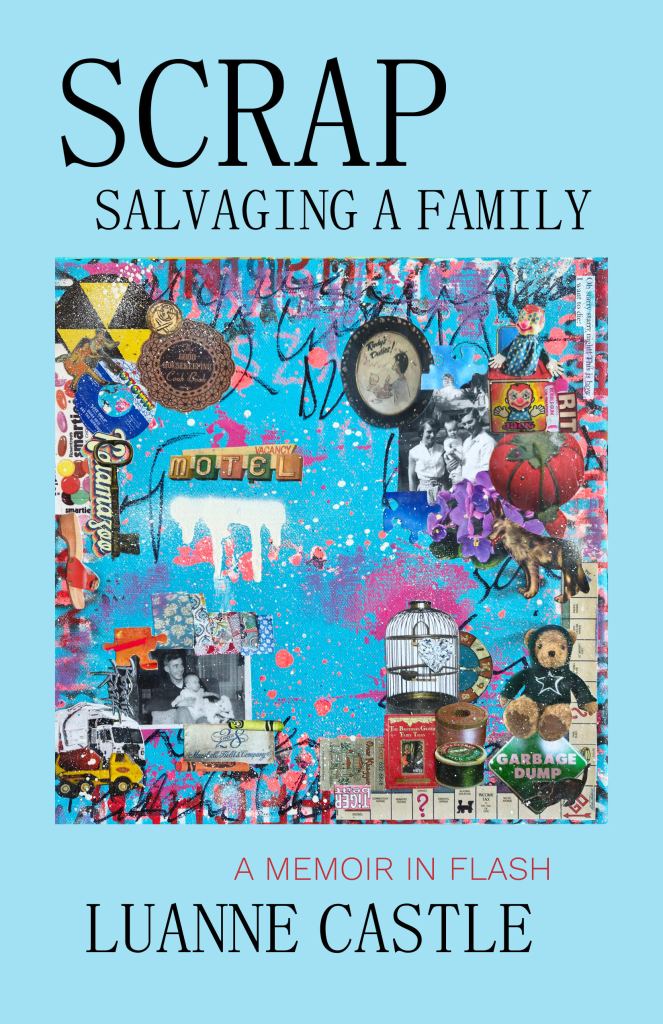
Christmas from the Dumpster

When I was five, Mom had a few days off work over Christmas. She rolled out sugar cookie dough and let me cut out Christmas trees and reindeer with little tin cookie cutters. I sprinkled them with colored sugar before she slipped the trays into the oven.

She led me before the cardboard fireplace hung with our Christmas stockings and pulled out a Bible, which she had marked with scraps of paper tucked here and there. She read the Christmas story to me, but it was one she created herself by mixing the versions in a way that was pleasing to her. The story of the baby Jesus brought tears to Mom’s eyes. We bowed our heads and clasped our hands together and prayed a prayer from my Little Golden Book.

Dad walked in the door, carrying a box. I thought it would be a Christmas present he planned to wrap downstairs on the ping pong table which he had set up with all his gift wrapping materials and tools. But it turned out to be a box he had discovered in a school dumpster.

“I had to get out of my truck because the dumpster was so full they had boxes spilling out all over. That’s when I spotted this.” Dad crooked his index finger for me to follow and then glanced back at me. “It’s books. Maybe you can use them now that you’re in school.” Although I had only started school in September, I already knew how to read.Recently I asked my mother if she taught me to read with flashcards, the way she did my younger brother, but she didn’t remember. When I was a toddler I knew how to spell ice cream and by age 5 I could read children’s series books, but how I got from point A to B, I don’t know.

I skipped down the hall behind Dad. Peeking into the box, I saw outdated textbooks from the forties. I couldn’t wait to open them and was glad when my father left the room. When I lifted the books out of the box, they smelled like real school, not like kindergarten where you have to take a nap and can’t read. I was glad Dad drove a garbage truck and could find presents for me.

The second-grade reader had a story where the porridge left unattended on the stove poured onto the floor, out the door, and down the hill. I tried to skim and sample each book. Some of the books had poems, and they were all illustrated with water colors. Some, in the manner of Walter Crane illustrations, featured black, white, and orange.

At the bottom of the box, missing its paper jacket and like a lot of old books covered in a plain green fabric, was a fairy tale book. The stories of witches and poor sons and goblins in this book opened my mind to the world of possibilities. I would only have the book for a year because eventually it would disappear (care of my mother). Some of the stories had a habit of giving me nightmares (thank you, Brothers Grimm). Nevertheless, I am forever grateful that I had the book long enough for the fire of my imagination to be lit.

20 Comments

Filed under Books, Children's Literature, Creative Nonfiction, Essay, Memoir, Nonfiction, Vintage American culture, Writing

A Cranky Reader on Modern Poetry

I hope you’ve enjoyed the posts about poetry by guest bloggers Carla McGill, Carol Bachofner, and Cullen Bailey Burns. After those C names and for the final post in this series of poetry talks by guest bloggers comes a D name, Deborah J. Brasket who blogs at Living on the Edge of the Wild. Enjoy!

by Guest Blogger Deborah J. Brasket

Lately I’ve been thinking a lot about poetry, how some moves me and some not at all. Reading recent issues of some prestigious journals, I found not one poem—not one—moved me. Amazing!

Most seemed like intellectual exercises or obtuse offerings of random thoughts and images. None engaged me intellectually, or stimulated my sensibilities, or even challenged me—let alone invited me—to a second reading. Instead they were studies in disappointment. I left them unfulfilled, still hungry and, admittedly, cranky.

Is it me? Is it them? Sigh.

Just what is it I crave from poetry?

Wallace Stevens once famously said: “You can’t get the news from poems, but men die every day for lack of what is found there.”

That’s what I want: The thing we die from lack of. That’s why I read poetry. What I look for in other works of art too—in prose and painting and music that rise to the level of poetry.

I want what Emily Dickinson referred to when she says, “If I feel physically as if the top of my head were taken off, I know that is poetry.” Something that tickles the hindermost parts of my brain, where I feel the synapses stretch and snap, reaching toward something just past my grasp.

I want what T.S. Elliot meant to when he writes that “poetry is a raid on the inarticulate.” Something dark and dormant, lying just below consciousness, rising into the light: a curved fin, a humped back, gliding momentarily along the surface of thought before dipping below again.

We have all felt that, I’m sure. Something deep and delicious, once known and now forgotten, woken momentarily. Something within us re-ignited, flashing briefly before dissolving into darkness again.

In “Ars Poetica,” Archibald MacLeish says: “A poem should be palpable and mute / As a globed fruit.”

He says: “A poem should be wordless / As the flight of birds.”

He says:

For all the history of grief
An empty doorway and a maple leaf.

For love
The leaning grasses and two lights above the sea—

Reading his poem, I’m with him. I’m saying: Yes!

But then he almost ruins it with the last two lines:

A poem should not mean
But be.

Pointing to something static. Not in motion. Art for art’s sake. An artifact showcased in a museum.

Gwendolyn Brooks writes:

Does man love Art? Man visits Art, but squirms.
Art hurts. Art urges voyages–
And it is easier to stay at home,
The nice beer ready.

If it doesn’t make us squirm, if it doesn’t hurt, if it doesn’t urge voyages, is it art? Is it poetry?

Stevens calls modern poetry “the poem of the mind.” It’s “the act of finding what will suffice.”

He says:

It has
To construct a new stage. It has to be on that stage,
And, like an insatiable actor, slowly and
With meditation, speak words that in the ear,
In the delicatest ear of the mind, repeat,
Exactly, that which it wants to hear, at the sound
Of which, an invisible audience listens,
Not to the play, but to itself, expressed
In an emotion as of two people, as of two
Emotions becoming one.

A poem must construct something that it inhabits, that speaks to the reader, in the “delicatest ear of the mind,” “exactly, that which it wants to hear,” what the reader, that invisible audience, wants to hear—which is not the play, not the poem, but “itself.” Itself “expressed / In an emotion as of two people, as of two emotions becoming one.”

It must
Be the finding of a satisfaction, and may
Be of a man skating, a woman dancing, a woman
Combing. The poem of the act of the mind.

Stevens is saying that a poem can no more “be” than “mean.” Rather, it must act. It must unite poet and reader in the act of finding what will suffice.

It is not static: It is “a man skating, a woman dancing, a woman combing.” It is always moving. It moves us to capture it in its passing. It moves us beyond ourselves, where the top of our head lifts away and there we go unbounded, grasping for just a brief moment what lies always, already, just beyond our grasp.

That which suffices. That which the lack thereof we die of every day. That’s what I’m looking for when I read poetry.

I want to feel my synapses snapping.

Deborah J. Brasket is a writer working on a novel and short story collection. She has an Masters in English and taught college composition and literature courses for many years near her home on the central coast of California. She features some of her poetry on her blog Living on the Edge of the Wild, where she writes about nature, writing, art, literature, and her travels sailing around the world with her family. Some of her work can also be found at www.djbrasket.com.

21 Comments

Filed under Books, Essay, Literary Journals, Nonfiction, Poetry, Poetry book, Writing

A Lesbian in Mayberry

Remember idyllic small town Mayberry? Imagine a town even smaller and put it in Texas. Deep in the heart of Texas.

Imagine the small local school, a nice small town man its principal. The Baptist church where he sings in the choir. Now imagine his little blonde daughter who also sings in the church choir.

Slam on the brakes. Wait. Now imagine that his little blonde daughter is a lesbian, ogling the other little girls.

This is WordPress blogger Sheila Morris’ coming-of-age memoir, Deep in the Heart: A Memoir of Love and Longing.

Sheila writes the blog, I’ll Call It Like I See It. Her rescued Welsh Terrier, Red, writes another blog, called Red’s Rants and Raves. I read both blogs, but I admit I have a real affinity for hilarious Red and his worldview–admittedly one low to the ground.

By reading Sheila’s book I’ve gotten to know her better. I was surprised to learn that she came from such a small town–one so small I can’t even imagine living there.  Even the food seems different from what I am used to.  Take Ma’s (her paternal grandmother) fried pineapple pies. They sound a bit like turnovers, and they clearly are delicious.

This book was a comfortable and enjoyable read. The main tension was young Sheila’s attraction to other girls in the midst of that tiny town and the Baptist relatives. Three of her grandparents had a big hand in raising her, and she was obviously doted upon.

I’m not saying that there aren’t other negative elements that occasionally pop into view. The racist viewpoints of one of her grandmothers, for instance. Her disconnect from her mother, for another. The beloved grandmother she shared a bedroom with losing the last part of her life to serious depression.  But she paints the story with a loving wash that makes her childhood seem as if it’s ideal (if only there wasn’t this huge secret that she carries and doesn’t understand).

The structure of the book is different. In fact, I’d call it a book of short stories–each one in the genre of memoir, but each one holding its own as a story. Frequently the end of a chapter (or story), brings that particular story to a conclusion, then the next chapter will zip back in time and pick up just a little later than the previous story began. I thought this was interesting because I have a chapter that necessitates a flash forward, and I couldn’t figure out how to work it in with the rest of my book. But maybe it takes another “rethink” about structure.

This book is as charming as life in Mayberry.

28 Comments

Filed under Book Review, Books, Creative Nonfiction, Essay, Memoir, Nonfiction, Research and prep for writing, Writing