Tag Archives: Writers Resources

Thank You So Much for Your Brilliant Comments on My Story!

Here is the notice on the website of Midlife Collage about my story:

“Still Photo” Lands First-Place

Monday, August 12th, 2013

Talkative passenger on a two-hour flight leaves a lasting impression in “Still Photo” by Luanne Castle. This first-place story, which leaves readers thinking, is now on the Winner’s
Circle page.

###
Thank you so much for helping my story win!!
The $50 is flying its way to me as I write. I will be thinking up a contest for the blog here, as promised.  Stay tuned . . . .

23 Comments

Filed under Blogging, Creative Nonfiction, Essay, Memoir, Nonfiction, Photographs, Writing

Voting on the Stories Ends Tomorrow at Noon

Commenting, Facebook liking, and voting (closing arguments) closes tomorrow, Sunday (August 11) at noon.

What’s that for? I have a creative nonfiction or memoir story up at Midlife Collage this week as I explained in my blog posts Monday and Tuesday.

If you have time, please go to the Midlife Collage contest and look for my story “Still Photo” by Luanne Castle. It competes with four other very short stories.

Even if I don’t win, the comments are rewarding to read because it’s wonderful to see if I have reached my readers. And if I win, I will set up a contest on this blog for blog readers :).

And whatever participation you can manage, I thank you from the ends of my toes and tips of my fingers.  Thank you!!!

Go here to find my story:

Midlife Collage  OR Facebook page.  Remember: it’s “Still Photo” by Luanne Castle.


Why is the story called "Still Photo" if the photo is of a camcorder?  Read my story and find out!

Why is the story called “Still Photo” if the photo is of a camcorder? Read my story and find out!

3 Comments

Filed under Blogging, Creative Nonfiction, Essay, Memoir, Nonfiction, Photographs, Writing

Shameless Begging for Help (Again)

I hate to beg for help. I asked for help last Thursday with my poetry reading skills. Now here I am asking for help again. I am definitely hanging my head and kicking the dirt with my shoe as I write this.

This time there is a time constraint. And rules.

One of my stories is in the Midlife Collage contest this week. See it up on the Home page:  “Still Photo” by Luanne Castle. It competes with four other very short stories.

The idea is that readers (that’s you, a reader 😉 ) read the stories which are up this week. Then you leave comments on at least three of them. (Note: the comments only count if you comment on at least three stories). Not “atta girl” type comments, but the sort of comment you might leave on one of my blog posts. If you think my story deserves to win, by all means, say so in your comment and give a reason why.

If you don’t have time to leave the comments, please leave a Facebook “like” for my story!  Here is the Facebook page.

The way they select the winner is through both the comments and the Facebook likes, with the comments being weighted more heavily.

I would be so grateful if you would read my story and the others and give the feedback that you are able to give.

Go here to find my story:

Midlife Collage  OR Facebook page.  Remember: it’s “Still Photo” by Luanne Castle.

Here’s my plan.

If my story were to win, I would like to use my award to design a contest for Writer Site–something you all can participate in. What do you think about that idea? I got the idea from the Paying It Forward segment on our local TV station.

Extra info:

Midlife Collage has a feature of interest to commenters called “Comments That Stick.” MC says, “We look for readers who write inspiring, enlightening or entertaining comments.” These will be comments that live on long after the contest for that particular story has closed.

Why is the story called "Still Photo" if the photo is of a camcorder?

Why is the story called “Still Photo” if the photo is of a camcorder?

Maybe you too will want to submit a piece to Midlife Collage!

AND THANK YOU FOR YOUR HELP, LOVELIES!

12 Comments

Filed under Blogging, Creative Nonfiction, Essay, Memoir, Nonfiction, Photographs, Writing

Another List for Me

I’m a list maker from way back.  The only way I can get through life is to keep a daily to-do list. Actually, I keep two.

List A is a grid I make using Word’s “table” function. The items on the list rarely change. They include grooming my four cats, riding the stationery bike, and writing blog posts. These items get checked off when accomplished.

List B is written on a legal pad, and the contents change as work comes up. Sometimes the list has 50 or 60 items I need to handle. My goal is to keep it down to ten, but that rarely happens. Once in a blue moon I can scratch off the last item–and scratch I do because this is a scratch off list, not a check off list.  Because I am constantly adding new chores and completing others, every few days I have to copy the “open items” to a new sheet of paper and throw away the old, messy one.

What do I like about living by these lists?  The main benefit is that once I add something to my list, I relax just a little bit inside.  Carrying around daily chores in my head is very difficult for me.  I find it stressful.  I certainly can’t think about writing if I keep my head filled with the mundane. So, instead, I put it all on my lists and then just pragmatically work my way through the lists.

The other benefit is that I love scratching off and checking off chores.  As I check or scratch, I say to myself in a very satisfied tone, “Yes!”

For the past few weeks, I’ve had a lot of extra business work and personal work, so I haven’t been able to get in much writing.  When I went to write yesterday, I found I couldn’t get one word on the screen–and that is really unusual for me.  I need to prime the pump again . . . somehow.

I’m going to try using my list making to help me get started writing again.

Here’s a preliminary list:

  1. Go through all my stories and scenes to sort for the book.  I hope to find a few scenes I’ve forgotten that I wrote.
  2. Find two  poem exercises that inspire me and write two poems. One has to be a doll poem.
  3. Finish the long play scene and do a first revision.
  4. Write a CNF short story that doesn’t take place in my childhood or youth.

Like all my lists, there is no deadline on accomplishing most of these items.

Lists are to reduce stress, not to cause stress!

List my cats: 1, 2, 3, um, where's #4?

List my cats: 1, 2, 3, um, where’s #4?

30 Comments

Filed under Creative Nonfiction, Essay, Nonfiction, Research and prep for writing, Writing

My Biggest Writing Problem

When I started writing my memoir, I floundered for the longest time.  I had the memories, the writing style, and just enough grammar.  But I could not figure out how to structure my story. Part of my story is the “child’s survival story” memoir like Mary Karr‘s The Liar’s Club and Tobias Wolff‘s This Boy’s Life. But another part of my story takes place in the present day and also involves family history which took place before I was born.

Cover of "The Bill from My Father"

Cover of The Bill from My Father

Then I read a memoir which showed me a new possibility. Bernard Cooper‘s The Bill from My Father.  In Cooper’s book, he sets the story in a very limited present-day, which covers his father’s aging and eventual death.  Then he goes on excursions into the past through flashbacks, which are in some cases very lengthy.

His structure is a far cry from what my first memoir instructor insisted upon–complete chronology without flashback.  And while I can understand that a story focused upon childhood or a coming-of-age story makes the most sense told chronologically, for my story it wasn’t working.

So I am trying to structure using a present-day framework which moves to the past and then comes back to the present again.  It works a lot better than telling the story chronologically.

Nevertheless, I still have problems with my structure. That’s because I have to deal with excursions into the far past.  Mine have to come near the end of my book.  Frank McCourt’s family info is provided at the beginning of the book, and to me it’s the one structural flaw in Angela’s Ashes: the stylistically different section where we meet the parents before the narrator was born.

What creates the biggest problem for you in your writing?

57 Comments

Filed under Creative Nonfiction, Memoir, Memoir writing theory, Nonfiction, Research and prep for writing, Writing

What I Learned about Revision

I’ve been reading a lot about the revision process this past week. I was particularly taken with a list created by Madeline Sharples.  In her list one particular point stood out.  In fact, I can’t get it out of my mind.

She says “Don’t edit as you write.  Write, wait a while, then edit.”  I thought that for a full-length book she couldn’t possibly mean write one scene or one chapter and set it aside, then revise, then write the next scene or chapter.  That must mean write the whole durn book, then wait a while and then edit.  Wow, why didn’t anybody tell me this before?

For the first couple of years, it’s true that I needed to keep revising because I had to find my story and how to start it.  I thought I had my story—it was about how I grew up with a father who was in some ways wonderful and in other ways a terror.  But it wasn’t until I wrestled with getting my memories down on paper that I learned I had to have a very specific string to hang these beads on.

Well, that’s been accomplished for a year now, and I am still revising by scene and by chapter and listening to a lot of advice from my wonderful and smart readers. But it’s time I take Sharples’ advice and just write the book already.

Then I can set it aside to breathe and start my next book about my goofy husband or maybe my cats.  Maybe finish my play, my young adult novel, or my poetry manuscript.

When I’m ready I can revise the entire book.  Good thing I planned for a ten year process.

Now there’s one caveat to this advice. If you’re a writer like Dylan Thomas , you can skip the advice altogether. He wrote two lines of poetry, revised, and then kept going.  He didn’t go back and revise the whole poem. That’s a writer with the final product in his head from the beginning. I can’t even imagine having that ability.

12 Comments

Filed under Creative Nonfiction, Memoir, Memoir writing theory, Poetry, Research and prep for writing

What About the Little Things in Life? Part 2

On Monday I wrote about an essay in Telling True Stories by Walt Harrington called “Details Matter.”  It reminded me how important are the small things in life.  But, as Harrington shows,  it’s our interpretations of them (in our writing) which are even more important.

Most writers realize that details are important.  In Writing Down the Bones, Natalie Goldberg writes, “This is what it is to be a writer: to be the carrier of details that make up history.”  Writers obsessively scribble notes to themselves about the shade of a flower petal, the height of a tree, and the sound of a motor.  I know I do this.  I want to remember it all. It becomes part of my history.

But it’s not enough that we add these details to our books.  It’s not enough to give our characters little details which differentiate them.  We need to know the emotional story of their belongings, their accoutrements, their props.

My friend Wilma, aka Jeannieunbottled, asked how we give the emotional story to these objects.  This is what I wrote to her:

I think it’s the context in which you present the details that show emotional meaning. If a man carries a bouquet of flowers next to him on the car seat, we don’t know anything until we know what he does with them or how he relates to them. He might be giving them to someone or he might be dumping them in the dumpster behind the restaurant.

Did I really just do the tacky thing of quoting myself?  Hah.  Well, it’s because I’m too lazy to re-write the thought.

I kind of like thinking of it in a magnified way to see it more clearly.  For the following photo, if I describe the luminosity of the white pearls and how they are speckled by light and shadow, but forget to mention where the pearls are hanging, you might automatically think of an entirely different emotional context.

Art by Janet Orr

12 Comments

Filed under Creative Nonfiction, Memoir, Memoir writing theory

Look Outward, Writer

Here’s a lovely reminder that writers need to turn outward, not just inward.  In writing about “the other,” one writes the self.

“We think that to find ourselves we need turn inward, examining the intricacies of origin, the shaping forces of personality.  But ‘I’ is just as much to be found in the world; looking outward, we experience the one who does the seeing.  Say what you see and you experience yourself through your style of seeing and saying.”

That quote is by Mark Doty in Still Life with Oysters and Lemon

Still Life with a Glass and Oysters
Jan Davidsz de Heem (Dutch, Utrecht 1606–1683/84 Antwerp)

14 Comments

Filed under Creative Nonfiction, Memoir, Memoir writing theory

Hey, You, Where Did You Get That Poem?

You can find a lot of good books about writing poetry.  They usually are divided into chapters such as metaphor, rhyme, rhythm, and image.  

But Kenneth Koch approached the subject a little differently.  He theorized that to teach poetry writing to children, you had only to teach them to tap into their imaginations and to give them quality poems to read.

For his simpler book Wishes, Lies, and Dreams, he created practical writing prompts for kids.   Chapters include Class Collaborations, Wishes, Comparisons, Noises, Dreams, and Poems Written While Listening to Music.  It’s exciting just to read the titles.  I want to sit in his class and start writing.

So that’s what I do, sort of—I use his ideas for poems.  After all, aren’t these great prompts for adult poets, as well?

Still, Koch knew that kids—and adults—couldn’t just stop there.  To prime our mental pumps, we have to read quality poetry.  The more we read, while keeping the gates to our imagination wide open, the more we can grow as poets.  Of course, in the circle of reading and writing, by writing our own poetry, we enrich our reading experience of the poetic greats.

In Rose, Where Did You Get That Red?, Koch structures this interconnection of reading and writing around ten poems by masters such as Blake, Donne, Whitman, Steven, Ashbery, and Rimbaud.  I’m sorry to say that he did only use poems by male poets.  I’m not going to make any excuses about that tremendous oversight.  Ahem, let’s continue.

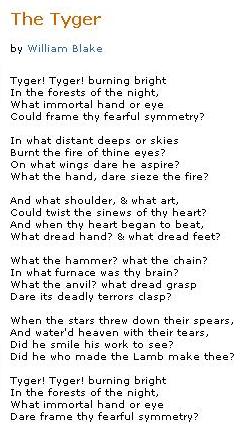
Koch introduced the children to Blake’s poem “The Tyger.”

He didn’t want them to stumble over Blake’s “language and syntax,” so he tried to connect the poem to the experiences of the kids, asking questions, such as had they seen a dog’s eyes glowing in the dark.

Here is the prompt he eventually gave them, and it’s one you can use too:

Write a poem in which you are talking to a beautiful and mysterious creature and you can ask it anything you want—anything.  You have the power to do this because you can speak its secret language.

14 Comments

Filed under Poetry, Writing prompt

That Character I Ought to Know Best,

Or Investigations into Developing My Own Characterization, Part I

A few years ago little quizzes kept popping up on my Facebook home page.  They all guaranteed self-discovery.

What Jane Austen character are you?  Emma?  Elizabeth?

Which Sondheim musical are you most like?  A Little Night Music?  Company?

For some reason I really had to find out if I was an Elizabeth, as I suspected, and if I was Into the Woods because I certainly couldn’t be Sweeney Todd.  I felt the quiz results might lead to some greater self- knowledge.  If not a deeper understanding (okay, so that’s a little tongue-in-cheek), at least I could step back from myself and look at the whole picture and therefore see myself with more perspective.

For while I have developed comfort with myself over the years, and I understand my own feelings and thoughts, I can’t really see myself as that complete package others do.  And if I don’t see myself that way, I can’t expect readers to see a fully dimensional character as my book’s protagonist either.

The irony is that I also have to develop that deeper understanding of myself to see my reactions in their entirety (both positives and negatives) and to recognize the hidden subtexts of my actions.  Without becoming bogged down in regrets for the past, I have to understand where I contributed to situations, even when the truth makes me look much less than perfect.

For this latter investigation, excavating memories, writing, and re-writing–and all done with an open mind–are the best tools.  When I think I can’t pull out one more memory, that’s just what I have to do and that memory will open up new truths about the past and, therefore, the present.

Tristine Rainer, in her handbook of memoir writing Your Life as Story, devotes a chapter to “Portraying Yourself: You Are Your Hero.”  She urges writers to see themselves as dramatic heroes with flawed personalities.

Ask yourself what your character weaknesses were at the time of a particular event you are writing about.  How did your flaw or flaws affect what transpired?  And writers can’t neglect their heroic traits, so you should identify those as well.

She also recognizes the need for the inside and outside views of the main character:

“In order to get a sense of yourself as the protagonist of a story, you need to see yourself from the outside as others might, as well as from the inside.”

Rainer suggests that writers discover what others want to know about them.  “‘What is it that people always ask you?'”  The answers to that question can lead to some great stories which will engage others.

Knowing that I have to learn more about myself from the outside and from the inside has clarified for me the task at hand.  As I learn more about myself, my scenes are becoming richer–more layered and shaded with meaning.  My character is becoming more likable as she becomes more flawed and takes more responsibility for herself.

It’s all relative.  I’m sure I still have far to go, but my writing improves with practice and research, and that keeps me moving forward.

###

So . . . what is it that people always ask you?

10 Comments

Filed under Creative Nonfiction, Memoir, Memoir writing theory, Research and prep for writing, Writing prompt