Liz Gauffreau is a master of historical fiction. And rather than creating a series (so far), she has written completely different books with different historical settings. I loved Telling Sonny, and now I love The Weight of Snow and Regret.
Here is my review of the latter. At the end I’ll share with you how you can purchase the book!
***
Elizabeth Gauffreau’s new novel, The Weight of Snow and Regret, is a tribute to the residents of the Sheldon Poor Farm in Sheldon Springs, Vermont, as well as testament to the harsh lives of society’s disadvantaged. The novel takes place in 1967-68, the last year of the tenure of the poorhouse. But the plight of the poor and culture-rocking events of that year resonate with familiarity with contemporary readers.
The first part of the story weaves in the life of Louisianian Claire and how she falls from her place in middle-class society to living in the poorhouse far from home. In this way, the reader is drawn into the novel through the perspective of this mysterious woman, then the reader is delivered into the capable hands of Hazel, a sympathetic foster child grown into a compassionate woman who now runs the home itself while her husband manages the associated farm. Through Hazel’s kindness and perspective, we meet the other residents of the poorhouse.
The place hasn’t always been run as Hazel manages it. Before her hard work, dedication, and home management skills, the neglect was extreme. Every surface was filthy, with trash strewn about. The residents’ clothing was in desperate need of laundering. In fact, Hazel believes that the men’s underwear had never been cleaned. Hazel cleans the home immaculately, creates wholesome meals with a tiny budget, and gives the residents the care and understanding that they need.
These residents range from the forgotten elderly to the mentally ill to those with intellectual disabilities. Although they respond differently to events, and their interactions with each other can be fraught, Gauffreau’s exploration of their behavior and treatment rings true. One twist is that Hazel herself lived in this poorhouse at one time. A couple of the residents from her childhood time at the shelter are still living there when Hazel takes over. This feels like a gut punch to her to think of them still living in the conditions she and her family had undergone.
Gauffreau meticulously researched the history of the home, poor farm life in the sixties and before, the blues music that spoke to Claire’s troubled and depressed soul, the national and world headlines of the time, and local history. Her painstaking implementation of her research with her compassionate feel for the characters, and her excellent storytelling senses makes this an engrossing read. I read far into the night, without being able to put down the book.
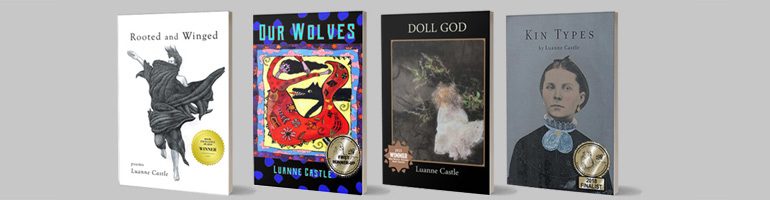
I am guessing that Meadowlark Songs: A Motherline Legacy feels like one of the children of the author Joy Neal Kidney. Writers often feel that way about their creations. If so, I am hoping I can call myself one of the book’s many grandparents. My chapbook Kin Types, a collection of poems and flash prose, reinvented the lives of my female ancestors. Kidney mentions my book as one of her favorite resources, which tickles me more than I can tell you—because the genre seems fresh and new and so dear to my heart. And now I see it reimagined by Kidney who has created a gorgeous, well-researched, and organized delve into the lives of the women of her family who came before her.
Meadowlark Songs is primarily a poetry collection illustrated with family photographs and supplemented with informative prose. Each “mother” before Kidney has her own section, as part of the “motherline.” The cover design by Nelly Murariu beautifully captures the feel of the book.
The ancestors in the book began their lives on the east coast of the United States, but gradually moved farther inland, as far as Nebraska but the family put down deep roots in Iowa. The women’s lives come to life in Kidney’s poetry. These women are strong, resolute, and inspired by their Christian faith.
Family stories and legends are also captured in the poetry. For instance, in “Startled by Santee Sioux,” we read how Laura Goff, Kidney’s great grandmother, was a Nebraska pioneer when a couple of Santee Sioux men walked into her home. She negotiated a trade for dress goods by bartering her chickens to the men. The book is full of fascinating anecdotes such as this.
Probably my favorite part of the book is the last section, about the author herself, “The Memory Keeper,”—and her passion for creating a lasting storyline of her family through this book, as well as her previous books. We read about what formative experiences she had, and how her faith has been her guidance through it all.
I’ve cried and laughed reading Kidney’s other books, but I felt even closer to this book as she connected with the women who made her who she is today. Such a powerful experience for any woman.
Click on the book image above to purchase through Amazon.
Joy Neal Kidney is the oldest granddaughter of Leora Wilson and author of four “Leora books.” She lives in central Iowa with her husband, Guy (an Air Force Veteran of the Vietnam War and retired Air Traffic Controller). Their son and his wife live out-of-state with a daughter named Kate.
A graduate of the University of Northern Iowa, Joy has lived with fibromyalgia for two dozen years, giving her plenty of home-bound days to write blog posts and books.
Joy Neale Kidney has documented an American saga of hard work, dedication, patriotism, and above all, sacrifice with her four Leora Books. I have reviewed Leora’s Dexter Stories, Leora’s Letters, and Leora’s Early Years previously.These first three volumes tell the Wilson family history and the tragedy of losing three sons to WWII through the mother, Leora’s, perspective. The fourth book in the series, What Leora Never Knew: A Granddaughter’s Quest for Answers, describes Kidney’s own search for more answers about her uncles’ military careers.
The book contains heartbreaking information, such as Leora receiving news of Dale being MIA on her birthday. Dale’s sister Doris was pregnant and had only told Dale in a letter. But the letter was returned to her, “marked ‘Missing in Action.’” Kidney puts together information and shares it in an easy-to-read style. For instance, the Wilsons received three notes from radio operators that Dale had been taken POW by the Japanese, but this was never confirmed. The information included personal identity info that was not on their ID tags. Where would the Japanese have gotten this information if they didn’t have Dale?
I love that Kidney included images of documentation and letters. The visuals help to connect the reader to these difficult days that her family went through. A poignant section is when Kidney realizes that Dale had a diary and how it was separated from his other belongings. I could tell you more, but why don’t you just read the book? You might want to read the other three before you get to this one or if you want to get right to this one, consider at least reading Leora’s Letters, the first book, the one where I learned that all three men had died during the war, a book that reduced me to tears in a doctor’s waiting room.
Instead of commenting here, feel free to head on over to Joy’s blog and comment over there if you want to say hi! https://joynealkidney.com/
I’ve pursued family history research for probably fifteen years and have been reading Eilene Lyon’s fascinating blog Myricopia about her own research for a long time as well. Therefore, I had an inkling of what her new book was going to be about. But I had no idea how thoroughly researched and well-structured Fortune’s Frenzy would be. Nor did I realize how engaging a story she would create about the California gold rush.
Eilene’s perspective, like mine, is that the history of ordinary Americans is important and fascinating. When she discovered that some of her ancestors had been involved in the gold rush—and that their story was something brand new to our traditional historical vision of that event—it was a fabulous starting point for her project.
PLOT SUMMARY PROVIDED BY EILENE LYON
In this true story, Henry Z. Jenkins and a group of Indiana farmers use shady financing to make their way to California during the gold rush, causing devastating impacts to their families and their futures. Fortune’s Frenzy relates previously untold aspects of the gold rush: how the wealthy took advantage of gold fever by offering usurious loans, and how the cold calculus of transporting people to California became a deadly game for profit.
Eilene Lyon immersed herself in American history from an early age, when her parents took her to iconic sites such as Williamsburg, Philadelphia, and Gettysburg. She has been putting history into context through studying the lives of her ancestors for over twenty years. Her work has appeared in various history journals and can be found on her blog at Myricopia.com. She speaks on genealogy and family history writing at regional and national conferences. Eilene lives in Durango, Colorado, with her husband and husky-lab Sterling (named for a great-grandfather, naturally).
INTERVIEW OF EILENE LYON
Eilene has agreed to respond to interview questions about her beautiful book.
Your book tells the story of previously unknown ramifications of the gold rush as it affected countless Americans, but your story begins and ends with the story of Henry and Abby Jenkins. How are you related to them? Can you please describe these two characters to give prospective readers an idea of who these people were?
They are my 3rd great-grandparents (maternal). At this time there are no known images of Henry and Abby, so I can’t provide a physical description. Both of them have a family background in the Quaker tradition, having been born and reared in Philadelphia. Henry, though, was never a member of the Society of Friends, but his mother was for most her life. Both were well educated—Abby sometimes stepped up to teach her children and others. Henry and Abby had a strong religious faith, but they spent much of their marriage struggling to make ends meet, which added strain to their marriage. I get a sense they were very loving to each other and to their children.
Your book cover provides a startling look at one of the new ways of looking at the gold rush that you provide: a 19th century ship on a choppy sea! All this time I thought that men traveled from the eastern U.S. to California by land—on their horses or with buggies or covered wagons. But your book presents a completely new vision. Can you explain a little about why some people would have traveled on water—and do you have any statistics on how many traveled by water versus overland?
The sea route to California was a principal one from the very beginning, even though it had its own dangers. It actually cost less and involved fewer logistics than overland travel. People living on the east coast rounded up any vessel that would float (and some that didn’t) and went around the horn of South America.
Even in 1849, some went across Mexico from Vera Cruz, or across the isthmus at Panama or Nicaragua. Unfortunately, in the early years of the rush, there were few ships available on the Pacific coast of these countries. The isthmus route became favored by 1851, both going to and coming back from California. If you factor in the people who went there from other countries, the majority of people heading to the gold rush arrived by sea, landing in San Francisco. There aren’t any accurate statistics, though.
A detail about the cover image I’d like to note is the early steamship in the background. This painting was done in 1838, but these old ships were very much still in use during the gold rush years.
I was very taken by your writing style. You give beautiful descriptive details of time and place that can only have come from very intensive research. You also tie in what happens in the book with larger financial and political events that really made me feel that I was “there.” What types of sources did you use and how did you find them? And how did you find primary sources, such as letters?
Thank you! I spent eight years researching and writing this book. It began with a collection of Jenkins family letters that I’ve had in transcript form for decades, passed on to me by my grandmother. The problem with letters is that the people writing and reading them know the context, but from a 170-year remove, all of that is missing and has to be reconstructed. I was fortunate that I also found a Liestenfeltz family descendant who had a memoir written by another character in the book, and a Lowry descendant with another letter. I combed archives, partly using ArchiveGrid and the Online Archive of California. Some records I could obtain via email, but much of it was collected by visiting places such as the Huntington Library and Bancroft Library in California. I also visited the places in Indiana and Ohio where my characters lived.
There is a character in the book called Allen Makepeace. How would you describe him and how he made a living? Did he perform any vital role in life in those days or was he merely a parasite?
That’s an interesting characterization for Makepeace—parasite! He got into the merchandise business as a teen, bringing wagon-loads of goods from Ohio to Native Americans and early settlers in the undeveloped areas of eastern Indiana. He and his extended family were responsible for creating the town of Chesterfield and developing the Madison County seat of Anderson. Once he became wealthy, he served as community banker, because there were no banks at the time. He was not a benevolent lender, though.
I don’t think this is really a question, but I must comment that Fortune’s Frenzy made me imagine that the United States of this time period was really the beginning of the way things are run today by financial movers and shakers and by the legal system. People certainly seemed to take advantage of litigation. If you would like to comment on that, it would be wonderful, but not necessary.
It’s actually fair to say that the gold rush helped usher in modern financial practices. Companies like Adams Express and Wells Fargo got their start there and the need to be able to send money to families in eastern states drove the development of money transfer certificates and such. I actually find all the financial aspects of this story quite fascinating. It may seem tedious to others. For a time there were fears that all this gold coming from California would disrupt global finances and markets, causing runaway inflation. Those fears generally weren’t realized.
Eilene, nothing about your book was tedious! What motivated Indiana farmers to leave home and go to California? I imagine the draw of becoming rich overnight was huge, but why leave where they were?
You know the acronym FOMO (fear of missing out). Very real back then, too! Indiana in the mid-19th century was nothing like it is today. It was covered in dense, swampy forests. Clearing and draining it to create farms was incredibly difficult, back-breaking work. The pioneer farmers were actually better equipped physically to endure the rigors of mining than the doctors, lawyers, and shopkeepers—once they figured out what to look for and how to extract the gold.
What is the most important idea(s) or feeling(s) you would like your readers to come away with after finishing Fortune’s Frenzy?
In one sense, I wanted this work to stand as a valuable piece of historical research. But I did not want it to read like an academic book. I wanted to create a story that anyone could enjoy reading. Hopefully I have managed to meet both of those goals.
I’ve read a lot of gold rush literature—fiction and nonfiction—in the course of researching the book. I think it’s fair to say that even scholars of the era will find new information that will be surprising.
It isn’t important that this is a story about my ancestors and their network, per se. I hope everyone will get a sense that their family history is important. Their ancestors lived through historic events and even created them. History is not just about famous people, politicians, wars, etc. I think the everyday life events in Indiana, as depicted in this book, are fascinating, too.
In part 3 of my readings, I want to share a few memoirs.
One of my favorite memoir writers is Sheila Morris. She’s witty and smart and involved in social justice issues. She’s also lived a very interesting life as a lesbian who grew up in rural Texas “back in the day” and had to learn how to live her love and her life in a time when people felt they couldn’t be open about their own identities. Furthermore, Sheila was one of the early voices writing about LGBTQ life. Her books are historical landmarks as well as entertaining reads.
Southern Perspectives on the Queer Movement: Committed to Home – edited by Sheila R. Morris
Sheila writes about politics, sports, and popular culture on her blog. She also writes about her family, including her loving wife and two adorable granddaughters. Check it out!
Harlan Greene at the College of Charleston writes this about Sheila Morris: “One wonders what is most impressive about her work–the range of it through various formats (nonfiction, blogging, a compiled collection of oral histories), or the range of topics she covers in those formats. What is most apparent, however, is her voice; it is seductive and trustworthy and never falters no matter what topic she is covering–the joys and sorrows of family life, breaking up or falling in love, the restrictions and consolations of religion, the unfairness of our social systems, marriage, racism, travel, and even corporate life. The reader instantly is taken with a no-nonsense . . . depiction of a complex southern lesbian life; no subject is taboo and the writing never fails in honesty or polish. Many people can write of the ups and downs of their daily lives and the gives and takes necessary to weather them, but few match the commonplace (and the transcendent) with such apparently simple but elegant prose. It’s hard to read a few lines without finding something quote-able.”
###
I recently read two memoirs by writers I had never heard of, books that I had never heard about. They were written by women suffering from chronic medical conditions.
Wired to be Dysfunctional is written by a young woman born with the very rare condition myoclonus dystonia and her mother. They alternate voices in the book, which I found to be very effective. She suffered a lot, not only physically, but emotionally when it took years and years for a diagnosis. My son went through much the same thing. This is the condition that my son has. He was diagnosed in his late 20s although we had taken him to major medical centers since he was a baby.
Drop the Skirt: How My Disability Became My Superpower was written by Amy Rivera. Amy was born with primary lymphedema in one of her legs, which made it huge in comparison with her other leg. She was also blessed with beauty and, as a young person, won a beauty pageant. But that didn’t stop the agony at trying to fit in at school. Amy takes the reader through the process of FINALLY getting diagnosed and finding treatments that would help her. She also became an activist because of her strong personality and what she had gone through, helping to bring about some changes in how insurance companies handle lymphedema claims. Lymphedema is one of the conditions that I was born with. Primary lymphedema like Amy and I have are similar to that brought about by surgery, such as the lymphedema that Kathy Bates, the actor, has, but not exactly the same. And mine is different from Amy’s because she is completely lacking in lymph nodes in that area of her body. Mine are sluggish and my lymph system is tiny. I also have venous insufficiency because, again, the veins are tiny. Mine has plagued me for most of my life, but it’s not as dramatically traumatic as Amy’s is. The title refers to how we all try to wear long flowy dresses and skirts to cover up our legs.
Think of this as part 2 of the reviews of some non-poetry books. If you’re one of the authors, feel free to drop your BOOK LINK or website and/or blog links in the comments! That’s because I am too lazy to pull together that information . . . . But if you put book link in the comments, I’ll try to add it to the post. How bout that?
HISTORICAL NOVEL ABOUT WOMAN IN 1920S VERMONT
Elizabeth Gauffreau’s novel Telling Sonny puts a few turbulent months in one woman’s life under the microscope. In doing so, the story captures subtle twists and turns in protagonist Faby Gauthier’s personality, character, and outlook on life. This psychological exploration is most akin to the excavations into the psyche as written by Henry James, but without his complicated sentences and repetitions. Instead, the reader’s attention is less focused on the psychology than on the details of the protagonist, Faby Gauthier’s, experience at home and on the road traveling with her new husband, a vaudeville dancer. Gauffreau manages to recreate a lost world of 1920s small-town New England, Atlantic City, the vaudeville circuit, and rail travel. She obviously painstakingly researched the novel, polishing every detail of each scene until it shines with clarity. Gauffreau’s writing style successfully marries the direct nature of contemporary writing with a more graceful syntax that befits the time period, as well as Faby’s upbringing. When I finished the book, I wanted to talk to other readers about the book, especially my thoughts about Faby and Louis, both micro (such as their choices) and macro (relating to history and sociology). So, please, read it and talk to me about it!
I did read Elizabeth Gauffreau’s novel some time ago, but wanted to post it here since it is on sale and is a personal favorite, plus I don’t believe I ever posted a review of the book on this blog. I’m eagerly awaiting Liz’s next novel . . . .
HISTORICAL NOVEL ABOUT JEWISH PIONEERS TO SANTA FE
Santa Fe Love Song, by Amy Bess Cohen, reads like a valentine from Cohen to her great-great grandparents Bernard and Frances (Nussbaum) Seligmann. The story of Bernard, a young immigrant from a small town in Germany to Philadelphia and Santa Fe, though fictionalized, gives a wonderful account of what it would have been like for a German Jewish young man to travel across the ocean by himself, get a job, learn English, and within a matter of months, move across the country to New Mexico via the grueling Santa Fe Trail to meet up with his brother. It’s fascinating to read about Bernard’s acclimation to living out west just before, during, and after the Civil War.
The story is of Bernard’s development as an important pioneer of Santa Fe, and his search for a Jewish wife to bring to a place where there were very few Jews, no Kosher foods, and no synagogue. When he traveled back to Philadelphia to look for a wife, he fell in love with Frances, but would she move to Santa Fe with him? And, if so, would she stay? The story is engaging and the suspense level is well-moderated. When the book ended, I didn’t want to leave the lives of the family of Bernard and Frances. I hope there will be a sequel.
Although the reader first meets Bernard when he is nineteen, he ages throughout the course of the novel, so in this one respect Santa Fe Love Song does not fit the definition of young adult literature. The main character is not a preteen or teen. Nevertheless, half the texts recommended for secondary school students have adult protagonists. The themes and the way mature subjects are handled mean that this book would be suitable for older children, teens, and adults.
Cohen wrote the book, in part, for her own grandchildren to learn about their heritage and the strength of the people who came before them. In keeping with that focus, her grandsons, Nathaniel Jack Fischer and Remy Brandon Fischer, illustrated the book with charming and detailed drawings. They really add to the overall experience of reading this lovely book.
Perhaps the book’s greatest importance lies in how it goes beyond the more often recorded history of Jewish immigrants enriching the eastern American cities where they tended to congregate in the mid to late 1800s and early 1900s. Instead, Santa Fe Love Song has a Jewish protagonist who quickly learns how to ride a horse, shoot a gun, and hold his own against the rough and tumble forces of the early American west.
MENNONITE MEMOIR
Marian Longenecker Beaman’s memoir Mennonite Daughter: The Story of a Plain Girl is a fascinating excursion into Marian’s life as a child and young woman who grew up in a Mennonite farm household in Lancaster County, Pennsylvania. This is the first time I have been shown what plain and fancy mean to the Mennonites. Marian was brought up plain, wearing no jewelry or makeup and hiding her hair under a cap. Most of the women did not drive, but the families did have cars that the men drove. (I grew up in Michigan, and many of the Michigan/Indiana Mennonites still ride in buggies like the Amish). Secretly, Marian was drawn to what is fancy, symbolized by her dream of wearing red shoes. While Marian does eventually make a move to the fancy world, she stays true to her Christian upbringing. The book is uplifting and inspirational but doesn’t shy away from the negative in the form of her father whose inability to demonstrate affection and harsh punishments of Marian is heart-breaking. You won’t be disappointed by this story of a different time (largely the 50s and early 60s) and a family rooted in a tradition quite different from most Americans.
P.S. This is not part of my review, but I will mention that I wish that Marian Beaman had set the Mennonites in context with the overwhelmingly majority Amish of the region. You might want to look that up before starting the book. She does, though, make some comparisons with Orthodox Jewish traditions. Also: I love the cover with the red shoes! The book can be purchased here: https://marianbeaman.com/
MYSTERY WITH A HISTORICAL AND ART WORLD TWIST
Attribution is not only a fun and riveting read, but it’s a smart one, too. I learned so much about art history (and art politics) along the way. The protagonist, Cate, a doctoral student finds a mystery painting. She decides to seek attribution for the painting. Her search takes her from her New York university to Spain where she meets a romantic descendant of an old aristrocratic family. The further Cate gets into the mess she’s created, the more questions and dangers arise about the painting and the characters who revolve around that painting. I have a feeling that the author, Linda Moore, spent a long time researching and writing this book, but I am ready for the sequel as I did not want the book to end!
NOVEL OF ADVENTURE IN INDIA, FOCUS ON TOPIC OF ADOPTION
Elaine Pinkerton’s novel The Hand of Ganesh took me on a journey to India with such great detail that I felt as if I accompanied Clara and Dottie/Arundati on their quest to find Dottie’s birth mother. The young women also visited India to carry out the wishes of others for the stone hand of Ganesh that had been in Dottie’s adoptive family. The omniscient novel focuses mainly on Clara, an American (and Native American) adoptee whose story was first told in Pinkerton’s novel All the Wrong Places. Clara, who has already searched for her birth mother, acts as a sort of guide for Dottie who was born in India, but she knows very little about her origins. She is the ideal viewpoint for the novel because she is an outsider to India and shares what she learned with the reader. Suspense lies both in the larger issue—will Dottie find the mother of the child Arundati—and in a more subtle question—how do foreigners know who to trust in a country they do not know or understand? Read The Hand of Ganesh for its engaging storyline, meticulous depiction of southern India, and adoptee themes. Read The Hand of Ganesh and you will be eager to plan a trip to India.
Colleen at Wordcraft poetry suggested this prompt today: to write a syllabic poem using this 19th century painting as inspiration. She mentioned how it looked like the girl is on her cell phone. For a time it was hard to unsee that cell. But then, after I saw something hanging down from the “cell phone,” I realized how important our own world views are to how we see something. As I researched, I read that Hitler loved the paintings of this artist, Ferdinand Georg Waldmüller, and made his work Nazi favorites. But the artist (blessedly) never lived long enough to see the Nazis come to power or to know the name Adolf Hitler. All these different perspectives are where my poem today comes from and it is what complicates the form, creating an ekphrastic contrapuntal tanka string with haiku.
I’m sorry that the poem had to be a screenshot as I couldn’t make it stay on the screen otherwise. If you click on the poem image a couple of times you might be able to make it larger. Please let me know if you can read it or if I need to figure out something else. Any ideas would be appreciated.
The beautiful South 85 Journal has published my essay, “Family History,” in the new issue. This creative nonfiction piece is about a violent crime that occurred within my extended family. Writing this has been so difficult, but also necessary. I just couldn’t wrap my head around what happened, so I explored it in this way. I hope you read this piece because the sharing of it also helps me process it all. But a warning: it is about violence and family.
Today is Memorial Day, a day to honor those who sacrificed their lives in our military. I am sharing a poem from my chapbook Kin Types about a sister who awaits word from her brother who is a soldier in WWI.
Once and Now

His letter, once wet and now dry, once
wrinkled now smoothed against her breast,
once a receptacle for all he could not say,
the lone poppy in the field, the striped sky, not
the mud, men, horses, bullets, shovels.
Definitely not, but she suspects as much.
She listens to her husband outside the church
door, reads the casualty lists, hovers around
those waiting. Now her big brother’s letter
like his touch on their dying mother’s cheek,
is enough. He’s been long a soldier, the bachelor
patriarch. In the early days he wrote pages
of the trembling sweep of the Pacific,
ancient trees and reeds poking like magic
sticks from the water, a field of buttercups
near the Presidio, a borrowed horse he rode.
Given their immigrant circumstances, the career
had seemed wise until now, with Huns like red
devils leering down from propaganda posters
jeering them with their German names,
a town friend’s Dachshund ripped from her arms,
his brains smashed on the pavement, onto
her shoes. Shoes she showed Clara, pointing,
See, see how dangerous they are in their hate!
The knock sneaks up on her from behind.
She has turned to put the letter in the ribbon-
tied stack, so standing between fourteen years
of letters and the knock, she knows that this
is not the paperboy coming for his coin.
She knows what a ridiculous leap her mind
has made, but still she is certain about the paper,
and it is a paper telegram. Without opening it,
she slips the Western Union under the grosgrain.
Once busy, she has all the time in the world now.

Clara Mulder née Waldeck
1884-1953
Caledonia, Michigan, United States
Clara has received the dreaded telegram that will validate her worst fears--that her laughing, vibrant brother will not be coming home.
I chose a very mild–in this case British–stamp with WWI propaganda.
Just wanted to share a post I published today over at The Family Kalamazoo. I wrote about my great-uncle Charles Mulder, Jr. (Chuck). He was the leader of a small group in the U.S. Army Signal Corps in Europe during WWII. He was with the 119th Infantry Regiment, which was a part of the 30th Infantry Division. According to Wikipedia, “The 30th Infantry Division was a unit of the Army National Guard in World War I and World War II. It was nicknamed the ‘Old Hickory’ division, in honor of President Andrew Jackson. The Germans nicknamed this division “Roosevelt’s SS.” The 30th Infantry Division was regarded by a team of historians led by S.L.A. Marshall as the number one American infantry division in the European Theater of Operations (ETO), involved in 282 days of intense combat over a period from June 1944 through April 1945.
Uncle Chuck was a lovely person whose life was changed because of his war service and an incident of friendly fire. Read about it here: