Category Archives: Poetry book

Review of Candice M. Kelsey’s New Poetry Collection, Another Place Altogether

Candice M. Kelsey’s new poetry collection, Another Place Altogether (Kelsay Books 2025), is a brilliant exploration of a woman’s relationship with her mother, with her children, and with a world both beautiful and intensely dangerous. The book also explores her relationship with the two places she lives between: Los Angeles and Augusta, Georgia.

The book is divided between the first section, called “Endings,” and the second, called “Beginnings.” In the first poem of the second section, the poet arrives in Georgia from Los Angeles. In Georgia, the California poet experiences discomfort with remnants of the Old South she sees in Georgia. At the end of the poem, “Because Your Husband’s Shirt is Ironed,” Kelsey well demonstrates this culture clash. At the beginning of the poem, a coach assumes her husband’s wife ironed his shirt. Later, she mentions to the other “homecoming moms” that the dads don’t have a group chat, the women ignore her. She says, “O how the South hates a wrinkle.” I love how she moves from misogyny to that ending.

The poems in this book are threaded with or even end on darkness. Some of the most stunning of these dark poems are about her treatment by her mother. In “Flesh and Bone,” she writes that her mother is “declaring me her own / flesh and blood. Nailing me to her.” Contrasted with her mother in this poem is her dead mother-in-law who offers supportive advice (emails from the beyond) and inspires her.

I found the introduction of this “found mother” very powerful and relate it to another aspect of this collection. Kelsey’s poetry here is inspired by other poets, especially women poets. “Menopause: A Cento from Female Poets Laureate” is the most obvious example of this. The homage is very welcome as a hopeful note that balances darker scenes, such as the friend’s brother who molests her when she’s 12-year-old and the friend’s father who abused his wife over her weight. In fact, the gender norm dictating a woman’s slimness is a theme that pops up several times. The poet’s mother was complicit in this emotional torture.

Most hopeful are the poems about the poet’s children. Love and pride shine through even the challenging times. And although sometimes she might want to act like her mother, she does not. In “Mothers & Daughters,” she would have good reason to send a nasty text (because she feels bad herself and her daughter is being selfish, a typical teen), but she does not, whereas her own mother would not have held back.

Near the end, even with the sound of her mother’s critical voice in her mind, she overcomes so that she can love herself: “Whispering Candice, I touch my ear / and hear self-love with these lips.” Read Another Place Altogether and you too will love Candice Kelsey and her powerful words.

###

You can find Candice on Instagram at feed_me_poetry


20 Comments

Filed under #amreading, #poetrycommunity, #writingcommunity, Book Review, Poetry, Poetry book, Poetry Collection

The Wonderful Feature Called the Poetry Bookshelf

I hope my American friends had a wonderful Thanksgiving. Mine was wonderful as my kids took on most of the work, and I got to spend a lot of time with my “best friend,” my little grandson. The gardener and I watched him the day before and the day after the holiday, as well as spending time on Thanksgiving Day itself. The day before we took him to the clock shop because he is passionate about clocks. And he sat down to explore our keyboard.

If you don’t celebrate Thanksgiving, I hope you still have much to be grateful for.

Enjoy the concert:

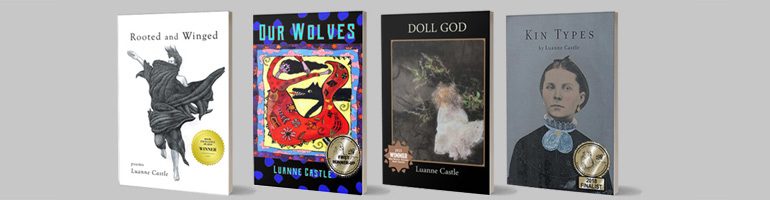
One of the Thanksgiving blessings of my life are writing friends and supporters. Case in point: A huge thank you to Editors Juan Re Crivello and Barbara Leonhard for putting my full-length poetry collection Rooted and Winged on the Poetry Bookshelf of LatinosUSA.

If you haven’t read my book, please check out this link if you have the time.

https://latinosenglishedition.wordpress.com/2025/11/30/featuring-rooted-and-winged-by-luanne-castle/

Enjoy your transition time into the holiday season!

P.S. I’m also grateful for decent medical care as I prep for this week’s colonoscopy. Yay!!!


31 Comments

Filed under #poetrycommunity, Book promotion, Books, Poetry, Poetry book, Poetry Collection, Rooted and Winged, Writing

Review of Merril D. Smith’s HELD INSIDE THE FOLDS OF TIME

Here is my book review of Merril D. Smith‘s beautiful new poetry collection. I hope it makes you want to order a copy!

Merril D. Smith’s new poetry collection, Held Inside the Folds of Time, is a testament to Smith’s background as a historian. But what is more important is Smith’s sensitivity to previous generations. She opens the collection with a poem about a cave painting. By doing so, he connects us with all who have come before.

She recognizes what she’s learned from her ancestors, who–in “How I Learned”–“showed me that I have my own wings– / unfold them, fly. This, too, is part of the pattern.” The poet can’t or won’t get away from them: “My dead follow me through every timeline” (“Suspended, Surrounded”).

Smith’s ancestors who immigrated to the United States, her own family of origin, even the soldiers who died in a Revolutionary War battle are all subjects of the book. “In Memorium: For the Unknown Soldiers at Red Bank Battlefield” asserts “their ghosts roam the battlefield / settling their bones, unsettled in time.”

Nature features prominently in Smith’s poetry, and this is where the lyrical beauty of her writing is best displayed. She uses many poetic techniques, particularly variations of rhyme, such as off rhyme, end rhyme, and internal rhyme. These lines are from “Cross-Quarter Days”:

The blooms have browned,

blossoms scattered to the wind

now snow veils the ground,

there above, one bony root unpinned.”

While the poems contain examples of the beauty of life, the overall tone of the book is a lovely mournfulness. As Smith writes in “Winter Birches,” “there is no happily ever, only after.”

Held Inside the Folds of Time demonstrates the potential gorgeousness of language as it mourns and celebrates the poet’s world.

34 Comments

Filed under #amreading, #poetrycommunity, Book Review, Poetry, Poetry book, Poetry Collection

Late to the Party, But With My Party Hat On!

I used to say I wouldn’t read ebooks because I loved real books. Then I needed to read some because the books written by some friends were only available for Kindle. Before long, I needed larger font and a bit of backlighting. The last blow was that I was diagnosed with macular degeneration. Now I LOVE my Kindle, which is already an older model of Paperwhite.

These days I read much more on my Kindle than I do paperbacks. Yet all of my own books have only been available in paperback (and hard cover for Rooted and Winged). This is because the majority of poetry small presses continue to just offer paperback books.

But I started to wonder and then to investigate.

And now I have a book available as EPUB on Amazon!!! The publisher of Our Wolves was very helpful and willing to list the ebook on Amazon alongside the paperback. Available for $5.50, the price he chose. I am hoping that this makes the Red Riding Hood revision collection more accessible to more readers. (Fingers crossed that this version works well for most readers’ devices!!!)

P.S. update: I should have mentioned (humbly haha) that Our Wolves was First Runner-Up for the Eric Hoffer Award.

OUR WOLVES, KINDLE EDITION

29 Comments

Filed under #OurWolves, #writingcommunity, Fairy Tales, Our Wolves, Poetry, Poetry book, Poetry Collection

Sirens to Larks: Interview with Poet Rose Mary Boehm

Please meet the prolific and multidimensional poet, Rose Mary Boehm. She has graciously consented to an interview. I will give you her official bio first, but you’ll discover in her interview replies that there is so much more to Rose and her poetry than what can be discovered in a paragraph.

German-born UK national, Rose Mary Boehm lives and works in Lima, Peru. Author of two novels and ‘Tangents’, a full-length poetry collection published in the UK in 2010/2011, her work has been widely published in US poetry journals (online and print). She was three times winner of the now defunct Goodreads monthly competition and has been nominated for a Pushcart and Best of Net. Her other poetry collections are: ‘From the Ruhr to Somewhere Near Dresden 1939-1949: A Child’s Journey’; ‘Peru Blues or Lady Gaga Won’t Be Back’; ‘The Rain Girl’; ‘Do Oceans Have Underwater Borders?’; ‘Whistling in the Dark’; ‘Saudade’, and ‘Life Stuff’. A new chapbook is about to be published by Kelsay Books. Find out more about the author and her work on her website: https://www.rose-mary-boehm-poet.com/

INTERVIEW OF ROSE MARY BOEHM

I first met Rose in the Verse Virtual poetry community and journal. The journal itself is part of a community of poets that are very supportive of each other.

At the end of the interview I won’t respond because I want to leave you with how Rose ends the interview. Thank you, Rose.

  1. I have a theory that the creative chronology of a poet is more important than the physical chronology; however, the poet is first shaped in childhood experience. Your book From the Ruhr to Somewhere Near Dresden 1939 to 1949: A Child’s Journey, is a witness to those years, but years that were intensely defined by being a German child living in Germany during WWII. The book describes the deprivation of a war fought elsewhere and on the homeland. Please share a poem from the book and tell us what you hope the book accomplishes.


Having been a young child during WWII in Germany (I had just turned seven when the War ended) will forever colour everything I do and think and feel. I have a kind of PTSD which is well controlled (even though I just cannot, CANNOT read stories and see photos of the children of Gaza without despairing completely), but I can’t help referring back to my childhood again and again in many poems.

Now that I am in the last years of my life, I am desperate that my children and their children should not experience war, and this seems increasingly unlikely, the way the wind is blowing all over the world. It makes me scared and sad.

The book, From the Ruhr to Somewhere Near Dresden 1939 to 1949: A Child’s Journey, was a bit of an exorcism, a talk with a therapist perhaps, and hopefully a message to all children who lived either this war or any other. And, if they survive, how they often find (a somewhat troubled) childhood, remember the finer points of a caterpillar rather than the next plane strafing the house, the next bomb killing your neighbours, your parents, or you… if you’ve been small enough not to understand it all. My brother, eight years older, was not so lucky.

The collection is more of a story told in free verse than individual poems, numbered only in the order of telling the story. Seen totally from the child’s point of view, told in the child’s voice. Whatever I remember I remembered in this way – once I started looking.

I think I have to use two poems to give you an idea of the contrasts (‘normal’ childhood versus little-understood horror):


Poem 5

Mother calls them ‘Christmas trees’. My brother calls them flares.

I am wrapped in a blanket, sitting on Mother’s arm.

We are on the balcony. It is nighttime. Danger time.

These ‘Christmas trees’ stay for a while, suspended in the night sky.

Now she runs with me down to the shelter. Moments later

there is the whizz, the rumble. I press my hands to my ears.


In the shelter I always lie on the sofa and trace the pattern

of the velvet cover.  Maybe that man with the hoarse, loud voice

comes in these explosions and sweeps through the house,

killing everything with his breath. Black. He wears black

and he has a cape, like on the posters.


The siren won’t sound the ‘all clear’ tonight—that long, long howl

which tells us it’s alright to go back upstairs.

As during thunderstorms, the bangs come closer.

My brother looks as white as a ghost

and holds me tight. Mother comes to my other side

and holds us both. Suddenly the candles die.


Screams.

Silence.

Confusion.


Everyone speaks at once.

‘Where are the matches–must have been next door.

The Brandt’s… Must have been the Brandt’s.’


A light appears from the other side

and a figure in white. It’s Herr Brandt holding a candle.

I can’t help giggling. He’s wearing long, worn-out underpants.


Many houses are still burning.

Burning flesh stinks,

burning rubber stinks.

Death stinks.


Poem 6

I stand on the balcony. On tiptoes.

I’ll see him any minute now. The tram has

turned the corner, and it’s the tram

on which Father usually comes.

It’s a sunny afternoon

and I feel expectant and happy.


I can see his trench-coated figure,

recognize the way he walks, the way

he wears his hat. He carries his leather case

and something wrapped in paper. He probably

bought two of those flat fish with yellow spots

because it’s Friday. We always eat fish on Friday.

I am never quite sure whether it’s Friday

because he brings the fish, or whether

he brings the fish because it’s Friday.


  1. From your poems that I have read and those I have had the pleasure of hearing you read aloud, I have taken away that you have lived through a variety of changes: lovers and husbands, having children, living in various countries, learning many languages. How do you think your “multiple lives” and languages enrich your poetry? It might help if you have a couple of quotes from your poems to illustrate your points.


Yes, Luanne, it’s been a rich and varied life, full of pain, miracles, adventures, more pain, and much, much love. There is no way I can not weave this into my poetry. What am I saying, I am weaving nothing: it ‘weaves’ me. Those memories want out, and most of the time they become poems.

I chose the following poem as an illustration where my travels did not produce ‘place poems’ but a deeply-felt incorporation of history, place, and DNA.


A Pilgrimage


In Rosh HaNicra I look across

to Lebanon. Below me is the sea.

I pick up a stone and let it bounce

against the rocks.


The Sea of Galilee cuts me

with contrition. I want to atone

for sins to which I feel fettered

by blood. The Jordan washes the dusty crust

of the Negev from my skin.

The Dead Sea lifts my burden.


Haifa receives me in a language

I understand, Bethlehem’s brittle

alliances don’t inspire. My friend rejects

the kipah and holds my hand.

And Yom Rishon is the first day.


The languages are an enrichment and sometimes a small-ish problem: with each language you learn so much more than words. You internalise different cultures, customs, religions (or interpretations of it), images, music, rhythms. That’s definitely enriching. What can make you stumble at times are words you know in one language, you can feel what they mean in its totality in your belly, but there is no way they can be directly translated into their complete components in one English word. You have to ‘write around’ that word in order to make its full, round meaning understood in the way you do.

Of course, my travels, my pains, my children have all been sources for poems in many iterations. But instead of a few quotes, I think I’d better use the title poem of my collection ‘Saudade’, a poem that is the perfect example of  ‘writing around’ the meaning (as perceive by me) of the word ‘saudade’ which means so many things in Portuguese:


What is Saudade?

A moment that passes like

a paler shade of Spring,

like the knowledge of a certainty,

the vague promise of repeat.


The echo of something

which never was, a butterfly wing

that may have brushed your cheek.

Dreaming of indolence.


Expecting the first rains on dry fields,

not quite hearing the last lark before

the autumn winds, the first smell of snow,

the never-ending final summer dance.

Softest touch of his hand on yours,

the death of an infatuation.

Your evanescent youth.


A strange bliss in your longing,

fear of fulfilment. Praying

for the becalmed sea of inertia.

Celebration of absence.


You carry a sharp, merciless

switchblade made of stainless grief.


  1. If you had to leave quickly and could only take two of your books, which would they be and why? I’m not asking which you think are the technically best collections, but the ones closest to your heart now. Do you think your feelings about any of your poems has changed over the years?


Oh my, that’s the ‘impossible’ question. Each one of my books represents an important part of me, and I can’t leave even one important part of me behind. I’d rather think that I would be allowed to grab’em all. It’s a ‘Sophie’s Choice’, if I may use such a heartrenting example for mere books (but they are my children too, in a way).

If hard-pressed, tortured, threatened with a bucket of maggots, I’d probably choose ‘The Rain Girl’ and ‘Saudade’. Still, just writing this hurts. I also need ‘Life Stuff’. But please, let us keep that very much between us.


  1. Rose, what brought you to Peru and what is your creative life like there? What does Peru add to your poetry?


I was brought to Peru by my Peruvian husband, Luis (a Luis is affectionately known as ‘Lucho’ in Peru). I met Lucho in Madrid, where I had moved to from London, licking my wounds from a previous marriage that hadn’t made it. By the time Lucho and I got together, I was quite ‘together’ again too, or this new love adventure wouldn’t have worked. Take it from Granny: never marry on the rebound!

We stayed in Madrid for 18 years, and then took the plunge. We have now been in Lima for almost 14 years.

Peru was the first time where I lived (not just visited) a completely different planet, new language (even though I was fluent in Spanish – it’s a different Spanish here), poverty, llamas, braids, hats, Andean music, the gentlest of people as well as cheap lives easily taken over a cell phone. My book ‘Peru Blues’ was the result. I couldn’t write it now, I had to write it while I still saw everything with ‘foreign’ eyes. Over the years Peru became home, no longer an unknown country, and many things one no longer ‘sees’.

For example:


At the Seaside in Peru

Houses made from basket weave lean

into the dunes of the desert only a few meters

from the salty dance of the Pacific,

shivering in the stiff breeze.


Sand mixed with plastic and excrement,

small children crawl atop the landfill

with burlap sacks, the odd pig snuffles

between shards and pieces of iron.


A half-dead plant wrenched from the root,

reminder of what once was — unsalvageable.

Here I am, holding a small, brown hand,

sticky and bruised. Her large dark eyes

are those of a cornered deer.

Her mother turns to leave.


Contrasts

I remember lipstick smears on empty wine glasses, kisses

blown into the air, muak, muak, how good to see you,

Dahhling. There were important decisions

to be made. Go for Dior or Cacharel, and the wonder


how some women would never lose that dark-red

which ringed their mouths and made them appear

like fathomless caves, dangerous suction channels

inhaling man and mammal into Dante’s Inferno,


and the whispers behind long-nailed hands, ready

to claw and destroy, freckled breasts arching out

of low-cut silks and cashmeres, gold weighing

on bony hands. ‘Can’t be too rich or too thin,


Honey,’ that’s what the Duchess said. And now

I am watching from afar, on the screens of lies

which used to be the ‘small’ screens, how mudslides


reclaim the riverbed. The poorest build their precarious

homes there every year against all advice and the offer

of other land. My grandfather, some say, my mother, say others.

Tradition meets ignorance, and they tearfully watch again

their houses, children, wives and husbands

disappear under boulders and mud.


  1. Please describe your current project and why it is important to you. Why is it important to readers?


One of my current projects is a chapbook called, ‘The Matter of Words’, that’ll be coming out in the autumn of this year. I LOVE words, and – as I did with ‘Saudade’ – have written poems (short ones and longer ones) around ‘difficult’ words, words that are not used in daily speech as a matter of course.

But there is a full-length manuscript that is now looking for a home. That one – I won’t mention the title or give an example poem, not to discourage potential publishers, you know how iffy they often are about ‘previously’ published or curated – is a collection of all my favourite poems written since the publication of my other books, or those that didn’t quite fit. This may well become another one I’ll sneak into my backpack when I have to leave a lot behind.

And that’s where we are, that backpack. I am 87, and where I am going in the not too distant future I won’t need a backpack, and I can only hope that my writing will not completely disappear but give some meaning, joy (or tears) to those I leave behind.
 

23 Comments

Filed under #amreading, #poetrycommunity, #writingcommunity, Interview, Poetry, Poetry book, Poetry Collection

A Gorgeous Collection Combining Genres of Poetry, Genealogy, and History

I am guessing that Meadowlark Songs: A Motherline Legacy feels like one of the children of the author Joy Neal Kidney. Writers often feel that way about their creations. If so, I am hoping I can call myself one of the book’s many grandparents. My chapbook Kin Types, a collection of poems and flash prose, reinvented the lives of my female ancestors. Kidney mentions my book as one of her favorite resources, which tickles me more than I can tell you—because the genre seems fresh and new and so dear to my heart. And now I see it reimagined by Kidney who has created a gorgeous, well-researched, and organized delve into the lives of the women of her family who came before her.

Meadowlark Songs is primarily a poetry collection illustrated with family photographs and supplemented with informative prose. Each “mother” before Kidney has her own section, as part of the “motherline.” The cover design by Nelly Murariu beautifully captures the feel of the book.

The ancestors in the book began their lives on the east coast of the United States, but gradually moved farther inland, as far as Nebraska but the family put down deep roots in Iowa. The women’s lives come to life in Kidney’s poetry. These women are strong, resolute, and inspired by their Christian faith.

Family stories and legends are also captured in the poetry. For instance, in “Startled by Santee Sioux,” we read how Laura Goff, Kidney’s great grandmother, was a Nebraska pioneer when a couple of Santee Sioux men walked into her home. She negotiated a trade for dress goods by bartering her chickens to the men. The book is full of fascinating anecdotes such as this.

Probably my favorite part of the book is the last section, about the author herself, “The Memory Keeper,”—and her passion for creating a lasting storyline of her family through this book, as well as her previous books. We read about what formative experiences she had, and how her faith has been her guidance through it all.

I’ve cried and laughed reading Kidney’s other books, but I felt even closer to this book as she connected with the women who made her who she is today. Such a powerful experience for any woman.

You can connect with the author here: https://joynealkidney.com/

Click on the book image above to purchase through Amazon.

Joy Neal Kidney is the oldest granddaughter of Leora Wilson and author of four “Leora books.” She lives in central Iowa with her husband, Guy (an Air Force Veteran of the Vietnam War and retired Air Traffic Controller). Their son and his wife live out-of-state with a daughter named Kate.

A graduate of the University of Northern Iowa, Joy has lived with fibromyalgia for two dozen years, giving her plenty of home-bound days to write blog posts and books.


35 Comments

Filed under #amreading, #writingcommunity, Book Review, Family history, History, Memoir, Nonfiction, Poetry, Poetry book, Poetry Collection

Review of Robert Okaji’s Our Loveliest Bruises

Robert Okaji’s new poetry collection Our Loveliest Bruises can be considered his greatest work, truly a magnum opus. The spare language belies the beautiful compelling imagery as it probes the depths of emotion.

Some of the poems have been published in various literary journals and anthologies, but the book is a tightly woven project of loss and grief. Okaji uses the Japanese bamboo flute shakuhachi as a metaphor for these emotions. Throughout the book, in various poems, the poet breathes his life force into the holes of the instrument, producing notes which are akin to his poems. The holes represent the absences of loss. Eventually, in “Self-Portrait as Shakuhachi,” the poet becomes the flute: “How easy to let air / slide through oneself.”

The poet’s mother’s ghost is a recurring character. She does not communicate, but there is a sense of competition between the two. The imagery in these poems is rough and realistic. There is a sense of profound regret, but also of love. From “Ghost, with a Line from Porchia”:

Your battle with language, with silence, invoked.
I stretch the word and weave this dirge for you.

Some poems address a “you,” and I believe in many cases this person is his mother’s ghost. But it could mean the poet himself. There are instances in some poems that point out the brief nature of life itself or are a merging of mother and self and perhaps even a universal human message. “Each day lived is one less to live,” Okaji writes in “Mother’s Day.”

Robert Okaji has written an extraordinary account of the “loveliest bruises” we experience from the love we have for loved ones, of self, of life itself.

***

Bob Okaji blogs at O at the Edges. If you haven’t read his blog you might not realize that Bob was diagnosed with late stage metastatic lung cancer. He has posted a couple of times on his blog about his illness. He continues to do well, although he doesn’t always feel that great.

Bob is the person who first introduced me to the Tupelo 30/30 poem challenge. I think that challenge really motivated me into writing more and more poetry.

Click the link to Bob’s blog so you can send him some good vibes. And then, if you can, click the link to his gorgeous book.

Our Loveliest Bruises

18 Comments

Filed under #amreading, #bloggingcommunity, #poetrycommunity, #poetswithcats, Book Review, Poetry, Poetry book, Poetry Collection

Buy Yourself a Gift of Sunflower Tanka!!!

Lily is enjoying her new anthology, Sunflower Tanka. These are wonderful examples of tanka and tanka prose. There are even some unusual tanka forms. I’m so blessed to have four tanka prose in the book. A huge thanks to the contributing editors, Colleen Chesebro and Robbie Cheadle.

Isn’t the art on the cover gorgeous? It’s by Robbie.

I sent a copy to my mom and suspect she’s going to love it!

You can pick up your own copy here: https://shorturl.at/XEKLb

You can also purchase a Kindle version.

Blurb

Sunflower Tanka, edited by Robbie Cheadle & Colleen M. Chesebro, is an annual anthology of contemporary tanka, tanka prose, & experimental tanka from a broad mix of new and established poetic voices from across the world.

Our theme, “Into the Light,” draws inspiration from the way a young sunflower bud constantly turns to face the sun. Poets delved into the realms of death, love, and the natural world, capturing their human experiences in the timeless form of syllabic poetry.

Contributors to the first edition of the Sunflower Tanka: Suzanne Brace, Yvette Calleiro, Kay Castenada, Luanne Castle, Robbie Cheadle, Colleen M. Chesebro, E.A. Colquitt, Melissa Davilio, Destiny, Tamiko Dooley, Lisa Fox, Cindy Georgakas, Chris Hall, Franci Hoffman, Marsha Ingrao, Jude Itakali, Jules Paige, Kenneth, MJ Mallon, Brenda Marie, Selma Martin, Michelle Ayon Navajas, Lisa Nelson, D. Wallace Peach, Freya Pickard, Dawn Pisturino, Gwen M. Plano, Jennifer Russo, Aishwarya Saby, Reena Saxena, Merril D. Smith, Nicole Smith, Ivor Steven, Ben Tonkin, Trilce Marsh Vazquez, Cheryl Wood.

Get yourself a holiday gift of Sunflower Tanka!

HAPPY HOLIDAYS TO ALL!!!

Leave a comment

Filed under #amreading, #bloggingcommunity, #poetrycommunity, #TankaTuesday, Poetry, Poetry book, Poetry Collection, Syllabic Poetry, Writing

Exploring the Ekphrastic Poetry of Hedy Habra

I love the work of Hedy Habra, a fabulous ekphrastic poet and painter. She is originally from Egypt and Lebanon and ended up where I grew up–in Kalamazoo, Michigan–, but I think of Hedy as a citizen of the world. She knows several languages perfectly, including but probably not limited to French, Spanish, English, and Arabic. You can find her bio at the end of this post.

Before I move into her poetry, I’d like to share a couple of her gorgeous paintings: “Dancing Egret” and “Woman & Leopard.”

Hedy and I were in the same MFA program at Western Michigan University, but we don’t think we were ever in the same classes. Part of that is because I didn’t strictly focus on poetry as my MFA coursework was divided between fiction and poetry. But the fun thing is that at the end of the program, we gave our final MFA reading together.

You couldn’t ask for a better example of ekphrastic poetry than Hedy’s new book, Or Did You Ever See the Other Side. It became apparent to me in reading this collection that Hedy and I have something else in common: an obsession with the art of Remedios Varo!

I was blessed to offer a blurb for the back of the book. Here is what I wrote:

In this extraordinary new collection, Hedy Habra weaves a marvelous life tapestry through dreams and the language of memory— “the right words thrown / pell-mell in the folds of memory.” These ekphrastic poems are not content to interpret painting and music but transcend the border between poet and art. Habra explores each piece from multiple angles to discover its locked heart: “See how colors arise from heartbeats.” Then she searches for a key, but there is never only one key. Each poem asks a question that invites the reader to see another perspective, then another. This collection is kaleidoscopic, stunning, and wrings a haunting beauty from every brushstroke and musical note. Or Did You Ever See The Other Side? “soars without wings,” taking the reader on a journey into its breathtaking dreamscape.

You can pick up a copy of the book on Amazon: https://www.amazon.com/Did-You-Ever-Other-Side/dp/1950413691

I asked Hedy to write about her work for this blog post:

Trajectory and influences.

I have a passion for art and I’m a visual artist, so art has always been an inherent part of my writing whether it is criticism, fiction, or poetry. I love prose poems but enjoy experimenting with forms, such as haikus, anaphoric poems, abecedarians, found sonnets, haibuns, pantoums, and most recently ghazals. The restrictions of a form call for concision and enable me to discard redundancies when I struggle with drafts.

The stories in Flying Carpets and the poems in Tea in Heliopolis and The Taste of the Earth, focus on my countries of origin, Egypt and Lebanon, weaving linguistic, historical, and mythical components with personal memories. I have also lived in Greece and Belgium and developed a sense of belonging encompassing cultural influences.

Even my ‘memoirs in verse’ are instilled with art. My mother was an artist and I grew up surrounded by her artworks. As a child, I imagined stories about the characters in her paintings and lived vicariously within this alternate world. Oftentimes, some elements from a painting would trigger deep emotions and revive memories or lead me to recreate imaginary worlds. For the past fifteen years, I studied Chinese Ink brush painting on rice paper, which enabled me to paint the covers of my poetry collections.

My first ekphrastic poetry collection, Under Brushstrokes (Press 53 2015) was inspired by artists of different genders, styles, and periods, whereas my most recent ekphrastic collection, Or Did You Ever See The Other Side? (Press 53 2023) is mainly inspired by contemporary and surrealist women artists. Spanish-Mexican surrealist, Remedios Varo is a primary influence, but I draw inspiration from other surrealists, such as Juanita Guccione, Leonor Fini, Deborah Tanning, and Leonora Carrington. I love surrealism because of its connection with the world of dreams and the unconscious.

When I write ekphrastic poetry, I don’t aim at depicting a work of art, but rather my response to it. I love to engage in a dialogue with the artwork itself, with one of the characters in the paintings, or at times with the artist. Often verbal images provide a sequel to the scene portrayed or another version of the original, adding a new dynamic life to the artwork. Even when verbal images coincide synchronously with the artwork, words stand on their own, creating a new world. As a result, after having written or read an ekphrastic poem, we can’t look back at the source of inspiration in the same way because the artwork will retain traces of the verbal images projected onto it in an inter-artistic dialogue.

 Here are two poems from Or Did You Ever See the Other Side?

Or Can’t You See How We’re Weaving Ourselves Tight?

After Three Women and Three Owls by Juanita Guccione


Didn’t you think you’d soar high up when you wore a miniskirt?

I lowered my hemline, surrendering to ghost owls’ hoots

Following the rhythm of my elder’s everlasting refrains

When she visited the Louvre she wanted to wear her skin bare


I lowered my hemline, surrendering to ghost owls’ hoots

Wore a key chain around my wrist that didn’t open any doors

When she visited the Louvre she wanted to wear her skin bare

Chest open to the drifts of wind as she’d march with Delacroix’s banner


Wore a key chain around my wrist that didn’t open any doors

Afraid to face the black sun of Melancholy sung by Gerard de Nerval

Chest open to the drifts of wind as she’d march with Delacroix’s banner

She enters the triple dance, a sarong loosely wrapped around her hips


Afraid to face the black sun of Melancholy sung by Gerard de Nerval

I conjure my younger self’s steps eager to unlock the darkness

She enters the triple dance, a sarong loosely wrapped around her hips

The three of us dive into the emerald waters under the blackened sun


I conjure my younger self’s steps eager to unlock the darkness

You didn’t soar high up still unable to satisfy your hunger

The three of us dive into the emerald waters under the blackened sun

United at last in our quest for meaning, weaving ourselves tight


First published by SLANT

From Or Did You Ever See The Other Side? (Press 53 2023)

The inspiring art for this poem:


Note for the following poem: WordPress does not allow the longer lines to be all on one line, but the idea is each line gets longer than the one before.

Or How Do You Keep Track of All the Keys You Once Owned?

After Chiharu Shiota’s The Locked Room


keys to unlock one’s buried memories

keys to the family cottage you had to sell

keys that once opened different-sized locks

keys that had to be changed after an effraction

keys that yearn for the doors they used to open

keys thrown into a deep well, still oozing blood

keys to the palaces King Farouk owned in Egypt

keys to learning how to deal with oneself and others

keys to the meaning of feelings that you kept losing

keys to the safes holding papers that ruled your lives

keys kept in a jewelry box that must have mattered once

keys, lost, forgotten or treasured as a possible come back

keys to the wrought-iron patio gate half-covered with jasmine

keys that opened the car door that led you straight to the beach

keys to dream’s horned and ivory gates that keep getting mixed up

keys meant to reach the heart of a man before he’d change the locks

keys you hold in your palm and run your fingers over and over again

keys to an old friend’s house who once relied upon you to water her plants

keys passed on from generation to generation to reclaim the ancestral home

keys that you had to return to the hotel where you wished you’d spend a lifetime

keys to all the cars you’ve ever owned and led you through long-forgotten crossroads

keys to the office you left carrying a cardboard box filled with what seemed important

keys to the wooden-carved secretary your mother handed down to you that held no secret to her

keys to the homes you kept leaving, from country to country, from one neighborhood to the next


First published by MockingHeart Review

From Or Did You Ever See The Other Side? (Press 53 2023)

This is the inspiring art:

Bio

Hedy Habra’s fourth poetry collection, Or Did You Ever See The Other Side? (Press 53 2023), won the 2024 International Poetry Book Awards and was a finalist for the Eric Hoffer Award; The Taste of the Earth won the Silver Nautilus Book Award and Honorable Mention for the Eric Hoffer Award; Tea in Heliopolis won the USA Best Poetry Book Award and Under Brushstrokes was a finalist for the International Book Award. Her story collection, Flying Carpets, won the Arab American Book Award’s Honorable Mention. Her book of criticism, Mundos alternos y artísticos en Vargas Llosa, focuses on the visual aspects of the Peruvian Nobel Laureate’s narrative. She holds a BS in Pharmacy from the French St Joseph University. Habra earned an MA in English, an MFA, and an MA and PhD in Spanish from Western Michigan University where she taught for over three decades. She is a twenty-two-time nominee for the Pushcart Prize and Best of the Net. https://www.hedyhabra.com/

30 Comments

Filed under #amreading, #poetrycommunity, #writingcommunity, Art and Music, Book Review, Ekphrastic, Poetry, Poetry book, Poetry Collection

Simple Pleasures: My Review of the New Elizabeth Gauffreau Poetry Collection


What a pleasure to open Elizabeth Gauffreau’s new book, Simple Pleasures: Haiku from the Place Just Right. Every page features a beautiful nature photo with an accompanying haiku. Combining poem with image creates a new art genre, one where each component gives more meaning to the other.

The first page displays a peaceful dirt road surrounded by evergreens. The poet invites the reader to accompany her on this trip through the natural beauty of the northeastern United States:

dirt road adventure

washboard, slapping branches, ruts

GPS turned off

I love that the GPS is turned off so that instead of following technology, we—poet and reader—are opening ourselves to the adventure.

Gauffreau directs us to majestic vistas, but she also points out the small or almost unnoticeable, such as a dappled woods image where you must look carefully or be directed by the poem:

new-growth pines, maples

farmer’s forgotten stone wall

a forest reclaimed

I learned things from the poems, which should not be surprising as Gauffreau seems so at home in the region.

stand of white birches

roots entwined canopy shared

indigenous trees

I hadn’t thought of birches as being Indigenous, so that was a bit of defamiliarizing the familiar, I suppose, as it made me take note. And it reminded me of the Robert Frost (another New England poet) poem, “Birches.”

The book is organized by the seasons of the year and makes a full cycle of the beauty of the area. Simple Pleasures: Haiku from the Place Just Right makes a gorgeous addition to my collection of Elizabeth Gauffreau books, Telling Sonny and Grief Songs. Heads up, though, I would recommend purchasing the paperback version because you will want to flip open the book often.

###

 Author Biography

Elizabeth Gauffreau writes fiction and poetry with a strong connection to family and place. Her work has been widely published in literary magazines, as well as several themed anthologies. Her short story “Henrietta’s Saving Grace” was awarded the 2022 Ben Nyberg  prize for fiction by Choeofpleirn Press.

She has published a novel, Telling Sonny, and a collection of photopoetry, Grief Songs: Poems of Love & Remembrance. She is currently working on a novel, The Weight of Snow and Regret, based on the closing of the last poor farm in Vermont in 1968.

Liz’s professional background is in nontraditional higher education, including academic advising, classroom and online teaching, curriculum development, and program administration. She received the Granite State College Distinguished Faculty Award for Excellence in Teaching in 2018. Liz lives in Nottingham, New Hampshire with her husband. Find her online at https://lizgauffreau.com.

Book2Read Purchase Link: https://books2read.com/SimplePleasures

Print & Fixed EPUB for tablets and Kindle Fire

BookFunnel PDF Purchase Link: https://buy.bookfunnel.com/gef1ili6qd

For any device.

Blog Tour Host Links: https://lizgauffreau.com/simple-pleasures-blog-tour-links/

31 Comments

Filed under #bloggingcommunity, #poetrycommunity, #thesealeychallenge, Book Review, Poetry, Poetry book, Poetry Collection, Syllabic Poetry