Category Archives: Writing goals

You Wanted to Hear What That Flash Nonfiction Course Was Like?

Marie from 1WriteWay and I completed our Flash Essay on the Edge course. It was offered by Apiary Lit, which offers editorial services, as well as courses they call workshops.

The course instructor was talented writer and teacher Chelsea Biondolillo. Her prose has appeared or is forthcoming in Brevity, Passages North, Rappahannock Review, Hayden’s Ferry Review, Shenandoah, and others. She has an MFA from the University of Wyoming and is a 2014-15 O’Connor Fellow at Colgate University. You can check out Chelsea here or do a search for her pieces in online magazines. Her knowledge of the genre and generosity to share that knowledge with her students was outstanding.

I took the course because I hadn’t written for months, mainly because of my father’s illness and death. Knowing the way I operate, I figured that a course would force me to focus and get a little writing done.

As planned, Marie and I evaluated the course when we were finished. We are both posting a list of the pros and cons of the course, as we saw it. At the end of the list, I’ll give you my additional impressions. Check out Marie’s post because she will give her own impressions.

Course Textbook

PROs

  • The teacher prep was outstanding. She provided a wealth of readings, which were useful in showing me what flash nonfiction can look and sound like.
  • The course was only four weeks, so I found that to be very manageable. If it had been longer, I would have been too stressed during the summer and at this time in my life.
  • The instructor generally gave useful feedback, seemed qualified in the subject, and was very nice. She seemed to love her subject.
  • The instructor was accessible, responding within the same day if there was a question or concern.
  • Other than a problem I will list under CONs, the website was pretty easy to negotiate.
  • The online classroom had various forums that enabled you to share your work with the other students and have discussions.
  • The writing prompts were generally interesting, but I didn’t feel tied to them, which was good.
  • The course was not graded.  I could focus on what I wanted to turn in, not what I thought I had to turn in in order to get an A.
  • The course got me writing without adding stress to my life.
  • I got more writing done in this past month than I would have otherwise.
  • I feel that I know where to go with flash nonfiction now. It would be ideal to get more feedback down the road on attempts at Flash Nonfiction, but at least I feel much more comfortable with the genre from taking this course.
  • Above all, I had fun with the readings and the writing.

CONS

  • Although there were forums available, we had no real discussion of any of the readings. We were not strongly encouraged to interact with each other. We had maybe one discussion prompt during the whole course.
  • The readings and essay examples were available through either some kind of Adobe program that took a bit of time to figure out, or through hyperlinks that weren’t always easy to download.
  • We posted our written assignments privately to the instructor so I had no way of learning from what others had turned in or from reading instructor comments on the work of others. I didn’t care for this method as it diminished what I could learn from the course by a hefty percentage. I suppose this is the difference between the workshop method and a traditional style class.
  • We felt isolated in this class and had little interaction with anyone but each other and the instructor.  In the discussion forum, one other student interacted with us, and another made a couple of independent comments.  Other than that, it was a strangely quiet class.
  • Two platforms were used for the course:  an online classroom and a blog, so sometimes I had a little trouble negotiating the course. Sometimes I had to login in two places. This inconvenience turned out to be less of a problem than I first anticipated, but it could be streamlined.  The blog material could have been included on the classroom platform.
  • Since I don’t know how many people were in the course, I don’t know the instructor’s workload. My belief is that in a course that is short in length, the instructor should return assignments in short order. The lag time between turning in an assignment/beginning reading for a new lesson and getting the instructor’s feedback on my previous assignment was a little too long for my comfort.
  • The price at $199 was a little steep for four weeks and no discussion/no workshopping.

***

 I want to make clear that I am really glad I took the course. Apiary hired a qualified instructor and offered a solid, contemporary course. There was so much that was right about the course. But I think it needs a little tinkering to make it better in terms of both learning environment and the economy of the course.

The above list really hits the main points of what I liked and didn’t care for about the course. The oddest thing for me was working in such an isolated environment. I’ve been in many workshops, and this isn’t a workshop. In workshops, your work is presented to the teacher and classmates. Typically, you receive feedback from both the instructor and at least a fair number of peers. I learn this way from what several people have to say about a piece. And I learn a lot from reading the work of others and seeing what all, especially the instructor, have to say about a variety of writing.

That said, there are people who hate workshops, generally because they have had a bad experience with one. I also find it fun to diss them sometimes. But, overall, they are an effective way to improve one’s writing.

The class seemed eerily quiet, perhaps because it wasn’t a workshop. But if we had had discussions about our readings, that would have provided some connection between students.

One other student (besides Marie and me) did participate in the class as much as possible. The course had a feature that she and I both used. It was called the Work-Sharing Blog. We were allowed to post anything we wanted to and see if anybody would give us feedback. It was not encouraged by the instructor or the course setup, but this other student and I both took advantage of it. I was thrilled to get feedback from her and from Marie on a piece I’ve struggled with.

I’ve taken online writing courses from a variety of schools/companies. They all have their pros and cons. For what I wanted this summer, Apiary’s course satisfied me fairly well.

If you are looking for an online writing course, my suggestion would be to decide how you want to learn and then ask questions. If you want a workshop, ask if all students will be sharing their work with the class and if the class will be providing peer feedback. Will there be guidelines for providing that feedback? The guidelines protect the writer from snarky or downright mean classmates. If you don’t want a workshop, ask those questions, too. Be aware that the majority of online writing courses are workshop-based.

Have fun! It’s so rewarding to get motivation, specialized readings, and writing feedback all in one place.

Once I get my thoughts together on the subject, I’ll post something about the genre of flash nonfiction, to give you an idea of what we were working on.

53 Comments

Filed under #AmWriting, Creative Nonfiction, Editing, Essay, Flash Nonfiction, Inspiration, Literary Journals, Memoir, Memoir writing theory, Nonfiction, Research and prep for writing, Writing, Writing goals, Writing prompt, Writing Tips and Habits

A Poll for Writers that Anybody Can Take

Are you a writer? (Hint: if you’re a blogger, you’re a writer)

Do you write in more than one genre? Do you want to expand to another genre?

Hippocampus Magazine, one of my favorite creative nonfiction lit mags, is advertising their August “HippoCamp.” On the website for the conference, they say this about “genre-hopping.”

Writers often take up creative nonfiction only after having established themselves in prior genres, bringing with them unique strengths that inflect their work, whether in the process of writing it, in the finished product, or both. This presentation features three writers who discuss the close relationship between creative nonfiction, poetry and fiction, as they share observations made in the process of moving from one genre to another, and on what we can gain as nonfiction writers when we make forays into other forms.

It’s true for me that I began with poetry and even fiction before I moved to creative nonfiction. I’ve noticed a fair number of poets move to creative nonfiction–even Carolyn Forché. It definitely surprised me the first time I saw her name as an editor on a volume of CNF.

I’d like you to respond to this poll, if you’re up to it.

Thanks for participating. I’ll post the results in a few days!

Grandma’s buttons

Leave a comment

Filed under Blogging, Creative Nonfiction, Essay, Fiction, Memoir, Nonfiction, Novel, Poetry, Writing, Writing goals

Mourning, Memories, Story, and Reflection

Between extra work, mourning, and a new project, I am wiped out. My cats have sad faces and obviously miss Mac. Felix, my big tabby, hid under the bed during a thunderstorm–something he’s never done before. He’s frightened not to have Mac around to protect him.

Grief has an insidious way about it. There is the past and then there are the stories we create about the past and our reflection upon them.

I’m still trying to rise out of the swamp around me.

To that end, along with Marie from 1WriteWay (yay!), I’m taking a four week course from Apiary Lit in “Flash Essay on the Edge.” You’re right: the title is perfect for me right now.  I’ll keep you posted. When we’re done, Marie and I will review the course.

Have a wonderful fourth of July. When I was a kid, I used to spend it on the lake with my father.

60 Comments

Filed under Blogging, Cats and Other Animals, Essay, Memoir, Nonfiction, Research and prep for writing, Writing, Writing goals, Writing prompt, Writing Tips and Habits

An Overheated Incubator

Last week was very hot in Phoenix. A couple of days were 115 degrees and all days were well over 100. Earlier this spring the weather was beautiful, which motivated some birds into filling their nests with eggs a second time. But now that we have a very hot June, the heat has taken its toll on the inhabitants of our outdoor nursery.

It’s way too hot for baby birds.

Thursday afternoon we found a baby bird (starling? sparrow?) that had fallen from a very high nest. He wasn’t quite a full fledgling yet, and he fell onto our upper deck, which was not a good place for Mama to take care of him. We ended up having to take him to the wildlife rehabilitation facility. Friday morning, his sister found herself in the same situation. She was taken to stay with her brother.

Saturday morning, hubby found a baby that was still a nestling, on the ground. Many baby birds do fall out of the nest before they fly, but he was clearly not ready and looked as if he were dying. I rushed him over to the caring rehabilitation and they administered fluids right away.

Humans have to be careful taking baby birds away from their mothers who may be nearby and feeding them. But in these cases, the heat was going to kill the birds first. Baby birds need some heat to thrive, but too much heat is deadly.

So you might be wondering how the hummingbird babies are doing.

On Saturday, almost exactly a month since the first 2015 batch of hummingbirds left the nest, the second batch followed their siblings out into the big world–or, at least, our neighborhood.

In preparation, Mama fed both babies, as she had been doing since they hatched from their eggs.

Although my videos aren’t very good, they will lead you to quality hummingbird videos posted by other people.

The larger, stronger, bolder brother (they could be sisters or a brother and a sister, but I think they are brothers)began flapping his wings, testing them out, and he gave encouragement to his brother. Then, on Saturday, he flew out of the nest, while Mama and brother watched.

He landed on a rock of our fountain, where he stayed for a few minutes until he got his courage. During that time, Mama flew back and forth between the nest and the rock.

After he flew off to explore, Mama spent several hours coaxing the skinnier, more timid baby from the nest. She fed him a few more times and even groomed him just a bit, as if to say, “I want you to look presentable out there in the world. Appearances matter. Show our predators that you are confident and know how to take care of yourself.” In this photo, she has turned her back on him momentarily, maybe to rest?

I was so impressed that Mama spent so much time with her offspring. She showed him what to do by flying out of the nest and returning to him repeatedly.

Eventually it worked and he flew off when Mama was out of the nest.

When I saw the empty nest I was a little sad, but wait: he came back several times, resting on the edge of the nest.

Saturday night and Sunday he didn’t come back. He’s off discovering his world, too.

All four hummingbirds that were raised in this nest have, no doubt, found the world to be a bit different from that of his siblings. I hope they all find it a pleasant place where they are rewarded for their hard work and don’t find any predators that can’t be avoided.

That’s it now for hummingbirds. It’s too hot to be creative here, but I am going to jumpstart the creativity by taking an online course in “flash essays.” I am hoping to learn how to write in a more cutting edge style. And I think I’m going to need the structure as I can see the summer melting away.

What are your summer plans?


66 Comments

Filed under Arizona, Cats and Other Animals, Inspiration, Memoir, Nonfiction, Writing, Writing goals, Writing Tips and Habits

New Poems and Old Ancestors

Although I haven’t been writing this spring–on purpose, I might add–when I started my new poetry project last fall I focused on creating poems out of the genealogical research that I do for my family history blog The Family Kalamazoo. It makes sense to narrow in this way, as I am always spreading out in too many directions. However, it’s difficult to write poems about a subject that is so personal to my family. It makes sense to write a poem about a maple tree or a new baby because these subjects are universal, but what makes someone else’s dead ancestors interesting to readers? That is a difficulty.

So far I’ve had one poem from this small grouping published, and that was in December. It was in the online journal Blast Furnacebut here is the poem, a prose poem:

When Your Grandfather Shows You Photographs of His Mother

You identify yourself in the antique image. Long slender neck, narrow torso, your face tipped to avoid the light. Your hands rest in the valley between your thighs sharp under yards of stiff calico. Your face long, well-sculpted by a lean diet and youth, nearly but not ascetic. Blue veins clutch the temples under translucent skin, a milky film that just contains you. In the next photograph your black dog Carlo poses at your side.

But Carlo isn’t your dog. Three degrees separate you across the time dimension. You never beat a man with his horse-whip for using it on his horse, though you wish you had that sort of courage and that sort of hands-on life, or burned all the books except the family Bible, praise her lord. And yet you hold your bodies as both shields and thresholds.

Because a face never reflects the same, every photo sees something else. You’re your father under the red star and your mother’s grandmother in the morning sun. But not your mother who is the image of her aunt. You never did let her kiss you. You see Carlo and his mistress in another photograph, and her smile is so familiar. Now the gauzy mask of your mother’s face floats across her-your features. Another light source and hour. Another shift of the hologram that is you.

If you happen to be one of the three people who read this blog from the first post you might find the subject recognizable. I rewrote that first blog post into this prose poem. I am fascinated with how we look like our ancestors and relatives, but in some lights, various shadows, or on different days, we might look like a completely different person–or share his features. It’s as if our general counteance is always shifting.

This is the great-grandmother I wrote about in the poem. Even I find our resemblance (when I was younger, of course) astonishing. The black dog in the one photo is Carlo.

My idea with the poems is to create a chapbook–a publishable collection that is smaller than a full-length poetry collection. Maybe around 20-25 poems. And I want to focus on my female ancestors. These are the people difficult to research because they don’t show up in old documents and newspapers as shopkeepers, dog breeders, or politicians. What was the day-to-day of their lives really like? I am trying to find out by researching and then allowing the material to develop into poems. At the moment a poem is completed, I feel that I have brought to life the experience of one woman.

It’s difficult to find literary magazines to send individual poems to because the subject matter is not contemporary and only universal in the notion of the project as excavating the lives of generations of women. In other words, I need to find places that specialize in or are sensitive to the intersection of history and poetry.

Are you interested in two unrelated subjects that you have been able to connect in your own life?

In case you are wondering why I am not writing on purpose, it’s because I was writing so much for so long that I knew I needed a period where I don’t take on any old or new projects. I’m resting my brain. Except for blogging, of course, dear peeps.

***

I have a DOLL GOD Giveaway going on at Goodreads right now. Hop on over there and sign up if you want to win a free copy!

CLICK HERE TO SIGN UP FOR A FREE COPY OF DOLL GOD


57 Comments

Filed under Book Giveaway, Memoir, Photographs, Poetry, Poetry Collection, Research and prep for writing, Vintage American culture, Writing, Writing goals

Read All About It Here: The Work-in-Progress Blog Tour Stop

UPDATE:  just wanted to add in here that a new review is up for Doll God.  Reviewer Gautami says “A few poems also comment on the scientific reality of life, yet the metaphysical and spirituality is never far away.” I love that she noticed that as that is never far from my mind when I write a poem.

Thanks to Sherrey Meyer, who blogs here for  inviting me to participate in the Work-in-Progress blog tour. Sherrey is writing a memoir based on a dysfunctional and abusive mother-daughter relationship. The twist is that, when Sherrey was 57, she discovered that her Southern matriarch mother needed to escape abuse herself.

Sherrey has completed a first draft of the memoir and is eager to begin a rewrite. Sherrey is widely published in various anthologies. She credits her love of words (and her editing knowhow) to her publisher father.

Thank you so much, Sherrey, for thinking of me and my memoir. It helps me get focused back on this intense writing project. You’re an inspiration with your dedication to the craft!

Synopsis of my book:

Secrets create a painful wound at the heart of a family. Dangerous emotions, such as anger, fear, guilt, shame and curiosity, grow from this wound.

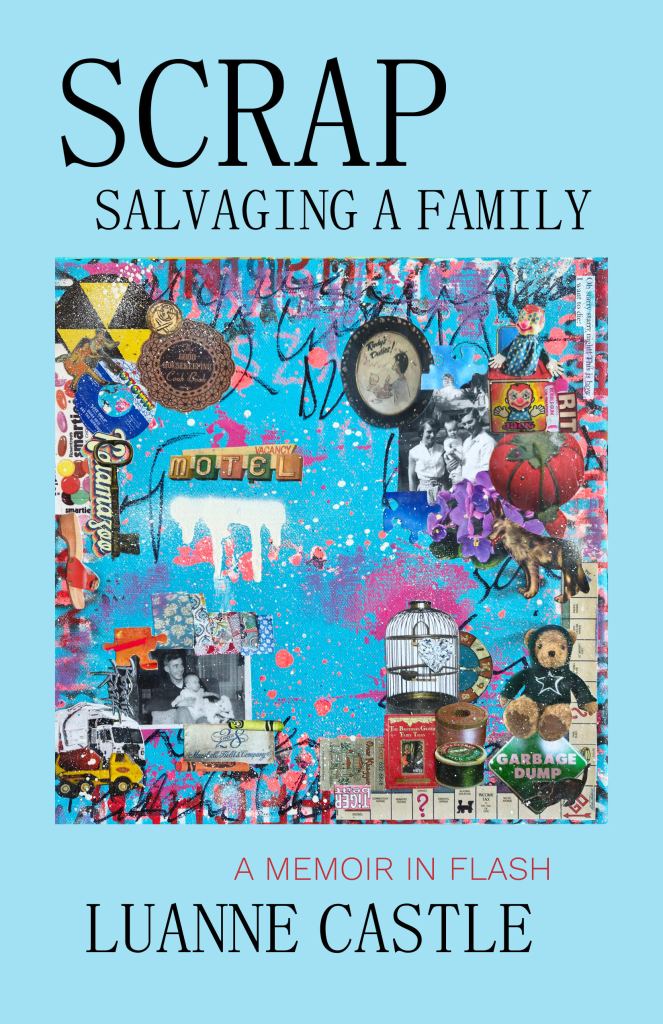
Memory must be excavated scrap by scrap, salvaged, and pieced together to create a new story of origins and identity. With the building of the story, the wound begins to heal, and the resulting emotions dissipate.

Thus it is with my family. My book is the story of an old family secret that infects the present and creates a dysfunctional father-daughter relationship–and the quest for answers that allows the father and daughter to learn and forgive.

Status of my book:

Although I wasn’t ready to finish my first draft, I had to pull something together for the final step to completing a certificate in Creative Nonfiction Writing at Stanford University. This step is a tutorial where I am working under the guidance of Julia Scheeres, author of Jesus Land and A Thousand Lives. She has now read my manuscript and given me revision suggestions, which I am working with. Things have been so hectic with the publication of Doll God and my father’s illness (not to mention that traffic blockage I wrote about last week!) that I don’t get much time to write.

Here are brief excerpts from my first three chapters of Scrap:

Prologue

1966

Dad popped his gray-streaked head into my open doorway on his way to the kitchen. Not much bigger than I, he seemed to fill the space. “Get dressed for ballet class!” His voice was a brief bark.

Chapter One: Frank Talk

Thanksgiving 2009

The drive south from our home in Phoenix exposed the flat desolation of the region. The only sights were the occasional saguaro and the roadside ostrich farm where travelers can stop and feed the animals. Since ostriches have a reputation for being downright mean, we had never stopped there on trips to my parents’ winter condo in Green Valley, twenty-five miles past Tucson. I’d brought up the idea once. My husband of over three decades said, “Sure, I want to get snapped at by a big bird and then by your father. I don’t think so.”

Chapter Two: Nuclear Fallout

2008: the year before

“Doesn’t look like much,” Mom said, as we pulled into the parking lot of the Titan Missile Museum.

The main building was low to the ground. A few small buildings, which looked like garages or tool sheds, and large equipment were scattered throughout the fenced property.

If I hadn’t known where we were, I would have thought it looked like a work site with a few trucks and what seemed to be oil tanks, not a nuclear missile site.

The work-in-progress blog tour rules:

  1.  Link back to the post of the person who nominated you.
  2.  Write a little about and give the first sentence of the first three chapters of your current work-in-progress. Sherrey gave more than the first sentences, and I like that idea, too.
  3.  Nominate some other writers to do the same.

Tag. You’re it!

I was thrilled that these writers have agreed to take part in this work-in-progress blog tour. Please stop by their sites and get to know them and their work.

RENEE at Unpacked Writer  teaches college writing. She has published creative nonfiction and won awards for her writing and is writing a book about her adventures as a young special education teacher in a small and remote Alaskan village. Renee describes herself  this way:

My interests might find me behind a camera, an acetylene torch, spending a day with a legislator, at the farmers market, or with my nose in a guidebook mapping an adventure. Usually, I’m responding to thoughtful student writings and preparing ways to get students to think about writing.

Most days find this mid-life mother of teenagers, behind the wheel of the mommy-taxi, revising writings, volunteering in the community, figuring out how to prepare a healthy meal everyone can or will eat, or shooing our urban chickens from our kitchen door.

I am a mother, writer, traveler, wife, thyroid cancer survivor and writing instructor.

During the work week, MARIE is a public health data analyst.  After hours, she is a writer, compiling a nice tall stack of first drafts that she rather dreads having to sort through.

Marie started writing when she was about 9 years old, but she was never very confident (if at all) about her writing talent, and it was easy for her to “give up” periodically, in spite of the support she got from mentors and fellow writers. Once she got a “real” job (cue public health), it was hard to argue with anyone that she should or could expect to do better by writing. She’s made a lot of detours on her path to happiness, but finally she’s woken up to the fact that she’d rather be writing than anything else (ideally, in her pjs with a pot of hot tea for fuel).

Through her blog, www.1writeway.com, Marie has discovered a truly wonderful community in blogging, one that has been so supportive that  she no longer hesitates to say, “I am a writer.”

A born and bred Brit, SHERRI lived in California for 17 years before returning to the UK with her three children in 2003.  She began her writing career a few years ago while caring for her Aspie daughter.  Since then, she has been published in magazines, anthologies and company websites and launched her blog, A View From My Summerhouse. Today, she lives with her husband, daughter and two cats in the West Country of England where she keeps out of trouble writing her book (a memoir), walking, gardening and taking endless photographs.  Her muse, a garden robin, visits regularly.

You can reach Sherri at these online locations:

Blog link:  http://sherrimatthewsblog.com/about/

Facebook Page:  https://www.facebook.com/aviewfrommysummerhouse

LinkedIn: http://www.linkedin.com/pub/sherri-matthews/60/798/aa3

Google Plus: https://plus.google.com/103859680232786469097/posts

Renee, Marie, and Sheri, thank you so much for agreeing to take part in this WIP blog tour. I look forward to reading your posts in the future.

How about you? Do you have a work in progress?


31 Comments

Filed under Blogging, Creative Nonfiction, Memoir, Nonfiction, Writing, Writing goals

Break Out, Go Ahead and Do It: Part II

Last week I introduced you to indigenous poet Carol Bachofner. She has published four excellent books of poetry. Check out her poetry! Part I can be found here.

In Part II, learn Carol’s original process for writing “something else” sonnets. Don’t know what those are? Read ahead . . . .

by guest blogger, poet Carol Bachofner

A poem Carol wrote that illustrates the breaking out she discusses

 Why Hang Out in Bookstores; a something else sonnet

There are other ways to take on the sonnet form and make it serve a different purpose. I recently had another breakthrough, courtesy of an unwitting Sherman Alexie. Visiting our daughter and her family in Seattle, I had one non-family wish of the trip: to spend some quantity and quality time at Elliott Bay Books, alone. I always make a beeline to the poetry section of any bookstore to see what’s new that I might not have seen at home. I found two books that really got my attention, my sustained attention. The first book is The Rose Metal Press Field Guide to Prose Poetry (ed. Gary L. McDowell and F. Daniel Rzicznek, 2010) and the other is Alexie’s latest poetry collection, What I’ve Stolen, What I’ve Earned (Hanging Loose Press, 2014). These book finds changed my view of prose poetry. Utterly changed. DRAT!!! Just when I was getting comfortable again! But it is why we hang out in bookstores, to be changed.

I confess that previously I have eschewed prose poetry, claiming loudly to all who would listen that this alleged form is nonexistent. Why do I do that? My literary protestations almost always lead to changing my mind about what I am avoiding or rejecting. On this particular lovely fall day in Seattle I was to be challenged yet again. I would have to face the fact that this form is real, to accept the fact that if Sherman Alexie was writing in this so-called “form,” I would have to see why. I was, from that moment, on the fast track to writing one or more prose poems myself. How could this happen? Prose was always prose and poetry always poetry. I was SURE of that. Until now. As a narrative writer, I knew I was always straddling the two worlds, but I knew somehow where the borders were. and I did not think those borders were crossable.

Where the breakthrough came for me was somewhere in the middle of Alexie’s book, the place where he starting labeling poems as “sonnet” when they clearly looked like prose to me. Have you ever become aware of a slight manic buzzing in your head when you are about to discover something new for yourself, ready to disembark from the safe ship of your life and wobble on the dock? I could feel myself getting hot all over, hearing the buzz, and feeling a twitch in my left eye. Uh-oh.

I tried to find where in his “sonnets” there was something sonnet. What I found was a “something else sonnet,” a combination of prose and poetry that spoke to me. Loudly. Profoundly. He was laying it out in a way that seemed properly improper. No worries over rhyme scheme (have you ever balked at the use of “scheme” as if it is some kind of a trick?) and no worries about where to break a line or where to put the turn or whether to put a turn at all. Instead of 14 clearly defined lines, he dared to make 14 segments of thought, of wondering, of action. Yes, 14 segments that said something without restriction. Oh my. Oh dear. Oh my. I had to try this.

Suddenly I was writing prose that felt more like poetry to me than anything I’d written in a while. Suddenly I was writing poetry that seemed more real, more honest. I was wobbling on the dock and dying to jump off and swim.

Then the inevitable questions for myself began flooding in. What was going to be MY take on this? How would I make something as real as Alexie, without being a poser, a fake, a phoney? It wouldn’t be easy to adapt my previous thinking to this new thing I’d so long rejected. But I knew I was comfortable with sonnets. I was comfortable with every aspect of sonnets. I was also very comfortable with narrative. So there. I had to jump.

At first I thought this meant I could just freewheel it, abandon all traditional aspects of the sonnet. But I had no desire to just throw myself into a sort of “freefall abyss.” I took a few deep breaths and began thinking of what parts of sonnets I might use to my purposes and how far into prose I wanted to venture. The more I pondered, the more one thought came to me: with the skills I possess as a poet, as a somewhat-formalist, I can combine prose and the sonnet, one of poetry’s most lasting forms and make something new for myself.

As I waded out into the deeper waters of form deconstruction, I felt a bit like an inventor. The process I devised is a basic guideline, a first way in. I chose to meld prose and the sonnet form in a way that was different but felt at least a little familiar. I needed my own process to serve as an entrance. Here is my initial process, one I have now abandoned as I continue to grow comfortable with this new “something else sonnet” form.

A Process Toward Writing a “Something Else Sonnet”

1. I decided to go by way of strong words, nouns and verbs. I elected to choose 14 nouns that are somewhat thematically connected. The words I chose are all words of restriction and stoppage and alienation. My theme (loose) is that of being held back or cordoned off from love. You will see my words in bold in the example below.

2. I set off in a direction, toward a theme or idea. I figured I could always reset my direction if the initial attempt was a wild goose chase. I did reset a couple times, but did not fully abandon the original impetus or word list.

3. I chose to follow Alexie in numbering each section (and in using sections or fragments rather than anything approaching lineation. After all, this was PROSE poetry. Beginning with the number 1, using what I determined to be the “best” word from my list of words, I created the first section/fragment.

4. At the place in that first bit of thought where my mind felt a bit like jumping, I put a period and wrote the number 2. After that I let myself leap (free association is the thing here) and used another word from the list. I found it helpful to cross off each word used to make sure I used all fourteen.

5. Repeating this process, paying no attention at all to where numbers landed, I wrote the whole poem as a paragraph with parts. Remember that any numbered portion may contain more than one sentence or fragment. It may be a bit self-contained with one major leap or it may slide into a transition as the piece nears its end, making the next leap smoother.

6. I also began to consider that I might keep going after number 14 and run the poem onward a bit, ending with a rhymed couplet; I did do this in the example below. I wondered as I wrote whether the poem wanted a somewhat traditional volta and where. In the example below, I came to see that the poem wanted to pivot a bit at line./section 9, a pretty traditional thing for a nontraditional sonnet.

NOTE: In the following example, I have bolded the nouns from my word list; these do not remain bolded outside of this example.

Love is Monstrous(ly) Wonderful(ly) Bordered, a prose sonnet

1. Natural barriers could be the colors of love, red lips shine, bruise-blue or some psychedelic bursts of argument hues at the edge of love’s known world. 2. Sterile areas pop up like rabbits. You want to go there to be safe, to be gravid with love. 3. Ditches burrow themselves into sidewalks where lovers pace, submerge to begin their travel along wrist-like veins recently scissored open in desperation. 4. You can achieve closure that way. Real closure. The slamming of the garden gate on too-rusted hinges made furious by rain. The door-bang of a car, locking itself with the keys still in the ignition. You learn how to leave and how to stay. 5. Love opens and closes on everyone eventually, even if no one hears it happening. Love maintains its elastic geography this way. 6. You cannot escape into a security zone to avoid it. 7. Even though you don’t recognize it, your heart is a sovereign state. 8. It has a seam-line of tissue paper tears. Rain will open up in it, open you eventually. 9. You’ll soon be seen at the checkpoint, tourist visa in your breast pocket, flashlight between your teeth. 10. You will head back to the colors of love and sketches you made of it at the blockade. It’s a secret. It is invincible ink. 11. Cruelty is the killing ground. 12. Vault over its borders. Ping between love and its doppelgänger. 13. Roadblock ahead! Drive. Run. 14. Decide to burn down the separation fence. 15. This is what you need to know about love and disaster, about a heart full of tacks. 16. Once you fill your suitcase, you get the monster off your back.

So, let’s review what has happened here that makes this a sonnet:

1. 14 somethings + couplet
2. volta at or near section 9. — of note: key words/phrases of the turn include checkpoint, head back
3. rhymed couplet at the end (though not metrical, it is musical)

We can see what makes this a sonnet and what makes this prose as well. The narrative is sacrosanct in the form, the combining of two forms. It is a hybrid that works well for me as a storyteller and poet. I owe it all to my obsession with hanging out in bookstores. Here is another example of story preserved as a brief prose poem, a sonnet that defies the usual end-rhymed final couplet. Find the turn, if any. Ask what makes this prose piece a sonnet.

Living On, a prose sonnet

1. From a waterfall 12 feet straight down, into 2 feet of water 2. Swept off like leaves ready to die. 3. Never thought about death then. Never thought about life then. All the same to me. 4. Carried to safety by a Paiute, slung sack on his back. Now a piece of him, he’s me too just that way; how I think of it. Carry me, I carry you. 5. The tee shirt he stripped from his back I wear as he wore me. American Indian Dance Theater. 6. I dance. I sway and stomp like the wind trees or the river that caught me. 7. Live on or die. 8. Be Indian. Be not Indian. You don’t get to decide. 9. If you break a bone, pray for all other bones. You will heal 4 people that way. 10. One of them will heal you. 11. The river didn’t want to feel so empty that day. 12. Wanted to fill itself with something that needed healing. 13. Indian Canyon ceremony, sweat running like the river. 14. Grandmothers and Grandfathers yielding to the fire. Me — natal, naked, and ready to live on.

From the Body, sonnets also shall emerge

Recently someone posted a meme on Facebook that was a pun in picture form, a line drawing of a human hip, with the caption: Hip Poetry. A child of the 60s, it tickled me to see this punning of the phrase Hip Poetry. Thinking of the beat poets, I wanted to do something creative in response to the meme, so I decided a contemporary prose sonnet to honor the beauty of the structure of the body, while keeping the humor of the drawing and its caption. I went with a beginning section that began the combination of bone and tone. I allowed myself to flex my verbal musculature and pun, rhyme a little (final couplet), and use marks of punctuation [brackets] wherever that felt organic, seemed to fit. I even included a line from a satire album from the 60s (see section 6). The pure pleasure I derived from creating this sonnet, this prose thing, is immeasurable. I hope you enjoy it too.

Poetry From the Hip, a prose sonnet

1. It’s a body thing, a guts and sinew and bone thing. No one comes to poetry without a body on fire. Flames of language consume the muscle, jerk the nerves, hum in the skull. 2. It’s the hip, that ball and socket controller, that swing along the sidewalk of metrics action, that bend at the, flex at the, sit right down and write it creation that lets it all roll along to conclusion or to an opening at the end. 3. Imagine no hip. No swishing skirts or petticoats, no rhumba or cha-cha-cha to inspire the words of love that pour onto the page, that plunge the poet into despair over loss of. Love pivots on such bones. Love poems pivot on them too. 4. Shoot from the [hip]. Be [hip]. [Hip] [Hip] hooray on the page or off into the air above the page. [Hip]ster, gangster, lover, mime, or magician. 5. [Hip] is your tour de force. 6. This is your hippy-dippy weather man, with the weather, Man 7. Whether or not. 8. Lines of poems hang from hip to hip, like bedsheets with secrets from old lovers. 9. Say lip [service or stick]. 10. Trip [up] or [the light fantastic]. 11. Ship [shape] or [out] and flip the switch to poems without secrets. 12. Secrets die like flies in winter when you turn on the lights. 13. It’s a body thing, a guts and sinew and bone thing. 14. Write it all, let it all, from the hip … swing.

Break Out… out there from here

Just as my last book, Native Moon, Native Days, was a departure from the regional, nature-oriented poems of the previous two collections, my newly-submitted manuscript is a departure. It is structure-oriented rather than topical, regional, or overtly ethnic. It contains an array of what seems to me to be like stardust, a sprinkle of light. Of course, the trick here is whether or not a publisher wants to spread my stardust. Regardless, I am happy to have assembled these particular poems in this way. Hands, These Clumsy Ears of Hands. Out there. Definitely out there.

About the guest blogger:

Carol W. Bachofner, MFA Poetry Vermont College of Fine Arts, is currently Poet Laureate of Rockland, Maine (2012-2016). She founded (2010) and directs the annual Poetry Month Rockand, a city-wide celebration of poetry. An indigenous woman (Abenaki), she writes with a strong sense of place through narrative poetry. Her poems have appeared in such notable journals as Prairie Schooner, CT Review, Main Street Rag, Bangor Metro, The Comstock Review, Crab Orchard Review, The Cream City Review, Naugatuck River Review, and others. Bachofner teaches poetry in her community and “on the road” via workshops and conferences. She has four published books of poetry: Daughter of the Ardennes Forest, 2007; Breakfast at the Brass Compass, 2010; I Write in the Greenhouse, 2011, and Native Moons, Native Days, 2012. In 2011, Bachofner was a runner-up in the Maine Literary Awards, one of three finalists in the short works/poetry category. Visit her web site www.carolbachofner.com for links to her blog, and her facebook page or to contact her for workshops. or contact her by email at poet.laureate.rcklnd@me.com.

Carol Bachofner headshot


17 Comments

Filed under Essay, Nonfiction, Poetry, Poetry book, Publishing, Writing, Writing goals

Break Out, Go Ahead and Do It: Part I

I asked the Poet Laureate of Rockland, Maine, Carol Bachofner, to write about a poetic subject important to her. In this piece (which I am posting in two parts–today and then next Thursday), she explores her journey re-creating herself as the sort of poet she envisioned. Maybe all artists have to search to redefine their artistic identities to remain creative.  See what you think.

by Guest Blogger Carol Bachofner

In the early 2000s, I faced myself coming and going in a kind of convergence between form and something “not form.” I needed expansion. I was fortunate at that time to have poetry mentors who sit cleanly in the “new expansionist” camp: David Mason, RS Gwynn, Dana Gioia, and BH Fairchild to be specific. I would describe myself as a new expansionist and count these poets as friends and mentors still. Having said that, I do see myself and my writing now as breaking ground — if only with a tiny hammer. I have not lost sight of my familial roots either, which have led back to ancestor William Dunbar (Scots poet of the 1600s). Despite the age and depths of my roots as a poet, I find myself searching for small breaths of innovation to keep myself and my poems moving forward. I see my contemporaries doing the same, thus debunking the criticism that new expansionists just want to make it old. I wanted to be “that poet,” one who would write the most memorable of poetry, find something new and exciting for my writing life. But instead I settled into a rather ordinary poetic life, satisfying and full, but pretty ordinary.

A breakthrough came for me in 2001while I was living in London. I spent time several days a week in the British Poetry Library located on the 5th floor of the Royal Festival Hall. One day, I came upon a children’s book that changed my writing. It was not a book of great acclaim or literary merit, but it had some language that, for me, was haunting. The story, about a hare in winter, was written by a Scots writer whose tale was poetically told, in a kind of verse that seemed to be prose and poetry combined. I decided to write a poem using some of the author’s rich language approach. I made my first pass at the poem, based upon translation and a parallel presentation, putting together a Scots language version with my translation side by side on the page. Although I did not (still do not) speak the language, I set about doing a translation, one phrase at a time. I still look at that parallel structure from time to time to please myself as a “translator.” As the messages of the story began to unfold in translation, so did the poem itself. I share it here in its final version, minus the original Scottish:

Peace, Tamh

What does one do but look
in a poem to what goes on out there …
Roland Jooris (Flemish poet)

White, cold white
stinging every bare unsheltering hill
Earth you dressed yourself up to be bare
watching snowfall, pleating snow
under doors, over meadows, over moors

The gusts of our longings dizzied us.
We warmed each other,
but the day did not endure

Silence, silence
O’ to be in the circle ‘round the hearth!

The skies are bruised in their seasons
Threads of breath from snowdrifts
travel for miles through the silence
shining white secret, it’s tinkling murmur,
well, that won’t be silent

White waves of stars at time of darkest moon,
a flag of truce for all tribes of the universe.
We are waking.

Then I Chose the Sonnet

Over time, the sonnet form has been adapted into something other than the form we were taught in school, something we can to choose to remake or reinterpret for a contemporary setting. We can open it up and break it into parts, shapes, and employ any manner of contemporary poetic gestures in so doing. Gerald Stern somewhat famously rendered the sonnet “American” by expanding it to more than 14 lines and abandoning obvious rhyme and meter. That got my attention, for its very boldness if nothing else. I found myself more and more attracted to the sonnet. To be honest, I had avoided the kind of regulation the sonnet took beyond what I needed to learn the mechanics of the form, the academic nuts and bolts. But here I was now, drawn to it like a moth to a streetlamp. I spent time, years, reading as many sonnets as I could reasonably do, from Shakespeare to Millay. I began to write sonnets. I wrote traditional ones (mostly terrible ones) and a few break-out ones. I was ready to accept another breakthrough moment.

What can form and an open attitude do to get you out of a rut in your poetry writing? It can redefine your aesthetic, give your writing system a jolt of energy. For me, it keeps me from writing the “same” poem even when focusing upon a particular topic over time. I recently sent off a manuscript that is rife with fractured forms and the whole seems to me to be a most pleasing concoction of what I am capable of doing with words. If I can please myself, I have at least a decent chance of pleasing my readers. Oh, certainly I do want to please you!

I have dared to bend, break, and reassemble form. Let’s look at this a bit in detail. I chose the sonnet, a form I’d rejected for the first half of my writing life. I thought the form stuffy. I hated the way all the sonnets I was reading felt artificial. I admit that my resistance comes a bit from “old stuff” in early college days when New Criticism was fading and free versifying was breaking down those walls. There is no doubt in my mind that I have pretty much always been teetering on the edge of a kind of cosmic divergence between constrained form and free form. If only…

Carol's office

Carol’s office

My very first experience with breaking open and “reassembling” a form occurred not long after this experience with translation. The resultant poem has somewhat traditional rhyme, a turn at line 9 (breakout from rhyme scheme included), and a rhyming couplet that is not exactly a couplet but rather part of a rhyme scheme that morphs into a couplet (fgfgg). Before sharing the broken open form, here is how the poem I wanted to write would look in traditional style (as a block of writing). Take a few minutes and look at all the tradition in this sonnet. There is meter, rhyme that is not entirely predictable, and the look of it screams SONNET! Ordinarily, I’d be proud to have this be my final draft. I’d be told it was a “good” sonnet.

But, for some reason it is not all that satisfying to me. It needed my further attention. You be the judge here. I trust you to see what I saw in the light of innovation and adventure.

Snow, a sonnet

From gardens of the fertile sky, a
fall blossoms made of air b
It’s God’s design that we might sigh a
as we see them sifting here. b
Each flower cut, is folded, sent c
flying stringless, pure, white kites d
to soften up the firmament c
with their muted spiraled light. d
Even the saints will try to shake e
the rumors they’ve been told f
of death that overtook a child g
who wandered in the dazzling cold f
blinded, lost and then beguiled g
by winter’s flowery, frozen smile. g

I think you can see how constrained the subject is due to the structure. It did not feel the way I felt doing the translation. Not at all. It was (is) tight, bordered, and rigid, with the possible exception being the rhyme break at line 9. More on that later when you have looked at the fractured version. The structure needed, wanted to be less rigid. Grief is not rigid. Snow is not rigid. I needed to do something so the poem could say its message. I needed to fracture and reset the bones of the poem.

Let’s look at what opening this poem up on the page did for it:

Snow

From hidden gardens of the fertile sky.
fall showy ice-spun blossoms made of air.
It’s God’s design
that we on earth might sigh
as we watch them sifting silently here.
Each pristine flower cut, is folded, sent
flying stringless, pure.
Latticed crystal kites
drift soft across the star-blank firmament.
From deep within the muted spiraled light,
saints and angels try to shake the news,
the frightful rumors they’ve been told:
of death
that overtook a child of two
who wandered out
into the dazzling cold,

blinded, lost, and then beguiled
by winter’s flowery, frozen smile.

If you look closely at the broken version of the poem, you will find the structure of the sonnet there (the “couplet” is there in its own way). It (the message) drifts down and settles, as snow does. It doesn’t overwhelm the message, but instead allows the message to settle on the reader as well.

Can you find the places where the rhyme lives? What about the turn? Does the turn happen somewhere different from the traditionally-structured version? What do you see as successful or not in this second version? Which pleases you and your particular aesthetic about sonnets? Does the breaking of form unsettle you? Is the second a sonnet at all? Only you can decide. But it pleases me to present it to you here.

Come back next Thursday for the rest of Carol’s essay.

Do you think that all artists have to search to redefine their artistic identities to remain creative?

About the guest blogger:

Carol W. Bachofner, MFA Poetry Vermont College of Fine Arts, is currently Poet Laureate of Rockland, Maine (2012-2016). She founded (2010) and directs the annual Poetry Month Rockand, a city-wide celebration of poetry. An indigenous woman (Abenaki), she writes with a strong sense of place through narrative poetry. Her poems have appeared in such notable journals as Prairie Schooner, CT Review, Main Street Rag, Bangor Metro, The Comstock Review, Crab Orchard Review, The Cream City Review, Naugatuck River Review, and others. Bachofner teaches poetry in her community and “on the road” via workshops and conferences. She has four published books of poetry: Daughter of the Ardennes Forest, 2007; Breakfast at the Brass Compass, 2010; I Write in the Greenhouse, 2011, and Native Moons, Native Days, 2012. In 2011, Bachofner was a runner-up in the Maine Literary Awards, one of three finalists in the short works/poetry category. Visit her web site www.carolbachofner.com for links to her blog, and her facebook page or to contact her for workshops. or contact her by email at poet.laureate.rcklnd@me.com.

Carol Bachofner headshot

22 Comments

Filed under Essay, Nonfiction, Poetry, Poetry book, Publishing, Writing, Writing goals

Assigning Stars to Books I’ve Read

HAPPY THANKSGIVING, AMERICAN READERS!!!

After I started transferring my memoir reviews over to Goodreads, I had to go through another critiquing process: assigning the number of stars to each book. What goes into that analysis is different from writing a review. A review focuses on all the ways the reader (the reviewer) reacts to and interacts with a book. I can love the experience of reading a book without thinking that overall the book deserves the highest score possible, 5 stars.

Also, there are books I want to give a 4.5, but I don’t know how to do that. Do you have to assign a 4 or a 5? No halves?

And what does a 5 mean? Does it always mean that I think the book is the most engaging story? Not necessarily because some books aren’t about the narrative. Does it mean that the book has the most literate, well-crafted sentences? Often times it does mean that. But not always. I am using 5 stars to mean a book that I can see myself reading again, should the occasion arise. And a book I can advise others to read, without qualification.

It kind of astonishes me how stingy some people are when they assign stars to books on Goodreads. I suspect those people have never written anything themselves ;).

Here are some unexpected stars in nature:

And here:

Speaking of book reviews, I plan on writing one for Julia Scheeres’ memoir Jesus Land in the near future.

This winter I will complete my tutorial in the Stanford program. In the tutorial I will be working with an instructor who will read my whole book draft (the memoir) and give me feedback for revision. Researching the Stanford instructors I realized that I so wanted to work with Julia Scheeres, especially after I read her Jesus Land.  Oh, what a book! Imagine my excitement when I got the email saying that my request had been approved and that I get to work with Ms. Scheeres this winter!

But I have to go work on my draft which needs another year’s worth of work before it’s ready. And I only have until the end of December. Good thing we’re not having our Thanksgiving dinner today. Pumpkin pie Saturday!


53 Comments

Filed under Book Review, Creative Nonfiction, Editing, Memoir, Memoir writing theory, Nonfiction, Research and prep for writing, Writing, Writing goals

Let’s Talk About Writing Process

Sherri Matthews who writes A View From My Summerhouse tagged me to write about my writing process.  She wrote about her own here. Sherri’s very welcoming blog shows her wonderful personality, her stories, and her photographs. I particularly love the way she crosses the pond by writing about her life in the UK and her experiences living in the US.Sherri

Sherri discovered her true calling to write three years while supporting her daughter through her diagnosis of Asperger’s Syndrome.    Since then she has had articles, poems and a short story published in magazines and two anthologies. She is writing her first book, a memoir telling the story of her three years spent with her American G.I. and the catastrophic events that changed both their lives forever. A born and bred Brit, Sherri moved to California in the mid 1980’s where she raised her three children for seventeen years.  Returning to the UK after her marriage broke up in 2003, today and happily remarried, she lives, writes and takes endless photographs in the West Country of England with her hubby, daughter, two cats and an African Land Snail called Vladimir (her daughter’s). Sherri publishes regularly on her blog, ‘A View From My Summerhouse’.

You can read about Sherri’s memoir book project here.

Writers meme

When I agreed to be tagged by Sherri, I had forgotten that I already wrote about my writing process last spring. At first I thought, why bother to think about this again. But after reading what I wrote at that time, I realized that a lot has changed. For that reason, I thought I’d think about the process again. Also, I wrote a lot about blogging at that time, but today I’ll focus on my other writing

1. What am I working on at the moment?

Last spring I was putting together my full-length poetry manuscript and working on my book-length memoir.

Since then, my poetry collection Doll God is being published by Aldrich Press. I finally started thinking of poetry beyond the book and began to write a series of poems based on old family photographs and the results of my genealogical research. Maybe I’ll collect them into a chapbook, eventually.

However, I just heard from the publisher of Doll God. Kelsay Books plans to put the book out earlier than expected! Perhaps mid-January. I’m getting excited, but I’m also getting too nervous.

I started working on short memoir pieces to send out. A chapter of my memoir was published here. Several other pieces are in various stages of completion and two have been submitted to magazines. Since I’ll be working on my memoir during my Stanford University certificate tutorial this winter, I will have to set aside the shorter pieces.

2.  How does my work differ from others of its genre?

I wasn’t given this question last time. It’s a very difficult one to answer because I haven’t looked at my own work with the analytic eye necessary for that. Instead, I write by instinct, using my own individual voice, experience, and outlook. I’ve been told often enough that I’m a little bit of a nut or that my view is “idiosyncratic,” so I’m pretty sure that means that my take is a little different. But I’ve also been told that my experience resonates with others, so maybe everybody is a little different, a little “nutty.”

My memoir is a story that is specific to me and to my family, but it has commonalities with the lives of many other people. It’s an emotional history of a family.

My poetry springs from the interaction of heart and head.

3.  Why do I write what I do?

I write poetry because I love to play work with language and see a poem take shape that is more complex and rich than what I envisioned when I began.

Why memoir? Because I am writing a burdensome history out of my body. Once it is shaped on the page, I no long have to carry the burden. The more well-crafted it is, the better job I’ve done at moving away from the raw material. Additionally, I am learning (in a therapeutic sense) how to recast my history in a light that feels healing.

4.  How does my writing process work?

The process I go through is the same as it was last spring:

For prose, I write in Word, one scene at a time. When I feel that I’ve taken a scene as far as I can at that moment, I put it away and move on to another scene. But I always print out drafts, revise by hand, and then make the corrections on the computer. I revise over and over and over again, often times for several little changes each time. It’s a big tree waster, but one I can’t seem to avoid at this point in my writing. However, I do turn the pages over and re-print on the other side.

Poems sometimes start out by hand, but in general, I don’t have an affinity for writing by hand and wonder how Jane Austin ever did it.

Process also includes what I do once I’ve taken a piece as far as I can. I do like to have a trusted reader read my work. My in-person writing group–Rudri at Being Rudri and Renee at Unpacked Writer–give me great feedback on where to improve and what to rethink. I have another long-time friend who is a fabulous writer and editor who is also a fabulous reader. These women help me bring my prose to completion. I wish I had friends who were this reliable as poetry readers, but I have not been as lucky in that genre.

I would like to introduce my three  four (rules are meant to be broken) nominees who will post their responses to these four writing process questions on their blogs. 

First up is American Ellen Morris Prewitt, an award-winning fiction writer. I love her stories. She’s recorded many of them in audio format, too, and listening to her read is quite the experience. She has a southern accent and a sort of deadpan delivery. What a delectable combination! Have a listen here.

Here’s a description of Ellen’s fascinating life right from her own distinctive southern voice:

My life has been shaped by two very early events: I was born into the racism of the civil rights South, and I carry the grief of my daddy being killed by a train. Much of my writing carefully picks at the nuances of racism, and many of my stories involve the child trying to understand the space left by a missing parent. The two jobs for which I’ve been well-paid are lawyering in Jackson, Mississippi and walking the runway in Memphis. I follow my own peculiar definition of God, which led me to start a writing group of men and women who have experienced homelessness. I love all the people in my life but mostly my husband, my dog (yes, she’s a person), and my two grandbabies. I’ve been known to appear in public in costume.Ellen

Ellen blogs at www.ellenmorrisprewitt.com under the tagline “Ellen Morris Prewitt: My Very Southern Voice.  In addition to Ellen’s skillful and engaging stories, I love reading Ellen’s posts for their heart and inspiration. Her work with the homeless is so important.

###

Next up is my Canadian buddy Sue Fletcher aka Menomama3. Sue writes two blogs.  I’ve been reading her first blog since I started blogging. She’s got a great voice and wonderful sense of humor–and I think eventually she will need to start sending out her memoir pieces. What she shares on her blog are wonderful stories and observations. This is what she says about herself:

Here’s a confession: When people read and comment on something I’ve written, I am thrilled to bits. But I also blog because it feels good to explore what’s in my head and work it out through writing. In a way it’s like taking your clothes to the dry-cleaners. Inside the closet they looked kinda dingy and lost among all the dresses and blouses and skirts and slacks. But when you show them the light of day and look at them one at a time and give them a good cleaning they look all new and fresh. Just like memories.

I call myself Menomama3 because when I started blogging four years ago I was deep in the throes of menopause, and my three daughters were like hormonal pressure cookers. Release was essential and writing was the form. Better than running away from home – me, not the girls.

Anyway, there are two Menomama3 blogs. “Wuthering Bites” is poetry, photos, and a few little stories. The other, “Life in a flash”, is an assortment of whatever comes into my head during dog-walking. Then I have to bolt home and write it down before I forget. Which I suppose is also what the blogs are about. Writing memories down before I forget.

menomama

###

Let’s go Down Under to meet novelist Dianne Gray.

Dianne is Australian author who lives in tropical Queensland, Australia. She has won numerous writing awards for her short stories and novels and is currently renovating an old club house she had moved to the family farm in 2012. She is currently working on three new novels which will be published in the coming months.

Dianne’s Freshly Pressed adorned blog can be found here. She blogs about her life on the family farm, as well as other aspects of daily living in rural Australia. Her resume is chockfull of book publications and writing awards.

Dianne

###

Quite recently, I found Adrienne Morris’ blog. And I love it. It’s intelligent and quirky and always has something new to say about the past.

Adrienne Morris is a writer, living in the country, who milks goats, chases chickens and sometimes keeps the dogs off the table while writing books about the Weldon and Crenshaw families of Gilded Age Englewood, New Jersey. Her first novel, The House on Tenafly Road was selected as an Editors’ Choice Book by The Historical Novel Society. http://historicalnovelsociety.org/reviews/the-house-on-tenafly-road/

You can find her blog, Nothing Gilded, Nothing Gained–Books & Writing at Middlemay Farm, here.

Adrienne MorrisEnjoy getting to know these bloggers if you don’t already read their wonderful blogs–and watch for their writing process posts!


43 Comments

Filed under Blogging, Creative Nonfiction, Essay, Memoir, Nonfiction, Research and prep for writing, Writing, Writing goals