Tag Archives: poetry book

Review of Merril D. Smith’s HELD INSIDE THE FOLDS OF TIME

Here is my book review of Merril D. Smith‘s beautiful new poetry collection. I hope it makes you want to order a copy!

Merril D. Smith’s new poetry collection, Held Inside the Folds of Time, is a testament to Smith’s background as a historian. But what is more important is Smith’s sensitivity to previous generations. She opens the collection with a poem about a cave painting. By doing so, he connects us with all who have come before.

She recognizes what she’s learned from her ancestors, who–in “How I Learned”–“showed me that I have my own wings– / unfold them, fly. This, too, is part of the pattern.” The poet can’t or won’t get away from them: “My dead follow me through every timeline” (“Suspended, Surrounded”).

Smith’s ancestors who immigrated to the United States, her own family of origin, even the soldiers who died in a Revolutionary War battle are all subjects of the book. “In Memorium: For the Unknown Soldiers at Red Bank Battlefield” asserts “their ghosts roam the battlefield / settling their bones, unsettled in time.”

Nature features prominently in Smith’s poetry, and this is where the lyrical beauty of her writing is best displayed. She uses many poetic techniques, particularly variations of rhyme, such as off rhyme, end rhyme, and internal rhyme. These lines are from “Cross-Quarter Days”:

The blooms have browned,

blossoms scattered to the wind

now snow veils the ground,

there above, one bony root unpinned.”

While the poems contain examples of the beauty of life, the overall tone of the book is a lovely mournfulness. As Smith writes in “Winter Birches,” “there is no happily ever, only after.”

Held Inside the Folds of Time demonstrates the potential gorgeousness of language as it mourns and celebrates the poet’s world.

34 Comments

Filed under #amreading, #poetrycommunity, Book Review, Poetry, Poetry book, Poetry Collection

Sirens to Larks: Interview with Poet Rose Mary Boehm

Please meet the prolific and multidimensional poet, Rose Mary Boehm. She has graciously consented to an interview. I will give you her official bio first, but you’ll discover in her interview replies that there is so much more to Rose and her poetry than what can be discovered in a paragraph.

German-born UK national, Rose Mary Boehm lives and works in Lima, Peru. Author of two novels and ‘Tangents’, a full-length poetry collection published in the UK in 2010/2011, her work has been widely published in US poetry journals (online and print). She was three times winner of the now defunct Goodreads monthly competition and has been nominated for a Pushcart and Best of Net. Her other poetry collections are: ‘From the Ruhr to Somewhere Near Dresden 1939-1949: A Child’s Journey’; ‘Peru Blues or Lady Gaga Won’t Be Back’; ‘The Rain Girl’; ‘Do Oceans Have Underwater Borders?’; ‘Whistling in the Dark’; ‘Saudade’, and ‘Life Stuff’. A new chapbook is about to be published by Kelsay Books. Find out more about the author and her work on her website: https://www.rose-mary-boehm-poet.com/

INTERVIEW OF ROSE MARY BOEHM

I first met Rose in the Verse Virtual poetry community and journal. The journal itself is part of a community of poets that are very supportive of each other.

At the end of the interview I won’t respond because I want to leave you with how Rose ends the interview. Thank you, Rose.

  1. I have a theory that the creative chronology of a poet is more important than the physical chronology; however, the poet is first shaped in childhood experience. Your book From the Ruhr to Somewhere Near Dresden 1939 to 1949: A Child’s Journey, is a witness to those years, but years that were intensely defined by being a German child living in Germany during WWII. The book describes the deprivation of a war fought elsewhere and on the homeland. Please share a poem from the book and tell us what you hope the book accomplishes.


Having been a young child during WWII in Germany (I had just turned seven when the War ended) will forever colour everything I do and think and feel. I have a kind of PTSD which is well controlled (even though I just cannot, CANNOT read stories and see photos of the children of Gaza without despairing completely), but I can’t help referring back to my childhood again and again in many poems.

Now that I am in the last years of my life, I am desperate that my children and their children should not experience war, and this seems increasingly unlikely, the way the wind is blowing all over the world. It makes me scared and sad.

The book, From the Ruhr to Somewhere Near Dresden 1939 to 1949: A Child’s Journey, was a bit of an exorcism, a talk with a therapist perhaps, and hopefully a message to all children who lived either this war or any other. And, if they survive, how they often find (a somewhat troubled) childhood, remember the finer points of a caterpillar rather than the next plane strafing the house, the next bomb killing your neighbours, your parents, or you… if you’ve been small enough not to understand it all. My brother, eight years older, was not so lucky.

The collection is more of a story told in free verse than individual poems, numbered only in the order of telling the story. Seen totally from the child’s point of view, told in the child’s voice. Whatever I remember I remembered in this way – once I started looking.

I think I have to use two poems to give you an idea of the contrasts (‘normal’ childhood versus little-understood horror):


Poem 5

Mother calls them ‘Christmas trees’. My brother calls them flares.

I am wrapped in a blanket, sitting on Mother’s arm.

We are on the balcony. It is nighttime. Danger time.

These ‘Christmas trees’ stay for a while, suspended in the night sky.

Now she runs with me down to the shelter. Moments later

there is the whizz, the rumble. I press my hands to my ears.


In the shelter I always lie on the sofa and trace the pattern

of the velvet cover.  Maybe that man with the hoarse, loud voice

comes in these explosions and sweeps through the house,

killing everything with his breath. Black. He wears black

and he has a cape, like on the posters.


The siren won’t sound the ‘all clear’ tonight—that long, long howl

which tells us it’s alright to go back upstairs.

As during thunderstorms, the bangs come closer.

My brother looks as white as a ghost

and holds me tight. Mother comes to my other side

and holds us both. Suddenly the candles die.


Screams.

Silence.

Confusion.


Everyone speaks at once.

‘Where are the matches–must have been next door.

The Brandt’s… Must have been the Brandt’s.’


A light appears from the other side

and a figure in white. It’s Herr Brandt holding a candle.

I can’t help giggling. He’s wearing long, worn-out underpants.


Many houses are still burning.

Burning flesh stinks,

burning rubber stinks.

Death stinks.


Poem 6

I stand on the balcony. On tiptoes.

I’ll see him any minute now. The tram has

turned the corner, and it’s the tram

on which Father usually comes.

It’s a sunny afternoon

and I feel expectant and happy.


I can see his trench-coated figure,

recognize the way he walks, the way

he wears his hat. He carries his leather case

and something wrapped in paper. He probably

bought two of those flat fish with yellow spots

because it’s Friday. We always eat fish on Friday.

I am never quite sure whether it’s Friday

because he brings the fish, or whether

he brings the fish because it’s Friday.


  1. From your poems that I have read and those I have had the pleasure of hearing you read aloud, I have taken away that you have lived through a variety of changes: lovers and husbands, having children, living in various countries, learning many languages. How do you think your “multiple lives” and languages enrich your poetry? It might help if you have a couple of quotes from your poems to illustrate your points.


Yes, Luanne, it’s been a rich and varied life, full of pain, miracles, adventures, more pain, and much, much love. There is no way I can not weave this into my poetry. What am I saying, I am weaving nothing: it ‘weaves’ me. Those memories want out, and most of the time they become poems.

I chose the following poem as an illustration where my travels did not produce ‘place poems’ but a deeply-felt incorporation of history, place, and DNA.


A Pilgrimage


In Rosh HaNicra I look across

to Lebanon. Below me is the sea.

I pick up a stone and let it bounce

against the rocks.


The Sea of Galilee cuts me

with contrition. I want to atone

for sins to which I feel fettered

by blood. The Jordan washes the dusty crust

of the Negev from my skin.

The Dead Sea lifts my burden.


Haifa receives me in a language

I understand, Bethlehem’s brittle

alliances don’t inspire. My friend rejects

the kipah and holds my hand.

And Yom Rishon is the first day.


The languages are an enrichment and sometimes a small-ish problem: with each language you learn so much more than words. You internalise different cultures, customs, religions (or interpretations of it), images, music, rhythms. That’s definitely enriching. What can make you stumble at times are words you know in one language, you can feel what they mean in its totality in your belly, but there is no way they can be directly translated into their complete components in one English word. You have to ‘write around’ that word in order to make its full, round meaning understood in the way you do.

Of course, my travels, my pains, my children have all been sources for poems in many iterations. But instead of a few quotes, I think I’d better use the title poem of my collection ‘Saudade’, a poem that is the perfect example of  ‘writing around’ the meaning (as perceive by me) of the word ‘saudade’ which means so many things in Portuguese:


What is Saudade?

A moment that passes like

a paler shade of Spring,

like the knowledge of a certainty,

the vague promise of repeat.


The echo of something

which never was, a butterfly wing

that may have brushed your cheek.

Dreaming of indolence.


Expecting the first rains on dry fields,

not quite hearing the last lark before

the autumn winds, the first smell of snow,

the never-ending final summer dance.

Softest touch of his hand on yours,

the death of an infatuation.

Your evanescent youth.


A strange bliss in your longing,

fear of fulfilment. Praying

for the becalmed sea of inertia.

Celebration of absence.


You carry a sharp, merciless

switchblade made of stainless grief.


  1. If you had to leave quickly and could only take two of your books, which would they be and why? I’m not asking which you think are the technically best collections, but the ones closest to your heart now. Do you think your feelings about any of your poems has changed over the years?


Oh my, that’s the ‘impossible’ question. Each one of my books represents an important part of me, and I can’t leave even one important part of me behind. I’d rather think that I would be allowed to grab’em all. It’s a ‘Sophie’s Choice’, if I may use such a heartrenting example for mere books (but they are my children too, in a way).

If hard-pressed, tortured, threatened with a bucket of maggots, I’d probably choose ‘The Rain Girl’ and ‘Saudade’. Still, just writing this hurts. I also need ‘Life Stuff’. But please, let us keep that very much between us.


  1. Rose, what brought you to Peru and what is your creative life like there? What does Peru add to your poetry?


I was brought to Peru by my Peruvian husband, Luis (a Luis is affectionately known as ‘Lucho’ in Peru). I met Lucho in Madrid, where I had moved to from London, licking my wounds from a previous marriage that hadn’t made it. By the time Lucho and I got together, I was quite ‘together’ again too, or this new love adventure wouldn’t have worked. Take it from Granny: never marry on the rebound!

We stayed in Madrid for 18 years, and then took the plunge. We have now been in Lima for almost 14 years.

Peru was the first time where I lived (not just visited) a completely different planet, new language (even though I was fluent in Spanish – it’s a different Spanish here), poverty, llamas, braids, hats, Andean music, the gentlest of people as well as cheap lives easily taken over a cell phone. My book ‘Peru Blues’ was the result. I couldn’t write it now, I had to write it while I still saw everything with ‘foreign’ eyes. Over the years Peru became home, no longer an unknown country, and many things one no longer ‘sees’.

For example:


At the Seaside in Peru

Houses made from basket weave lean

into the dunes of the desert only a few meters

from the salty dance of the Pacific,

shivering in the stiff breeze.


Sand mixed with plastic and excrement,

small children crawl atop the landfill

with burlap sacks, the odd pig snuffles

between shards and pieces of iron.


A half-dead plant wrenched from the root,

reminder of what once was — unsalvageable.

Here I am, holding a small, brown hand,

sticky and bruised. Her large dark eyes

are those of a cornered deer.

Her mother turns to leave.


Contrasts

I remember lipstick smears on empty wine glasses, kisses

blown into the air, muak, muak, how good to see you,

Dahhling. There were important decisions

to be made. Go for Dior or Cacharel, and the wonder


how some women would never lose that dark-red

which ringed their mouths and made them appear

like fathomless caves, dangerous suction channels

inhaling man and mammal into Dante’s Inferno,


and the whispers behind long-nailed hands, ready

to claw and destroy, freckled breasts arching out

of low-cut silks and cashmeres, gold weighing

on bony hands. ‘Can’t be too rich or too thin,


Honey,’ that’s what the Duchess said. And now

I am watching from afar, on the screens of lies

which used to be the ‘small’ screens, how mudslides


reclaim the riverbed. The poorest build their precarious

homes there every year against all advice and the offer

of other land. My grandfather, some say, my mother, say others.

Tradition meets ignorance, and they tearfully watch again

their houses, children, wives and husbands

disappear under boulders and mud.


  1. Please describe your current project and why it is important to you. Why is it important to readers?


One of my current projects is a chapbook called, ‘The Matter of Words’, that’ll be coming out in the autumn of this year. I LOVE words, and – as I did with ‘Saudade’ – have written poems (short ones and longer ones) around ‘difficult’ words, words that are not used in daily speech as a matter of course.

But there is a full-length manuscript that is now looking for a home. That one – I won’t mention the title or give an example poem, not to discourage potential publishers, you know how iffy they often are about ‘previously’ published or curated – is a collection of all my favourite poems written since the publication of my other books, or those that didn’t quite fit. This may well become another one I’ll sneak into my backpack when I have to leave a lot behind.

And that’s where we are, that backpack. I am 87, and where I am going in the not too distant future I won’t need a backpack, and I can only hope that my writing will not completely disappear but give some meaning, joy (or tears) to those I leave behind.
 

23 Comments

Filed under #amreading, #poetrycommunity, #writingcommunity, Interview, Poetry, Poetry book, Poetry Collection

Season 5 Episode 14:  Luanne Castle on A Poet’s Voice

“Note how the red rose,velvet worn by early frost,clings confidentlyto its own treacherous stem,never accursed by mirrors.” Luanne Castle Welcome to …

Season 5 Episode 14:  Luanne Castle on A Poet’s Voice

5 Comments

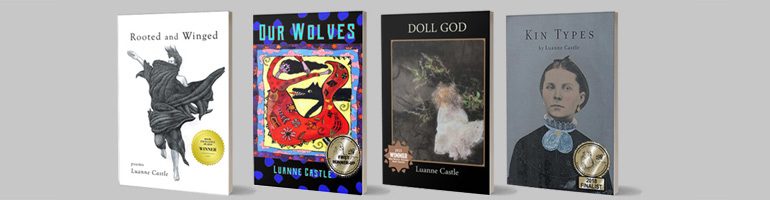
Filed under #AmWriting, #bloggingcommunity, #OurWolves, #poetrycommunity, #writingcommunity, Doll God, Kin Types, Poetry, Poetry book, Poetry Collection, Poetry reading, Rooted and Winged, Writing

Elizabeth Gauffreau Reads a Poem from Rooted and Winged

I did post about the beautiful review of Rooted and Winged by Elizabeth Gauffreau in the new issue of Anti-Heroin Chic. Now Liz has recorded a poem from the book–and it’s such a treat! She published it on her post with her link of the review.

9 Comments

Filed under #amreading, #amwriting, #poetrycommunity, #writingcommunity, Book Review, Poetry, Poetry book, Poetry Collection, Poetry reading, Reading

An Interview by Christine Butterworth-McDermott for Gingerbread House

This post is about something exciting to me at the same time that it is sad. Gingerbread House Editor Christine Butterworth-McDermott has interviewed me in the new issue up today. You can read it here:

Gingerbread House Lit Mag, with its emphasis on fairy tale-inspired literature, is one of my very favorite journals. Very sadly, I must say that this is the final issue of GH! Butterworth-McDermott will go on to do exciting things in the literary and artistic worlds (she’s an artist as well as a poet/writer), but this feels like the end of an era.

Please check out the whole gorgeous issue through the link above.

And here’s to a healthy and peaceful 2023.

19 Comments

Filed under #amreading, #amwriting, #poetrycommunity, #writingcommunity, Interview, Poetry, Poetry book, Poetry Collection, Poetry reading, Reading

Millicent Borges Accardi Interviews Me for CutBank Literary Magazine

What fun to be interviewed by poet Millicent Borges Accardi, author of the new Quarantine Highway, for the beautiful CutBank Literary Magazine. Her questions really made me think about my life, and in the process, I discovered things about myself. You might, too!

http://www.cutbankonline.org/interviews/2022/12/cutbank-interviews-a-conversation-between-luanne-castle-and-millicent-borges-accardi

Let me know what you think!

17 Comments

Filed under #amreading, #amwriting, #poetrycommunity, #writingcommunity, Interview, Poetry, Poetry book, Poetry Collection, Poetry reading, Reading

Anti-Heroin Chic Publishes Review of Rooted and Winged by Elizabeth Gauffreau

So excited to see such a beautiful review of Rooted and Winged by Elizabeth Gauffreau in the new issue of Anti-Heroin Chic. A big thank you also to editor James Diaz.

You can find the review here: http://heroinchic.weebly.com/blog/luanne-castles-rooted-and-winged-reviewed-by-elizabeth-gauffreau

See below image for update on Perry.

Perry’s ultrasound showed that he definitely has either IBD or lymphoma. Our decision was narrowed down to starting steroids or having investigative surgery. A complication is that he has recently developed a heart murmur so nothing can be done (except food change nightmare) until after his echocardiogram which is after Christmas! If you are a praying person, please put us on your list. Or send healing vibes or demands to the universe that this is IBD and that the steroids will make him well!

38 Comments

Filed under #amreading, #amwriting, #poetrycommunity, #writingcommunity, Book Review, Poetry, Poetry book, Poetry Collection, Poetry reading, Reading

An Update on My Dear Darling Perry Cat

A couple of months ago I wrote that I was thinking of changing my weekly posts from Mondays. After trying things out on other days, I have to say that I like my old pattern best which is to try for Mondays and if other days arise, then post then instead or additionally. So it’s Monday. And I’m posting.

I want to tell you about my darling Perry (in the photo he’s nestling up against Kana). It’s been years now since he first showed up in our backyard and we trapped him, got him neutered, took him to the shelter where he was all but kicked out. They thought he was feral because he was completely shut down emotionally. I ended up bringing him home and earning his trust over weeks and weeks. I read poetry and stories to him, sang to him, and held his food bowl while he ate. Then one day when I stuck my hand under the bed, he came toward me and started to touch my hand with his paw. That was the moment when I knew he wasn’t feral and was going to be a big sweetheart. Video of Perry Hiding Under the Bed Touching my Hand

Perry has been a member of our family for 5.5 years now, and he’s the King of the Castle. He’s been the babysitter of cats and kittens. He is in charge of it all. I have expected to have him around until I was really old. Imagine my shock to realize something is wrong with his health. He’s got weird poos that have gotten increasingly soft, light-colored, and smelly. He’s lost weight–down a couple of pounds in the last two years. He feels skinny. And yet he’s a picky eater which gives me anxiety as it reminds me of Felix and Tiger when they got sick. On top of the GI symptoms, he suddenly has a level 3 heart murmur. This isn’t a terrible one, but it’s significant and especially for a seven-year-old cat. So he needs medical tests. The GI troubles could be Irritable Bowel Disease–or they could be lymphoma. The vet want to start with an abdominal ultrasound. Perry’s going to get an echocardiogram to examine the heart murmur. Please send all your prayers, vibes, and general good wishes for my dear darling special boy. The ultrasound is Friday, and the echo is in a month (they are hard to schedule). 

As you may realize, we took in my son’s two cats six months ago. Two older cats who have their own ingrained habits and don’t get along that well to begin with is a pretty big thing to bring into a household with three older cats (two seniors plus Perry). It has not been a smooth six months. Not. smooth. at. all. 

The gardener and I are over our Covid (we hope). It wasn’t fun, but it sure wasn’t anything like Valley Fever (I’m only speaking for myself here). 

If you haven’t picked up a copy of Rooted and Winged, please consider it as a way to support the poetry community :).

If you have one and haven’t posted a review at Amazon (and maybe Goodreads, too), I’d sure appreciate it.

If you would like to review it for your blog or a lit journal, please email me at luanne[dot]castle[at]gmail[dot]com and ask for an ARC.

And if you have already bought a copy and reviewed the book, a million thank yous!!!!

52 Comments

Filed under #poetrycommunity, #poetswithcats, Books, Cats and Other Animals, Poetry, Poetry book, Poetry Collection, Rooted and Winged

Review of Rooted and Winged by Marie A. Bailey

For some reason WordPress doesn’t allow me to reblog to Writer Site, so I am posting a link to Marie Bailey’s fun review of Rooted and Winged. Thank you so much, Marie, for giving me a fresh look at my poetry collection!!!

https://1writeway.wordpress.com/2022/10/31/the-ease-of-wind-filled-wings-a-review-of-luanne-castles-rooted-and-winged-poetry-bookreview/

Read why Marie felt anxiety and exhilaration . . . .

Leave a comment

Filed under #amreading, #amwriting, #poetrycommunity, #writingcommunity, Book Review, Poetry, Poetry book, Poetry Collection, Poetry reading, Reading

Review of a Treasure: Millicent Borges Accardi’s Through a Grainy Landscape

The title of Millicent Borges Accardi’s new poetry collection Through a Grainy Landscape is from a quote by Tiago Araújo about driving at night where the view has been altered by the “dim and orangey lights” and from the final poem of the book, which explores the journey of living in a world where “walls / built across artificial boundaries” harms even children.

The poems of this book spring from strong influences on Accardi and her writing: Portuguese culture and the Portuguese diaspora; her childhood as the daughter of immigrants, and her mother, a lively figure in party dresses and good times. Accardi says that the poems were inspired by writing by “Portuguese-American writers and Portuguese writers in translation.” I have not read these muses and mentors, but appreciate the wellspring and focus they give the collection.

“It was my Mother who Taught me to Fear,” gives you an idea of what to expect from Through a Grainy Landscape:

The irregular verbs of culture that brought
the family away from The Azores, to the promised
land of California, was, were been.
Shocking like a past to push away
And start over born, born/borne.
As if invisibility could be
Run away from, a new start
in the garage of an uncle,
after a cross-country railroad
trip like pioneers, Los Angeles
was away from beat, and was beaten
down, the promised land was
to become became, begin,
a location that pushed away
and helped folks to start over,
pretending you were someone
else to fight, fought, fought.
To flee, fled. To approach
a way to make-over, redo, make-believe.
To start again. As if half-life
never happened. Not the Great
Depression of your grandmothers,
or the Great War, with its aircraft
carriers and new breed of
how to be and what to do. California
was a gifted promise for the melting
pot generation, goodbye to bend (bent, bent)
into shape. As the train car runs through
every state in the union, interwoven, interwoven
in a pattern called starting over,
in a safe place with a brand new method of
keeping, kept, kept. Where no one genuflected
on Sundays, kneel (knelt/kneeled, knelt/kneeled).
to recreate yourself from nothing is a wonderful thing.
Time were, you almost believed
it was possible.

Accardi’s collection is a treasure, both for its specific context within Portuguese-American literature and because it responds to the perspective that the United States is a country of immigrants and the descendants of immigrants. I even learned a favorite new word: saudade, which means “a feeling of longing, melancholy, or nostalgia that is supposedly characteristic of the Portuguese or Brazilian temperament” (Oxford Languages). This poetry collection left me with something akin to that feeling.

Through a Grainy Landscape is available HERE.

I remind those of you who preordered Rooted and Winged that the writing contest ends on Wednesday, July 27. That’s the last day you can submit a flash fiction, flash nonfiction, or poem that addresses the prompt in the guidelines. See HERE.

Before too long I will write about the two new cats living at my house. For now I will say that integrating them is a work in progress! Perry is helping me, of course.

14 Comments

Filed under #amreading, #poetrycommunity, #writingcommunity, Book Review, Poetry, Poetry book, Poetry Collection