Category Archives: Vintage American culture

Everyday [Super] Hero

If I make a promise and decide not to keep it (even if I think it’s a for a good reason), I feel icky. So I feel icky this morning because I promised you two memoir reviews this week, and you’re only going to get one–on Thursday.

But I do have a good reason (you knew that was coming!), and that is because I hit you with two really negative posts last week, and I hate ending the story that way.

What I like to remember is that after negative events start to commandeer my life, all it takes is one good person to turn it around. An everyday hero.

After my negative experiences in the last part of 3rd grade, with the teacher bully and the bus bullies, I was matriculated into Mr. Polonowski’s 4th grade classroom.

He was Miss Slack’s opposite. A phenomenal teacher.

Mr. P, as we called him, was a tall lanky young man with a brush cut (crew cut) haircut and glasses. Before 4th grade, I didn’t realize teachers could be men.

Mr. P’s classroom was ruled by respect, meaning he respected us. So we, of course, respected him.

It was my best year of school . . . ever.

Here are some of the many high points of Mr. P’s class:

  • He set up a long table in the front of the fully windowed wall with Michigan’s natural and cultural treasures: fossils, Petoskey stones, arrow heads, copper, and rock salt. Unlike show and tell, the goodies stayed up for a long time and we were free to handle and examine when our assignment was done. I particularly enjoyed sampling the rock salt ;).
  • We used SRA* reading materials, so I was allowed to read as much and as fast as I wanted, plowing through all the beautiful colors and then back up through them again.
  • Mr. P didn’t require boxes around answers during arithmetic. He never put a kid on the spot. He helped us learn division, to feel pride, and not to dislike math.
  • Mr. P read to us every day. He read from The Oregon Trail and Pippi Longstocking. The way he read them with his deep expressive voice, they were two of the most exciting books I’d ever “read.”
  • We watched science documentaries and got very engaged in our discussions afterward. I still remember those films and how relaxed our classroom felt–how free we were to explore new ideas and information.
  • During lunch, we were allowed to rehearse plays. A friend and I wrote the plays, usually based on fairy tales, and we coerced a few classmates into performing them. I’d started directing plays when I lived in my old neighborhood and still loved it. I think Mr. P also knew that I was a little hyperactive and needed an extra activity.

Sometimes I wonder if Mr. P, everyday hero, stayed in teaching or ended up leaving for business or law or another career. For the sake of the children, I hope he stuck with it.

Mr P


* SRA reading lab was a supply of color-coded reading material. We were assigned a level to begin at and we would read articles and respond to questions within that color level. When we mastered it, we would move up to the next color. When we reached the highest level, we could start back at the bottom of the box and keep reading. It functioned a bit like the Montessori method in that an entire class could be at all different reading levels–nobody would be dragged ahead until she mastered her level and nobody would be held back when she could move forward. Although eventually the color and design were changed, when we used SRA, there were many colors so it was a system that was both tangible and aesthetically pleasing.

Did you have an everyday hero when you were a child?

88 Comments

Filed under Creative Nonfiction, Memoir, Nonfiction, Vintage American culture, Writing

The Neighborhood of My Puberty

You might know that I’m writing a memoir. It probably won’t be done for a long time yet. I’m not complaining about the time it takes; I just don’t want you to pass out holding your breath ;).

To give you an idea of one of the book’s settings, I’ve written a description.

I’ve lived in a different neighborhood for every stage of my life.  The one I think of as quintessential suburban America was the scene of my puberty, from fifth through ninth grades.  At the head of the street, intersecting the busy main drag, sat the First United Methodist Church with its big parking lot.  Next to the cars, the church had installed one swing set and one seesaw and called it a playground.  Crabapple trees tempted bored children with their small, hard, bitter fruit.

Church at the head of the street

Church at the head of the street

My parents and brother and I lived a lazy walk down the street from the church, in a three-bedroom, one-and-a-half bath ranch. We had a large front yard with lots of grass to mow with the old egg beater Dad made me use.

Vintage "egg beater" lawn mower

Vintage “egg beater” lawn mower

At the boundary of my backyard my parents kept a garden of tomatoes, string beans, and zucchini.  Next door, the old man’s garden soil was darker and richer. His tasselled corn could be eaten crisp off the cob.  Next to our garden was my tether ball court and on the other side of the concrete slab, the playhouse my father built me smiled its crescent moon grin.  Dad’s joke was that crescent moons used to mark outhouses when he was a kid.

Some of the houses on my street were new like mine, but the ones on both sides of us were at least ten years old, and a few were close to twenty.  The houses were in good repair, with aluminum siding and front lawns—some green, others brown and patchy.  Around the corner, the houses were both single family and duplexes.  My grandmother’s duplex was at the end of that street, and I bicycled down there for dried apricots and butterscotch Dumdum lollipops and to babysit the baby boy of the young lawyer who lived on the other side of the duplex.

Along the back of the houses on the other side of my street was a forest of Balsam firs and white pines known as “The Pines.”  Under the trees, the earth was two inches thick with fallen needles.  When we slept out there in our sleeping bags, the boys visited.  Warm nights increased the pungent fragrance of the pine needles, which blended with the spicy scent of the teen boys.

At one end of the pines was the church and at the other end the minister lived in his parsonage with his wife, my piano teacher.  Below my scales and arpeggios, I could hear the boys playing softball outside and the timbre of their voices was a call to me to come play with them.

The little kids rode their Schwinn Stingrays and Huffy bicycles on the street, warm breezes blowing in their faces.  Between five and six-thirty every day, mothers called their children in to dinner.  A dinner gong at my house called me home just in time for the Mercury Vapor lamp to light up the yard.

Behind our house was an open field where we dug out forts in the dirt and weeds, which we covered with scrap lumber from the new houses being built in the next neighborhood.  Down at one end of the field, where there were a few oak trees, somebody had built a simple tree house, and even the protruding rusty nails couldn’t keep us from climbing to it.

Beyond the field was the City Dump which attracted us like maggots to a dead squirrel. A large pharmaceutical company dumped its wastes at the landfill.  The foam from their trucks hardened into large sculptures we climbed all over.  On hot and humid days, the toxic stink cloud hung over the dump and the field, and I held my breath.  The refuse from all the homes and businesses in the city ended up out back of our houses.  The best trash was the stacks and stacks of dirty magazines, molding and solidifying into blocks.

That gives you an idea of where my childhood turned into my adolescence.  When I was fully a teen, we moved to a new house in a new neighborhood, and my world changed.

###

My best memories are of the summers. But the photos I have are of the winter. In the parking lot of the church above, we ice skated on the frozen pavement. I wonder why so many of my memories are of the short summers?

Our house

My playhouse post can be found here.

My fort post can be found here.

Because my book takes place in a variety of settings (I have moved quite a bit), I probably will end up combining a couple of settings or using one setting over a period that is longer than I actually lived there. It’s a bit like combining two or more characters into one. It will be necessary to keep the book focused on what’s important, rather than forcing the reader to spend too much energy processing all the moves.

34 Comments

Filed under Books, Creative Nonfiction, Essay, Nonfiction, Research and prep for writing, Vintage American culture, Writing

Your Sense of Play

I know that Christmas lights use too much energy. They aren’t the best thing for our environment. But there is something about the big light displays that bring me joy. Maybe you, too.

When I lived in California, there was a magical display every Christmas at a house at the end of a cul-de-sac. Another house on the street had a big lighted arrow, pointing to the display, which said: DITTO. That always gave me a chuckle.

In Phoenix, where I live now, there is a house with the same type of display, but this one also has window displays of vintage carousels and Christmas village buildings and characters.

Sometimes I wonder what motivates someone into putting so much time and effort and, let’s face it, money into such a temporary display. But I suspect it’s the inner child, which lurks inside many of us. It’s why some of us collect dolls, some love vintage or antique cars,  and some spend every weekend off-roading. What do I mean by inner child? The part of us that loves to play.

Do you think that keeping a sense of play is important to your adult life?

16_nIf you celebrate Christmas, I hope it’s a magical one.

28 Comments

Filed under Creative Nonfiction, Essay, Memoir, Nonfiction, Photographs, Research and prep for writing, Sightseeing & Travel, Vintage American culture, Writing

Path to Gratitude

On Monday I posted about  the book that most influenced me for the lesson it taught about optimism: Pollyanna, written by Eleanor H. Porter. You can find that post here.

Did you see this coming? Today is Thanksgiving, a day to give thanks and show gratitude.

Even more than optimism, Pollyanna (the character, the book, and the movie) teaches a path to gratitude.  The focus on finding something to be glad about makes us find something to be grateful for:

Miss Polly actually stamped her foot in irritation. “There you go like the rest,” she shouted. “What game?”
At last Nancy told her all about the story of how the crutches arrived instead of a doll, and how Pollyanna’s father had taught her that there was always something to be glad about.
Miss Polly couldn’t believe it. “how can someone ever be glad of crutches?” she demanded to know.
“Simple” said Nancy. “In Pollyanna’s case, she could be glad she didn’t need them!”

Pollyanna’s father taught her to be grateful that she was healthy and had full use of her limbs. After all, that’s more valuable than any doll. Later, when Pollyanna learns that she can’t walk, we are reminded of this earlier lesson as Pollyanna has to learn to use her powerful positive attitude in the face of worse odds than she ever had faced before.

While the book has a Christian context, I think it’s valuable for all people. What is the point of being unhappy or, as Pollyanna points out in the story, merely breathing? Living in the fullest sense is so much more important than just existing–and to do that we have to find reasons to be grateful. The path to gratitude is built of many steps, and each step is a point at which the traveler chooses to be grateful for a trouble.

PollyannaAs I sarcastically mentioned in my last post, that’s the problem with The Glad Game  or The Path to Gratitude: it’s a never-ending path. You have to stay the course your whole life. It’s like any exercise, though, do it often enough and you get better and better at it ;)!

Happy Thanksgiving!! I hope you find much to be grateful for today!

19 Comments

Filed under Books, Creative Nonfiction, Essay, Memoir, Nonfiction, Vintage American culture, Writing

The Glad Game, or Happy Birthday, Pollyanna

The best contemporary children’s literature is usually not preachy. If there are good lessons in the book, they are natural byproducts of a good story. That’s how we best absorb what they have to teach us.

A book that most influenced me for the lesson it taught about optimism was Pollyanna, written by Eleanor H. Porter. Published in 1913, the book is 100 years old this year. Happy Birthday, Pollyanna!

Pollyanna didn’t teach through preachiness, although there is a preacher in the book. While it is sentimental, the characters, especially Pollyanna herself, are vital and memorable. I also fell in love with the beautiful dresses Aunt Polly bought for her niece, with the crystal prisms at Mr. Pendergast’s mansion, and with my identification with Pollyanna herself.

My first introduction to the story was the Disney movie starring Hayley Mills, which I saw the summer before I started school. I read the book a couple of years later when I found my mother’s old copy at my grandparents’ house. There are many sequels to the book, written by various writers. I read my mother’s copy of Pollyanna’s Jewels, by Harriet Lummis Smith, which is about Pollyanna’s children. This was eye-opening to me that a happy, independent girl like Pollyanna could turn into somebody’s mother. But I digress . . . .

1943 edition of 1913 book

1943 edition of 1913 book

A few weeks after I saw the movie and near the end of the summer, my mother was working in the kitchen, while I sat at the table, finishing my lunch.  Mom handed me some Ovaltine in a coffee cup and said, “I have exciting news.”

“Is it about school?” I said, staring down at the murky liquid.

“No, but it is exciting that you are going to start kindergarten, isn’t it?”

Winter resistance? That sounds scary!

“Ye-es.”  The idea of starting school thrilled and terrified me at the same time.  My hands got gooey just imagining the experience.  Mom had raised my suspicions by serving me Ovaltine right at this moment.  It was supposed to be a chocolaty treat, but in truth, it tasted like molasses and made me gag.  Mom always said I had to swallow it down because it was good for me.  What if school turned out to be like that?

“You’re going to love school, LuluBelle.”  Mom nodded at me.

I raised my shoulders and brought them down heavily, sighing just loud enough so that I wouldn’t sound too dramatic.

I thought of Pollyanna.  What would she think about school? Whenever something bad happened, Pollyanna played The Glad Game to make herself and other people feel better. This game is merely a positive attitude and a determination to find something good in the midst of something bad. A silver lining, so to speak. Pollyanna’s deceased father taught her the game and she eventually teaches it to the citizens of her new town.

I struggled to come up with the reason to be glad about starting school when the idea made me anxious. “Ooh!” I said, as a happy idea came into focus.  “I’m glad I’m starting school because I’ll get to take the school bus with all my friends.”

Mom changed the subject.  “My news is that I got a job!  I’m going to be the personal secretary to an important man at The Upjohn Company.”

“That’s good.  Right?”

“Yes, it’s very good.  Kindergarten is half day, so you will be staying with Grandma before and after school.”

“I love them!”  Even as I said that, anxiety flickered at my hands and feet, fluttered across my stomach.  I loved Grandma and Grandpa Zuidweg and Aunt Alice and their house, but especially Grandma.  What I didn’t love was Aunt Alice’s English Springer Spaniel Sandy.  Not that he and I had had any run-ins to my memory, but when he was near me, people rustled me away from him, with panicked admonitions of “Don’t go near the dog,” and a whispered story about a jealous Sandy biting off my eyelid when I was a baby.

“Yes.  It also means you’re going to go to kindergarten at McKinley school because it’s across the street from Grandma’s house,” she explained.

“Is that where Debbie and Judy and the rest of them go to school?”  I listed the neighbor kids in my mind.

“No, they go to Gull Road School.”

There went the buoyancy of the latest gladness I’d invented, popped like a birthday balloon by a pin.  Now I had to find a reason to be glad to go to some school where I didn’t know anybody.

That’s the problem with The Glad Game. You have to keep playing it–over and over and over again.

Just my little dose of sarcasm for the day!

###

My good friend and foe Wikipedia lists some interesting facts about the influence of this story on popular culture:

“When you look for the bad in mankind expecting to find it, you surely will find it.”

Although a quote similar to this was attributed to Abraham Lincoln and inserted by the director into the 1960 Disney movie version of the story, it is actually, as written here, from the original book and not attributed.

The novel’s success brought the “Pollyanna principle” (along with the adjective “Pollyannaish” and the noun “Pollyannaism”) into the language to describe someone who seems always to be able to find something to be “glad” about no matter what circumstances arise. It is sometimes used pejoratively, referring to someone whose optimism is excessive to the point of naïveté or refusing to accept the facts of an unfortunate situation. This pejorative use can be heard in the introduction of the 1930 George and Ira Gershwin song But Not For Me: “I never want to hear from any cheerful pollyannas/who tell me fate supplies a mate/that’s all bananas.”

The word “pollyanna” may also denote a holiday gift exchange more typically known as Secret Santa. This term is used in Philadelphia and the surrounding areas of Pennsylvania. It can instead mean a gift exchange rotation in which several families each give gifts to one other family in the “pollyanna” each year. This is often done when siblings in a large family begin to have children of their own.[2]

Pollyanna is still available in reprint editions. At the height of her popularity, Pollyanna was known as “The Glad Girl”, and Parker Brothers even created The Glad Game, a board game. The Glad Game, a type of Parcheesi, was made and sold from 1915 to 1967 in various versions, including: “Pollyanna – The Glad Game”; “Pollyanna – The Great Home Game”; “Pollyanna – Dixie”; and “Pollyanna”. The board game was later licensed by Milton Bradley but has been discontinued for many years.

“Glad Clubs” appear to have been popular for a while; however, it is questionable if they were ever more than a publicity gimmick. Glad Clubs may have been simply a means to popularize The Glad Game as a method for coping with the vicissitudes of life such as loss, disappointment, and distress.[citation needed] Nevertheless, at least one “glad club” exists today, in Denver, Colorado.[3]

In 2002 the citizens of Littleton, New Hampshire unveiled a bronze statue in honour of Eleanor H. Porter, creator of the Pollyanna books and one of the town’s most famous residents. The statue depicts a smiling Pollyanna, arms flung wide in greeting. Littleton also hosts a festival known as “The Official Pollyanna Glad Day” every summer.[4]

The vocalized version of the song “Pollyanna” for the video game Mother characterizes a cheerful girl that believes in fairy tales and optimism, but disregards any comments towards her sanity. The girl rejects the negative opposition against her and the mockery that comes with it, saying “You can call me ‘Pollyanna’/Say I’m crazy as a loon”. The name of the song, and that of the girl in the song, is most likely a direct characterization of Porter’s character. Another theory is that the name is based on Ana, a character in the game.

The celebrated American science fiction writer Ray Bradbury described himself as “Janus, the two-faced god who is half Pollyanna and half Cassandra, warning of the future and perhaps living too much in the past—a combination of both”.[5]
24 Comments

Filed under Books, Creative Nonfiction, Essay, Memoir, Nonfiction, Vintage American culture, Writing

What Do Your Memories Look Like?

Maybe they look like scraps.  Mine do.

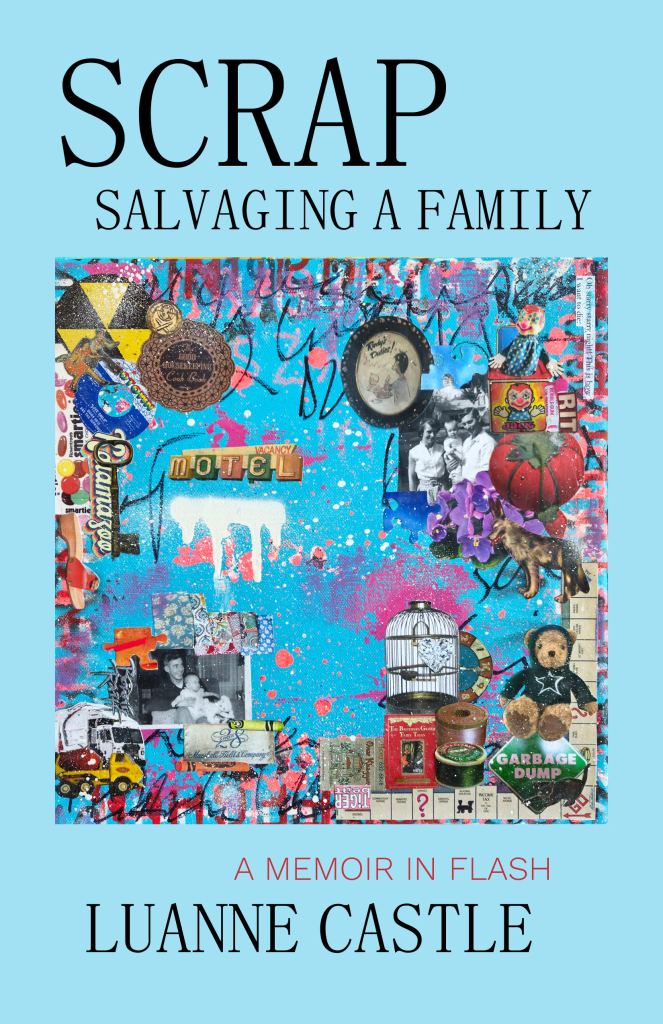
Have you found Anneli’s Place yet on WordPress? She showcases the work of writers on this site. She was so kind to showcase a little piece which introduces Scrap, the memoir I’m working on.  Please check out “Memory Patchwork” for an image of what structures my book.

And then drop over and read Anneli’s other blog, too: Words from Anneli.

13 Comments

Filed under Blogging, Books, Creative Nonfiction, Essay, Memoir, Nonfiction, Photographs, Vintage American culture, Writing

The Love Factor of Dolls

(Cross-posting this on The Family Kalamazoo under a different title)

Thanks to a comment by Robin (be sure to check out the stories on her blog), I was reminded how handmade doll clothing can be more meaningful than the dolls themselves. Sewing doll clothing for me is how my grandmother Marie stirred my love of dolls. Grandma was the Head Fitter of the 28 Shop at Marshall Field’s flagship store in Chicago for years and an artist with a needle.

From the time I was born, Grandma sewed me beautiful dresses. But I first paid attention to her sewing on Christmas the year I was four. As we opened gifts, Grandma leaned down toward me, with her pearls swinging, and handed me a huge box.  The blue eyes of a doll my size stared back at me when I pulled up the lid.  I named her Bonnie, after one of my favorite records, “My Bonnie Lies Over the Ocean.”

Grandma handed me another large, but more beautifully wrapped, box.  I untied the grosgrain ribbon and discovered she had sewn an array of beautiful dresses trimmed in selfsame bows and flowered beads.  The beret Grandma created for Bonnie matched the pink satin-lined pale blue velvet coat.

Bow on back of Bonnie's velvet coat

Bow on back of Bonnie’s velvet coat

Pearl button closures on Bonnie's velvet coat

Pearl button closures on Bonnie’s velvet coat

When I was eight, Grandma sewed me a glorious trousseau of clothes for the imitation Barbie (Miss Suzette) my parents had given me.  My doll didn’t have the requisite zebra-striped swimsuit or the Enchanted Evening gown and fur stole, but she had a copper satin cocktail sheath covered with a copper rose point lace outer skirt.  Both were trimmed in copper seed beads.  The wedding dress of white satin was heavily beaded with real seed pearls. A lace trimmed slip fit underneath and the veil was matching lace and beaded with the pearls.  I looked for stitches to see Grandma’s tricks, but they were invisible as all good magic.

When I was away at college, my mother gave the Barbie clothes away. While Bonnie has always sat on a chair in my bedroom, for a long time I kept Bonnie’s clothes in a small suitcase in my closet, away from dust and sunlight, and reveled in the knowledge that I had preserved these treasures.  After moving to my last house, I decided to put them away more securely.

Then I forgot where I put them! For years I thought they were lost. Finally, last year, I found the clothing. The only piece missing is the velvet beret.  All I have left of the Barbie clothes are the memories as I don’t have a photo of them.

All these years later, my parents have given me my grandmother’s German porcelain doll and the clothing she made for her.

This slideshow requires JavaScript.

These doll clothes represent all the beautiful clothing my grandmother designed and sewed over the years. Clothing, Art really, which is long gone.

###

My recent doll posts:

The Creep Factor of Dolls

The Historical Factor of Dolls

17 Comments

Filed under Creative Nonfiction, Dolls, Essay, Memoir, Nonfiction, Photographs, Vintage American culture, Writing

Vintage Trick-or-Treating, circa 1961: A Ghost Story

Tess Trueheart

Tess Trueheart

I’d been waiting at the door for the bell to ring, but I heard the scuffle of their shoes on the porch first and opened the door. Cindy and Judy, the big girls who lived next door, were taking me trick-or-treating. I recognized them because their costumes only slightly altered their everyday appearance.

“Oh don’t you look cute! I’m going to a hootenanny,” Cindy said, adjusting the bandana around her neck.

“What a cute gypsy outfit,” Judy tugged on my gold hoop earring. “I’m Tess Trueheart.” She loved comic book characters and could draw comic strip girls with curvy silhouettes just like a professional. “Are you ready? Let’s go.”

Mom kissed me goodbye. “Be careful, girls.”

“We’ll take good care of her, don’t worry!” Cindy smiled reassuringly at my mother. I wondered if Mom had paid the girls to babysit me. That took a little shine off the night. My hand moved to the scarf tied gypsy style on top of my head as if to make sure it was still there.

On our small front porch–a 4×4 foot cement block–we scanned the neighborhood, debating which route to take. The sky gleamed black as a witch’s cape and glittered its spangle of stars. I figured there would be a full moon grinning above us, but the stars and the porch lamps were the only light which broke up the vast blackness.

“Let’s go to Mark’s first and up and around Gull Road and then back into the neighborhood.” Cindy decided because she was the oldest.

As we began to walk, the black chow which patrolled the boundaries of the yard across the street ran along his property line, yapping and growling, until the man called him into the house.

In the dark, the houses looked like jack-o-lanterns with their dark opaque walls and windows lit up like cut-out eyes and noses. The ripe smell of decaying leaves hung in the crisp air.KONICA MINOLTA DIGITAL CAMERA

Mark’s front door had a cardboard black cat silhouette taped up, and his mother gave us each a Tootsie roll. Their house looked like mine, with a front living room window and one bedroom window facing street side, and a one car garage set back at the end of the driveway.

The Smiths’ house was next. Mr. Smith let us choose hard candy from a bowl because Pam’s mom was busy with the baby. We each grabbed two pieces, not daring to take three. Mrs. Smith would have handed us one piece each.

At the top of the street, the only two-story house in our neighborhood sat waiting for us. Last year a fire had destroyed the furniture and some of the interior walls. One of the kids had set the fire by playing with matches, or so Mom had explained to me. “That’s why you NEVER play with matches!”

The rumor I heard was that a child had died in the fire, but I wasn’t sure if it was true. Nobody seemed to know the family. Now the house sat vacant and was said to be haunted.

When we got near the house, the girls stopped and Cindy said, “Who’s going to ring the doorbell?”

“Not me,” said Judy.

At six, I was too young to question why we were trick-or-treating at an abandoned house.

Cindy looked at me. “I’m not going to either because I have to be in charge. But we have to see if the spirits answer the bell. Maybe Luanne should do it.” At a tall eleven, Cindy’s form threatened from the shadows.

I glanced at the high, skinny house. Unlike our houses, this one was from before the war. The once-white paint glowed in the dark a smoky ghostlike color. The porch slanted down on one side. It gave the appearance of a building about to fall down to the ground.

Mainly I scanned the dark windows. Then I glanced behind me. Across the street, the only house I could see was the one bedroom bungalow rented by the divorced beautician who wore a big Madge ‘do and had a toy poodle that smelled of perm chemicals. Her porch light was not on. No backup support from over there.

As I looked back up at the second story of the haunted house, I saw a flash of movement. I didn’t wait to see what it was; I took off running.

Within moments, I heard a loud crash and the tinkling sound of glass breaking, then two sets of feet running behind and then alongside me. I held my long skirt tautly to the side so it didn’t wrap around my legs and trip me.

We didn’t stop until we reached Gull Road. Judy and Cindy panted on both sides of me as we leaned over and caught our breaths. I thought Judy was starting to throw up as she revved up her breathing, but then she coughed and spit up some phlegm.

“What in the heck was that?” Judy said.

“I don’t know, but we are going to be killed,” Cindy answered. “Did you see it, Luanne? Is that why you ran?”

“I did! I saw something.” My insides started twittering in fear that Cindy thought we would be killed.

“What was it?” Cindy said. I started to tell her that it looked like a kid that flickered like a candle, but she turned to Judy and grabbed her arm, shaking her. “You’re in so much trouble, you idiot! I can’t believe you did that.”

We walked into the lighted National parking lot. “I want a monster charm!” Judy said.

She put a nickel into the fancy gumball machine and pulled out a monster ring with glowing eyes which she promptly stuck on her finger. She shoved her hand in my face so I could see its smug face.

I had no money and didn’t understand wasting a nickel when it was Halloween. However, Cindy and Judy were my elders, so I held my tongue and watched in jealousy while they compared shiny charms. Sighing, I ripped open my tootsie roll and popped it into my mouth.

Eventually I realized that Cindy said we were going to be killed because Judy had broken the window and we would be punished, but that epiphany came many years later. Until then I lived in terror of the house up the street.

Have you ever lived by a haunted house? I’d love to read your story about it!

18 Comments

Filed under Creative Nonfiction, Essay, Memoir, Nonfiction, Vintage American culture, Writing, Writing prompt

What’s the Place of Capitalism in Book Publishing?

This past weekend we had house guests. A friend I hadn’t seen in a long time visited with her new husband. I hadn’t met him yet, but I knew he was a scientist who has been writing a children’s fantasy chapter book.

We ended up discussing writing over breakfast. The scientist-writer said that at a writing conference he attended writers were asked if they wanted to write timeless novels or if they wanted to be marketable.

The idea is that, as a writer, you can aim for the highest quality writing or you can focus on writing what will sell. The implication is that these two goals rarely, if ever, overlap.

My friend’s husband thought a lot of writers want to be marketable because they need to make money from their writing. He argued that this goal is a manifestation of capitalism (which he favors), and that the market should determine which are the best books, the most deserving of being read. I would add he is also talking about democracy (although he didn’t say that) and that the vote of the reader will shape what will be read and published.

But should the number of readers be the main or only consideration for which books ultimately succeed?

Maybe if I look at the subject through visual art, I can see the issue more clearly. I love the old and new masters at the Metropolitan, the Louvre, the Uffizi, and the Courtauld. To be able to see a piece anew every time one sees it (or a representation of it) truly reveals the depth of the artistry.

But I admit that I love cels of Disney cartoon art. I love them for their imagination and because they resonate with the popular culture I grew up in. No way do I think they are art of the quality of a Renoir or a Picasso. And I don’t want to live in a world with only Disney cels. Or pictures of babies with angel wings (as cute as they are).

Autobiography for children and adults of one of Disney's great illustrators, Bill Peet

Autobiography for children and adults of one of Disney’s great illustrators, Bill Peet

So I think the idea of capitalism determining the books that are published and that we read can be carried too far because we still need deeper, more complex, and finely crafted literature, not just books that sell well.

Do you agree that capitalism should or will determine which books are published or do you think that high quality writing should be nurtured in other ways?

One of my favorite paintings at the Chicago Art Institute: Gustave Caillebotte - Paris Street; Rainy Day, 1877

One of my favorite paintings at the Chicago Art Institute: Gustave Caillebotte – Paris Street; Rainy Day, 1877

19 Comments

Filed under Books, Vintage American culture, Writing, Writing goals

Does Anne Sexton Still Deliver A Fairy Tale Punch?

Fairy tales serve as powerful archetypes for me.

I’ve written before how the Little Red Riding Hood image is at the center of the story I am shaping into a book-length memoir (link to post).  The girl, the wolf, the grandmother, the danger, and the huntsman are all there.  In my post which describes how I found out I am a Highly Sensitive Person, I wrote about the function of “The Princess and the Pea,” and how I go through my life-like the girl who feels the pea underneath all those mattresses and featherbeds. In my last post, I wrote about my terror at meeting Maleficent in Sleeping Beauty.

So it’s probably not a surprise that I love to read different versions of these tales. There are a lot of movies which remake the old stories. Ever After might be one of the most popular, but there have been many versions of the Snow White and Cinderella stories.  If you want to watch a really creepy Red Riding Hood tale, check out Reese Witherspoon in Freeway.

Because the majority of these tales originated either from the ancient oral tradition of storytelling or from storytellers who lived hundreds of years ago, the cultural mores and expectations are different from those of today.  That’s why seeing them through modern eyes, such as witnessing the Rapunzel character in Tangled showing herself to be the opposite of the helpless princess of days gone by, can be very satisfying.

Library shelves are jam-packed with picture book versions of these traditional stories which have been re-told, either by staying true to the original or by updating to conform to today’s viewpoints.  There are also feminist versions for adults, such as are found side by side with the classic versions in Maria Tatar’s The Classic Fairy Tales.

Some of my favorites are the poems by Anne Sexton.  She based each poem on a Grimm Brothers fairy tale.  Note: these are not Disney versions.

Sexton passed away in 1974, and her book of fairy tale poems, titled Transformations, was published in 1972. So there are some dated references.  At the very ending of “Cinderella,” Cindy and the prince are described this way:

Cinderella and the prince

lived, they say, happily ever after,

like two dolls in a museum case

never bothered by diapers or dust,

never arguing over the timing of an egg,

never telling the same story twice,

never getting a middle- aged spread,

their darling smiles pasted on for eternity.

Regular Bobbsey Twins.

That story.

Clearly, to understand the reference, a reader needs to know who the Bobbsey Twins were. The Bobbsey Twins books were a series developed by the Stratemeyer Syndicate in the early 20th century.  The twins were two sets of twins which comprised, with their parents, the Bobbsey family. They were a younger reader version of books like the Nancy Drew books, which were also Stratemeyer books.  The term “Bobbsey Twins” has been used for decades to mean two people who are a lot alike, such as “two peas in a pod.”

For fun, here’s the full text of Sexton’s Snow White version.  See what you think–is it still relevant?

Snow White and the Seven Dwarfs

by Anne Sexton

No matter what life you lead
the virgin is a lovely number:
cheeks as fragile as cigarette paper,
arms and legs made of Limoges,
lips like Vin Du Rhône,
rolling her china-blue doll eyes
open and shut.
Open to say, 
Good Day Mama,
and shut for the thrust
of the unicorn.
She is unsoiled.
She is as white as a bonefish.

Once there was a lovely virgin
called Snow White.
Say she was thirteen.
Her stepmother,
a beauty in her own right,
though eaten, of course, by age,
would hear of no beauty surpassing her own.
Beauty is a simple passion,
but, oh my friends, in the end
you will dance the fire dance in iron shoes.
The stepmother had a mirror to which she referred--
something like the weather forecast--
a mirror that proclaimed 
the one beauty of the land.
She would ask,
Looking glass upon the wall,
who is fairest of us all?
And the mirror would reply,
You are the fairest of us all.
Pride pumped in her like poison.

Suddenly one day the mirror replied,
Queen, you are full fair, 'tis true,
but Snow White is fairer than you.
Until that moment Snow White
had been no more important
than a dust mouse under the bed.
But now the queen saw brown spots on her hand
and four whiskers over her lip
so she condemned Snow White
to be hacked to death.
Bring me her heart, she said to the hunter,
and I will salt it and eat it.
The hunter, however, let his prisoner go
and brought a boar's heart back to the castle.
The queen chewed it up like a cube steak.
Now I am fairest, she said,
lapping her slim white fingers.

Snow White walked in the wildwood
for weeks and weeks.
At each turn there were twenty doorways
and at each stood a hungry wolf,
his tongue lolling out like a worm.
The birds called out lewdly,
talking like pink parrots,
and the snakes hung down in loops,
each a noose for her sweet white neck.
On the seventh week
she came to the seventh mountain
and there she found the dwarf house.
It was as droll as a honeymoon cottage
and completely equipped with
seven beds, seven chairs, seven forks
and seven chamber pots.
Snow White ate seven chicken livers
and lay down, at last, to sleep.

The dwarfs, those little hot dogs,
walked three times around Snow White,
the sleeping virgin.  They were wise
and wattled like small czars.
Yes.  It's a good omen,
they said, and will bring us luck.
They stood on tiptoes to watch
Snow White wake up.  She told them
about the mirror and the killer-queen
and they asked her to stay and keep house.
Beware of your stepmother,
they said.
Soon she will know you are here.
While we are away in the mines
during the day, you must not
open the door.

Looking glass upon the wall . . .
The mirror told
and so the queen dressed herself in rags
and went out like a peddler to trap Snow White.
She went across seven mountains.
She came to the dwarf house
and Snow White opened the door
and bought a bit of lacing.
The queen fastened it tightly
around her bodice,
as tight as an Ace bandage,
so tight that Snow White swooned.
She lay on the floor, a plucked daisy.
When the dwarfs came home they undid the lace
and she revived miraculously.
She was as full of life as soda pop.
Beware of your stepmother,
they said.
She will try once more.

Looking glass upon the wall. . .
Once more the mirror told
and once more the queen dressed in rags
and once more Snow White opened the door.
This time she bought a poison comb, 
a curved eight-inch scorpion,
and put it in her hair and swooned again.
The dwarfs returned and took out the comb
and she revived miraculously.
She opened her eyes as wide as Orphan Annie.
Beware, beware, they said,
but the mirror told,
the queen came,
Snow White, the dumb bunny,
opened the door
and she bit into a poison apple
and fell down for the final time.
When the dwarfs returned
they undid her bodice,
they looked for a comb,
but it did no good.
Though they washed her with wine
and rubbed her with butter
it was to no avail.
She lay as still as a gold piece.The seven dwarfs could not bring themselves
to bury her in the black ground
so they made a glass coffin
and set it upon the seventh mountain
so that all who passed by
could peek in upon her beauty.
A prince came one June day
and would not budge.
He stayed so long his hair turned green
and still he would not leave.
The dwarfs took pity upon him
and gave him the glass Snow White--
its doll's eyes shut forever--
to keep in his far-off castle.
As the prince's men carried the coffin
they stumbled and dropped it
and the chunk of apple flew out
of her throat and she woke up miraculously.And thus Snow White became the prince's bride.
The wicked queen was invited to the wedding feast
and when she arrived there were
red-hot iron shoes,
in the manner of red-hot roller skates,
clamped upon her feet.
First your toes will smoke
and then your heels will turn black
and you will fry upward like a frog,
she was told.
And so she danced until she was dead,
a subterranean figure,
her tongue flicking in and out
like a gas jet.
Meanwhile Snow White held court,
rolling her china-blue doll eyes open and shut
and sometimes referring to her mirror
as women do.

13 Comments

Filed under Creative Nonfiction, Essay, Memoir, Nonfiction, Poetry, Vintage American culture, Writing