Category Archives: Memoir

Five Things You Never Knew About Me

I started writing this blog over 12 years ago. Some of you might remember me back then. But the blog has new readers and even with 12 years I think there are things I’ve never talked about. So here are FIVE THINGS YOU NEVER KNEW ABOUT ME.

  1. When I was ten, my brownies won a blue ribbon at the county fair.

  2. I’m not that great at sports, but I used to love water skiing and cross-country skiing.

  3. I don’t drink coffee, and that seems to be a genetic anomaly because my aunt and my uncle are the same.

  4. When my kids were young, I got them to clean the kitchen floor by letting them slide across the floor with a bucket and rags.

  5. My favorite movie is Babe. My second favorite is Beetlejuice (the original one). #3 is Sitting Pretty (1948). #4 is Mr. Blandings Builds His Dream House (1948). I love the Batman movies. Lots of Bs there!

Seriously, if you’ve never seen those two 1948 movies you are really missing some hysterical comedy.

Tag, you’re it. What are five things I don’t know about you?

62 Comments

Filed under #bloggingcommunity, #writerlife, #writerslife, #writingcommunity, Memoir

Missing My Cats

If you’ve been reading this blog for some time you may remember the year of cat rainbow heaven (2021). In July of that year, my daughter’s cat Isabella Rose passed.  We had a close relationship because we used to babysit her at our house a lot. Perry loved to watch over her, so we called him the babysitter. When Izzie suffered a sudden and never diagnosed illness and was failing, my daughter asked me to come to the emergency vet so I could say goodbye. When I got there, the on-call vet pressured us to let him euthanize her before she coded. They never told us what was wrong. We all–but especially my daughter–still miss her a lot.

A month later we lost our sweet sweet boy Felix.

A month after that my heart completely broke with the loss of the amazing love (and nurse to all who are sick–human, cat, dog), Pear Blossom.

Pear Blossom

What a difficult year. But what followed was a worse year. Heart-rending family troubles, and the loss of Tiger Queen Princess Mimi. I wrote a hybrid poem/story/journal that is mostly nonfiction (some time elements were shifted, etc.). You could call it hybrid nonfiction/fiction. Founder and Editor of the new journal Feed the Holy, Barbara Harris Leonhard has published this piece today. I hope you cry a little, but then can smile.

https://feedthehol.blogspot.com/2025/01/journal-from-year-after-several-of-my.html?fbclid=IwY2xjawH19mdleHRuA2FlbQIxMQABHS2KrLj8JUWfD6FmONxP1g60hnuILFReTWuxPMg9acU9U853ncR4UKxfuQ_aem_m7QeVSF3ab1C2nV4sZbXcw

Tiger on the piano

If you’re still reading you can also find three of my collages at the journal Thimble. Yay!!! You can find them all at this link. Let me know which one you like best if you have time to check them out!

https://www.thimblelitmag.com/author/lcastle/

28 Comments

Filed under #AmWriting, #poetswithcats, Art and Music, Cats and Other Animals, Flash Nonfiction, Literary Journals, Memoir, Poetry, Writing

Sixteen Years and Done

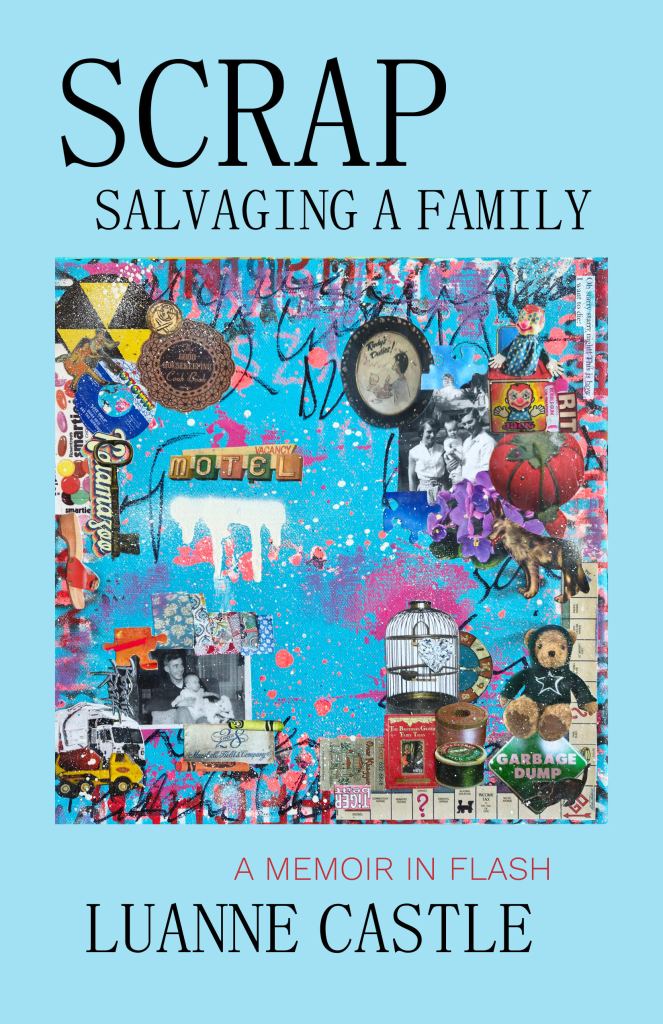
I had some really exciting news recently. Some of you might know that I started writing a memoir about my father (my story, how it relates to him) in 2008. Some of you might be sick of hearing about this mythical project haha. It took many many shapes over the years, but I ended up with a hybrid form of memoir-in-flash called Scrap: Salvaging a Family. I wrote at least 400,000 words over the past sixteen years, although the final manuscript has about 10% of that amount.

My book is finally being published by ELJ Editions in 2026. So grateful to ELJ and editor Ariana D. Den Bleyker and to the many readers who have lent their skills to help shape this story. It really is worth it to just keep on keeping on, in case you needed to hear that today.


Coincidentally, yesterday the stunning journal Your Impossible Voice published a new flash story by me—thanks to Managing Editor Keith J. Powell—inspired by my father.

https://www.yourimpossiblevoice.com/when-you-were-still-too-young-for-school/

This story is a sort of introduction to my memoir.

###

I have had some publications I forgot to share here, including two collages by Raw Lit.

https://rawlit.weebly.com/5_5.html

https://rawlit.weebly.com/5_7.html

46 Comments

Filed under #amwriting, #writerlife, #writerslife, #writingcommunity, Books, Creative Nonfiction, Flash Fiction, Flash Nonfiction, Memoir, Writing

Mama Isn’t Always Right: 2-minute podcast

Gosh, it’s been a month or more since I’ve posted on here. That’s because it’s now been five months that I have been taking care of the baby like a full-time daycare :). I am dropping down to part-time in a week (also :)) because he’s getting heavy for me, and I need to catch up on stuff.

Before I’m back to blogging regularly, I thought you might enjoy hearing me read a two-minute flash memoir story on Guerrilla Podcast. There are two other writers reading as well, Ethan Goffman and John Stanizzi. My story is in between theirs. Hope you like them all!

https://thesongis.blogspot.com/2024/07/podcasts-bite-sized-nutrition-for-mind.html

In case you’re in doubt of where to go, once you click the link you should see this view (my screen shot). The podcast is right below the titles of the stories and the author names.

The image is from a later era than my story, but it’s the same park as in the story. About ten years after the events of this story occurred, Kalamazoo was hit with a tornado that took out a lot of the gorgeous old trees that had been there in Lincoln’s day. Since this photo was taken at a date after the tornado, you can’t see how thick the trees were “back in my day.”

27 Comments

Filed under Flash Nonfiction, Memoir, Nonfiction, Podcasts and readings, Writing

Three Stories in MacQueen’s Quinterly

What a lovely surprise this morning. The fabulous EIC of MacQueen’s Quinterly, Clare MacQueen, has published three of my stories in the new journal issue. This is one of my favorite lit mags because Clare has a very eclectic taste, so the magazine offers so much variety, including funny stories and syllabic poetry.

Here are links to my stories:

Very micro humor story: http://www.macqueensquinterly.com/MacQ23/Castle-New-One.aspx

Surreal flash story: http://www.macqueensquinterly.com/MacQ23/Castle-Mountain-Painting.aspx

Creative nonfiction/memoir childhood story: http://www.macqueensquinterly.com/MacQ23/Castle-Haunted-Childhood.aspx

34 Comments

Filed under #AmWriting, #amwriting, #writingcommunity, Essay, Family history, Fiction, Flash Fiction, Flash Nonfiction, Memoir, Microfiction

Joy Neal Kidney’s Latest Leora Book in the Wilson Family Saga

Joy Neale Kidney has documented an American saga of hard work, dedication, patriotism, and above all, sacrifice with her four Leora Books. I have reviewed Leora’s Dexter Stories, Leora’s Letters, and Leora’s Early Years previously.These first three volumes tell the Wilson family history and the tragedy of losing three sons to WWII through the mother, Leora’s, perspective. The fourth book in the series, What Leora Never Knew: A Granddaughter’s Quest for Answers, describes Kidney’s own search for more answers about her uncles’ military careers.

The book contains heartbreaking information, such as Leora receiving news of Dale being MIA on her birthday. Dale’s sister Doris was pregnant and had only told Dale in a letter. But the letter was returned to her, “marked ‘Missing in Action.’” Kidney puts together information and shares it in an easy-to-read style. For instance, the Wilsons received three notes from radio operators that Dale had been taken POW by the Japanese, but this was never confirmed. The information included personal identity info that was not on their ID tags. Where would the Japanese have gotten this information if they didn’t have Dale?

I love that Kidney included images of documentation and letters. The visuals help to connect the reader to these difficult days that her family went through. A poignant section is when Kidney realizes that Dale had a diary and how it was separated from his other belongings. I could tell you more, but why don’t you just read the book? You might want to read the other three before you get to this one or if you want to get right to this one, consider at least reading Leora’s Letters, the first book, the one where I learned that all three men had died during the war, a book that reduced me to tears in a doctor’s waiting room.

Instead of commenting here, feel free to head on over to Joy’s blog and comment over there if you want to say hi! https://joynealkidney.com/

Leave a comment

Filed under #writerlife, Book Review, Cats and Other Animals, Family history, History, Memoir, Reading

Some More Memoir and Nonfiction Suggestions

In part 3 of my readings, I want to share a few memoirs.

One of my favorite memoir writers is Sheila Morris. She’s witty and smart and involved in social justice issues. She’s also lived a very interesting life as a lesbian who grew up in rural Texas “back in the day” and had to learn how to live her love and her life in a time when people felt they couldn’t be open about their own identities. Furthermore, Sheila was one of the early voices writing about LGBTQ life. Her books are historical landmarks as well as entertaining reads.

Books by Sheila R. Morris (her Amazon profile):

Four Ticket Ride

Short Side of Time

I’ll Call It Like I See It: A Lesbian Speaks Out

Not Quite the Same

Deep in the Heart: A Memoir of Love and Longing

Southern Perspectives on the Queer Movement: Committed to Home – edited by Sheila R.
Morris

Sheila writes about politics, sports, and popular culture on her blog. She also writes about her family, including her loving wife and two adorable granddaughters. Check it out!

SHEILA MORRIS’ WEBSITE

Harlan Greene at the College of Charleston writes this about Sheila Morris: “One wonders what is most impressive about her work–the range of it through various formats (nonfiction, blogging, a compiled collection of oral histories), or the range of topics she covers in those formats. What is most apparent, however, is her voice; it is seductive and trustworthy and never falters no matter what topic she is covering–the joys and sorrows of family life, breaking up or falling in love, the restrictions and consolations of religion, the unfairness of our social systems, marriage, racism, travel, and even corporate life. The reader instantly is taken with a no-nonsense . . . depiction of a complex southern lesbian life; no subject is taboo and the writing never fails in honesty or polish. Many people can write of the ups and downs of their daily lives and the gives and takes necessary to weather them, but few match the commonplace (and the transcendent) with such apparently simple but elegant prose. It’s hard to read a few lines without finding something quote-able.”

###

I recently read two memoirs by writers I had never heard of, books that I had never heard about. They were written by women suffering from chronic medical conditions.

Wired to be Dysfunctional is written by a young woman born with the very rare condition myoclonus dystonia and her mother. They alternate voices in the book, which I found to be very effective. She suffered a lot, not only physically, but emotionally when it took years and years for a diagnosis. My son went through much the same thing. This is the condition that my son has. He was diagnosed in his late 20s although we had taken him to major medical centers since he was a baby.

Drop the Skirt: How My Disability Became My Superpower was written by Amy Rivera. Amy was born with primary lymphedema in one of her legs, which made it huge in comparison with her other leg. She was also blessed with beauty and, as a young person, won a beauty pageant. But that didn’t stop the agony at trying to fit in at school. Amy takes the reader through the process of FINALLY getting diagnosed and finding treatments that would help her. She also became an activist because of her strong personality and what she had gone through, helping to bring about some changes in how insurance companies handle lymphedema claims. Lymphedema is one of the conditions that I was born with. Primary lymphedema like Amy and I have are similar to that brought about by surgery, such as the lymphedema that Kathy Bates, the actor, has, but not exactly the same. And mine is different from Amy’s because she is completely lacking in lymph nodes in that area of her body. Mine are sluggish and my lymph system is tiny. I also have venous insufficiency because, again, the veins are tiny. Mine has plagued me for most of my life, but it’s not as dramatically traumatic as Amy’s is. The title refers to how we all try to wear long flowy dresses and skirts to cover up our legs.

My newest journal page:

18 Comments

Filed under #amreading, #writingcommunity, Book Review, History, Memoir, Reading, Writing

How About Some More Book Suggestions?

Think of this as part 2 of the reviews of some non-poetry books. If you’re one of the authors, feel free to drop your BOOK LINK or website and/or blog links in the comments! That’s because I am too lazy to pull together that information . . . . But if you put book link in the comments, I’ll try to add it to the post. How bout that?

HISTORICAL NOVEL ABOUT WOMAN IN 1920S VERMONT

Elizabeth Gauffreau’s novel Telling Sonny puts a few turbulent months in one woman’s life under the microscope. In doing so, the story captures subtle twists and turns in protagonist Faby Gauthier’s personality, character, and outlook on life. This psychological exploration is most akin to the excavations into the psyche as written by Henry James, but without his complicated sentences and repetitions. Instead, the reader’s attention is less focused on the psychology than on the details of the protagonist, Faby Gauthier’s, experience at home and on the road traveling with her new husband, a vaudeville dancer. Gauffreau manages to recreate a lost world of 1920s small-town New England, Atlantic City, the vaudeville circuit, and rail travel. She obviously painstakingly researched the novel, polishing every detail of each scene until it shines with clarity. Gauffreau’s writing style successfully marries the direct nature of contemporary writing with a more graceful syntax that befits the time period, as well as Faby’s upbringing. When I finished the book, I wanted to talk to other readers about the book, especially my thoughts about Faby and Louis, both micro (such as their choices) and macro (relating to history and sociology). So, please, read it and talk to me about it!

Telling Sonny is on sale right now at Smashwords: https://www.smashwords.com/books/view/1364146

I did read Elizabeth Gauffreau’s novel some time ago, but wanted to post it here since it is on sale and is a personal favorite, plus I don’t believe I ever posted a review of the book on this blog. I’m eagerly awaiting Liz’s next novel . . . .

HISTORICAL NOVEL ABOUT JEWISH PIONEERS TO SANTA FE

Santa Fe Love Song, by Amy Bess Cohen, reads like a valentine from Cohen to her great-great grandparents Bernard and Frances (Nussbaum) Seligmann. The story of Bernard, a young immigrant from a small town in Germany to Philadelphia and Santa Fe, though fictionalized, gives a wonderful account of what it would have been like for a German Jewish young man to travel across the ocean by himself, get a job, learn English, and within a matter of months, move across the country to New Mexico via the grueling Santa Fe Trail to meet up with his brother. It’s fascinating to read about Bernard’s acclimation to living out west just before, during, and after the Civil War.

The story is of Bernard’s development as an important pioneer of Santa Fe, and his search for a Jewish wife to bring to a place where there were very few Jews, no Kosher foods, and no synagogue. When he traveled back to Philadelphia to look for a wife, he fell in love with Frances, but would she move to Santa Fe with him? And, if so, would she stay? The story is engaging and the suspense level is well-moderated. When the book ended, I didn’t want to leave the lives of the family of Bernard and Frances. I hope there will be a sequel.

Although the reader first meets Bernard when he is nineteen, he ages throughout the course of the novel, so in this one respect Santa Fe Love Song does not fit the definition of young adult literature. The main character is not a preteen or teen. Nevertheless, half the texts recommended for secondary school students have adult protagonists. The themes and the way mature subjects are handled mean that this book would be suitable for older children, teens, and adults.

Cohen wrote the book, in part, for her own grandchildren to learn about their heritage and the strength of the people who came before them. In keeping with that focus, her grandsons, Nathaniel Jack Fischer and Remy Brandon Fischer, illustrated the book with charming and detailed drawings. They really add to the overall experience of reading this lovely book.

Perhaps the book’s greatest importance lies in how it goes beyond the more often recorded history of Jewish immigrants enriching the eastern American cities where they tended to congregate in the mid to late 1800s and early 1900s. Instead, Santa Fe Love Song has a Jewish protagonist who quickly learns how to ride a horse, shoot a gun, and hold his own against the rough and tumble forces of the early American west.

MENNONITE MEMOIR

Marian Longenecker Beaman’s memoir Mennonite Daughter: The Story of a Plain Girl is a fascinating excursion into Marian’s life as a child and young woman who grew up in a Mennonite farm household in Lancaster County, Pennsylvania. This is the first time I have been shown what plain and fancy mean to the Mennonites. Marian was brought up plain, wearing no jewelry or makeup and hiding her hair under a cap. Most of the women did not drive, but the families did have cars that the men drove. (I grew up in Michigan, and many of the Michigan/Indiana Mennonites still ride in buggies like the Amish). Secretly, Marian was drawn to what is fancy, symbolized by her dream of wearing red shoes. While Marian does eventually make a move to the fancy world, she stays true to her Christian upbringing. The book is uplifting and inspirational but doesn’t shy away from the negative in the form of her father whose inability to demonstrate affection and harsh punishments of Marian is heart-breaking. You won’t be disappointed by this story of a different time (largely the 50s and early 60s) and a family rooted in a tradition quite different from most Americans.

P.S. This is not part of my review, but I will mention that I wish that Marian Beaman had set the Mennonites in context with the overwhelmingly majority Amish of the region. You might want to look that up before starting the book. She does, though, make some comparisons with Orthodox Jewish traditions. Also: I love the cover with the red shoes! The book can be purchased here: https://marianbeaman.com/

MYSTERY WITH A HISTORICAL AND ART WORLD TWIST

Attribution is not only a fun and riveting read, but it’s a smart one, too. I learned so much about art history (and art politics) along the way. The protagonist, Cate, a doctoral student finds a mystery painting. She decides to seek attribution for the painting. Her search takes her from her New York university to Spain where she meets a romantic descendant of an old aristrocratic family. The further Cate gets into the mess she’s created, the more questions and dangers arise about the painting and the characters who revolve around that painting.
I have a feeling that the author, Linda Moore, spent a long time researching and writing this book, but I am ready for the sequel as I did not want the book to end!

NOVEL OF ADVENTURE IN INDIA, FOCUS ON TOPIC OF ADOPTION

Elaine Pinkerton’s novel The Hand of Ganesh took me on a journey to India with such great detail that I felt as if I accompanied Clara and Dottie/Arundati on their quest to find Dottie’s birth mother. The young women also visited India to carry out the wishes of others for the stone hand of Ganesh that had been in Dottie’s adoptive family. The omniscient novel focuses mainly on Clara, an American (and Native American) adoptee whose story was first told in Pinkerton’s novel All the Wrong Places. Clara, who has already searched for her birth mother, acts as a sort of guide for Dottie who was born in India, but she knows very little about her origins. She is the ideal viewpoint for the novel because she is an outsider to India and shares what she learned with the reader. Suspense lies both in the larger issue—will Dottie find the mother of the child Arundati—and in a more subtle question—how do foreigners know who to trust in a country they do not know or understand? Read The Hand of Ganesh for its engaging storyline, meticulous depiction of southern India, and adoptee themes. Read The Hand of Ganesh and you will be eager to plan a trip to India.

I’ve enjoyed more books than this, but whew, I’m tired just remembering them all. Hope you find something that appeals to you here! And note that Anneli Purchase writes some stellar novels. Here’s my review on this blog of my favorite, Julia’s Violinist: https://writersite.org/2021/12/20/my-review-of-julias-violinist-by-anneli-purchase-and-note-from-the-author/ Another author of note is Joy Neale Kidney whose Leora historical series makes for an entertaining, educational, and sometimes heartbreaking experience. I have read all three books. Here is the first one I read and the review I posted here: https://writersite.org/2020/01/27/book-review-leoras-letters-or-how-i-learned-empathy-for-americans-during-wwii/

26 Comments

Filed under #amreading, #writingcommunity, Art and Music, Book Review, History, Memoir, Novel, Reading, Sightseeing & Travel, Writing

Want Some Book Suggestions?

Here are reviews of some non-poetry books I’ve read recently. If you’re one of the authors, feel free to drop your website and/or blog links in the comments!

SEXY ROMANCE & MYTHOLOGY

Heart of a Warrior, by Eden Robins, is the super steamy romantic adventure of a mortal contemporary Arizona woman, Dora, who meets an immortal from the time of Greek mythology and is awakened to knowledge of a past life she never knew she had. Dora, or Pandora, as she once was called, needs all her empathic healing powers and strong warrior qualities to deal with the evil Silvers. The immortal, Philoctetes, joins forces with Dora—or does he? Is their relationship destined for war or will their ignited passions result in the love-making Dora fantasizes? A question is implicit throughout: What if loving someone could kill you?

The contrast of the realistic Arizona setting that includes cacti, caverns, cars, and computers with the mores and ethics of the gods and goddesses, past intrigues, and the evil machinations of the Silvers makes every plot event and character trait believable. The plot moves quickly, but a sense of suspense kept me engaged throughout. In fact, the suspense is whether or not Dora and Phil will achieve success against the Silvers, but also what they will do about their outlawed attraction for each other. I was surprised by a cliffhanger ending, and then I realized that this is the first in the Gold series planned by Robins. I can’t wait for book 2!

https://champagnebooks.com/store/blanc-de-blanc-paranormal/1019-heart-of-a-warrior-9781959036104.html

FAIRIES!!!!!

D.L. Finn’s middle-grade short story collection, Tree Fairies and Their Short Stories, is a charming read. I think young children would be able to understand, as well, and this adult reader certainly loved it. The tree fairy world that Finn has created is delightful, the characters–both fairy and human–are well-drawn, and the environmentalism that underlies the book is important to the health of humans, animals, and our planet. I’m so glad I read this book, and in my imagination I can still see the fairies flying in the forest and visiting the Wise Trees!

MURDER MYSTERIES WITH A UNIQUE TWIST

I always enjoy reading Carol Balawyder’s books. The Lilac Notebook is no exception. In fact, it might be my favorite. When I first heard that it was a mystery, and that the “detective” character at the center of the book was a woman, Holly, with early onset Alzheimer’s, I was intrigued but not sure that the book could really work. After all, if Holly was losing her memory, how could she put together a proper answer to the question “who done it?” Well, Balawyder imagination, knowledge, and knowhow accomplished the seemingly impossible. I was fully enmeshed in the tragedy of Holly’s life, watching her go through the agony of starting to lose pieces of herself all the while she had to create a new life for herself after her husband left her. I cheered for her when she joined a poetry class and began to do what she wanted, rather than what her husband wanted. I cried for her when she couldn’t remember—and most especially when she didn’t know if she was missing a memory or if someone wanted her to think so. Ultimately, Holly does solve the crime, although perhaps not in the manner we expect out of a murder mystery. This book, though, is so much more than a murder mystery. It is a caring, compassionate look at early-onset Alzheimer’s and a person faced with it. It is bound to generate more compassion in its readers for future encounters with those suffering memory loss. You won’t want to miss this wonderful book by Carol Balawyder.

###

Fractured Oak: This hybrid genre of fantasy and murder mystery is well-written, engaging, and a joy to read. I don’t know how Dannie Boyd (Carrie Rubin) does it, but she manages to have a tree as a detective! This is no ordinary tree, though, but a 19th century woman who has turned into a tree. From her vantage point she witnesses murder, and she does all she can to try to bring the murderer to justice. Another aspect of the book I really liked is that the tree-woman was the first female medical school student at her school in Ohio. This brings in the author’s medical training and adds to the realism and intelligence of the novel. The writing is sensitive and lyrical, but smart and, when needed, even tough. I have enjoyed several books by the author under her own name, and this one is my new favorite.

ADVENTURE AND FANTASY

John Howell’s novel The Last Drive, the sequel to Eternal Road, well satisfies my curiosity in the continued journey of Sam and James as they try to accomplish their heavenly tasks amidst interference from the powerful and disgusting Lucifer. In this narrative, the angelic duo enlists the help of Eddie Rickenbacker (a historical figure) to save the soul of his charge, the newly dead Ryan. The four time travel between historical events, such as the Holocaust, the sinking of the Titanic, and WWI. As in Eternal Road, Howell is adept at merging the fantasy of time travel with the details of history. Sam and James are adept at following God’s plan for Eternity and his angels. This book is a thoroughly enjoyable, engaging, and rewarding read.

MEMOIR

What happens when you’re given a diagnosis of a very rare and fatal cancer, but there is a horrible experimental treatment being offered to you? In The Winding Road, we learn what Miriam Hurdle decided–to undergo the grueling chemo and radiation schedule–and how she copies with it. She set her daughter’s still unfulfilled life mileposts of marriages and children as a goal–she wanted to see her daughter married and to meet her future grandchildren. The reader knows from the beginning of the story that Miriam will overcome the cancer because she has written her memoir about it. But life is in the details, and this book provides many. I loved getting the inside information on how her illness affected her job, as well as seeing the loving support she got from friends and fellow church members. Because I lived for over twenty years in the same general geographic location, I could picture all the hospitals and other places she talks about. But that knowledge isn’t necessary because we all know what hospitals and medical care can be like. When a doctor ignores a referral for three weeks when Miriam has no time to lose, it is so easy to imagine her visiting the office, being completely ignored by the fools at the counter, and sitting there in the waiting room until someone takes pity on her after hours and tries to help her. This is a short book, and you will want to read to the finish in one or two sittings.

42 Comments

Filed under #amreading, #writingcommunity, Book Review, Children's Literature, Fairy Tales, Memoir, Novel, Reading, Writing

Making Space

My mother gave me my baby book which I have started to go through. I found a photo in it that I have never seen of the person who was my favorite when I was a kid: my maternal grandmother. In this image I am 20 months old. I also read in the book that for my first week of life Grandma and her other daughter, my sweet Aunt Alice, stayed with my parents and helped take care of me. She was the best grandmother anyone could ever have. The grandmother poems in Rooted and Winged are about her.

For months now I have been writing this post in my mind. The reason is that the post is meant to help clarify my thinking about a matter.

I grew up in an era where people still believed that it was important to “pull yourself up by your bootstraps” and to “put a good face on.” I also like to be seen as strong or even tough. Most importantly, there are always people worse off than ourselves. Some people have such horrible “roads to hoe” in life. It makes me cry to think of what some people go through.

Further down there is going to be a “but.”

Without boring you with too many details, underneath a lifetime of many and varied illnesses, I have a few chronic conditions that are a bit extraordinary. One of these is primary congenital lymphedema, particularly in the lower extremities. It’s what used to be known as elephantiasis.

Additionally, I have a migraine disorder that for the last 25 years has not (for the most part) been headaches, but a sudden and extreme set of symptoms. Because the symptoms didn’t fit neatly into a specific type of migraine, I was told they were “complicated migraines.” Most recently, the diagnosis is that I have genes for more than one rare type of migraine—and that they work together to give me symptoms of more than one disorder. Most likely these are vestibular and hemiplegic.

An extra issue in the mix, and I’ve written about this before, doctors at Mayo Clinic discovered that I had a very rare tumor in my right foot (rare meaning at that time medical staff couldn’t find any medical literature of a tumor in that particular bone). This was a nightmare that went on for 1 1/2 years and was complicated by my lymphedema. There were only two surgeons in the United States that Mayo considered competent to do surgery on this tumor, and it was performed by the AMAZING Dr. Eckhart at UCLA orthopedic hospital (RIP to a wonderful person and doctor). Five years after the surgery, he told me he never thought the surgery would work but he watched over me so carefully. Since the surgery I am not allowed to run, jump, hike, or do most aerobic activities.

I write about these details to give a little context. Back to putting a good face on and all that. Because I am a writer and keep up with current events in the writing world, I am more aware of new ways of thinking about things than I might be if I weren’t writing and especially reading new work. My view of myself that I have had my whole life has been as a blessed person–certainly privileged in many ways–and that I needed to stay tough and “power through” everything and then set it aside. Another way of putting it is to say burying it down deep. Perhaps what best fits is that I never made space for my health issues. I let everything else in my life intrude and take over the space they needed.

But (I told you there would be a but!) reading young writers, I am beginning to change my view of myself. I am disabled. Any time I go out I must have a hat and sunglasses with me for lighting situations (migraine trigger). I can’t go to concerts or sports games because of flashing lights. I can’t travel alone because it’s become too dangerous with the migraines which occur in a moment and are completely incapacitating. I must bring my lymphedema pump with me to travel–as well as lots of other things for the condition, and it takes a lot of time and energy every day. Most importantly, lymphedema affects much of the rest of my health, and as I age (arthritis and other deteriorations, for instance) it will become more and more of a problem.

So, while I have no ridiculous illusions that my situation is comparable to the tragic illnesses of so many others, I am finally realizing that disability has nothing to do with comparison between one person and another. And it isn’t negative or counter-productive for me to finally understand that it’s ok to admit that I am disabled, that it’s just a useful way to communicate with others. If people don’t realize that I am disabled, how can they be supportive?

I wish I had had this epiphany years ago when my son was still young. He has an exceedingly rare disorder that doctors misdiagnosed for decades. It’s so rare that in the NORD (National Organization for Rare Disorders) list it is lumped in with other disorders and diseases instead of being listed separately. At the most, only a couple thousand people in the U.S. have his disorder. The reason it’s important to note the rareness is because the less others know about your disability, the less helpful they are–even if they want to be!

You see where I am going with this? If I had been better about making space for my disabilities, it might have been easier for my son with his own situation. It’s hard enough when people see you from the outside and say, “Oh, it’s not such a big deal,” with absolutely NO understanding of what it’s like to live that life. So, while the gardener and I always respected the importance of his disorder (which I first noticed when he was nine months old, and the pediatrician practically laughed at me), we didn’t teach him to make space.

Now I see everything differently.

Have you ever had a big shift in how you viewed yourself?

OK, ending on something a little lighter. Perry is very unhappy about the cane I’ve been using since I injured my knee more fully when I got home from Michigan. Yesterday, I was walking in the living room, and Perry came up from behind and crashed into the cane, forcing me down on the bad knee. Yes, it hurt like heck, but it was funny, too, because what cat does something like that? A dog might do that if he’s frustrated enough. But Perry was just being Perry! And then we had the hugging session afterwards where he apologized to me! Sweetest, funniest little goober.

44 Comments

Filed under #amwriting, #poetswithcats, #writerlife, #writingcommunity, Cats and Other Animals, Disabled identity, Family history, Memoir, Nonfiction, Writing