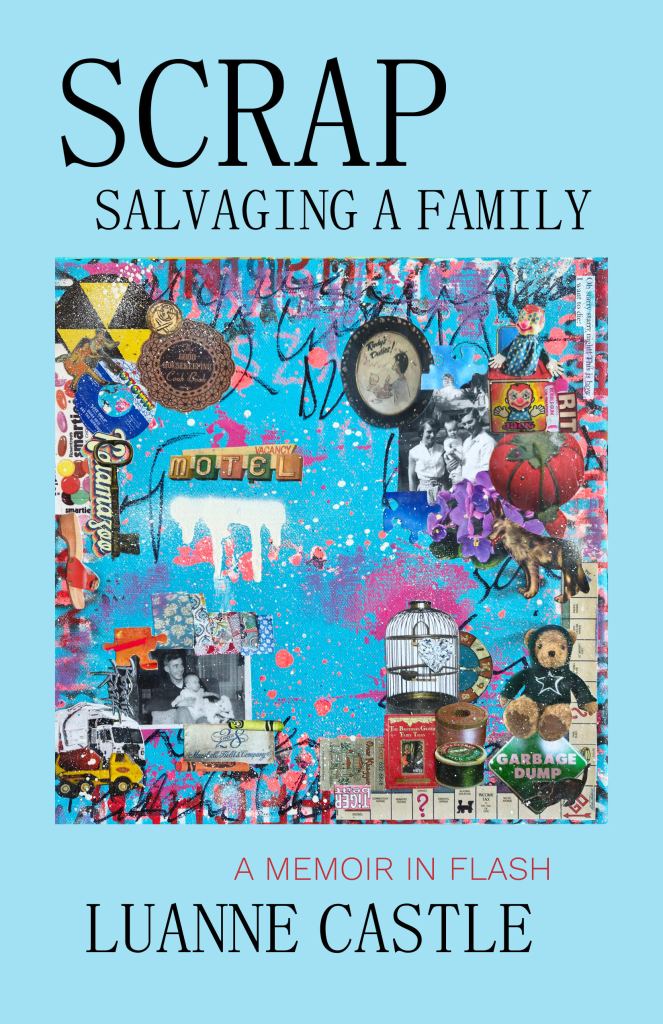
Category Archives: Creative Nonfiction

Cover Reveal of Rooted and Winged

Finishing Line Press has revealed the new cover of my full-length collection Rooted and Winged.

PRE-ORDER HERE

Release date: September 9

Book description:

The poems of Rooted and Winged explore the emotional and physical movement of flight and falling. They are of the earth, the place of fertile origins, and of the dream world we observe and imagine when we look upward. Golems and ghosts that emerge from the ground, as well as the birds and angels that live above us, inhabit the collection. We will always be striving for flight, even as we feel most comfortable closest to the earth.

There are poems about Arizona, California, and the lakes of Michigan. My maternal grandparents are the characters that most inhabit this book.

Cover art: Leonard Cowgill

If you pre-order . . .

I would love it if you could pre-order the book, if you can swing it. For the pre-order period, I am donating $5 in the name of each person who pre-orders the book to Liberty Wildlife, a wildlife rehabilitation center.  Two months into the pandemic, we had a red-tailed hawk in our yard. She was unable to fly, and a volunteer from Liberty Wildlife came out to rescue her. I wrote a poem about the incident, which was published in The Orchards Poetry Journal and is in Rooted and Winged. The gardener and I have brought many smaller injured and orphaned birds to Liberty Wildlife over the years.  Some of the poems in the book are about the wildlife in our area.

If you place an order for the book, please let me know with your name and email address. That way I can keep track of the pre-orders to make sure my list matches that of the publisher. When the pre-order period is over, I will give the list of names and emails to Liberty. You will then receive an acknowledgement by email of your donation for the birds and bunnies.

As always, I am available for blog interviews and guest posts and would particularly love to set things up for fall when the book is in our hands!

all my ghosts and angels become each

other and then me with a hinted outline of wings.

from “The Shape of Me”

35 Comments

Filed under #AmWriting, Book promotion, Books, Creative Nonfiction, Poetry, Poetry book, Poetry Collection, Publishing, Research and prep for writing, Writing

“The Gamemaster and the Reluctant Daughter” Published by Rind Literary Magazine

The editors at Rind Literary Magazine have published my creative nonfiction piece, “The Gamemaster and the Reluctant Daughter,” in the new issue, #15. You can find it, beginning on page 33, here:

RIND: AN ONLINE LITERARY MAGAZINE, ISSUE 15

I hope you enjoy the story. Again, it relates very closely to the memoir I am working on.

***

Our bobcat, as seen through the window.

***

My positive hopeful plans for 2022 include making my daughter a wedding junk journal, which she’s excited about. I am collecting pretty little scraps and ephemera for that. Then I joined the Ugly Art Club, and I’ll see how that goes. Also, I want to study drawing faces a bit. And I need to get the publisher all the pieces for the poetry book. I really need my headshots retaken. I don’t like the last ones, except the accidental one of me holding Perry. (Should I just use that?) And, finally, I will be attending a special workshop at the Tucson Festival of Books for my memoir. I’m working on a collection of Red Riding Hood poems. So we’ll see how the year goes. Lots of plans. We’ll see what God has in store for me heh.

What are you planning for yourself this new year? Go get 2022!!!!

67 Comments

Filed under #AmWriting, #writerlife, #writerslife, #writingcommunity, Creative Nonfiction, Memoir, Nonfiction, Poetry Collection, Publishing, Writers Conference, Writing

My Essay Published by North Meridian Review

This news has been in process for some time, but I’m thrilled to share an essay I wrote about the loss of retail business, featuring my hometown Kalamazoo, Michigan. I am so thankful to editor Wesley R. Bishop and the journal North Meridian Review for publishing this essay. NMR is a super cool journal hosted by academics from several Indiana Universities and specializing in interdisciplinary scholarship, culture, and art.  In other words, NMR is a hybrid entity, straddling the creative and academic worlds.

“A Long Time from Burdick Street” is named thus because Burdick Street was an important artery for retail in days past–and still is the heart of the downtown. In fact, Kalamazoo was known for building the nation’s first outdoor pedestrian mall. Time changed, and eventually the downtown section of Burdick had to be reopened to traffic, but I grew up with the mall. Further south on Burdick Street my grandfather grew up–his family home and parents’ businesses were on Burdick–and he stayed there and raised his own family, running a Sunoco gas station at the corner of Burdick and Balch.

Disclosure: I used a fake name for the gardener because he’s such a private person. I keep changing his identity in my writing. Maybe he won’t be able to find himself that way. 😉

Here is a link to the issue–you can find my essay starting on page 104:

NORTH MERIDIAN REVIEW

My MIL painted the mall when the gardener and I were first going out. It had been commissioned by Irving Gilmore, of the department store family. She used to sit in her burnt orange Opel hatchback, painting. When she picked me up from work her car smelled like oil paints.


I’ve written in the past on this blog about the loss of retail: RIP Dreamland. At that time, I was focused on the loss of Marshall Field (“Field’s”) and shared a photo of the location of my family’s 19th century retail business in the Netherlands.

Hope you enjoy this new piece!

56 Comments

Filed under #amreading, #AmWriting, #writerlife, #writerslife, #writingcommunity, Creative Nonfiction, Essay, Family history, History, Literary Journals, Memoir, Publishing

10 Real Life Home Fashion Choices from the 1970s

Part of research for writing can be mining one’s own past environment.  I made a list of the early 70s fashion items which impressed themselves most indelibly in my memory. Maybe you even have some of these goodies in your own home today. (I admit that I have two of these items).

  1. The fork and spoon on the kitchen wall. Ours came from an interior designer who rented an old house from my dad for her business. When she couldn’t pay the rent and wanted to move out, she gave him some merchandise in lieu of the back rent. These items included the big wooden eating implements. I couldn’t find a photo of ours when I wanted them, but there are images all over Google.
  2. The long, low brown, tan, or gold couch with the beige drapes. The sample here is from my in-laws’ house. Being Canadian, my MIL still called the couch a chesterfield. Also please note the Stiffel lamp and the leggy houseplants.
  3. The small, light-colored television set. In the following photo, once again we have a long, low brownish couch–this time it’s in my parents’ living room. The same beige drapes that my in-laws had. To watch our TV you had to sit in one of the two arm chairs that were facing the couch. Remember that these couches were not for lying down to watch TV. Most people weren’t couch potatoes. This couch was “Swedish modern,” and it was very uncomfortable. Photo shows Dad, brother, and me at one of our usual pastimes, Monopoly.
  4. The odd hotel-like artwork on walls. In this case, we have a rug in a fake design (as opposed to a real hooked design). Bland paintings and posters were other common wall hangings, as were macrame plant hangers. Notice that the following image also features a couch of the time period–in this case, there is a pattern. The lamp and shade are similar in shape to the Stiffel.
  5. The table/lamp combination. Here is my MIL at another relative’s home. We all had these lamps.
  6. Large feathers, even peacock, or pampas grass stuck in vases or baskets to decorate corners of rooms. In the following photo, the chair is a mini version of the couches, and the lamp once again has the same shape.
  7. Paneling on the walls. Wood paneling was particularly popular in living rooms, family rooms, and basement rec rooms. This one is a rec room, and my brother is trying to keep from being stabbed with a dart.
  8. Another favorite for walls was flocked wallpaper. Which was worse: the wallpaper or my perm?
  9. Long strands of beads instead of draperies. In the window behind Uncle Frank we have a “wall” of green beads on our kitchen window. Also, please note the strange plastic “canisters” for storage, both on the counter and hanging from the cabinet.
  10. The large, free-standing microwave on its own cart. Good grief. As if it’s a kitchen altar. I must mention the gold wall phone. That cord was always tangling up dishes, food, and pens.Make it a great week, everyone!

70 Comments

Filed under #writerlife, #writerslife, #writingcommunity, Creative Nonfiction, Family history, History, Memoir, Nonfiction, Research and prep for writing, Writing

Three Micros in MacQueen’s Quinterly

A huge thank you to editor Clare MacQueen for publishing my three micros in the new issue of MacQueen’s Quinterly. This journal is very special because of how it is organized on the website. It’s a very creative and thoughtful design. These pieces are a sample of what I am working on for my memoir. You might think of them as a hybrid–sort of a cross between micro nonfiction and prose poems. I hope you like them.

Three Linked Micros

Toasting myself (virtually) with a glass of bubbly ;). Non virtually, we had a little family celebration the other day and drank this special prosecco. It’s called Blumond, and it’s made with blue curaçao.

43 Comments

Filed under #amrevising, #AmWriting, Creative Nonfiction, Flash Fiction, Flash Nonfiction, Literary Journals, Memoir, Reading, Writing

Poetic Book Tours: Review of Arisa White’s Who’s Your Daddy

Today’s post is on Tuesday instead of Monday because I am participating in a pre-publication book tour of poet Arisa White’s Who’s Your Daddy through Poetic Book Tours.

Here is a synopsis of the book

Who’s Your Daddy is a lyrical genre-bending coming-of-age tale featuring a young, queer, black Guyanese American woman who, while seeking to define her own place in the world, negotiates an estranged relationship with her father.

After my review, I will share advance praise for the book, as well as information about the author, Arisa White. Then there is a list of blog tour links, including interviews and guest posts so you can learn more about Arisa White.


This hybrid is specifically memoir, but Who’s Your Daddy? shapes itself as a prose (and lyric) poem collection. I don’t know why we don’t have more books available to us that are a long narrative told in poetry. They are rare and yet so compelling, perhaps because poem series elicit more complex mixtures of emotions from readers than linear traditional memoirs do.


What attracted me to the book before I read it was the feeling of connection (my memoir-in-progress has to do with my father’s estranged relationship with his father) and the ping of curiosity about White’s life as a “young, queer, black Guyanese[-] American woman” since I fit only one of those descriptives.


From the first page I was captivated by the story. In the first section, the writing is succinct with a smattering of specifics that bring White’s childhood to life. She imagines or fills in what she can’t remember—the ride to the hospital for her birth, what life was like in the first few years. She grows up without her father, Gerald, a married man. She does experience love from her mother and her uncles, but life is still difficult. The book skips ahead to White at the time of her post-graduate studies. She has difficulties with relationships, but manages to forge one with Mondayway. White feels there is something missing. Halfway through the book, she realizes she has been running from something.


Deep breaths open my

tight chest, and I feel how running has taken more than

given. I rub my heart with the heel of my palm, and my

heart stays voicing,


Find your father

                   Find what’s missing there

                   Find what is enough

                   Find yourself whole

                   Forgive and be forgiven


In the second half of the story, White tries to get to know her father. He has been deported back to Guyana from the U.S. for participation in a crime. White and Mondayway visit Guyana to spend time with Gerald, but also to get to know White’s roots. Her movement toward acceptance and growth is a bit back and forth which feels realistic and painful. Again, powerful words that mark another epiphany are set apart from the prose poem form:


I got her back,

who I abandoned

in his going.

And, Yes,

                   she is enough.


Arisa is enough. She doesn’t need her fantasy of a father to fulfill her identity.


There is so much I could write about this book, but I just want to give you an idea of why you would want to read it. The prose poems are short. The organization is helpful, as are the brief Guyanese proverbs and quotes from thinkers. I found references to even an old standby like the Bible and Shakespeare or Eliot (the pearls that are his eyes from The Tempest or The Waste Land—I wasn’t sure which one she was referencing, maybe both). But much of the book is punctuated with more contemporary thinking, such as the context of toxic masculinity. Gerald is a tragic example of that phenomenon. In fact, near the end of the book I realized that I can’t stand Gerald. I was willing to try to get to know him “while” Arisa did, but when he continued to do harm to her through his selfishness and misogyny, I could no longer try to tolerate him.


The book can be read in two sittings, but you will want to mark passages and go back to them. You will be thinking about Arisa White’s story for days afterward.

***

Those of you who know I have been working on my memoir for 1,000 years might be interested to hear that I found White’s format super inspiring. I’m trying out writing my memoir in prose poems instead of traditional prose. In some ways, I feel that I am going back to the beginning of my project a bit, when I was writing in “scraps,” but it’s a world away from what I’ve done before, too.

***

Advance Praise:
“…absence breeds madness, an irreconcilable relationship you know is there but can’t call it by its name…” In these crisply narrative poems, which unreel like heart-wrenching fragments of film, Arisa White not only names that gaping chasm between father and daughter, but graces it with its true and terrible face. Every little colored girl who has craved the constant of her father’s gaze will recognize this quest, which the poet undertakes with lyric that is tender and unerring.
-Patricia Smith, Incendiary ArtArisa White channels the ear of Zora Neal Hurston, the tongue of Toni Cade Bambara, and the eye of Alice Walker in the wondrous Who’s Your Daddy. She channels Guyanese proverbs, Shango dreams, games of hide and seek, and memories of an absentee father to shape the spiritual condition. What she makes is “a maze that bobs and weaves a new style whenever there’s a demand to love.” What she gives us are archives, allegories, and wholly new songs.
-Terrance Hayes, American Sonnets for My Past and Future AssassinsSomewhere nearing its end, Arisa White says of Who’s Your Daddy, it’s “a portrait of absence and presence, a story, a tale, told in patchwork fashion…” This exactly says what Who’s Your Daddy is, though it doesn’t say all it takes to do justice to the mythic paradox an absent parent guarantees a child, young or grown, or what it takes to live with and undergo such birthright. There’s not only a father’s absence and presence, there’s a mother who says you raise your daughters, and love your sons, there are stepfathers, uncles, aunts, cousins, a grandmother, brothers, lovers, all of whom leave their marks and give and take love. Surrounding the whole book hovers the questions do I forgive him, and is forgiveness possible? This beautifully, honestly conceived genius of a book shook me to the core.
-Dara Wier, You Good ThingHow does a lyric memoir—a queered-up autobiographical hybrid of prose and poetry—become a real page-turner? Well, for one thing, its speaker uses her authenticity and open-heartedness to generate a rib-cracking amount of courage to look for, find, and emotionally confront a missing Guyanese father who ends up being the “unhello” of a “nevermind.” What’s so moving about this discovery is the speaker’s lyric response. It’s a shrug that’s a song that’s the speaker telling it experimentally-straight about how it feels to have “arms free of fathers.” It’s a story that’s a song that’s the speaker’s “gangster swagger” that beautifully tells of how to confront one’s relation to “a culture of deadbeats, wannabes, has-beens, what-ifs, [and] can’t-shows” without succumbing to despair. One really wants to quote Plath’s line here about “eat[ing] men like air.” Oh, I love the courage of this book. The whole “black heart” and love-strength of it. And you will too!
-Adrian Blevins, Appalachians Run AmokA lyric anthem for the fatherless, for seekers of the places and people that made us, for the artists ready to unearth and reshape their own stories. I gulped this exquisite manual like precious medicine, a spell that made me more myself.
-Melissa Febos, Abandon MeCollaborative, interactive, this work of poetry and memoir offers life as a recurring question. Who’s Your Daddy is a study of how power and loss work on the intimate scales of daily living and queer loving. Read this with compassion for your own defining questions and the raw texture they have left upon your heart.
-Alexis Pauline Gumbs, Dub: Finding Ceremony

Who’s Your Daddy is striking and gorgeous. “I’m born into a bracket of boys,” White writes, framing a portrait of fatherhood that shutters and aches; it enthralls. I wanted to lap it up. A reflection on family that permeates via knitted prose with deep verse—my favorite kind. White’s work is sonic, lyric, and important. I can’t wait for y’all to read this book.
-Emerson Whitney, Heaven

ARISA WHITE is a Cave Canem fellow, Sarah Lawrence College alumna, an MFA graduate from the University of Massachusetts, Amherst, and author of the poetry chapbooks Disposition for Shininess, Post Pardon, Black Pearl, Perfect on Accidentand “Fish Walking” & Other Bedtime Stories for My Wife won the inaugural Per Diem Poetry Prize. Published by Virtual Artists Collective, her debut full-length collection, Hurrah’s Nest, was a finalist for the 2013 Wheatley Book Awards, 82nd California Book Awards, and nominated for a 44th NAACP Image Awards. Her second collection, A Penny Saved, inspired by the true-life story of Polly Mitchell, was published by Willow Books, an imprint of Aquarius Press in 2012. Her latest full-length collection, You’re the Most Beautiful Thing That Happened, was published by Augury Books and nominated for the 29th Lambda Literary Awards. Most recently, Arisa co-authored, with Laura Atkins, Biddy Mason Speaks Up, a middle-grade biography in verse on the midwife and philanthropist Bridget “Biddy” Mason, which is the second book in the Fighting for Justice series. She is currently co-editing, with Miah Jeffra and Monique Mero, the anthology Home is Where You Queer Your Heart, which will be published by Foglifter Press in 2021. And forthcoming in February 2021, from Augury Books, her poetic memoir Who’s Your Daddy.
Blog Tour Schedule:

Oct. 12: Diary of an Eccentric (Guest Post)

Oct. 21: Review Tales by Jeyran Main (Review)

Nov. 20: CelticLady’s Reviews (Interview)

Nov. 23: Unconventional Quirky Bibliophile (Review)

Jan. 19: Allonge and emzi_reads (Review)

Feb. 23: Luanne Castle’s Writer Site (Review)

March 12: Anthony Avina Blog (Guest Post)

36 Comments

Filed under #writerslife, Book Review, Creative Nonfiction, Inspiration, Memoir, Nonfiction, Poetry, Writing

The Self WHAT?

If you are disturbed by vulgarities and crass language, feel free to skip this post, but please come back next week because I don’t make a habit of subjecting people to it.

I have a nonfiction short story out in a new anthology published by Devil’s Party Press. The theme of this collection is a bad word in the title of each story. Lest you think this is sophomoric hijinks, the writers are all over forty!

Click through the photo if you want to order a copy. My story is called “The Self-Mindf**k.” See, I can’t bring myself to spell it out in public!  As for the title of the anthology, you can read the book cover above.

Seriously, though, my story is childhood memoir, about the way the fear and anxiety of living in my parents’ home over a basement bomber shelter affected my thinking—hence, the self-mindf**k. Here is a little “teaser.”

In the summer I turned six, my father dismantled his cozy basement workshop and built a secret underground bomb shelter out of cement blocks. This intrusion into our home was my first encounter with the Cold War. Television regularly put us through tests of emergency broadcasting via CONELRAD, and at school, duck-and-cover drills were weekly rituals. The goblins in our nightmares were “Commies, Reds, and Pinkos.” The anxiety this threat gave me was palpable and made even more acute because I was supervised by nervous parents. I had to wear a cumbersome lifejacket just to play in the sand at the beach. Overprotective was an adjective created for my mother and father. I don’t know if I would have been a fearful child if I had grown up in a different environment. Maybe part of it was genetic. But a fraidy cat I was–too scared to attempt cartwheels or to ride atop someone’s handlebars. Living across the street from an intimidating dog was one more frightening aspect of life in those days.

***

Thanks to Marie K. Bailey  I discovered I could post a deal on my first poetry collection Doll God on this blog. Ten bucks covers a signed copy and postage to a U.S. address I’m so sorry that I can’t offer the same deal to my friends in other countries. However, if you are interested in shipment elsewhere, please email me and let’s try to work something out.


Leave a comment

Filed under #AmWriting, #writerlife, Book promotion, Books, Creative Nonfiction, Doll God, Family history, Memoir, poems about dolls, Poetry, Poetry book, Poetry Collection, Publishing, Writing

Jury Excuses

Last week, writer and blogger Cinthia Ritchie was called in for jury duty and tweeted about it. I was reminded of what happened to me the last time I was called in for jury duty.

Before I tell you let me say that my favorite grandmother was ALWAYS put on juries. Murders, robberies, everything. She was exactly what they wanted for every case she was ever called in for. Sweet lady who got along everyone. Educated, but not “overly” so. A “housewife” who went back to work when her grandchildren were growing up.

I sort of wanted to be like her because I thought that court cases would be good fodder for writing.

But I was always in a teaching quarter/semester when I was called, so I always had to ask for an extension.

Then one day I was able to go. And you know what we did? Sat in a big group under fluorescents (you know I can’t handle those because they are a trigger for my complicated migraines, right?) and waited

and waited

and waited.

In addition to the complicated migraines, I also have primary lymphedema. Lymphedema is an everyday thing. And it is extremely exacerbated by sitting or standing still for long periods of time. I can practically watch my feet and legs swell up if I am too still (without lying down).

If you want to know more about lymphedema, here is a great blog (The Lymphie Life), written by a good writer who suffers from lymphedema.

Around 2:30 they finally corraled us all before the judge. There were at least 100 people in the room. One by one, we had to go around and tell the judge if there was some reason we could not be on the jury. By that time I could see that I wouldn’t be able to sit still for a trial. What if it went on for a full day? Or two days? Or a week or more? I would need a hospital, and they would need an alternate.

As I waited my turn, I heard all manner of excuses, mainly dealing with work and/or children. I was embarrassed for everyone having to talk about their personal lives in front of all these strangers. When people were done with their excuses, the judge explained that he would keep their difficulties in mind but that they might end up having to serve.

When it was my turn, I stood up and pretended nobody was in the room–or I would have been too scared to say anything. Then I described lymphedema, and why I couldn’t sit still long enough to be on a jury. Keep in mind that I would have loved to be on the jury.

The gray-haired judge looked at me over his glasses and nodded. “OK, you are excused from serving jury duty. You may leave.”

I turned to go, and the entire room erupted in applause. The man next to me slapped my arm and said, “Good one!” A woman raised her voice. “That’s the best excuse I’ve ever heard to avoid jury duty.”

Before the door shut behind me, I heard the judge admonishing everyone to settle down and be quiet.

I’m filing that story in the “life is unplanned” section.

PERRY SAYS HI!!!!

62 Comments

Filed under #AmWriting, #writerlife, Creative Nonfiction, Memoir, Nonfiction, Writing

Favorite Outfits Never Really Leave You

I didn’t get much accomplished this week since I had to go to California for business and got caught in the floods there, delaying my return by one day. On the way to California, I saw an odd blimp out in the middle of the desert, just off the 10.

At the time, I found it confusing. Then I saw an article about Carnival Cruise Line starting a blimp campaign last year.  But the gardener saw a different article. That one said that the DEA is using blimps for border surveillance. Hmm. I guess it could be both. Truth is strange, as you know.

I’ve been working on my own version of Swedish Death Cleaning by trying to go through file drawers a little bit every day that I am home. I’m also finding objects and papery reminders which make me want to write more posts about the life of objects.

I found a couple of old photographs of one of my favorite outfits ever which led to a week-long meditation on “favorite outfits,” and the beginning of a possible poem. How many favorite outfits have you had in your life? I can count mine on both hands–maybe one hand.

I bought this one with my store discount from the fancy store in Kalamazoo where I worked when I first started college. It was called Jacobson’s, and they had an apparel store and a “store for the home,” but the prototype was probably Saks. This 3-piece jersey outfit was comfortable, and I loved the cream/vivid blue combination (although I’m not actually a blue person, probably half my favorite outfits have been blue or had blue in them). In these two photos you can see both the tank top and the jacket, but not the almost-palazzo pants. The beads were from work, too. I don’t know what ever happened to the outfit, but I suspect I literally wore it out. I never would have gotten rid of it otherwise. That’s how much I loved it. Best memory wearing it was in Jamaica, at our months-after-the-wedding honeymoon.

The man on the right is one of my uncles, and the other man was his FIL. I was serving punch at a family party. Isn’t it funny that seeing that outfit in the photos makes me as happy as wearing it used to? And why did I love that outfit so much more than anything else? I have always loved birds, and pheasants run loose on the fabric, but that’s only one aspect.

I can’t imagine feeling this way about what I wear today since I have it down to a uniform involving either yoga pants or Duluth Trading Company stretch pants along with a tunic, athletic shoes, and a ballcap.

Anybody else have those thoughts about favorite outfits of the past? Tell me about your favorites, please!

79 Comments

Filed under #AmWriting, #writerslife, Creative Nonfiction, Inspiration, Memoir, Nonfiction, Vintage American culture, Writing

Magical Music Box

I forgot about writing posts based on Dawn Raffel’s memoir, The Secret Life of Objects. Joey over at Joeyfully Stated reminded me, so I’m happy to be back at it. I’ve written about the magical bowls of my childhood snacking and the name sign from my grandmother’s mailbox, as well as some jewelry that holds meaning for me.

Maybe the object that I still have that carries my earliest memories is the music box I have had since I was a baby. I know it’s weird, but I am a person with very early memories. I apparently inherited this ability from my grandfather. If you wonder what toddler memories are like, they are exactly like memories from all the other times of your life: vivid and realistic.

When my mother put me down for a nap, she would wind up the music box and set it going. I still remember standing in my crib, looking over the white iron bars, willing the music box to start up again. It didn’t, of course, as it had to be wound by someone.

I think I must have been a hard kid to settle to sleep (undiagnosed ADHD or anxiety?), and I always felt I was missing something. But then again my parents wanted me to nap AND have an extremely early bedtime. As a child I used to play shadow games or read under the covers with my flashlight.

When I became a teen, it was the sixties and incense was very popular, so I used my music box as an incense burner.

Have you ever heard that music is one of the best triggers for memory? Well, my music box–after 60+ years–still works. (Take that you plastic parts in today’s merchandise!)

I did a quick search online for a vintage round metal music box, and there are quite a few that look very similar, even to the color. They are called “powder puff” style. It’s very possible that this music box is from the 1940s and predates me. It could have belonged to my mother or grandmother well before I was born.

Question of the day: what song does the music box play?

Anybody want to play along and write about the secret life of an object? If so, please post the link in the comments here!

###

On another note, my uncle has been visiting for two weeks and the kids (daughter and BF) are still living here, so for an HSP like me it’s been Grand Central Station over here.


77 Comments

Filed under #AmWriting, #writerlife, #writerslife, Creative Nonfiction, Essay, Family history, Flash Nonfiction, Memoir, Nonfiction, Vintage American culture, Writing, Writing prompt