Category Archives: Interview

Judy Kronenfeld on her Memoir _Apartness_ and Her Identity as a Scholar Poet, Part 1

Today I am introducing poet and writer Judy Kronenfeld. Although we didn’t know each other at the time, Judy and I were at the University of California, Riverside, at the same time–Judy taught there when I was a grad student.

Here is a beautiful poem Judy published in Sheila-Na-Gig, “Blue Corduroy Baseball Cap.”

Judy Kronenfeld

Judy has recently published a wonderful memoir comprised of prose and poetry called Apartness. Here is the book description:

Through a collection of honest yet often humorous essays and complementary poems, Apartness: A Memoir in Essays and Poems grapples with the feeling of unbelonging as a first-generation Jewish-American woman from an immigrant family in a primarily Protestant nation. Kronenfeld illuminates a sense of divide between herself and the world around her with graceful vulnerability and truthful ambivalence as she reckons with religion, social class, and aging.

Apartness is for anyone who has ever felt left out or struggled to find home.

My addition to the above description is that I think it’s a book for everyone.

My interview of Judy is in two parts. Today I am posting part 1 and next Monday I will post part 2 and will link back to this post. My questions are in italics; Judy’s responses are in Roman type. Here is part 1, which consists of two questions and answers:

1: Judy, you are a scholar and a poet/writer, two identities that have often warred with each other. When I was graduating with my PhD a fellow graduate student who knew I wanted to return to poetry told me that Sharon Olds said she was going to forget everything she learned (in grad school) so she could write poetry. The reference I found to a similar quote by Olds is from the Writers Almanac: “So what I said was something like: ‘Give me my own poems and I’ll give up everything that I’ve learned.’” https://writersalmanac.publicradio.org/index.php%3Fdate=2011%252F11%252F19.html  Her point was that she had learned the impersonal New Critical way of reading poetry (aka literature) and wanted to write intimate poetry fresh from personal experience, in other words autobiographical. As you know and write about in your book, New Criticism doesn’t allow the reader to take the writer’s own life into consideration. And this mentality permeated the landscape throughout the 40s, 50s, and 60s when poets like Sylvia Plath began to take it apart. You were steeped in New Criticism, yet you wanted to write poems based on your own emotions and experience. How did you weave those two aspects of yourself—creative and scholar–into one? Or did you have to keep them separate and if so do you feel as if you have two minds?


JK: For much, but far from all of my adult life, I have been involved with producing either scholarship or creative work—most often poetry, but also creative nonfiction and some short fiction. But I have also taught literature and criticism while trying to write creatively, or done scholarly research and writing, while teaching creative writing! Talk about liminality! And yes, it certainly can feel as if one is participating in divided and distinguished worlds. Yet that liminality may also foster “a disinclination to work within institutionalized frameworks of thought,” as I say in the preface to my critical and historical book on King Lear.

 I’ve tended to be something of a muckraker in response to the limitations of various academic approaches to literature. I was shocked at the almost religious “New Critical” shunning of historical and social context in my first English seminar (on the English novel) as an undergraduate, for example, and hoped to correct it in my own critical work. And I was skeptical (in a way that ultimately led to some of the understandings that underpin my book King Lear and the Naked Truth) of the simplistic “old historical” paradigm used as a heuristic for examining 17th century literature by one of my English professors in graduate school. He put “Anglicans” in one box labeled something like “appropriately or decently dressed” and “Puritans” in another labeled “the naked truth.” And this governing polarity was expected to illuminate content and form in a great deal of literature. My lucky New Critically close reading of Saussure in a seminar on Structuralism (taught by my anthropologist husband in 1972) gave me an understanding of contrast and reference in language that illuminated such matters as Reformation controversy on the appropriate “clothing” or “dress” in church services. “In short,” to quote my book, “the Reformation controversialists . . . all claim . . . to be as clothed and naked as they ought to be. . . . [S]hared contrasts and abstractions concerning appropriate and inappropriate uses of clothing permit controversialists to ‘talk the same language,’ even though they may not mean the same things at all” (p.67). Their specific referents for their abstract terms are what one needs to look at. What is an example of “comely” or “decent” clothing in the church? What is not?

To try to summarize a crucial point of my very long and rather complex book of criticism here is a bit insane. But it serves to illustrate, perhaps, that my desire to deeply understand the history, culture, and language in and surrounding literature I love has been important for me, even if I have not written on early modern literature since my book on Lear was published in 1998 (with the exception of a handful of book reviews from 1998 to 2001). So much of my self was deeply invested in criticism; I had to “say goodbye” to it in an emotionally and intellectually meaningful and public way by pushing myself to complete this very comprehensive critical book which makes use of everything I knew and learned about language and the religious culture of Shakespeare’s time. And I must say, to read any part of it again, after many years teaching creative writing until my retirement, and even more years writing poetry, is to acquaint myself with a mind reclaimable but somewhat foreign.

New Criticism, especially when I was an undergraduate, seemed to enshrine a view of creative writing as accomplished quite coolly and impersonally, perhaps best by a social elite, and not by ethnic minorities, or, indeed, very much by women. Yet the secular and religious poetry of John Donne and the religious poetry of George Herbert, for example, were passionate! And New Critical pedagogy also encouraged the student to give herself to such poetry, to live with its sounds and rhythms, to take such poems into herself. At the same time, this Jewish girl had to process such poems intellectually, which meant understanding enough of Christian theology to grasp the speaker’s emotions in a way fully related to his words. I was moved (even if not converted), perhaps because the course I took in the Metaphysicals as an undergraduate allowed me to concentrate fully and thoroughly on lyric poetry of a particular historical moment, for the first time. I was in love with lyric poetry and also with the leap across time involved in understanding it.

This experience of slow emotional processing of poems, combined with analytical and intellectual understanding, deposited the poems in my mind and heart in a lasting way, I found. Something I had deeply felt and analytically absorbed, for example, the sound of a line like “Oh! of thine only worthy blood”—in Donne’s sonnet “If poisonous minerals, and if that tree”—whose rhythm and wailing long o’s contrast with the sound of immediately preceding lines, could subliminally affect something unrelated I was writing years later. I think it’s important for those who want to write poetry to have this combined experience of emotional and intellectual understanding of poems when they begin to study. It was an experience that affected my own teaching of creative writing. I think analysis deposits the words read along with the emotional reaction one has to them in the writer’s mind in a more lasting way than emotional reaction alone.


2: Your essays—and I hate to call them essays because that word has always conjured up the boring genre of literature I didn’t want to read in grad school. Give me poetry, give me novels, or for teaching even give me drama so the class can read aloud. At the time, there was nothing called creative nonfiction, so everything else was called an essay. And I notice you call your pieces essays, but they are exciting and filled with fascinating cultural and historical details, emotional resonance, and an ability to straddle both a perceived mainstream American culture and your own ethnic upbringing that creates a tone of loving humor. Each essay on its own is a wonderful “article” that feels so satisfying to this reader. Taken together, they create an autobiographical feel as they are the archival creation of a life. Have you been writing essays as long as you have poetry? How do you know when a particular image or memory will work best in a poem or an essay? Did writing scholarly essays help you in writing creative essays such as those in the book?

JK: I haven’t been writing personal essays/creative nonfiction as long, or as frequently as I’ve written poetry. But I have kept private diaries or journals intermittently since adolescence and have quite a collection of these. In the last decade or so, I have slacked off. There were never obligatory daily entries (even weekly or monthly ones). I wrote when I needed to describe a new environment, or record a complex, disturbing or confusing experience, or indulge in a fantasy, or release anger or distress—really for any reason involving some sort of burden of emotion and/or thought relieved by the loops and glide of a pen in the hand. It wasn’t until the complex experience recounted in “Death and Belief” that I tried to deal in a public voice with a multi-layered experience that, as it turned out, shined a light on some central conundrums of my life. Once I had done this, it became possible to do it again. Writing scholarly essays was really different from writing these personal memoir essays. One has many sources to organize and credit, an argument to construct that relates to current critical paradigms, i.e. speaks in the current critical language of the academic institution of “English,” so it can be understood by academicians, yet provides something new as well. The task of organizing is definitely labor-intensive. In contrast, writing the essays that comprise Apartness (which I did not originally write with the idea of combining them into a book) was in many ways more spontaneous, indeed, easier (although that definitely does not mean that I did not revise!). I had written stories and published a number of them before I began writing these memoir essays which can share narrative arcs, characters, and dialogue, with fiction. However, the experience of learning to organize a lot of material is always a useful one, whether for the critical or the personal essay, though the materials are different.

Memory has long been an essential aspect of my poetry, perhaps because I returned to writing poetry, and first dedicated myself to the process in early middle age, when I was already able to look back on so much life. I don’t think there’s anything intrinsic to a particular image or memory that makes it work better in a poem or an essay. But essays are, of course, usually more discursive, so there has to be enough meat to the memory and the experience to sustain longer, perhaps more multi-faceted consideration. Both essays and poems have elements of showing, rather than telling, but a poem’s approach to a memory may be more glancing—even if only because it contains fewer words. A few of the shorter pieces included in Apartness, like “Blue Bowl of Sky,” are probably more like what has sometimes been called “lyric essay.” And the line between that and “prose poem” (“Resident Dead,” for example, was originally published in a collection of prose poems) might be pretty fuzzy.

Watch for part 2 on Monday!


Author bio:

Judy Kronenfeld’s six full-length books of poetry include If Only There Were Stations of the Air (Sheila-Na-Gig Editions, 2024), Groaning and Singing (FutureCycle, 2022), Bird Flying through the Banquet (FutureCycle, 2017), Shimmer (WordTech, 2012), and Light Lowering in Diminished Sevenths, 2nd edition (Antrim House, 2012)—winner of the 2007 Litchfield Review Poetry Book Prize. Her third chapbook, Oh Memory, You Unlocked Cabinet of Amazements! was released by Bamboo Dart Press in June, 2024. Her poems have been published by such journals as Cider Press Review, DMQ Review, Gyroscope Review, MacQueen’s Quinterly, New Ohio Review, Offcourse, One (Jacar Press), One Art, Rattle, Sheila-Na-Gig, Valparaiso Poetry Review, and Verdad, and four dozen of them have appeared in anthologies. She is a four-time Pushcart Prize nominee, and has also been nominated for Best of the Net. Judy has also published criticism, including King Lear and the Naked Truth (Duke, 1998), short stories, and creative nonfiction.  Apartness: A Memoir in Essays and Poems, was published by Inlandia Books in February, 2025.


24 Comments

Filed under #amreading, Essay, Family history, Interview, Memoir, Poetry, Reading

Interviewed by LatinosUSA about Poetry and Our Wolves

I’m thrilled that Editor Juan Re Crivello has interviewed me for LatinosUSA-English Edition’s. Hope you like it! Here’s a link:

https://latinosenglishedition.wordpress.com/2025/06/27/the-internet-has-given-new-life-to-poetry-luanne-castle/


19 Comments

Filed under #AmWriting, #bloggingcommunity, #poetrycommunity, #writerlife, Interview

Sirens to Larks: Interview with Poet Rose Mary Boehm

Please meet the prolific and multidimensional poet, Rose Mary Boehm. She has graciously consented to an interview. I will give you her official bio first, but you’ll discover in her interview replies that there is so much more to Rose and her poetry than what can be discovered in a paragraph.

German-born UK national, Rose Mary Boehm lives and works in Lima, Peru. Author of two novels and ‘Tangents’, a full-length poetry collection published in the UK in 2010/2011, her work has been widely published in US poetry journals (online and print). She was three times winner of the now defunct Goodreads monthly competition and has been nominated for a Pushcart and Best of Net. Her other poetry collections are: ‘From the Ruhr to Somewhere Near Dresden 1939-1949: A Child’s Journey’; ‘Peru Blues or Lady Gaga Won’t Be Back’; ‘The Rain Girl’; ‘Do Oceans Have Underwater Borders?’; ‘Whistling in the Dark’; ‘Saudade’, and ‘Life Stuff’. A new chapbook is about to be published by Kelsay Books. Find out more about the author and her work on her website: https://www.rose-mary-boehm-poet.com/

INTERVIEW OF ROSE MARY BOEHM

I first met Rose in the Verse Virtual poetry community and journal. The journal itself is part of a community of poets that are very supportive of each other.

At the end of the interview I won’t respond because I want to leave you with how Rose ends the interview. Thank you, Rose.

  1. I have a theory that the creative chronology of a poet is more important than the physical chronology; however, the poet is first shaped in childhood experience. Your book From the Ruhr to Somewhere Near Dresden 1939 to 1949: A Child’s Journey, is a witness to those years, but years that were intensely defined by being a German child living in Germany during WWII. The book describes the deprivation of a war fought elsewhere and on the homeland. Please share a poem from the book and tell us what you hope the book accomplishes.


Having been a young child during WWII in Germany (I had just turned seven when the War ended) will forever colour everything I do and think and feel. I have a kind of PTSD which is well controlled (even though I just cannot, CANNOT read stories and see photos of the children of Gaza without despairing completely), but I can’t help referring back to my childhood again and again in many poems.

Now that I am in the last years of my life, I am desperate that my children and their children should not experience war, and this seems increasingly unlikely, the way the wind is blowing all over the world. It makes me scared and sad.

The book, From the Ruhr to Somewhere Near Dresden 1939 to 1949: A Child’s Journey, was a bit of an exorcism, a talk with a therapist perhaps, and hopefully a message to all children who lived either this war or any other. And, if they survive, how they often find (a somewhat troubled) childhood, remember the finer points of a caterpillar rather than the next plane strafing the house, the next bomb killing your neighbours, your parents, or you… if you’ve been small enough not to understand it all. My brother, eight years older, was not so lucky.

The collection is more of a story told in free verse than individual poems, numbered only in the order of telling the story. Seen totally from the child’s point of view, told in the child’s voice. Whatever I remember I remembered in this way – once I started looking.

I think I have to use two poems to give you an idea of the contrasts (‘normal’ childhood versus little-understood horror):


Poem 5

Mother calls them ‘Christmas trees’. My brother calls them flares.

I am wrapped in a blanket, sitting on Mother’s arm.

We are on the balcony. It is nighttime. Danger time.

These ‘Christmas trees’ stay for a while, suspended in the night sky.

Now she runs with me down to the shelter. Moments later

there is the whizz, the rumble. I press my hands to my ears.


In the shelter I always lie on the sofa and trace the pattern

of the velvet cover.  Maybe that man with the hoarse, loud voice

comes in these explosions and sweeps through the house,

killing everything with his breath. Black. He wears black

and he has a cape, like on the posters.


The siren won’t sound the ‘all clear’ tonight—that long, long howl

which tells us it’s alright to go back upstairs.

As during thunderstorms, the bangs come closer.

My brother looks as white as a ghost

and holds me tight. Mother comes to my other side

and holds us both. Suddenly the candles die.


Screams.

Silence.

Confusion.


Everyone speaks at once.

‘Where are the matches–must have been next door.

The Brandt’s… Must have been the Brandt’s.’


A light appears from the other side

and a figure in white. It’s Herr Brandt holding a candle.

I can’t help giggling. He’s wearing long, worn-out underpants.


Many houses are still burning.

Burning flesh stinks,

burning rubber stinks.

Death stinks.


Poem 6

I stand on the balcony. On tiptoes.

I’ll see him any minute now. The tram has

turned the corner, and it’s the tram

on which Father usually comes.

It’s a sunny afternoon

and I feel expectant and happy.


I can see his trench-coated figure,

recognize the way he walks, the way

he wears his hat. He carries his leather case

and something wrapped in paper. He probably

bought two of those flat fish with yellow spots

because it’s Friday. We always eat fish on Friday.

I am never quite sure whether it’s Friday

because he brings the fish, or whether

he brings the fish because it’s Friday.


  1. From your poems that I have read and those I have had the pleasure of hearing you read aloud, I have taken away that you have lived through a variety of changes: lovers and husbands, having children, living in various countries, learning many languages. How do you think your “multiple lives” and languages enrich your poetry? It might help if you have a couple of quotes from your poems to illustrate your points.


Yes, Luanne, it’s been a rich and varied life, full of pain, miracles, adventures, more pain, and much, much love. There is no way I can not weave this into my poetry. What am I saying, I am weaving nothing: it ‘weaves’ me. Those memories want out, and most of the time they become poems.

I chose the following poem as an illustration where my travels did not produce ‘place poems’ but a deeply-felt incorporation of history, place, and DNA.


A Pilgrimage


In Rosh HaNicra I look across

to Lebanon. Below me is the sea.

I pick up a stone and let it bounce

against the rocks.


The Sea of Galilee cuts me

with contrition. I want to atone

for sins to which I feel fettered

by blood. The Jordan washes the dusty crust

of the Negev from my skin.

The Dead Sea lifts my burden.


Haifa receives me in a language

I understand, Bethlehem’s brittle

alliances don’t inspire. My friend rejects

the kipah and holds my hand.

And Yom Rishon is the first day.


The languages are an enrichment and sometimes a small-ish problem: with each language you learn so much more than words. You internalise different cultures, customs, religions (or interpretations of it), images, music, rhythms. That’s definitely enriching. What can make you stumble at times are words you know in one language, you can feel what they mean in its totality in your belly, but there is no way they can be directly translated into their complete components in one English word. You have to ‘write around’ that word in order to make its full, round meaning understood in the way you do.

Of course, my travels, my pains, my children have all been sources for poems in many iterations. But instead of a few quotes, I think I’d better use the title poem of my collection ‘Saudade’, a poem that is the perfect example of  ‘writing around’ the meaning (as perceive by me) of the word ‘saudade’ which means so many things in Portuguese:


What is Saudade?

A moment that passes like

a paler shade of Spring,

like the knowledge of a certainty,

the vague promise of repeat.


The echo of something

which never was, a butterfly wing

that may have brushed your cheek.

Dreaming of indolence.


Expecting the first rains on dry fields,

not quite hearing the last lark before

the autumn winds, the first smell of snow,

the never-ending final summer dance.

Softest touch of his hand on yours,

the death of an infatuation.

Your evanescent youth.


A strange bliss in your longing,

fear of fulfilment. Praying

for the becalmed sea of inertia.

Celebration of absence.


You carry a sharp, merciless

switchblade made of stainless grief.


  1. If you had to leave quickly and could only take two of your books, which would they be and why? I’m not asking which you think are the technically best collections, but the ones closest to your heart now. Do you think your feelings about any of your poems has changed over the years?


Oh my, that’s the ‘impossible’ question. Each one of my books represents an important part of me, and I can’t leave even one important part of me behind. I’d rather think that I would be allowed to grab’em all. It’s a ‘Sophie’s Choice’, if I may use such a heartrenting example for mere books (but they are my children too, in a way).

If hard-pressed, tortured, threatened with a bucket of maggots, I’d probably choose ‘The Rain Girl’ and ‘Saudade’. Still, just writing this hurts. I also need ‘Life Stuff’. But please, let us keep that very much between us.


  1. Rose, what brought you to Peru and what is your creative life like there? What does Peru add to your poetry?


I was brought to Peru by my Peruvian husband, Luis (a Luis is affectionately known as ‘Lucho’ in Peru). I met Lucho in Madrid, where I had moved to from London, licking my wounds from a previous marriage that hadn’t made it. By the time Lucho and I got together, I was quite ‘together’ again too, or this new love adventure wouldn’t have worked. Take it from Granny: never marry on the rebound!

We stayed in Madrid for 18 years, and then took the plunge. We have now been in Lima for almost 14 years.

Peru was the first time where I lived (not just visited) a completely different planet, new language (even though I was fluent in Spanish – it’s a different Spanish here), poverty, llamas, braids, hats, Andean music, the gentlest of people as well as cheap lives easily taken over a cell phone. My book ‘Peru Blues’ was the result. I couldn’t write it now, I had to write it while I still saw everything with ‘foreign’ eyes. Over the years Peru became home, no longer an unknown country, and many things one no longer ‘sees’.

For example:


At the Seaside in Peru

Houses made from basket weave lean

into the dunes of the desert only a few meters

from the salty dance of the Pacific,

shivering in the stiff breeze.


Sand mixed with plastic and excrement,

small children crawl atop the landfill

with burlap sacks, the odd pig snuffles

between shards and pieces of iron.


A half-dead plant wrenched from the root,

reminder of what once was — unsalvageable.

Here I am, holding a small, brown hand,

sticky and bruised. Her large dark eyes

are those of a cornered deer.

Her mother turns to leave.


Contrasts

I remember lipstick smears on empty wine glasses, kisses

blown into the air, muak, muak, how good to see you,

Dahhling. There were important decisions

to be made. Go for Dior or Cacharel, and the wonder


how some women would never lose that dark-red

which ringed their mouths and made them appear

like fathomless caves, dangerous suction channels

inhaling man and mammal into Dante’s Inferno,


and the whispers behind long-nailed hands, ready

to claw and destroy, freckled breasts arching out

of low-cut silks and cashmeres, gold weighing

on bony hands. ‘Can’t be too rich or too thin,


Honey,’ that’s what the Duchess said. And now

I am watching from afar, on the screens of lies

which used to be the ‘small’ screens, how mudslides


reclaim the riverbed. The poorest build their precarious

homes there every year against all advice and the offer

of other land. My grandfather, some say, my mother, say others.

Tradition meets ignorance, and they tearfully watch again

their houses, children, wives and husbands

disappear under boulders and mud.


  1. Please describe your current project and why it is important to you. Why is it important to readers?


One of my current projects is a chapbook called, ‘The Matter of Words’, that’ll be coming out in the autumn of this year. I LOVE words, and – as I did with ‘Saudade’ – have written poems (short ones and longer ones) around ‘difficult’ words, words that are not used in daily speech as a matter of course.

But there is a full-length manuscript that is now looking for a home. That one – I won’t mention the title or give an example poem, not to discourage potential publishers, you know how iffy they often are about ‘previously’ published or curated – is a collection of all my favourite poems written since the publication of my other books, or those that didn’t quite fit. This may well become another one I’ll sneak into my backpack when I have to leave a lot behind.

And that’s where we are, that backpack. I am 87, and where I am going in the not too distant future I won’t need a backpack, and I can only hope that my writing will not completely disappear but give some meaning, joy (or tears) to those I leave behind.


23 Comments

Filed under #amreading, #poetrycommunity, #writingcommunity, Interview, Poetry, Poetry book, Poetry Collection

Interview with Eilene Lyon, Author of a Groundbreaking and Exciting Account of the California Gold Rush

I’ve pursued family history research for probably fifteen years and have been reading Eilene Lyon’s fascinating blog Myricopia about her own research for a long time as well. Therefore, I had an inkling of what her new book was going to be about. But I had no idea how thoroughly researched and well-structured Fortune’s Frenzy would be. Nor did I realize how engaging a story she would create about the California gold rush.

Eilene’s perspective, like mine, is that the history of ordinary Americans is important and fascinating. When she discovered that some of her ancestors had been involved in the gold rush—and that their story was something brand new to our traditional historical vision of that event—it was a fabulous starting point for her project.

PLOT SUMMARY PROVIDED BY EILENE LYON

In this true story, Henry Z. Jenkins and a group of Indiana farmers use shady financing to make their way to California during the gold rush, causing devastating impacts to their families and their futures. Fortune’s Frenzy relates previously untold aspects of the gold rush: how the wealthy took advantage of gold fever by offering usurious loans, and how the cold calculus of transporting people to California became a deadly game for profit.

Eilene Lyon immersed herself in American history from an early age,
when her parents took her to iconic sites such as Williamsburg, Philadelphia,
and Gettysburg. She has been putting history into context through
studying the lives of her ancestors for over twenty years. Her work has
appeared in various history journals and can be found on her blog at
Myricopia.com. She speaks on genealogy and family history writing at
regional and national conferences. Eilene lives in Durango, Colorado,
with her husband and husky-lab Sterling (named for a great-grandfather,
naturally).

INTERVIEW OF EILENE LYON

Eilene has agreed to respond to interview questions about her beautiful book.

  • Your book tells the story of previously unknown ramifications of the gold rush as it affected countless Americans, but your story begins and ends with the story of Henry and Abby Jenkins. How are you related to them? Can you please describe these two characters to give prospective readers an idea of who these people were?

They are my 3rd great-grandparents (maternal). At this time there are no known images of Henry and Abby, so I can’t provide a physical description. Both of them have a family background in the Quaker tradition, having been born and reared in Philadelphia. Henry, though, was never a member of the Society of Friends, but his mother was for most her life. Both were well educated—Abby sometimes stepped up to teach her children and others. Henry and Abby had a strong religious faith, but they spent much of their marriage struggling to make ends meet, which added strain to their marriage. I get a sense they were very loving to each other and to their children.

  • Your book cover provides a startling look at one of the new ways of looking at the gold rush that you provide: a 19th century ship on a choppy sea! All this time I thought that men traveled from the eastern U.S. to California by land—on their horses or with buggies or covered wagons. But your book presents a completely new vision. Can you explain a little about why some people would have traveled on water—and do you have any statistics on how many traveled by water versus overland?

The sea route to California was a principal one from the very beginning, even though it had its own dangers. It actually cost less and involved fewer logistics than overland travel. People living on the east coast rounded up any vessel that would float (and some that didn’t) and went around the horn of South America.

Even in 1849, some went across Mexico from Vera Cruz, or across the isthmus at Panama or Nicaragua. Unfortunately, in the early years of the rush, there were few ships available on the Pacific coast of these countries. The isthmus route became favored by 1851, both going to and coming back from California. If you factor in the people who went there from other countries, the majority of people heading to the gold rush arrived by sea, landing in San Francisco. There aren’t any accurate statistics, though.

A detail about the cover image I’d like to note is the early steamship in the background. This painting was done in 1838, but these old ships were very much still in use during the gold rush years.

  • I was very taken by your writing style. You give beautiful descriptive details of time and place that can only have come from very intensive research. You also tie in what happens in the book with larger financial and political events that really made me feel that I was “there.” What types of sources did you use and how did you find them? And how did you find primary sources, such as letters?

Thank you! I spent eight years researching and writing this book. It began with a collection of Jenkins family letters that I’ve had in transcript form for decades, passed on to me by my grandmother. The problem with letters is that the people writing and reading them know the context, but from a 170-year remove, all of that is missing and has to be reconstructed. I was fortunate that I also found a Liestenfeltz family descendant who had a memoir written by another character in the book, and a Lowry descendant with another letter. I combed archives, partly using ArchiveGrid and the Online Archive of California. Some records I could obtain via email, but much of it was collected by visiting places such as the Huntington Library and Bancroft Library in California. I also visited the places in Indiana and Ohio where my characters lived.

  • There is a character in the book called Allen Makepeace. How would you describe him and how he made a living? Did he perform any vital role in life in those days or was he merely a parasite?

That’s an interesting characterization for Makepeace—parasite! He got into the merchandise business as a teen, bringing wagon-loads of goods from Ohio to Native Americans and early settlers in the undeveloped areas of eastern Indiana. He and his extended family were responsible for creating the town of Chesterfield and developing the Madison County seat of Anderson. Once he became wealthy, he served as community banker, because there were no banks at the time. He was not a benevolent lender, though.

  • I don’t think this is really a question, but I must comment that Fortune’s Frenzy made me imagine that the United States of this time period was really the beginning of the way things are run today by financial movers and shakers and by the legal system. People certainly seemed to take advantage of litigation. If you would like to comment on that, it would be wonderful, but not necessary.

It’s actually fair to say that the gold rush helped usher in modern financial practices. Companies like Adams Express and Wells Fargo got their start there and the need to be able to send money to families in eastern states drove the development of money transfer certificates and such. I actually find all the financial aspects of this story quite fascinating. It may seem tedious to others. For a time there were fears that all this gold coming from California would disrupt global finances and markets, causing runaway inflation. Those fears generally weren’t realized.  

  • Eilene, nothing about your book was tedious! What motivated Indiana farmers to leave home and go to California? I imagine the draw of becoming rich overnight was huge, but why leave where they were?

You know the acronym FOMO (fear of missing out). Very real back then, too! Indiana in the mid-19th century was nothing like it is today. It was covered in dense, swampy forests. Clearing and draining it to create farms was incredibly difficult, back-breaking work. The pioneer farmers were actually better equipped physically to endure the rigors of mining than the doctors, lawyers, and shopkeepers—once they figured out what to look for and how to extract the gold.

  • What is the most important idea(s) or feeling(s) you would like your readers to come away with after finishing Fortune’s Frenzy?

In one sense, I wanted this work to stand as a valuable piece of historical research. But I did not want it to read like an academic book. I wanted to create a story that anyone could enjoy reading. Hopefully I have managed to meet both of those goals.

I’ve read a lot of gold rush literature—fiction and nonfiction—in the course of researching the book. I think it’s fair to say that even scholars of the era will find new information that will be surprising.

It isn’t important that this is a story about my ancestors and their network, per se. I hope everyone will get a sense that their family history is important. Their ancestors lived through historic events and even created them. History is not just about famous people, politicians, wars, etc. I think the everyday life events in Indiana, as depicted in this book, are fascinating, too.

WHERE TO GET A COPY OF EILENE’S NEW BOOK

40 Comments

Filed under #writingcommunity, Book Review, Family history, History, Interview, Writing

Robbie Cheadle’s Guest on Treasuring Poetry

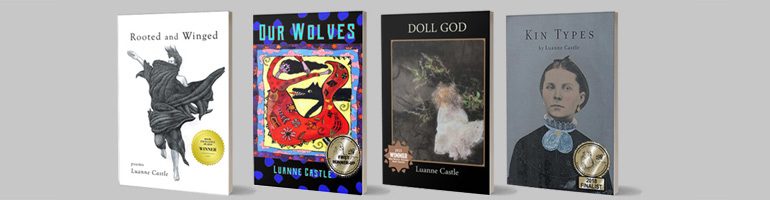
I’m excited to be author and blogger Robbie Cheadle’s May guest for her monthly Treasuring Poetry article on Writing to be Read. She had some wonderful questions for me about writing, and I enjoyed answering them! You can find the publication here: https://writingtoberead.com/2023/05/17/treasuring-poetry-meet-poet-and-blogger-luanne-castle-and-a-review-poetry-poetrycommunity-bookreview/. Robbie has also posted a beautiful review of both Rooted and Winged and Our Wolves.

With son and DIL living here, we have their dog Theo here as well. He’s such a little goofy guy, and I get to let him out when his mom and dad are both gone for three hours or more. I can’t physically handle walking him on a leash, although in a pinch I can take him on the driveway on a leash because he’s very good for me. But I like to let him roam the backyard, which is fenced. He’s very loved and what’s rewarding for me is that he loves his Grandma! In his photo you can see a very typical expression he gets on his face as he is always trying to figure out what’s going on.

35 Comments

Filed under #OurWolves, #poetrycommunity, #writerlife, #writerslife, #writingcommunity, Book Review, Interview, Our Wolves, Poetry, Poetry book, Rooted and Winged, Writing, Writing Talk

Day 2 of Our Wolves Release

On this day 2 of the 2-day release of Our Wolves, I would like to share an interview by journalist Deborah Kalb on her book blog. In this interview, she asks questions that probe the origins of the project, including why I chose Red Riding Hood as my “fractured fairy tale.”

https://deborahkalbbooks.blogspot.com/2023/03/q-with-luanne-castle.html?fbclid=IwAR3PRNHUs0FQRKtPml2ObZ1cGMmTVYQUI8ARSOjf6QdC5qefzl_CoLOxarY

Here’s a photo of the champagne I shared with the gardener yesterday for the launch. Note that he tried to order me yellow gerbera daisies which would have been in the photo, but he called Saturday and the florist had already left for the day. So he owes me flowers.

https://www.amazon.com/Our-Wolves-Luanne-Castle/dp/B0BTKNP31D/ref=sr_1_1?crid=8PAK9E03LTBV&keywords=our+wolves&qid=1677978570&sprefix=our+wo%2Caps%2C355&sr=8-1&asin=B0BTKNP31D&revisionId=&format=4&depth=1

18 Comments

Filed under Fairy Tales, Interview, Our Wolves, Poetry, Poetry book, Poetry Collection, Publishing, Writing

New News and an Anniversary Present

Don’t miss my interview yesterday with poet Millicent Borges Accardi: https://writersite.org/2023/02/06/from-mrs-virtue-to-the-covid-19-pandemic-an-interview-of-millicent-borges-accardi/ Millicent talks about the teacher who instilled her love of poetry as a kid. It so happened that the teacher was the daughter of a famous poet. She talks about her Portguguese heritage, both generally and the literature as well.

In January, I had another ekphrastic piece, this time a poem, taken at Visual-Verse. I neglected to mention last time that we only get one hour to write these to the art prompts. It’s a very intense process. https://visualverse.org/submissions/the-tournament/

Are you interested in a Giveaway for Rooted and Winged? LibraryThing is running one right now. https://www.librarything.com/ner/detail/46725/Rooted-and-Winged

Main Street Rag has published my review of Justin Hamm’s Drinking Guinness with the Dead. While I can’t post a copy of the review as it’s a print issue, I can tell you I give it two thumbs up. Hamm’s work is really tied to the Midwest and its vast once-farmland, so while anyone would love it (I think), Midwesterners would especially cherish it.

My daughter’s wedding was a year ago this coming Sunday. So look what I made for daughter and son-in-law. A wedding junk journal.

I had to find this nifty little suitcase after I realized that with the fragility of the book (cuz junk) and their lifestyle the book wouldn’t last long without protection. I was able to add in their wooden ring boxes, little place cards, extra photos, and the napkins from their previous courthouse wedding where we drank blue prosecco and ate cookies. Last year’s wedding was the whole shebang because that’s what they like.

See inside on the left? That’s a little clutch I made out of plastic grocery bags to store the cassettes of their wedding music.

That project was loads of fun, but now I’m about hearted and laced and sweetthinged out.

27 Comments

Filed under #poetrycommunity, #writingcommunity, art journaling, Book Giveaway, Book Review, Interview, Poetry, Publishing, Writing, Writing Talk

From Mrs. Virtue to the Covid-19 Pandemic: An Interview of Millicent Borges Accardi

I asked Millicent Borges Accardi to sit for an interview about poetry in general and her newest book, Quarantine Highway, specifically. This book was written during the first part of the Covid-19 pandemic. I think you’re going to be as interested in her answers as I was!

How did you come to poetry? Did you read poetry as a child? Write it? Or did you come to it later?

My first grade teacher Hope Virtue was the daughter of Harlem Renaissance poet Claude McKay and most days she read poetry to the class—whether we liked it or not.

As a teacher, she ran a tight ship, regularly ordering boys into the corner with their hands on their head, and Mrs. Virtue had particular punishments for me and my friends (for talking too much), one trick was she made us sit at our desks and hold our lips shut (like ducks) so, in that sense, she was not my favorite teacher –but the poetry?

Especially on rainy days, Mrs. Virtue would close the grey venetian blinds and read verses her father wrote.  Perhaps magical, but I disliked the teacher at the time so my opinion is complicated. Yet, looking back, I feel blessed. For days spent so early in my life, to know poetry in that way. She never talked down to us. She just read poem after poem.  Such a gift now, I think.

As far as Luther Burbank school knew, poetry meant that we stood up and recited “Trees” by Joyce Kilmer from our textbook, which was nowhere near as interesting as the verses Mrs. Virtue read to us, like “Courage,”

O lonely heart so timid of approach,
Like the shy tropic flower that shuts its lips
To the faint touch of tender finger tips:
What is your word? What question would you broach?

Your lustrous-warm eyes are too sadly kind
To mask the meaning of your dreamy tale,
Your guarded life too exquisitely frail
Against the daggers of my warring mind.

There is no part of the unyielding earth,
Even bare rocks where the eagles build their nest,
Will give us undisturbed and friendly rest.
No dewfall softens this vast belt of dearth.

But in the socket-chiseled teeth of strife,
That gleam in serried files in all the lands,
We may join hungry, understanding hands,
And drink our share of ardent love and life.

She wore turbans, dangly earrings and colorful robes and gestured with arms adorned by heavy brass and gold bracelets (that rang like thick bells when she moved). And, when we were good? There were scoopfuls of pastel marshmallows (taken from a glass jar on her desk) and more poetry. There was always poetry.

Claude McKay By James L. Allen – http://www.si.umich.edu/CHICO/Harlem/text/mckay_slide.html, Public Domain, https://commons.wikimedia.org/w/index.php?curid=8220852

Your new book, Quarantine Highway, probes deeply into how it feels to live in a now that is radically different from a then that we were removed from only by months. Although we are almost three years from the start of Covid now, your poems make me remember how different things were before spring 2020—because we still have not gone back to before: “Do you / remember that time when we held everything / in our arms tightly, as if we knew what we were talking about.” There is a metaphysical sense to these poems that seems different from your last book, Through a Grainy Landscape. Did you plan that or model it on a certain school of poetry or a certain poet’s work? Or was it that you were writing these during the first year of “quarantine” and were questioning our concepts of existence, living, and knowledge?

In a way Grainy Landscape was modeled after the poems and writings I was reading in translation from the Portuguese and the work was less desperate and gentler. There was a hope and an ease and less franticness to my life and my writing There seemed to be an endless pathway of hope, that anything was possible, the lush landscape of Portugal and The Azores—with influences by writers such as João Miguel Fernandes Jorge,  Armando Silva Carvalho, Margarida Vale de Gato  and the title taken from lines in a poem Tiago Araújo:

I’ve driven all night through a grainy landscape, on a motorway with dim and orangey lights

–Tiago Araújo

And the tone for the book is inspired by this passage:

  The light crossing the room between

the two windows is always the same, although

on one side it’s west – where the sun is now – and on

the other it’s east – where the sun has already been.

–Nuno Júdice

 But?  the Covid and its fall-out (especially) impacted our world and put a lid on my writing. I would say. The work in Quarantine Highway are more self-contained and fenced in. Quarantine was written as a way out.  Attempting to reach out and create connections, to deal with what everyone says is “the new normal,” a phrase I hate, as if things were now different and stuck. Forever stuck.

But then also, Good luck? Bad luck? Too soon to tell. There were a lot of pandemic tragedies and also a re-setting of how we do things as a society. One bright spot was, when the national parks were shut down, miraculously native plants and wildlife returned. The same is true for waterways. So many rivers and creeks, with an absence of tourists and fishermen suddenly rejuvenated. And people too, reanalyzed their work-life recipes and started to make different choices, more people working remotely and children being homeschooled, there was more reading and baking bread. A slowing down of the Type A lifestyle that a whole generation of people had been used to—People began to reconsider what they valued versus money and material goods, health and quality of life.

I was desperate to reach out, when writing Quarantine Highway, through social media, Zoom meetings and literary events, books. The written word. Latching onto old habits like knitting and growing food from seed.

The poems in Quarantine Highway were inspired by the work of Emily Perez, Rosebud Ben-Oni, Carl Marcum, Amy Sayre Baptista, Norma Cantu, Ángel García, Eduardo C. Corral, Carolina Ebeid, Diana Marie Delgado, Sheryl Luna, Laurie Ann Guerrero, Luivette Resto, Leticia Hernández-Linares, Ire’ne Lara Silva, Raina León, Javier Zamora, Juan Morales–

Here’s the final poem in the book (that I think lends a sense of hopefulness)

Wet was the Light

from a line by Pablo Neruda

Wet was the light as we saw it

through a threadbare lens

of what we call time or that period

of waiting between what will happen

next and what we regret having happened,

the hard-bad opposite of a world hunch or an omen,

the silent-low sense of doom to come,

a spirit arising in the country we

call home, the desire for isolation,

desperately to be different, the

unexplored nonsense of late.

This is the air in the pastel room when we

are enclosed and locked up by

an intense wondering and fear

of comfort fear of letting our guard

down and forgetting to protect ourselves

from nearly everything we can imagine,

even the scrape of skin upon

our hands, the whispered hello

of a neighbor or a child playing in the creek

below the yard where there are dirt

banks instead of lawn. We are who

we choose to become, are becoming

or perhaps we mean we are who we

are sentenced to be, a corona crown

of in the if and now and meant for always

that time is a path to follow, as we near the

day of the year when June rises

her longest glance of a day and tells us

it is all right to enter.

At the same time that these poems seem metaphysical, they contain beautiful and surprising images of the physical world. In the poem “Yes it’s Difficult,” I was particularly struck by a description of how we interacted with each other before Covid: “.  . . it was how we did things then, / sighing air, sipping in fine water droplets / into each other’s lungs.” It seems unimaginable now. Sorry, no question. I just really wanted to say how much I loved these images in the book.

Thank you!  I appreciate that–

As far as the question,  I had read about The Spanish Flu, from 1919, where  500 million people or one-third of the world’s population became infected with the virus, or 25%–30% of the world population, with over 50 million deaths, where COVID-19 has infected nearly 60 million , with 1.3 million deaths. Both pandemics significantly changed society, and nearly no one was writing artifacts about the Spanish Flu—perhaps the devastation was too much to document? And, for me, there was comfort in writing down what was and is going on, documenting the experience, creating artifacts gave me some comfort.

In the middle of that, I was re-reading TS Eliot’s “The Wasteland,” and so many parallels came up for me that I had missed when I read the work originally in college. The sparse imagery, the talks of destruction.  Although published in 2022, the poem is an artifact of the aftermath or carnage from the first world war, and the Spanish Flu, among other things, of course.

From an essay by Michael Austin, “The Wasteland” is a poem that imagines what it would be like to be trapped in the wounded land – one incapable of growth, productivity, or renewal. The young Eliot saw this as a metaphor of the modern malaise …

There’s a juxtaposition in some of the poems of scenes from your youth. I found this fascinating and would love to hear you talk about it a bit.

I suppose being cooped up, in quarantine, sends one back to memories. Like being in a cage– all you have to work with are memories so you look back for analogies. You look back for examples from life because outside life is in the past. All we have is the past. Our memories of how the “outside” world used to be, before.

Some of the poems in this collection seem to have begun from a line in the poem by another poet, such as Jane Kenyon, Inês Fonseca Santos, and Pablo Neruda. I began to wonder how you begin a poem. Is there usually a mental “irritant” in the way that a pearl is formed in an oyster? Where do your poems originate?

It depends on the poem. Sometimes a line comes to me or I overhear a phrase, or read a word.  An image dreamt. Many phrases drift in and out of my consciousness  and/but it is the images that stick with me that I tend to write about and pursue further. Many of the poems in Quarantine Highway were inspired by poetry I was reading especially during the early days of Covid when we were all newly terrified and looking for hope and a way out on the written page.

Much of your work involves your identity as a Portuguese-American poet. I’ve read about your connections, but I’d love to hear your description of how you relate to the identity, how it informs your poetry, and your involvement in the Portuguese-American poetry community.

Portuguese-ness, is or can be complicated– Most Portuguese in the US are from The Azores, not the mainland and there were three “waves” of immigration to the US, the last significant influx being in the 1970s, and most of the migrants sought work in industries that did not require a formal education: textile mills and whaling (New Bedford), tuna fishing and dairy farms (California)—So as a child I was discouraged from learning Portuguese or asking too many questions. Because being Portuguese was seen as being “less than” or lower class.  I was admonished to BE American! And yet, I was so interested in my Portuguese heritage, fascinated by it.

My dad was dark skinned and –at Sears (where he worked)– his friends were Mexican -and he easily moved between Spanish and Portuguese languages. We went to festas in Artesia and San Pedro, San Diego — BUT I did not live in a distinctly Luso area like Ferry Street (in New Jersey), “Little Portugal” in San Jose or New Bedford, MA (where the ATMS are in Portuguese)—

In junior high, I was bused across town because of my Hispanic last name, Borges. For me, personally, as a adult and as a writer I have felt freer to explore my own identity  by participating in Portuguese communities, giving readings and workshops, like the Kale Soup for the Soul cooperative, a group of writers reading work about family, food and Luso culture. The terrific lectures and talks that Diniz Borges at the Portuguese Beyond Borders Institute presents– In the past twenty years, I have interviewed maybe 60 or 70 writers, artists , actors, musicians in the Portuguese community (in an effort to understand where I come from).

Here is an older poem that illustrates my childhood, trying to explore my own identity (from Only More So, Salmon Poetry 2016):

The Last Borges

Like God and his Eve,

you never passed on

your secrets; I struggled

to learn. Coitadinho, coitadinho.

Never sure which accent to

migrate towards; which window pane

to breathe on for the best cursive fog.

I shunned the loud

Portuguese fights.

The visiting relatives, named for saints,

Over and over, in the driveway

at night, drunken Uncle John or Paul,

or Robert crashed his truck

into the side of our house:

filha da puta!

While you went to night school

two nights a week–for twenty years,

and ate linguiça sandwiches,

I watched and listened.

I would catch you: sitting at

Rudy the barber’s chair

I would sneak up behind to hear

foreign words.

At school, I pronounced our name

as you taught me,

as an Englishman would:

flat and plain, riming it with

a word for “pretty.”

After a while it seemed

that someone else

had heard a grandmother’s

lullabies at night:

a verse that sounded like

a baby’s cries for milk,

wanting the nipple:

Mamã eu quero, Mamã eu quero

As you grow older, papa,

I long for a language that joins us,

beyond our last name,

the space between our front teeth,

and wavy black hair. 

Beyond linguiça,

kale soup and sweet bread.

But, the only Portuguese words

you ever gave me do not stand for love.

Que queres, que queres.

What do you want, what do you want.

How does being a Los Angeles poet inform your work? I wondered this, in part, because of the title of this book. I lived in Riverside County for decades and so I traveled to LA often. An overwhelming image I have of LA, therefore, is the vast freeway system, but of course, you live there, so you have many other perspectives of the city. Do you feel that the city does or does not inform your poems?

It’s funny but even though I was born in Long Beach (LA County) no one seems to consider me an LA writer. Even though many of my poems and essays feature landscape and places in Southern California, like Venice, Santa Monica, downtown LA, Topanga, the beaches along PCH, the mountains. And most of my publications have been in non-local literary journals and presses.  I just had a poem in The Citadel (Los Angeles City College magazine, and it was one of the only local credits I have had. This is also true for readings and events. For some reason, when I get lucky enough to be invited for a featured reading or to teach a workshop, it’s nearly always on the East Coast or in Texas.

But perhaps I did not respond to your question properly? Where I live and where I travel informs my work, definitely. For example, I wrote a lot more gritty poems about the Boardwalk and the coming an goings of the vendors and homeless population when I lived in Venice and since I have been in the hippie enclave of Topanga. My work reflects the creek, the seasonal birds and wildlife from the Santa Monica mountains and the canyon roadways, more rural settings. Definitely affected is the fact that we have only one road, Topanga Canyon Blvd, in and out of the canyon where live and our lives tend to be framed and formed by that one main artery. During floods, storms, fires—we have one very rickety and curvy way out. My hippie shack is near a place called Edelman Park, which is a wildlife corridor, which means we get a fair amount of rattle snakes, coyotes, rabbits, racoon, bobcats, hawks, squirrels and even deer. Once I was on the deck and the backyard was foggy and like a magical spell, two deer arose up from the mist and looked at me—then scampered away. We also have a family of coopers hawks who circle the yard and hang out (looking for food I would imagine) but it s also a mystical experience when one alights on our wooden foot bridge–

Are you already at work on a next project? If so, do you mind sharing what you have in mind or are working on?

I am in the midst of poems LOOSELY based on the psalms, but not in a traditional way, not an interpretation. Mostly, as the psalms are sorted thru and buttressed into the messy world we are still enmeshed in —

Find out more about Millicent Borges Accardi and Quarantine Highway:

Link to Quarantine Highway on Amazon: https://www.amazon.com/gp/product/195344735X/ref=dbs_a_def_rwt_bibl_vppi_i8

At FlowerSong Press: https://www.flowersongpress.com/store-j9lRp/p/pre-order-quarantine-highway-by-millicent-borges-accardi

Quarantine Highway Blurbs 

With an immigrant lens that defies and armed with a linguistic deftness that challenges, these poems grind against expectations and bust open the façade, the nuance, and go straight to the heart. —Norma E. Cantú
Amid a global pandemic, the ceaseless wildfires of California, a political landscape of turmoil, Millicent Borges Accardi offers us a powerful collection of self-reckoning. —Ángel García, author of Teeth Never Sleep

  • Millicent Borges Accardi, an NEA fellow, is a Portuguese-American writer. She has four poetry collections including Only More So (Salmon Poetry Ireland). Among her awards are fellowships from the National Endowment for the Arts, California Arts Council, CantoMundo, Fulbright, Foundation for Contemporary Arts NYC (Covid grant), Yaddo, Creative Capacity, Fundação Luso-Americana, and Barbara Deming Foundation, “Money for Women.” She lives in the hippie-arts community of Topanga, CA.

http://www.MillicentBorgesAccardi.com

@TopangaHippie  on Twitter

21 Comments

Filed under #poetrycommunity, #writingcommunity, Books, Interview, Poetry, Poetry book, Poetry Collection, Writing

A New Interview and a Worthy Journal (and a flash)

Thimble Magazine was founded by the multi-talented Nadia Arioli. Nadia, a poet and artist, is also editor-in-chief of the journal.

Check out Thimble’s interview of me in their newsletter of Patreon supporters. It was really fun to respond to some new questions!

https://mailchi.mp/6f9b64c0d540/five-questions-with-luanne-castle

If you would like to help support (for as little as $1/month) a deserving poetry journal, I can’t think of one I enjoy more than Thimble. Nadia is a delightful person with excellent taste in poetry. I think the statement on the journal’s website is very telling: “THE THIMBLE LITERARY MAGAZINE IS BASED ON THE BELIEF THAT POETRY IS LIKE ARMOR. LIKE A THIMBLE, IT MAY BE SMALL AND SEEM INSIGNIFICANT, BUT IT WILL PROTECT US WHEN WE ARE MOST VULNERABLE.” https://www.patreon.com/thimblelitmag

Thimble seems a magazine by the people for the people. I love it.

Speaking of literature journals, I’m part of the community surrounding the magazine Verse-Virtual. VV held a book party the other day for VV poets who have new books out. I read from Rooted and Winged. Nine others read from their books as well, and thanks to that reading, I bought four new poetry books! I start to read at 2:20: https://www.youtube.com/watch?fbclid=IwAR2xh0R1rNEpauOqIscRoZsbOcBbODRNsTEveIjcej0ApPq-jP8z5Z58qLQ&v=nLYpTk-HAQQ&feature=youtu.be

Guess what I just discovered? I wanted to start to submit to Visual Verse to practice writing ekphrastically. So for my first try I wrote a flash piece about the art Visual Verse used as a prompt. I didn’t know they published mine, but I just found it: https://visualverse.org/submissions/the-mess-of-mindfulness/

Without saying anything else (because what can be said is endless), I just want to place this link for Tyre Nichols’ photography.

https://thiscaliforniakid2.wixsite.com/tnicholsphotography/portraits.

27 Comments

Filed under #amreading, #amwriting, #poetrycommunity, #poetswithcats, #writingcommunity, Cats and Other Animals, Interview, Literary Journals, Poetry reading, Rooted and Winged, Writing

An Interview by Christine Butterworth-McDermott for Gingerbread House

This post is about something exciting to me at the same time that it is sad. Gingerbread House Editor Christine Butterworth-McDermott has interviewed me in the new issue up today. You can read it here:

Gingerbread House Lit Mag, with its emphasis on fairy tale-inspired literature, is one of my very favorite journals. Very sadly, I must say that this is the final issue of GH! Butterworth-McDermott will go on to do exciting things in the literary and artistic worlds (she’s an artist as well as a poet/writer), but this feels like the end of an era.

Please check out the whole gorgeous issue through the link above.

And here’s to a healthy and peaceful 2023.

19 Comments

Filed under #amreading, #amwriting, #poetrycommunity, #writingcommunity, Interview, Poetry, Poetry book, Poetry Collection, Poetry reading, Reading