Tag Archives: Book Writing

Here at Last: The Best Guide to Structuring Your Novel or Memoir

Last summer I explained that structure was a problem for me in writing a full-length book. I wrote a couple of posts here and here about a book I found very helpful: Stuart Horwitz’s Blueprint Your Bestseller.  By following Horwitz’ directions for isolating “series” and creating a bull’s-eye target, I was able to get past the biggest hurdle I’ve had in writing the book.  Horwitz’ method is known as the “Book Architecture” method. He critiques, edits, and coaches writers on their manuscripts and can be found here.

After Blueprint’s help with my book, I discovered a smaller and farther-down-the-road structural problem that Blueprint didn’t address. I contacted Horwitz and asked him about it. He said something like “funny thing you should mention that as it’s going to be in my next book.” That’s when he asked me to be a Beta Reader for his new book!!

And here is the masterpiece:

CLICK ON THE LINK TO PURCHASE FROM AMAZON

I almost feel like one of the midwives for this book. Gee, I wonder how Stuart Horwitz feels about me using the childbirth metaphor for Book Architecture!

If you’re writing a novel or a memoir or any full-length book–or planning to write one–you will want to click the link above and order the book.

You haven’t started your book yet? Unlike his previous book, you don’t have to have written any pages. Dig in and learn how it’s done. He doesn’t provide you with a formula, but a clearcut and easy-to-follow guideline to create the bones of your unique book.

He uses a handful of books and films–one per chapter–to show how others have done it–and you can, too. You don’t have to be familiar with the stories ahead of time. Horwitz tells you what you need to know. If you are familiar, it’s even more fun. I knew some and not others.

The first chapter begins simply, with a children’s book, Corduroy. 

The other chapters cover the book The Great Gatsby, the film Slumdog Millionaire (I saw the movie, but it wasn’t until I read this chapter that I understood what it was all about!), the film The Social Network, the book Harry Potter and the Order of the Phoenix, the book Catch-22, and The Metamorphosis, a novella  by Kafka. The last is the most complex, but by the time you get to the last chapter of the book you will easily understand Horwitz’ points.

His first book explained the concept of series and how to use them as building blocks for a book very well. But in Book Architecture we learn how to use series arcs and series grids to pull together  a rich plot and subplots.

I have a different reason to love each chapter, but one of my favorites is the Joseph Heller/Catch-22 because Horwitz shares the series grid that Heller created for his novel. What a fascinating document–and so helpful to understand how it’s all done.  It’s as if Horwitz pulls aside the curtain and lets us see the wizard at work.

Best yet? After reading Book Architecture, I was able to solve the remaining little problems with structure. I am happy with my structure now, plus I understand how it works so if I decide I want to change things around it won’t be a big deal because I have knowledge of my building blocks and how they can work together via series, series arcs, and series grids.

Thanks so much, Stuart Horwitz! Your new book rocks!


29 Comments

Filed under Book Review, Books, Creative Nonfiction, Fiction, Memoir, Nonfiction, Novel, Writing, Writing Tips and Habits

What Inspires My Poems

Is it annoying if I admit that I’m really enjoying reading the reviews of Doll God ? All but one have been highly positive (5 stars on Amazon and 5 stars with a 4 star on Goodreads, as well as written reviews).

Here are two blog tour reviews from the end of last week:

Harvee Lau at Book Dilettante is fascinated by the dolls in the book. I love her reading of the poem “Caught.”  She shares the poem in the review. Check it out :).

Randi at Bell Book and Candle Blog says Doll God is “an outstanding collection of poems.”

Today I have a guest post up at Peeking Between the Pages

 about my poetic inspiration. I’d be tickled if you go check it out.

MaryGold enjoying the Arizona weather

UPDATE:  A review of Doll God is up at Peeking Between the Pages.

38 Comments

Filed under Arizona, Blogging, Book Review, Books, Doll God, Dolls, poems about dolls, Poetry, Poetry book, Poetry Collection, Publishing

Read All About It Here: The Work-in-Progress Blog Tour Stop

UPDATE:  just wanted to add in here that a new review is up for Doll God.  Reviewer Gautami says “A few poems also comment on the scientific reality of life, yet the metaphysical and spirituality is never far away.” I love that she noticed that as that is never far from my mind when I write a poem.

Thanks to Sherrey Meyer, who blogs here for  inviting me to participate in the Work-in-Progress blog tour. Sherrey is writing a memoir based on a dysfunctional and abusive mother-daughter relationship. The twist is that, when Sherrey was 57, she discovered that her Southern matriarch mother needed to escape abuse herself.

Sherrey has completed a first draft of the memoir and is eager to begin a rewrite. Sherrey is widely published in various anthologies. She credits her love of words (and her editing knowhow) to her publisher father.

Thank you so much, Sherrey, for thinking of me and my memoir. It helps me get focused back on this intense writing project. You’re an inspiration with your dedication to the craft!

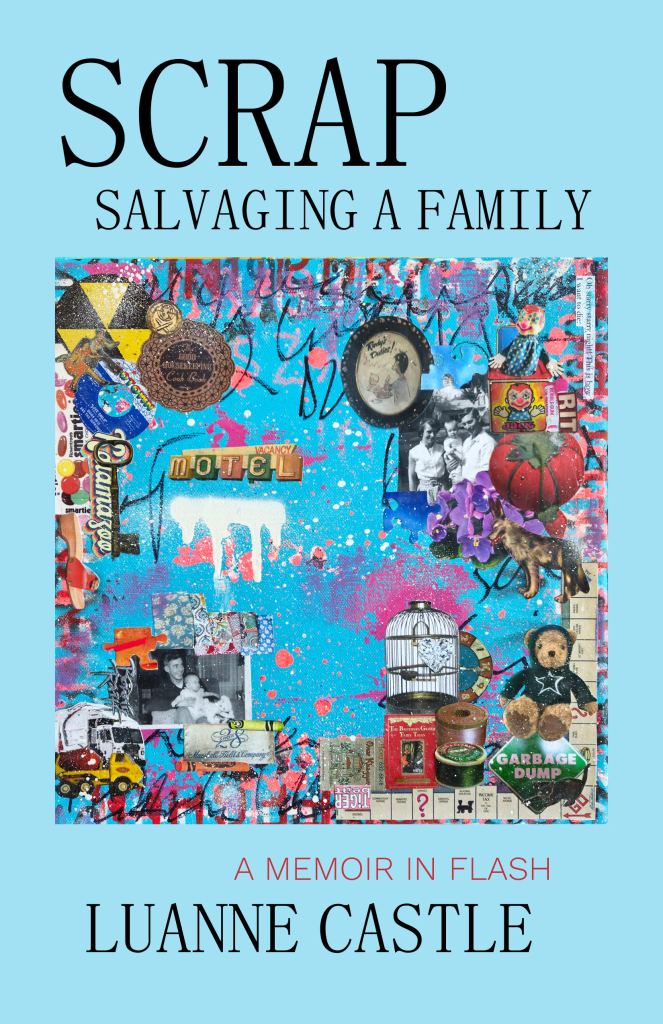
Synopsis of my book:

Secrets create a painful wound at the heart of a family. Dangerous emotions, such as anger, fear, guilt, shame and curiosity, grow from this wound.

Memory must be excavated scrap by scrap, salvaged, and pieced together to create a new story of origins and identity. With the building of the story, the wound begins to heal, and the resulting emotions dissipate.

Thus it is with my family. My book is the story of an old family secret that infects the present and creates a dysfunctional father-daughter relationship–and the quest for answers that allows the father and daughter to learn and forgive.

Status of my book:

Although I wasn’t ready to finish my first draft, I had to pull something together for the final step to completing a certificate in Creative Nonfiction Writing at Stanford University. This step is a tutorial where I am working under the guidance of Julia Scheeres, author of Jesus Land and A Thousand Lives. She has now read my manuscript and given me revision suggestions, which I am working with. Things have been so hectic with the publication of Doll God and my father’s illness (not to mention that traffic blockage I wrote about last week!) that I don’t get much time to write.

Here are brief excerpts from my first three chapters of Scrap:

Prologue

1966

Dad popped his gray-streaked head into my open doorway on his way to the kitchen. Not much bigger than I, he seemed to fill the space. “Get dressed for ballet class!” His voice was a brief bark.

Chapter One: Frank Talk

Thanksgiving 2009

The drive south from our home in Phoenix exposed the flat desolation of the region. The only sights were the occasional saguaro and the roadside ostrich farm where travelers can stop and feed the animals. Since ostriches have a reputation for being downright mean, we had never stopped there on trips to my parents’ winter condo in Green Valley, twenty-five miles past Tucson. I’d brought up the idea once. My husband of over three decades said, “Sure, I want to get snapped at by a big bird and then by your father. I don’t think so.”

Chapter Two: Nuclear Fallout

2008: the year before

“Doesn’t look like much,” Mom said, as we pulled into the parking lot of the Titan Missile Museum.

The main building was low to the ground. A few small buildings, which looked like garages or tool sheds, and large equipment were scattered throughout the fenced property.

If I hadn’t known where we were, I would have thought it looked like a work site with a few trucks and what seemed to be oil tanks, not a nuclear missile site.

The work-in-progress blog tour rules:

  1.  Link back to the post of the person who nominated you.
  2.  Write a little about and give the first sentence of the first three chapters of your current work-in-progress. Sherrey gave more than the first sentences, and I like that idea, too.
  3.  Nominate some other writers to do the same.

Tag. You’re it!

I was thrilled that these writers have agreed to take part in this work-in-progress blog tour. Please stop by their sites and get to know them and their work.

RENEE at Unpacked Writer  teaches college writing. She has published creative nonfiction and won awards for her writing and is writing a book about her adventures as a young special education teacher in a small and remote Alaskan village. Renee describes herself  this way:

My interests might find me behind a camera, an acetylene torch, spending a day with a legislator, at the farmers market, or with my nose in a guidebook mapping an adventure. Usually, I’m responding to thoughtful student writings and preparing ways to get students to think about writing.

Most days find this mid-life mother of teenagers, behind the wheel of the mommy-taxi, revising writings, volunteering in the community, figuring out how to prepare a healthy meal everyone can or will eat, or shooing our urban chickens from our kitchen door.

I am a mother, writer, traveler, wife, thyroid cancer survivor and writing instructor.

During the work week, MARIE is a public health data analyst.  After hours, she is a writer, compiling a nice tall stack of first drafts that she rather dreads having to sort through.

Marie started writing when she was about 9 years old, but she was never very confident (if at all) about her writing talent, and it was easy for her to “give up” periodically, in spite of the support she got from mentors and fellow writers. Once she got a “real” job (cue public health), it was hard to argue with anyone that she should or could expect to do better by writing. She’s made a lot of detours on her path to happiness, but finally she’s woken up to the fact that she’d rather be writing than anything else (ideally, in her pjs with a pot of hot tea for fuel).

Through her blog, www.1writeway.com, Marie has discovered a truly wonderful community in blogging, one that has been so supportive that  she no longer hesitates to say, “I am a writer.”

A born and bred Brit, SHERRI lived in California for 17 years before returning to the UK with her three children in 2003.  She began her writing career a few years ago while caring for her Aspie daughter.  Since then, she has been published in magazines, anthologies and company websites and launched her blog, A View From My Summerhouse. Today, she lives with her husband, daughter and two cats in the West Country of England where she keeps out of trouble writing her book (a memoir), walking, gardening and taking endless photographs.  Her muse, a garden robin, visits regularly.

You can reach Sherri at these online locations:

Blog link:  http://sherrimatthewsblog.com/about/

Facebook Page:  https://www.facebook.com/aviewfrommysummerhouse

LinkedIn: http://www.linkedin.com/pub/sherri-matthews/60/798/aa3

Google Plus: https://plus.google.com/103859680232786469097/posts

Renee, Marie, and Sheri, thank you so much for agreeing to take part in this WIP blog tour. I look forward to reading your posts in the future.

How about you? Do you have a work in progress?


31 Comments

Filed under Blogging, Creative Nonfiction, Memoir, Nonfiction, Writing, Writing goals

Websites and Nursing Homes

The guy who created my daughter’s website made one for me (ask me for his contact information if you are interested in hiring him). I might make a few small changes to it, but see what you think: website link. I wanted it to focus right now on Doll God, but to provide samples of my writing, as well.

Then I wanted to add something fun related to dolls and art, in honor of Doll God. So I asked blogger mareymercy if I could put up her recent doll photographs. Here they are! If you want to find her photos from the home page of my website you click on DOLL GOD and then go to Dolls as Art. There is a reason her blog subtitle is “Photography and Frivolity”–so much fun!

On my links section, I have mareymercy’s photography links. If you know of other doll art that is appropriate, good-natured, and high quality, post me the link in the comments here so I can consider adding it to my list of links.

 PHOTO BY MAREYMERCY

My dad is in the nursing home now. He’s not happy to be there, and I completely understand. My experiences with nursing homes have not made me too keen on the places–even the best of the nursing homes are still “institutions” with all the potential problems of institutions.

When my grandmother was in a nursing home for rehab after surgery (years ago), a large lady named Frieda gave her baths, shoving and slapping her. Grandma had a panic attack and called me, telling me how she needed to get out of there. It’s the same for my dad. He had a nightmare that he was in jail.

Those of you so inclined please pray for him. And he will be thrilled with good vibes, virtual Reiki, and all manner of well wishes.

53 Comments

Filed under Art and Music, Blogging, Creative Nonfiction, Doll God, Dolls, Nonfiction, Photographs, poems about dolls

Luanne Castle’s new book of Poetry: Doll God

Poliblog wrote such a cool review of Doll God–as a poem!

9 Comments

Filed under Blogging, Book Review, Books, Doll God, poems about dolls, Poetry, Poetry book, Poetry Collection, Publishing, Writing

A Doll in Need of a Name

Thank you so much for your support for the publication of Doll God. I had no idea there is so much work involved with the birth of a book. I’m running on little sleep and learning everything from scratch.

I feel like I did when my son was a baby. Nearly headachey through the eyes, foggy, and sleepy.  But definitely not crabby. Hahaha.

If you did or do order a copy of my book and you like it, please write a couple of nice sentences over at Amazon (and Goodreads if you’re on that site). Apparently this is very important to the sale of the book. It doesn’t have to take much time; it’s more  important that it be heartfelt.

So what have I been doing? Too much and I’m too tired to make a list, I’m afraid, but I can tell you that at both Amazon and Goodreads I set up author profiles. I spent hours reading a book telling how to market a book on Amazon only to discover that the information was so old that it’s no longer applicable. Most of the bells and whistles the writer referred to are no longer available.  I contacted friends by email about Doll God.

It’s also important for me to pay it forward by reading and reviewing other poetry books (along with my memoir and some fiction reviews).

With all this hubbub, I don’t have anything brilliant to say. But I do have a shot of the doll from my book cover cavorting in my flowers. Note that these flowers were saved from the freeze this year by lots of hard work by hubby and by me. We had to cover all the shrubs and flower beds and even the cacti and succulents when we had a freeze that lasted a week.This doll has been through the mill, as my mother would say. She’s been face down in mud puddles and tide pools and traveled back and forth between Arizona and California several times (through the USPS).  This photo is proof she has a face, too.  In the book cover below, her face is hidden.

Doll God promo coverI think she needs a name. My daughter, who took the original photo for the book art and who took the photo of her in the flowers, as well, thought she needed a name, but we never settled on one.

Any ideas on a name for the doll?


38 Comments

Filed under Art and Music, Book Review, Books, Doll God, Dolls, Nonfiction, Photographs, poems about dolls, Poetry, Poetry book, Poetry Collection, Writing

Cover Reveal of Doll God

At long last (as if anybody has been waiting for this moment but moi hahaha) I can reveal the cover of Doll God, my poetry collection.  Here ’tis.

Doll God promo cover

Here is a quote from the book description:

Luanne Castle’s debut poetry collection, Doll God, studies traces of the spirit world in human-made and natural objects–a Japanese doll, a Palo Verde tree, a hummingbird. Her exploration leads the reader between the twin poles of nature and creations of the imagination in dolls, myth, and art.

All I can say is: FINALLY.

We had all kinds of problems transferring the artwork to the book cover. It took four book proofs to get it right. The original photograph was taken by my daughter and artist Kenneth Nicholson created the art. Well, finally. The book should be available online later this week, so I will post the links when I get them.

More champagne is called for. Good thing it’s on my new diet!

66 Comments

Filed under Art and Music, Books, Doll God, Dolls, Photographs, Poetry, Poetry book, Publishing

The Words I Didn’t Know I Knew Until I Read Them

Have you ever read a line or two in a poem or a sentence in prose that you “recognize”? Words that seem to speak to you? I’ve had the thrill of that experience many times, and even so, it always feels like something rare and special. As if the words reach somewhere inside me and find a perfect match. A puzzle piece in the proper place.

I began a memoir piece I wrote about the bomb shelter my father built in our basement with lines from a poem by Brigit Pegeen Kelly:

while the one divides into two: the heart and its shadow,
The world and its threat, the crow back of the sparrow.

These lines are from a poem called “Of Ancient Origins and War.” When I read them for the first time, I felt as if I already knew them although they contained fresh images that I had never read.

They reminded me of when I lived in the house with the bomb shelter under my feet. I previously wrote about the shelter here. When I last visited Michigan, I drove by the house. The trees are much more mature today, and the house is no longer white. Is the bomb shelter still there?

I think the reason Kelly’s lines struck me is because they felt “real” to me. The notion that the heart has a shadow. That’s not something ever said, but it’s true. It’s kind of frightening. There is love and there is love’s shadow. There is the beating center of our existence and there is a shadow created by our very existence.

And of course there is the world and the threat to the world, as well as the threat that comes from the world. What better representation of the threat is a bomb shelter. By trying to protect his family, my father terrified us.

Although “the crow back of the sparrow” feels so right here, my understanding of it seems to float. What do you think it means?

What fresh new words from a story or poem have you recognized?


28 Comments

Filed under Creative Nonfiction, Essay, Literary Journals, Memoir, Nonfiction, Poetry, Writing

Break Out, Go Ahead and Do It: Part II

Last week I introduced you to indigenous poet Carol Bachofner. She has published four excellent books of poetry. Check out her poetry! Part I can be found here.

In Part II, learn Carol’s original process for writing “something else” sonnets. Don’t know what those are? Read ahead . . . .

by guest blogger, poet Carol Bachofner

A poem Carol wrote that illustrates the breaking out she discusses

 Why Hang Out in Bookstores; a something else sonnet

There are other ways to take on the sonnet form and make it serve a different purpose. I recently had another breakthrough, courtesy of an unwitting Sherman Alexie. Visiting our daughter and her family in Seattle, I had one non-family wish of the trip: to spend some quantity and quality time at Elliott Bay Books, alone. I always make a beeline to the poetry section of any bookstore to see what’s new that I might not have seen at home. I found two books that really got my attention, my sustained attention. The first book is The Rose Metal Press Field Guide to Prose Poetry (ed. Gary L. McDowell and F. Daniel Rzicznek, 2010) and the other is Alexie’s latest poetry collection, What I’ve Stolen, What I’ve Earned (Hanging Loose Press, 2014). These book finds changed my view of prose poetry. Utterly changed. DRAT!!! Just when I was getting comfortable again! But it is why we hang out in bookstores, to be changed.

I confess that previously I have eschewed prose poetry, claiming loudly to all who would listen that this alleged form is nonexistent. Why do I do that? My literary protestations almost always lead to changing my mind about what I am avoiding or rejecting. On this particular lovely fall day in Seattle I was to be challenged yet again. I would have to face the fact that this form is real, to accept the fact that if Sherman Alexie was writing in this so-called “form,” I would have to see why. I was, from that moment, on the fast track to writing one or more prose poems myself. How could this happen? Prose was always prose and poetry always poetry. I was SURE of that. Until now. As a narrative writer, I knew I was always straddling the two worlds, but I knew somehow where the borders were. and I did not think those borders were crossable.

Where the breakthrough came for me was somewhere in the middle of Alexie’s book, the place where he starting labeling poems as “sonnet” when they clearly looked like prose to me. Have you ever become aware of a slight manic buzzing in your head when you are about to discover something new for yourself, ready to disembark from the safe ship of your life and wobble on the dock? I could feel myself getting hot all over, hearing the buzz, and feeling a twitch in my left eye. Uh-oh.

I tried to find where in his “sonnets” there was something sonnet. What I found was a “something else sonnet,” a combination of prose and poetry that spoke to me. Loudly. Profoundly. He was laying it out in a way that seemed properly improper. No worries over rhyme scheme (have you ever balked at the use of “scheme” as if it is some kind of a trick?) and no worries about where to break a line or where to put the turn or whether to put a turn at all. Instead of 14 clearly defined lines, he dared to make 14 segments of thought, of wondering, of action. Yes, 14 segments that said something without restriction. Oh my. Oh dear. Oh my. I had to try this.

Suddenly I was writing prose that felt more like poetry to me than anything I’d written in a while. Suddenly I was writing poetry that seemed more real, more honest. I was wobbling on the dock and dying to jump off and swim.

Then the inevitable questions for myself began flooding in. What was going to be MY take on this? How would I make something as real as Alexie, without being a poser, a fake, a phoney? It wouldn’t be easy to adapt my previous thinking to this new thing I’d so long rejected. But I knew I was comfortable with sonnets. I was comfortable with every aspect of sonnets. I was also very comfortable with narrative. So there. I had to jump.

At first I thought this meant I could just freewheel it, abandon all traditional aspects of the sonnet. But I had no desire to just throw myself into a sort of “freefall abyss.” I took a few deep breaths and began thinking of what parts of sonnets I might use to my purposes and how far into prose I wanted to venture. The more I pondered, the more one thought came to me: with the skills I possess as a poet, as a somewhat-formalist, I can combine prose and the sonnet, one of poetry’s most lasting forms and make something new for myself.

As I waded out into the deeper waters of form deconstruction, I felt a bit like an inventor. The process I devised is a basic guideline, a first way in. I chose to meld prose and the sonnet form in a way that was different but felt at least a little familiar. I needed my own process to serve as an entrance. Here is my initial process, one I have now abandoned as I continue to grow comfortable with this new “something else sonnet” form.

A Process Toward Writing a “Something Else Sonnet”

1. I decided to go by way of strong words, nouns and verbs. I elected to choose 14 nouns that are somewhat thematically connected. The words I chose are all words of restriction and stoppage and alienation. My theme (loose) is that of being held back or cordoned off from love. You will see my words in bold in the example below.

2. I set off in a direction, toward a theme or idea. I figured I could always reset my direction if the initial attempt was a wild goose chase. I did reset a couple times, but did not fully abandon the original impetus or word list.

3. I chose to follow Alexie in numbering each section (and in using sections or fragments rather than anything approaching lineation. After all, this was PROSE poetry. Beginning with the number 1, using what I determined to be the “best” word from my list of words, I created the first section/fragment.

4. At the place in that first bit of thought where my mind felt a bit like jumping, I put a period and wrote the number 2. After that I let myself leap (free association is the thing here) and used another word from the list. I found it helpful to cross off each word used to make sure I used all fourteen.

5. Repeating this process, paying no attention at all to where numbers landed, I wrote the whole poem as a paragraph with parts. Remember that any numbered portion may contain more than one sentence or fragment. It may be a bit self-contained with one major leap or it may slide into a transition as the piece nears its end, making the next leap smoother.

6. I also began to consider that I might keep going after number 14 and run the poem onward a bit, ending with a rhymed couplet; I did do this in the example below. I wondered as I wrote whether the poem wanted a somewhat traditional volta and where. In the example below, I came to see that the poem wanted to pivot a bit at line./section 9, a pretty traditional thing for a nontraditional sonnet.

NOTE: In the following example, I have bolded the nouns from my word list; these do not remain bolded outside of this example.

Love is Monstrous(ly) Wonderful(ly) Bordered, a prose sonnet

1. Natural barriers could be the colors of love, red lips shine, bruise-blue or some psychedelic bursts of argument hues at the edge of love’s known world. 2. Sterile areas pop up like rabbits. You want to go there to be safe, to be gravid with love. 3. Ditches burrow themselves into sidewalks where lovers pace, submerge to begin their travel along wrist-like veins recently scissored open in desperation. 4. You can achieve closure that way. Real closure. The slamming of the garden gate on too-rusted hinges made furious by rain. The door-bang of a car, locking itself with the keys still in the ignition. You learn how to leave and how to stay. 5. Love opens and closes on everyone eventually, even if no one hears it happening. Love maintains its elastic geography this way. 6. You cannot escape into a security zone to avoid it. 7. Even though you don’t recognize it, your heart is a sovereign state. 8. It has a seam-line of tissue paper tears. Rain will open up in it, open you eventually. 9. You’ll soon be seen at the checkpoint, tourist visa in your breast pocket, flashlight between your teeth. 10. You will head back to the colors of love and sketches you made of it at the blockade. It’s a secret. It is invincible ink. 11. Cruelty is the killing ground. 12. Vault over its borders. Ping between love and its doppelgänger. 13. Roadblock ahead! Drive. Run. 14. Decide to burn down the separation fence. 15. This is what you need to know about love and disaster, about a heart full of tacks. 16. Once you fill your suitcase, you get the monster off your back.

So, let’s review what has happened here that makes this a sonnet:

1. 14 somethings + couplet
2. volta at or near section 9. — of note: key words/phrases of the turn include checkpoint, head back
3. rhymed couplet at the end (though not metrical, it is musical)

We can see what makes this a sonnet and what makes this prose as well. The narrative is sacrosanct in the form, the combining of two forms. It is a hybrid that works well for me as a storyteller and poet. I owe it all to my obsession with hanging out in bookstores. Here is another example of story preserved as a brief prose poem, a sonnet that defies the usual end-rhymed final couplet. Find the turn, if any. Ask what makes this prose piece a sonnet.

Living On, a prose sonnet

1. From a waterfall 12 feet straight down, into 2 feet of water 2. Swept off like leaves ready to die. 3. Never thought about death then. Never thought about life then. All the same to me. 4. Carried to safety by a Paiute, slung sack on his back. Now a piece of him, he’s me too just that way; how I think of it. Carry me, I carry you. 5. The tee shirt he stripped from his back I wear as he wore me. American Indian Dance Theater. 6. I dance. I sway and stomp like the wind trees or the river that caught me. 7. Live on or die. 8. Be Indian. Be not Indian. You don’t get to decide. 9. If you break a bone, pray for all other bones. You will heal 4 people that way. 10. One of them will heal you. 11. The river didn’t want to feel so empty that day. 12. Wanted to fill itself with something that needed healing. 13. Indian Canyon ceremony, sweat running like the river. 14. Grandmothers and Grandfathers yielding to the fire. Me — natal, naked, and ready to live on.

From the Body, sonnets also shall emerge

Recently someone posted a meme on Facebook that was a pun in picture form, a line drawing of a human hip, with the caption: Hip Poetry. A child of the 60s, it tickled me to see this punning of the phrase Hip Poetry. Thinking of the beat poets, I wanted to do something creative in response to the meme, so I decided a contemporary prose sonnet to honor the beauty of the structure of the body, while keeping the humor of the drawing and its caption. I went with a beginning section that began the combination of bone and tone. I allowed myself to flex my verbal musculature and pun, rhyme a little (final couplet), and use marks of punctuation [brackets] wherever that felt organic, seemed to fit. I even included a line from a satire album from the 60s (see section 6). The pure pleasure I derived from creating this sonnet, this prose thing, is immeasurable. I hope you enjoy it too.

Poetry From the Hip, a prose sonnet

1. It’s a body thing, a guts and sinew and bone thing. No one comes to poetry without a body on fire. Flames of language consume the muscle, jerk the nerves, hum in the skull. 2. It’s the hip, that ball and socket controller, that swing along the sidewalk of metrics action, that bend at the, flex at the, sit right down and write it creation that lets it all roll along to conclusion or to an opening at the end. 3. Imagine no hip. No swishing skirts or petticoats, no rhumba or cha-cha-cha to inspire the words of love that pour onto the page, that plunge the poet into despair over loss of. Love pivots on such bones. Love poems pivot on them too. 4. Shoot from the [hip]. Be [hip]. [Hip] [Hip] hooray on the page or off into the air above the page. [Hip]ster, gangster, lover, mime, or magician. 5. [Hip] is your tour de force. 6. This is your hippy-dippy weather man, with the weather, Man 7. Whether or not. 8. Lines of poems hang from hip to hip, like bedsheets with secrets from old lovers. 9. Say lip [service or stick]. 10. Trip [up] or [the light fantastic]. 11. Ship [shape] or [out] and flip the switch to poems without secrets. 12. Secrets die like flies in winter when you turn on the lights. 13. It’s a body thing, a guts and sinew and bone thing. 14. Write it all, let it all, from the hip … swing.

Break Out… out there from here

Just as my last book, Native Moon, Native Days, was a departure from the regional, nature-oriented poems of the previous two collections, my newly-submitted manuscript is a departure. It is structure-oriented rather than topical, regional, or overtly ethnic. It contains an array of what seems to me to be like stardust, a sprinkle of light. Of course, the trick here is whether or not a publisher wants to spread my stardust. Regardless, I am happy to have assembled these particular poems in this way. Hands, These Clumsy Ears of Hands. Out there. Definitely out there.

About the guest blogger:

Carol W. Bachofner, MFA Poetry Vermont College of Fine Arts, is currently Poet Laureate of Rockland, Maine (2012-2016). She founded (2010) and directs the annual Poetry Month Rockand, a city-wide celebration of poetry. An indigenous woman (Abenaki), she writes with a strong sense of place through narrative poetry. Her poems have appeared in such notable journals as Prairie Schooner, CT Review, Main Street Rag, Bangor Metro, The Comstock Review, Crab Orchard Review, The Cream City Review, Naugatuck River Review, and others. Bachofner teaches poetry in her community and “on the road” via workshops and conferences. She has four published books of poetry: Daughter of the Ardennes Forest, 2007; Breakfast at the Brass Compass, 2010; I Write in the Greenhouse, 2011, and Native Moons, Native Days, 2012. In 2011, Bachofner was a runner-up in the Maine Literary Awards, one of three finalists in the short works/poetry category. Visit her web site www.carolbachofner.com for links to her blog, and her facebook page or to contact her for workshops. or contact her by email at poet.laureate.rcklnd@me.com.

Carol Bachofner headshot


17 Comments

Filed under Essay, Nonfiction, Poetry, Poetry book, Publishing, Writing, Writing goals

Break Out, Go Ahead and Do It: Part I

I asked the Poet Laureate of Rockland, Maine, Carol Bachofner, to write about a poetic subject important to her. In this piece (which I am posting in two parts–today and then next Thursday), she explores her journey re-creating herself as the sort of poet she envisioned. Maybe all artists have to search to redefine their artistic identities to remain creative.  See what you think.

by Guest Blogger Carol Bachofner

In the early 2000s, I faced myself coming and going in a kind of convergence between form and something “not form.” I needed expansion. I was fortunate at that time to have poetry mentors who sit cleanly in the “new expansionist” camp: David Mason, RS Gwynn, Dana Gioia, and BH Fairchild to be specific. I would describe myself as a new expansionist and count these poets as friends and mentors still. Having said that, I do see myself and my writing now as breaking ground — if only with a tiny hammer. I have not lost sight of my familial roots either, which have led back to ancestor William Dunbar (Scots poet of the 1600s). Despite the age and depths of my roots as a poet, I find myself searching for small breaths of innovation to keep myself and my poems moving forward. I see my contemporaries doing the same, thus debunking the criticism that new expansionists just want to make it old. I wanted to be “that poet,” one who would write the most memorable of poetry, find something new and exciting for my writing life. But instead I settled into a rather ordinary poetic life, satisfying and full, but pretty ordinary.

A breakthrough came for me in 2001while I was living in London. I spent time several days a week in the British Poetry Library located on the 5th floor of the Royal Festival Hall. One day, I came upon a children’s book that changed my writing. It was not a book of great acclaim or literary merit, but it had some language that, for me, was haunting. The story, about a hare in winter, was written by a Scots writer whose tale was poetically told, in a kind of verse that seemed to be prose and poetry combined. I decided to write a poem using some of the author’s rich language approach. I made my first pass at the poem, based upon translation and a parallel presentation, putting together a Scots language version with my translation side by side on the page. Although I did not (still do not) speak the language, I set about doing a translation, one phrase at a time. I still look at that parallel structure from time to time to please myself as a “translator.” As the messages of the story began to unfold in translation, so did the poem itself. I share it here in its final version, minus the original Scottish:

Peace, Tamh

What does one do but look
in a poem to what goes on out there …
Roland Jooris (Flemish poet)

White, cold white
stinging every bare unsheltering hill
Earth you dressed yourself up to be bare
watching snowfall, pleating snow
under doors, over meadows, over moors

The gusts of our longings dizzied us.
We warmed each other,
but the day did not endure

Silence, silence
O’ to be in the circle ‘round the hearth!

The skies are bruised in their seasons
Threads of breath from snowdrifts
travel for miles through the silence
shining white secret, it’s tinkling murmur,
well, that won’t be silent

White waves of stars at time of darkest moon,
a flag of truce for all tribes of the universe.
We are waking.

Then I Chose the Sonnet

Over time, the sonnet form has been adapted into something other than the form we were taught in school, something we can to choose to remake or reinterpret for a contemporary setting. We can open it up and break it into parts, shapes, and employ any manner of contemporary poetic gestures in so doing. Gerald Stern somewhat famously rendered the sonnet “American” by expanding it to more than 14 lines and abandoning obvious rhyme and meter. That got my attention, for its very boldness if nothing else. I found myself more and more attracted to the sonnet. To be honest, I had avoided the kind of regulation the sonnet took beyond what I needed to learn the mechanics of the form, the academic nuts and bolts. But here I was now, drawn to it like a moth to a streetlamp. I spent time, years, reading as many sonnets as I could reasonably do, from Shakespeare to Millay. I began to write sonnets. I wrote traditional ones (mostly terrible ones) and a few break-out ones. I was ready to accept another breakthrough moment.

What can form and an open attitude do to get you out of a rut in your poetry writing? It can redefine your aesthetic, give your writing system a jolt of energy. For me, it keeps me from writing the “same” poem even when focusing upon a particular topic over time. I recently sent off a manuscript that is rife with fractured forms and the whole seems to me to be a most pleasing concoction of what I am capable of doing with words. If I can please myself, I have at least a decent chance of pleasing my readers. Oh, certainly I do want to please you!

I have dared to bend, break, and reassemble form. Let’s look at this a bit in detail. I chose the sonnet, a form I’d rejected for the first half of my writing life. I thought the form stuffy. I hated the way all the sonnets I was reading felt artificial. I admit that my resistance comes a bit from “old stuff” in early college days when New Criticism was fading and free versifying was breaking down those walls. There is no doubt in my mind that I have pretty much always been teetering on the edge of a kind of cosmic divergence between constrained form and free form. If only…

Carol's office

Carol’s office

My very first experience with breaking open and “reassembling” a form occurred not long after this experience with translation. The resultant poem has somewhat traditional rhyme, a turn at line 9 (breakout from rhyme scheme included), and a rhyming couplet that is not exactly a couplet but rather part of a rhyme scheme that morphs into a couplet (fgfgg). Before sharing the broken open form, here is how the poem I wanted to write would look in traditional style (as a block of writing). Take a few minutes and look at all the tradition in this sonnet. There is meter, rhyme that is not entirely predictable, and the look of it screams SONNET! Ordinarily, I’d be proud to have this be my final draft. I’d be told it was a “good” sonnet.

But, for some reason it is not all that satisfying to me. It needed my further attention. You be the judge here. I trust you to see what I saw in the light of innovation and adventure.

Snow, a sonnet

From gardens of the fertile sky, a
fall blossoms made of air b
It’s God’s design that we might sigh a
as we see them sifting here. b
Each flower cut, is folded, sent c
flying stringless, pure, white kites d
to soften up the firmament c
with their muted spiraled light. d
Even the saints will try to shake e
the rumors they’ve been told f
of death that overtook a child g
who wandered in the dazzling cold f
blinded, lost and then beguiled g
by winter’s flowery, frozen smile. g

I think you can see how constrained the subject is due to the structure. It did not feel the way I felt doing the translation. Not at all. It was (is) tight, bordered, and rigid, with the possible exception being the rhyme break at line 9. More on that later when you have looked at the fractured version. The structure needed, wanted to be less rigid. Grief is not rigid. Snow is not rigid. I needed to do something so the poem could say its message. I needed to fracture and reset the bones of the poem.

Let’s look at what opening this poem up on the page did for it:

Snow

From hidden gardens of the fertile sky.
fall showy ice-spun blossoms made of air.
It’s God’s design
that we on earth might sigh
as we watch them sifting silently here.
Each pristine flower cut, is folded, sent
flying stringless, pure.
Latticed crystal kites
drift soft across the star-blank firmament.
From deep within the muted spiraled light,
saints and angels try to shake the news,
the frightful rumors they’ve been told:
of death
that overtook a child of two
who wandered out
into the dazzling cold,

blinded, lost, and then beguiled
by winter’s flowery, frozen smile.

If you look closely at the broken version of the poem, you will find the structure of the sonnet there (the “couplet” is there in its own way). It (the message) drifts down and settles, as snow does. It doesn’t overwhelm the message, but instead allows the message to settle on the reader as well.

Can you find the places where the rhyme lives? What about the turn? Does the turn happen somewhere different from the traditionally-structured version? What do you see as successful or not in this second version? Which pleases you and your particular aesthetic about sonnets? Does the breaking of form unsettle you? Is the second a sonnet at all? Only you can decide. But it pleases me to present it to you here.

Come back next Thursday for the rest of Carol’s essay.

Do you think that all artists have to search to redefine their artistic identities to remain creative?

About the guest blogger:

Carol W. Bachofner, MFA Poetry Vermont College of Fine Arts, is currently Poet Laureate of Rockland, Maine (2012-2016). She founded (2010) and directs the annual Poetry Month Rockand, a city-wide celebration of poetry. An indigenous woman (Abenaki), she writes with a strong sense of place through narrative poetry. Her poems have appeared in such notable journals as Prairie Schooner, CT Review, Main Street Rag, Bangor Metro, The Comstock Review, Crab Orchard Review, The Cream City Review, Naugatuck River Review, and others. Bachofner teaches poetry in her community and “on the road” via workshops and conferences. She has four published books of poetry: Daughter of the Ardennes Forest, 2007; Breakfast at the Brass Compass, 2010; I Write in the Greenhouse, 2011, and Native Moons, Native Days, 2012. In 2011, Bachofner was a runner-up in the Maine Literary Awards, one of three finalists in the short works/poetry category. Visit her web site www.carolbachofner.com for links to her blog, and her facebook page or to contact her for workshops. or contact her by email at poet.laureate.rcklnd@me.com.

Carol Bachofner headshot

22 Comments

Filed under Essay, Nonfiction, Poetry, Poetry book, Publishing, Writing, Writing goals